Agapanthus is since the reclassification in AGP III the only genus in subfamily Agapanthoideae in the family of Amaryllidaceae. It was previously considered to be in the Alliaceae family (now also a subfamily of Amaryllidaceae) from which it differs in not having the characteristic sulfide-containing substances which dominate the smell of those. Plants grow from rhizomes and have strap-like leaves. Flowers are umbels of blue or white funnel-shaped or tubular flowers. This genus is found in rocky grasslands on the southern and eastern fringes of southern Africa. Species in areas where there is year round rainfall are evergreen and those where rainfall is sparse in winter are deciduous. Information from the South African National Biodiversity Institute's web pages tells about this genus.
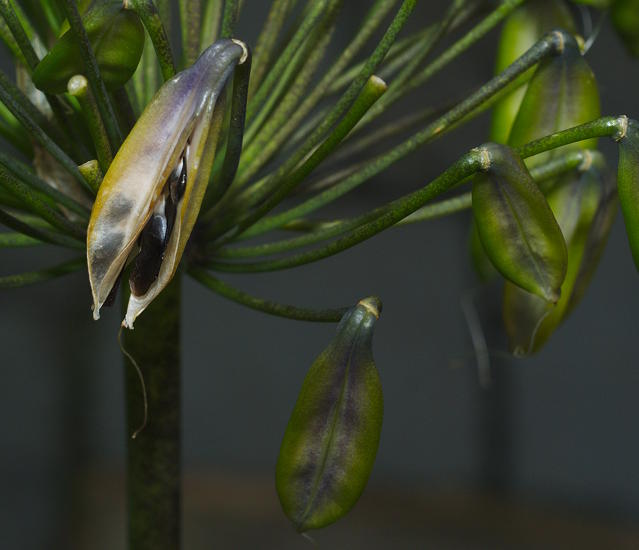
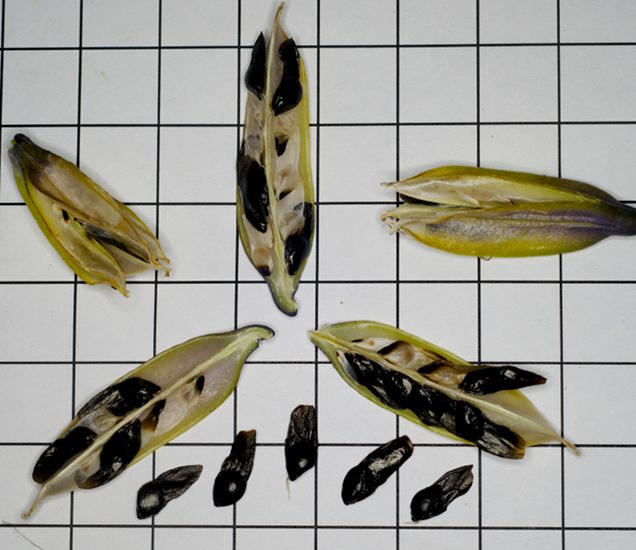
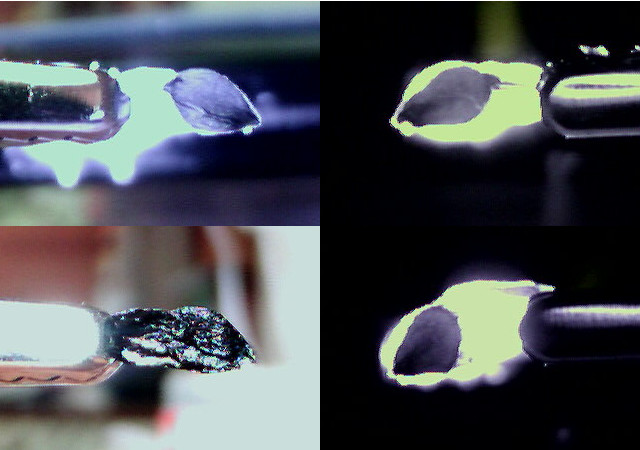
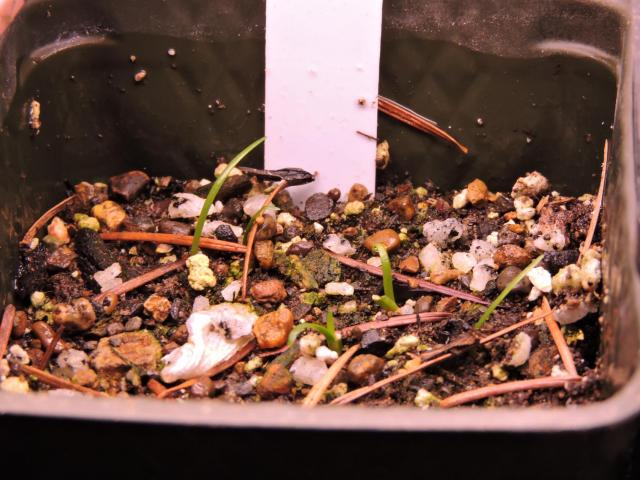
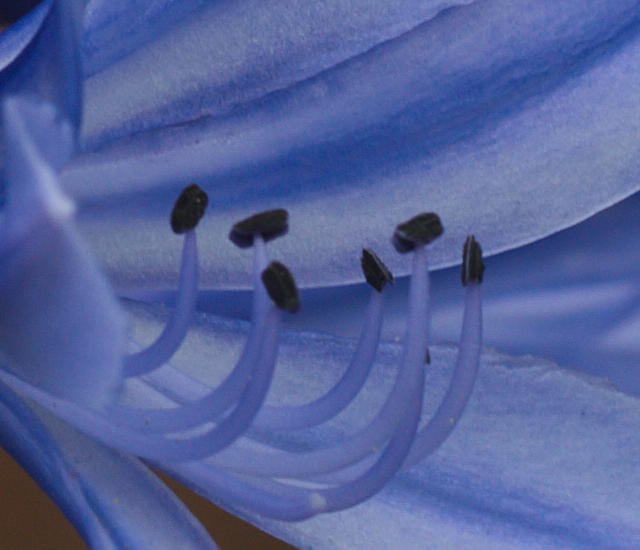
Seeds are somewhat ephemeral and will last for about 6 months. Most sources recommend sowing seed fresh. The seeds are sometimes shed while the pods are still green, so it may be good to collect the pods just as they begin to split open. Travis Owen experimented with sowing depth of seed from an Agapanthus hybrid, and found that seed sown on the surface germinated quickly with a good germination rate, while seed sown under a half inch layer of grit or soil was unable to push through the surface, or didn't germinate at all. Seed sown in the Autumn was kept moist and under lights with bottom heat, germination occurred within a few weeks. The first four photos from David Pilling show seed pods and seeds and a seed pod split into its three sections on a 10 m grid; notice the swollen head of the seeds. Photo 4 is of seed viewed using transmitted infrared light, the first three frames are of the same seed from both sides and using visible light. These confirm the seed has a large wing. Photo 5 is of a pot of seedlings by Travis Owen. In the last photo from David Pilling there seven anthers instead of the usual six.

The tables below show species and hybrids of Agapanthus.
See all the species together on a single page, go to the Agapanthus species overview page.
See all the hybrids together on a single page, go to the Agapanthus hybrids overview page.
Click on the name in the tables below to find more information and/or to see photographs of the named species or cultivar.
| Agapanthus Species | |||
![Agapanthus africanus close, Cameron McMaster [Shift+click to enlarge, Click to go to wiki entry]](https://www.pacificbulbsociety.org/pbswiki/files/Agapanthus/th00---Agapanthus_africanus_close_CM.jpg.jpg?svg=640x480 "Agapanthus africanus close, Cameron McMaster [Shift+click to enlarge, Click to go to wiki entry]") africanus | ![Agapanthus campanulatus, Maclear, Cameron McMaster [Shift+click to enlarge, Click to go to wiki entry]](https://www.pacificbulbsociety.org/pbswiki/files/Agapanthus/th00---Agapanthus_campanulatus_Maclear_CM.jpg.jpg?svg=640x480x1050x788 "Agapanthus campanulatus, Maclear, Cameron McMaster [Shift+click to enlarge, Click to go to wiki entry]") campanulatus | ![Agapanthus inapertus, Jamie Vande [Shift+click to enlarge, Click to go to wiki entry]](https://www.pacificbulbsociety.org/pbswiki/files/Agapanthus/th00---Agapanthus_inapertus_jv.jpg.jpg?svg=413x550 "Agapanthus inapertus, Jamie Vande [Shift+click to enlarge, Click to go to wiki entry]") inapertus | ![Agapanthus praecox, Gaika's Kop, Mary Sue Ittner [Shift+click to enlarge, Click to go to wiki entry]](https://www.pacificbulbsociety.org/pbswiki/files/Agapanthus/th00---Agapanthus_praecox_GaikasKop_msi2.jpg.jpg?svg=608x550 "Agapanthus praecox, Gaika's Kop, Mary Sue Ittner [Shift+click to enlarge, Click to go to wiki entry]") praecox |
| Agapanthus Hybrids and Selections | |||
![Agapanthus 'Ellamae', Arnold Trachtenberg [Shift+click to enlarge, Click to go to wiki entry]](https://www.pacificbulbsociety.org/pbswiki/files/Agapanthus/th00---Agapanthus_Ellamae5.jpg.jpg?svg=640x512 "Agapanthus 'Ellamae', Arnold Trachtenberg [Shift+click to enlarge, Click to go to wiki entry]") 'Ellamae' | ![Agapanthus inapertus 'Graskop', Rogan Roth [Shift+click to enlarge, Click to go to wiki entry]](https://www.pacificbulbsociety.org/pbswiki/files/Agapanthus/th00---Agapanthus_inapertus_Graskop.jpg.jpg?svg=640x469 "Agapanthus inapertus 'Graskop', Rogan Roth [Shift+click to enlarge, Click to go to wiki entry]") 'Graskop' | ![Agapanthus hybrids dk, Mary Sue Ittner [Shift+click to enlarge, Click to go to wiki entry]](https://www.pacificbulbsociety.org/pbswiki/files/Agapanthus/th00---Agapanthus_hybrid_dark_msi.jpg.jpg?svg=550x392 "Agapanthus hybrids dk, Mary Sue Ittner [Shift+click to enlarge, Click to go to wiki entry]") hybrid 1 | ![Agapanthus hybrid white, Mary Sue Ittner [Shift+click to enlarge, Click to go to wiki entry]](https://www.pacificbulbsociety.org/pbswiki/files/Agapanthus/th00---Agapanthus_hybrid_white_msi.jpg.jpg?svg=550x366 "Agapanthus hybrid white, Mary Sue Ittner [Shift+click to enlarge, Click to go to wiki entry]") hybrid 2 |