Eucomis is a southern African genus in the Hyacinthaceae family. The name is derived from the Greek word Eukomos, meaning "Beautifully Haired". Plants are commonly known as pineapple lilies because in many of the species the blooms resemble a pineapple. They often have an unpleasant scent, so they are pollinated by flies. Most of the species are found in the summer rainfall areas of South Africa, some at higher elevations. In cultivation they have proved to be hardy to frost, especially if planted deeply or protected during their dormancy by snow. They are best grown in the shade and given regular water during growth. This is especially true of plants grown in sun as otherwise the leaves will become limp. Cameron McMaster has provided extremely interesting information about this genus in an article he wrote for Farmer's Weekly in 2008.
This genus can be propagated by leaf cuttings (see this wiki article) best taken early in the season and not misted. Two pictures below from Brian Whyer show propagation from leaf cuttings. The third photo from David Fenwick shows a pollinator, a common house fly.
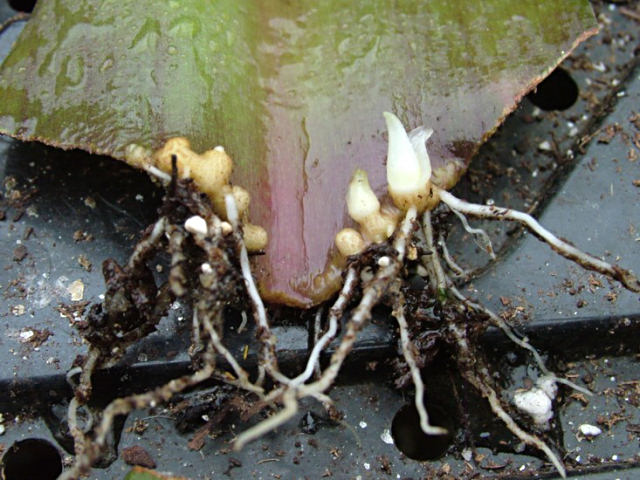
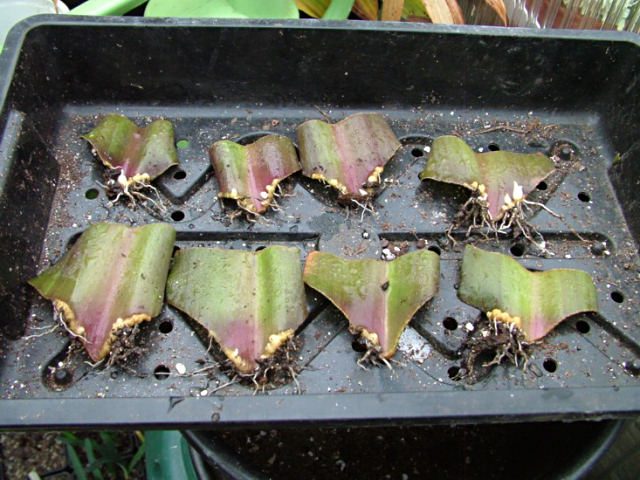
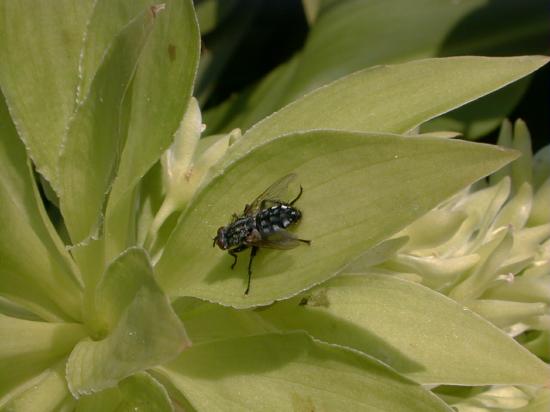
Eucomis was the subject of the Pacific Bulb Society topic of the week in August 2003. Click on the Introduction by David Fenwick.
For more photos and information about the species select the appropriate wiki page:
or click on the name in the table below:
![Eucomis autumnalis, Kirstenbosch, Mary Sue Ittner [Shift+click to enlarge, Click to go to wiki entry]](https://www.pacificbulbsociety.org/pbswiki/files/Eucomis/th00---Eucomis_autumnalis_Kirst_msi.jpg.jpg?svg=640x425 "Eucomis autumnalis, Kirstenbosch, Mary Sue Ittner [Shift+click to enlarge, Click to go to wiki entry]")
![Eucomis autumnalis ssp. amaryllidifolia, Waainek, Cameron McMaster [Shift+click to enlarge, Click to go to wiki entry]](https://www.pacificbulbsociety.org/pbswiki/files/Eucomis/th00---Eucomis_autumnalis_ssp_amaryllidifolia_Waainek_CM.jpg.jpg?svg=412x550 "Eucomis autumnalis ssp. amaryllidifolia, Waainek, Cameron McMaster [Shift+click to enlarge, Click to go to wiki entry]")
![Eucomis autumnalis ssp. clavata, Gaika's Kop, Mary Sue Ittner [Shift+click to enlarge, Click to go to wiki entry]](https://www.pacificbulbsociety.org/pbswiki/files/Eucomis/th00---Eucomis_autumnalis_GaikasKop_msi.jpg.jpg?svg=640x425 "Eucomis autumnalis ssp. clavata, Gaika's Kop, Mary Sue Ittner [Shift+click to enlarge, Click to go to wiki entry]")
![Eucomis bicolor, Sentinel Peak, Cameron McMaster [Shift+click to enlarge, Click to go to wiki entry]](https://www.pacificbulbsociety.org/pbswiki/files/Eucomis/th00---Eucomis_bicolor_Sentinel_Peak_CM4.jpg.jpg?svg=640x480 "Eucomis bicolor, Sentinel Peak, Cameron McMaster [Shift+click to enlarge, Click to go to wiki entry]")
![Eucomis comosa, Cameron McMaster [Shift+click to enlarge, Click to go to wiki entry]](https://www.pacificbulbsociety.org/pbswiki/files/Eucomis/th00---Eucomis_comosa_CM.jpg.jpg?svg=400x500 "Eucomis comosa, Cameron McMaster [Shift+click to enlarge, Click to go to wiki entry]")
![Eucomis 'Sparkling Burgundy', Nhu Nguyen [Shift+click to enlarge, Click to go to wiki entry]](https://www.pacificbulbsociety.org/pbswiki/files/Eucomis/th00---Eucomis_comosa_SparklingBurgundy3NN.jpg.jpg?svg=413x550 "Eucomis 'Sparkling Burgundy', Nhu Nguyen [Shift+click to enlarge, Click to go to wiki entry]")
![Eucomis comosa var. striata, David Fenwick [Shift+click to enlarge, Click to go to wiki entry]](https://www.pacificbulbsociety.org/pbswiki/files/Eucomis/th00---Eucomis_comosa_striata.jpg.jpg?svg=400x533 "Eucomis comosa var. striata, David Fenwick [Shift+click to enlarge, Click to go to wiki entry]")
![Eucomis grimshawii, Tiffendell, Cameron McMaster [Shift+click to enlarge, Click to go to wiki entry]](https://www.pacificbulbsociety.org/pbswiki/files/Eucomis/th00---Eucomis_grimshawii_Tiffendell_CM.jpg.jpg?svg=485x363 "Eucomis grimshawii, Tiffendell, Cameron McMaster [Shift+click to enlarge, Click to go to wiki entry]")
![Eucomis humilis, Andrew Harvie [Shift+click to enlarge, Click to go to wiki entry]](https://www.pacificbulbsociety.org/pbswiki/files/Eucomis/th00---Eucomis_humilis_AMH.jpg.jpg?svg=600x450 "Eucomis humilis, Andrew Harvie [Shift+click to enlarge, Click to go to wiki entry]")
![Eucomis sp., Paul Tyerman [Shift+click to enlarge, Click to go to wiki entry]](https://www.pacificbulbsociety.org/pbswiki/files/Eucomis/th00---Eucomis_purple_leaf_pink_flowers.jpg.jpg?svg=365x573 "Eucomis sp., Paul Tyerman [Shift+click to enlarge, Click to go to wiki entry]")
![Eucomis montana, Ellen Hornig [Shift+click to enlarge, Click to go to wiki entry]](https://www.pacificbulbsociety.org/pbswiki/files/Eucomis/th00---Eucomis_montana1_EH.jpg.jpg?svg=640x480 "Eucomis montana, Ellen Hornig [Shift+click to enlarge, Click to go to wiki entry]")
![Eucomis pallidiflora ssp. pole-evansii, David Fenwick [Shift+click to enlarge, Click to go to wiki entry]](https://www.pacificbulbsociety.org/pbswiki/files/Eucomis/th00---Eucomis_pole-evansii.jpg.jpg?svg=400x533 "Eucomis pallidiflora ssp. pole-evansii, David Fenwick [Shift+click to enlarge, Click to go to wiki entry]")
![Eucomis regia, Cameron McMaster [Shift+click to enlarge, Click to go to wiki entry]](https://www.pacificbulbsociety.org/pbswiki/files/Eucomis/th00---Eucomis_regia_cm.jpg.jpg?svg=640x426 "Eucomis regia, Cameron McMaster [Shift+click to enlarge, Click to go to wiki entry]")
![Eucomis schijffii, Sentinel Peak, Cameron McMaster [Shift+click to enlarge, Click to go to wiki entry]](https://www.pacificbulbsociety.org/pbswiki/files/Eucomis/th00---Eucomis_schijffii_SentinelPeak_CM2.jpg.jpg?svg=640x480 "Eucomis schijffii, Sentinel Peak, Cameron McMaster [Shift+click to enlarge, Click to go to wiki entry]")
![Eucomis vandermerwei, Ellen Hornig [Shift+click to enlarge, Click to go to wiki entry]](https://www.pacificbulbsociety.org/pbswiki/files/Eucomis/th00---Eucomis_vandermerwei_EH.jpg.jpg?svg=640x480 "Eucomis vandermerwei, Ellen Hornig [Shift+click to enlarge, Click to go to wiki entry]")
![Eucomis zambesiaca, Alessandro Marinello [Shift+click to enlarge, Click to go to wiki entry]](https://www.pacificbulbsociety.org/pbswiki/files/Eucomis/th00---Eucomis_zambesiaca_AM.jpg.jpg?svg=640x480 "Eucomis zambesiaca, Alessandro Marinello [Shift+click to enlarge, Click to go to wiki entry]")