We think of them as bulbs...
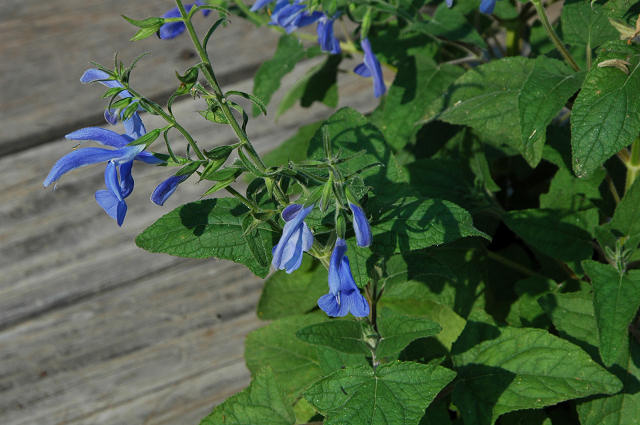
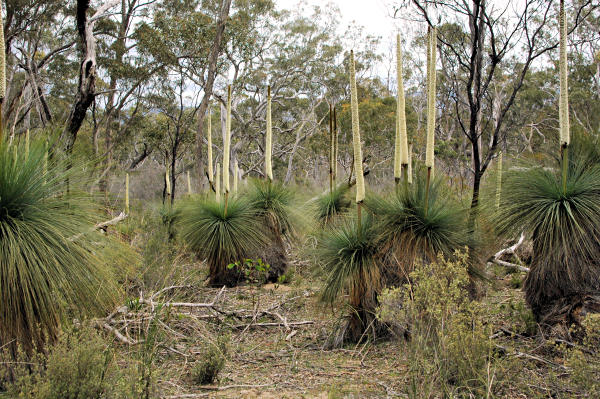
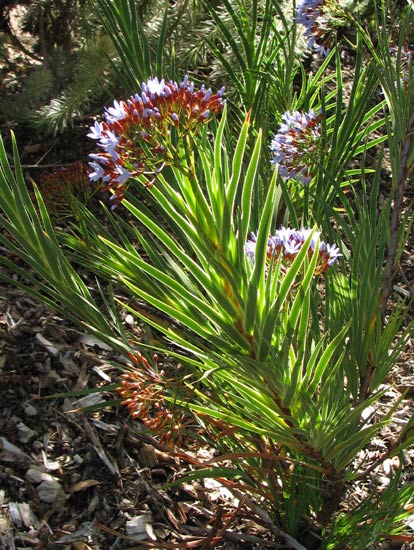
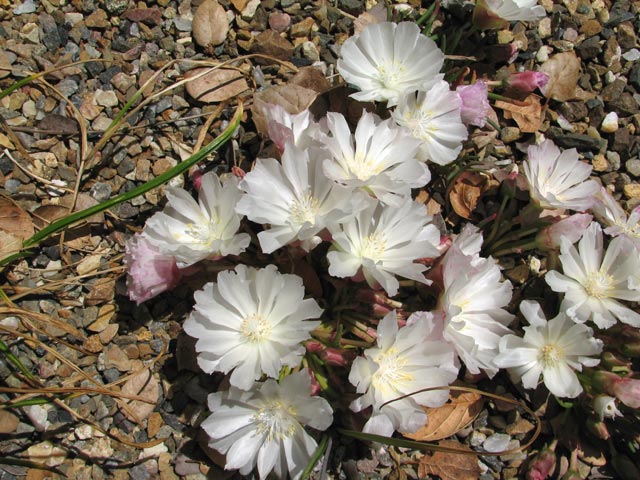
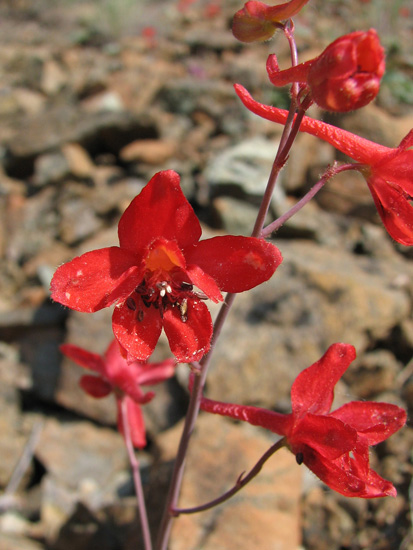
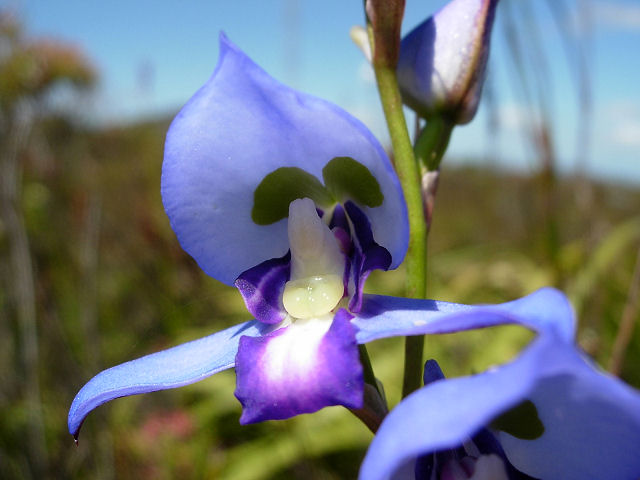
Left to right: Salvia patens, Xanthorrhoea australis, Nivenia stokoei, Lewisia rediviva, Delphinium nudicaule, Disa graminifolia (a terrestrial orchid).
Every child knows what a flower bulb is. It's a leafless lumpy thing you plant underground in the fall, and the next spring it makes flowers.
But sometimes the definition's not so clear. Some of the plants that most people consider bulbs don't ever lose their leaves (crinums, for example, are definitely bulbs, but most species never go dormant). Some plants go completely dormant underground every year, just like a bulb does, but if you dig them up you'll see that they don't actually grow from anything that looks like a bulb.
Some people define a bulb by the leaves -- if a plant's leaves look like bulb leaves, the plant is a bulb. But yuccas and agaves have bulb-like leaves, yet most don't have any sort of underground bulb.
Botanically, a bulb is a compact stem surmounted by proportionately large, specialized leaves (or cataphylls) that contain stored water and food. There are also corms (compact bulb-like stems that are typically regenerated each season), tubers (thickened, compact stems), rhizomes (perennial stems, usually horizontal), stolons (mostly slender connections between aerial shoots), pseudobulbs (thickened, modular shoots inserted on a rhizome), and variously modified types of roots. Plants with these adaptations may be evergreen or deciduous, with a roostock that is subterranean or epigeal, and regular or irregular in form. Taken together, they're respectively referred to as "Geophytes."
The more closely you look at the question, the harder it is to define exactly what is and is not a bulb. You either end up leaving out some plants you want to include, or you include some plants that you strongly suspect don't really belong.
It would be nice just to leave the definition a bit vague, but for the purposes of this wiki we have to decide what plants are eligible to be listed. That sometimes leads to passionate discussions with the advocates of a particular plant, so we want to be as open as we can about the process we use to decide.
We ask four questions:
1.) Does the plant go dormant completely underground at any point during the year? (For example, a tulip disappears completely underground in mid-summer.) If the answer is yes, we generally include it. If no, go to question 2.
2.) Is the plant generally recognized to grow from some sort of thickened storage organ (a bulb, tuber, corm, thickened rhizome, thickened root, or fleshy pseudobulb)? In other words, would scientists call it a geophyte? If the answer is yes, we include it. If no, go to question 3.
3.) Does the plant belong to a family/genus in which the majority of species are considered geophytes? If the answer is yes, we include it. If no, go to question 4.
4.) Do our members collect and grow it like a bulb, even though it doesn't exactly fit the questions above? If the answer is yes, we include it. If no, we don't.
For example...
We include some species that are not usually called bulbs but grow like them. For example, some species Delphinium (Larkspurs) go dormant and more or less disappear underground in summer. They are often grown by bulb collectors, so we included them under rule 4.
We include some orchids. Most people would not think of orchids as bulbs, but some Orchid species, known as terrestrial orchids, grow from below-ground tubers. Some even go dormant in the summer like other bulbs. Their flowers often have the same extravagant beauty as other orchids, and unfortunately they range from difficult to impossible in cultivation. We classify terrestrial orchids as bulbs.
We exclude succulents. A number of our members grow Lewisia species. They live alongside bulbs in many parts of California, and respond to the exact same growing conditions. We decided to include only the couple of Lewisia species that go dormant underground, but we excluded the majority because they keep their leaves all year. We decided those really count as succulents (and there are other organizations dedicated just to them).
When botanical definitions fail, we use our best judgment.
- There are many species of Salvia (sage) that go dormant in part of the year, but only a few grow from tuberous roots. The tuberous ones are included, the others are not.
- On the other hand, the genus Nivenia from South Africa is a small shrubby plant that never goes dormant, but otherwise looks like an Iris relative and is classified as a member of the Iridaceae family. We include it.
- Can a vine also be a bulb? Yes. The common garden flower Nasturtium (Tropaeolum majus) is an annual and not included. But some other Tropaeolum are climbing vines that grow from tubers and are included.
- The genus Xanthorrhoea (the famous Grass Tree of Australia) is not generally considered a geophyte, but its roots can be very thick and fleshy, and botanists once considered it a member of the Lily family. We include it.
- On the other hand, Hesperaloe (the genus that includes the popular Red Yucca) has foliage that resembles Xanthorrhoea, but it has no tubers. We exclude it.