Alstroemeria is a genus of perennials (one annual species) with fleshy rhizomes, in the Alstroemeriaceae family. All species are from South America. Dwarf Alstroemeria was the topic of the week for the Pacific Bulb Society list in June 2003. Click on the link to read Jane McGary's Introduction.
Growers of this genus utilize different techniques to get the seeds germinated, but most will agree that soaking the seeds for 24 hours is the best way to get the process started. Alstroemeria seeds don't seem to respond to dormancy breaking hormones. Some growers scarify them by making a small nick just above the embryo, which may be seen as a dark spot. Scarification, however, is not always necessary. Seeds do not have to be sown "fresh" but sown at the right time of the year. However, even in the best conditions, seeds collected before they are fully ripened will have low a germination rate. In habitat, the ripe seeds have a dry rest period of about 3 months. Therefore planting after the rest period (of up to 7 months as reported by Jane McGary) will yield very good germination. The seeds (both species and hybrids) should be sown in the fall where night time temperature is around 40-50 °F (4-10 °C) and day time temperature is lower than 20 °C (68 °F). The mix can range from 1:1 perlite/vermiculite to 1:1 organic/inorganic material. Plant the seeds about 1/4" (1/2 cm) below the surface. The mix must be kept moist either through occasional watering or kept under a mist system. Germination occurs in 2-6 weeks depending on the species. Germination may not occur during the coldest part of the winter in some places (even without frost). Some growers use a chill-warm-chill method (mentioned by Paul Chapman) combined with scarification for good results. Some stratify the seeds in the refrigerator (40 °F/4 °C) for one month after planting. Seedlings can be transplanted after they are about 2" (5 cm) tall. Light fertilization during growth usually helps the seedlings grow faster. A slow release fertilizer is recommended.
Although most Alstroemeria are summer-dormant, many of them have fleshy tubers that can be harmed or killed by complete summer dryness. If you live in a dry-summer climate, it's probably best to keep the pots slightly moist during dormancy.
Alstroemeria Hybrids is our wiki page where you can view pictures of hybrids.
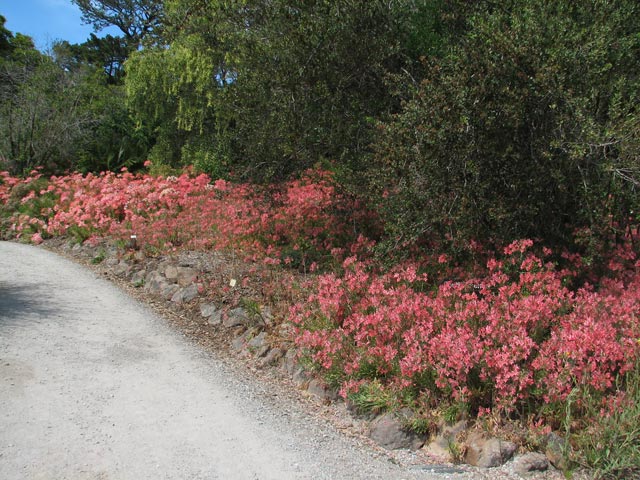
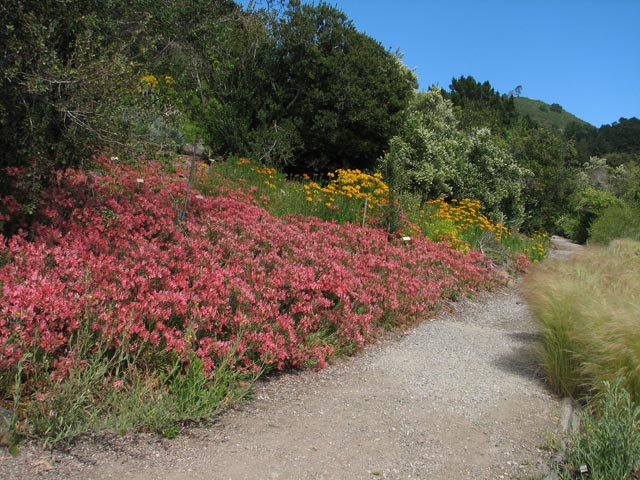
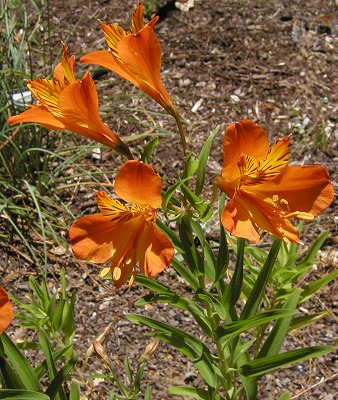
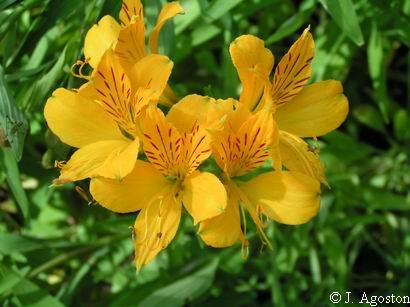
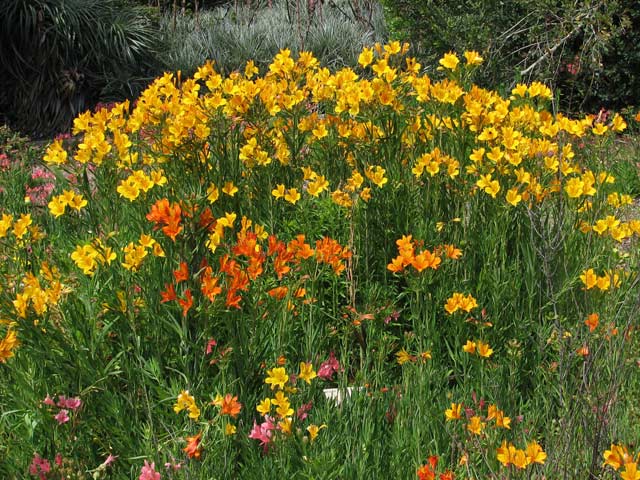
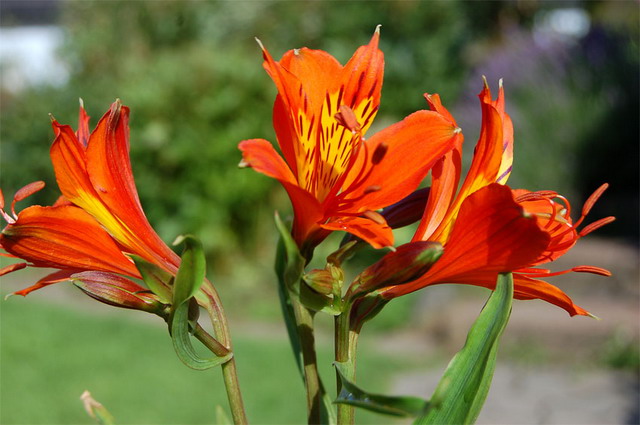
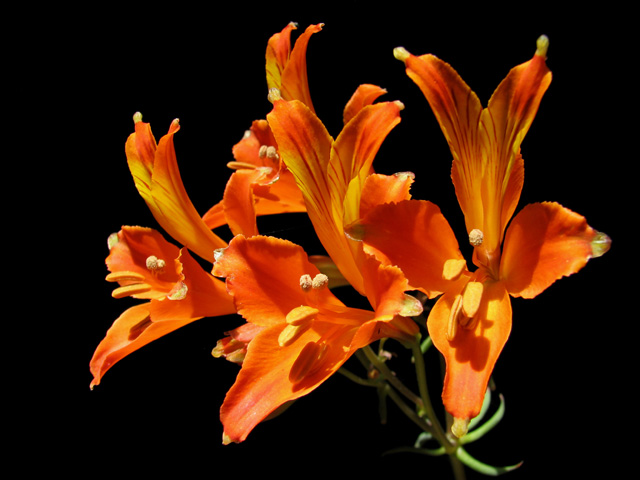
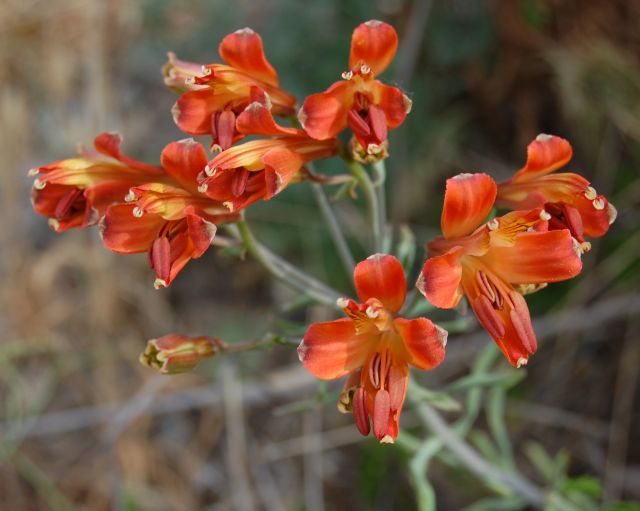
Alstroemeria aurea Graham (syn. Alstroemeria aurantiaca D.Don) from Chile and Argentina has yellow, orange, or orange-red flowers with dark stripes and flecks. It can become invasive in gardens where it is happy (loose, sandy soils) both by running and seed, but this has not happened in my garden. Height: to about 1 m. Photo 1 was taken by Mary Sue Ittner. Photo 2 was taken by Janos Agoston. Photo 3 was taken by Nhu Nguyen at the UC Botanical Garden where it certainly has spread within the bed. Photos 4-5 from Hans Joschko. The last photo from Ernie DeMarie of plants flowering in June in New York.
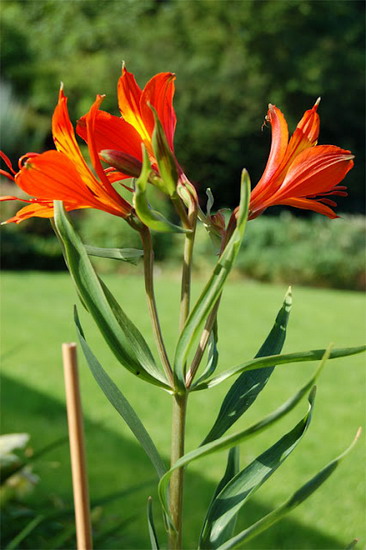
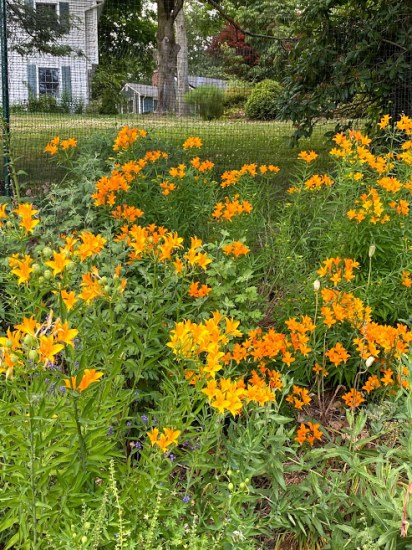
Alstroemeria caryophyllacea Jacq. is one of the many Brazilian species so little known. It is a forest plant, evergreen in zones 10-12 and makes a very fine dwarf ground cover. Height: to about 35 cm. This photo by Roy Sachs shows it in bloom for the first time (December 2002) in 8 years after blooming the first two years in cultivation. It was grown in a greenhouse. It is aromatic (smelling like carnations).
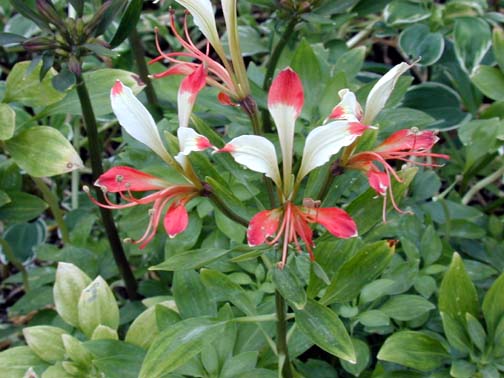
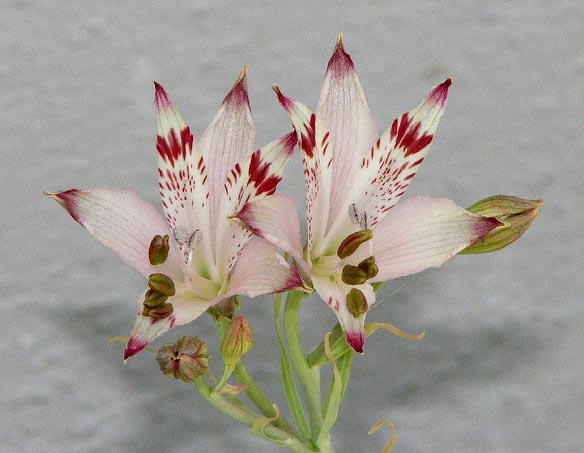
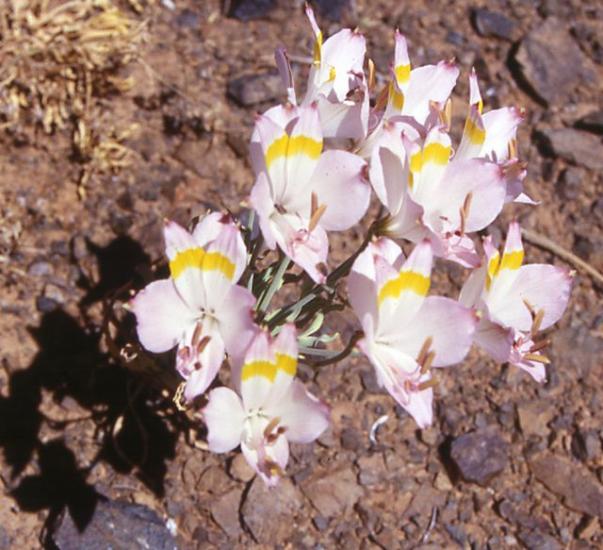
Alstroemeria diluta Ehr.Bayer was grown from seed received as A. versicolor. It has similar linear, grayish leaves and scapes that are 25-30 cm long, with flowers about 4 cm across. It has two subspecies. Alstroemeria diluta ssp. chrysantha Ehr.Bayer is native to Northern Chile. Photo from Jane McGary.
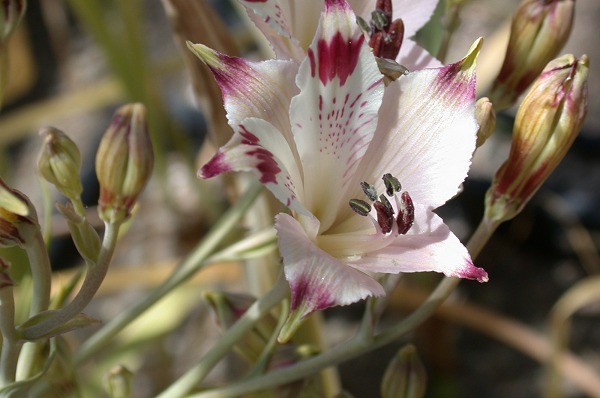
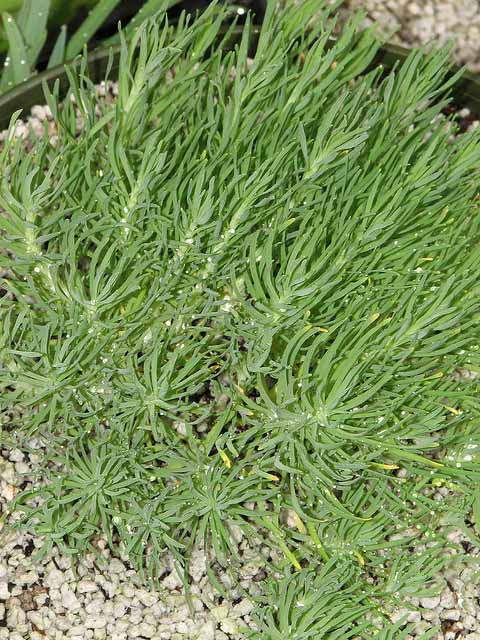
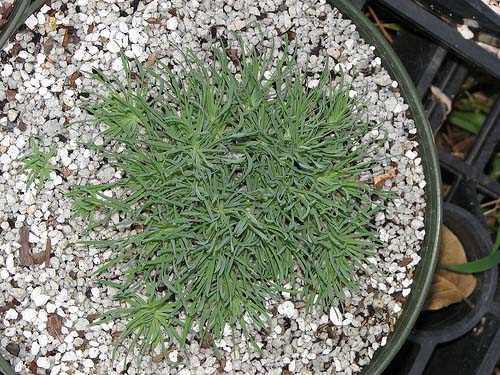
Alstroemeria diluta spp. diluta is native to central Chile. It produces compact winter foliage, low and mounded; flowering stems in spring about 24-46 cm (10-18") tall. Flowers (April-May) appear when the foliage is mostly dried, light dull pink with dark red highlights at the tips of the upper inner segments. In nature this subspecies is found at low elevations between 34º and 36º south. It occurs to the south of subsp. chrysantha, which is more often encountered in the wild. The pictures below show material grown and photographed by Dylan Hannon that was obtained via an IBS seed exchange in 1994. It's one of his favorite winter geophytes because of its tufted mounds of light green linear leaves. Most people who see it in this phase are surprised to learn it is an Alstroemeria. Culture is easy in full sun in a sandy well-drained mix. It is hardy to at least light frost and requires a dry summer rest. It takes well to containers and though it is deep-rooted like most alstroemerias it is at home in a 6" or one gallon pot.
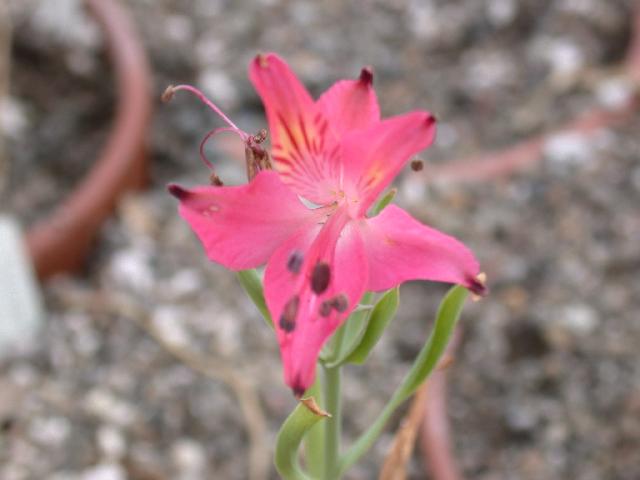
Alstroemeria exserens Meyen (tentatively identified) is shown in the wild near Portillo in the central Chilean Andes. This high-elevation species stays small in cultivation and tolerates temperatures at least down to 20 degrees F. Height: 30 cm. The second picture is of a plant grown from seed from Watson & Flores received as Alstroemeria pseudospathulata; however, it does not conform to the description of that species (unmarked and bright yellow), and at least one other species (Alstroemeria pelegrina) came up from the same seed packet. It is probably Alstroemeria exserens. It is shown flowering in a bulb frame in northwestern Oregon in late June, on a stem about 7 inches tall. Photos by Jane McGary

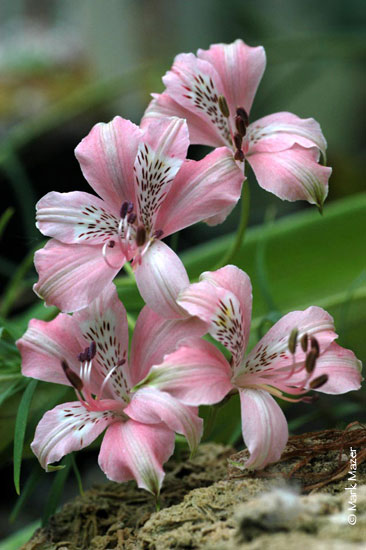
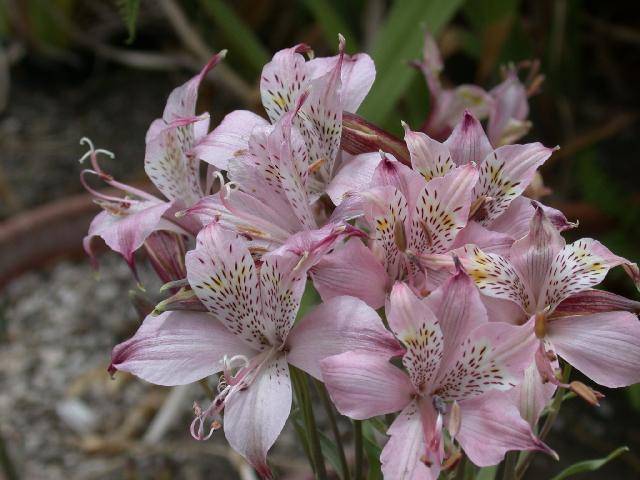
Alstroemeria hookeri Sweet is native to Chile. The first photo was taken by Mark Mazer. The second plant pictured below, grown from seed purchased from Watson & Flores, is growing in a mixture of coarse sand, loam, and pumice plunged in an unheated cold frame in Oregon. It flowers heavily in July and August. Height: 30 cm. Photo by Jane McGary. The little green zone near the tips of the outer tepals is characteristic of most forms of A. hookeri, as are bluish anthers.
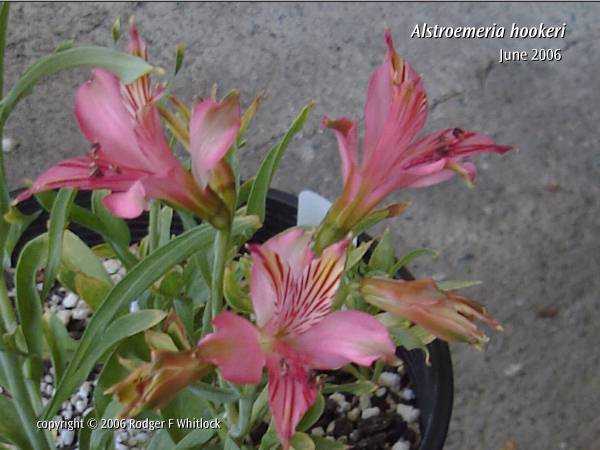
Alstroemeria hookeri ssp. maculata Ehr.Bayer has strongly streaked inner tepals. The picture below was taken by Rodger Whitlock who grew it from seed and questioned whether it was indeed this species.
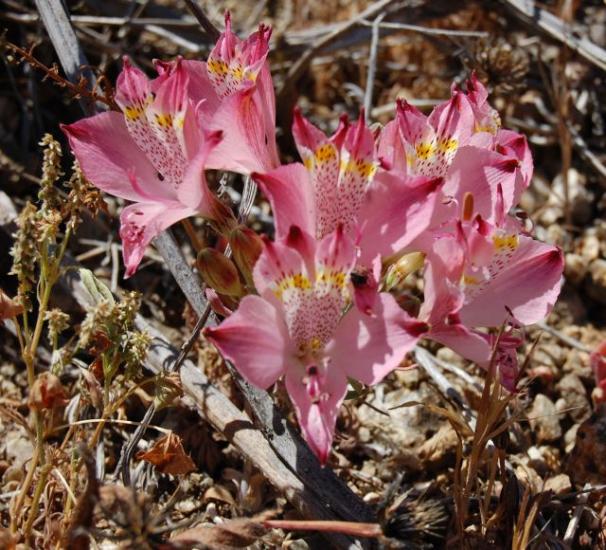
Alstroemeria hookeri subsp. recumbens (Herb.) Ehr.Bayer is considered by Plants of the World to be a synonym of Alstroemeria recumbens Herb. This plant, photographed by Jane McGary on a sandy coastal bluff near Algarrobo, central Chile, probably represents this subspecies as described by Bayer. It appears to differ from subsp. maculata only in lacking dark streaks on the lower inner tepal.
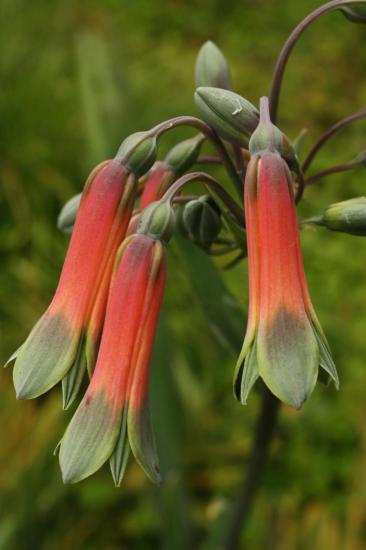
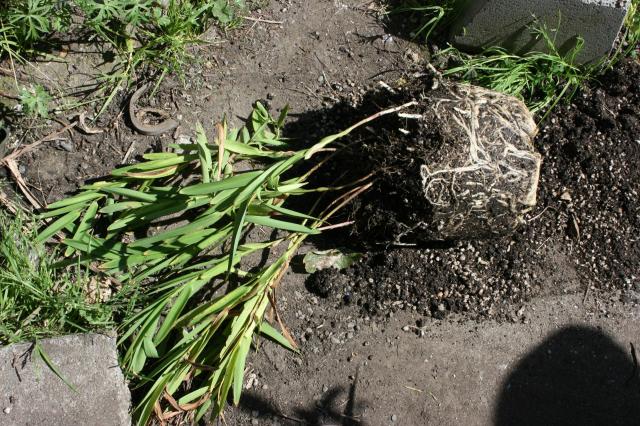
Alstroemeria isabellana Herb. is a lovely species with a distribution from eastern/southern Brazil to northeastern Argentina. It has striking convergence in flower morphology with many Central/South American plants like Phaedranassa, Eustephia and Fuchsia elegans. In the Bay Area, seeds planted in the fall sprouted in February. Plants can come into bloom in just 2 years from seeds. However, these plants do not like to be restricted in containers and will only bloom shyly in a 5 gallon pot (20 L). Once in the ground, they are much happier and can produce dozens of stalks during the blooming season. Plants go dormant in winter and return in spring. This species does not mind water during its winter dormancy. Height: about 60 cm. The photos below were taken by Nhu Nguyen. Photo 6 shows the plant being unpotted from its 5 gallon container and ready to go into the ground.
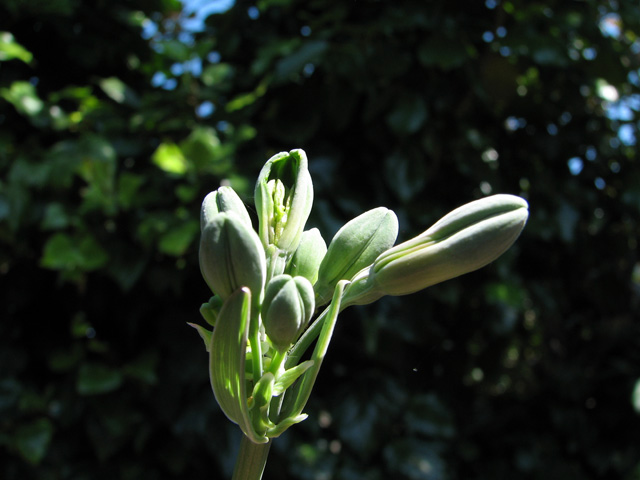
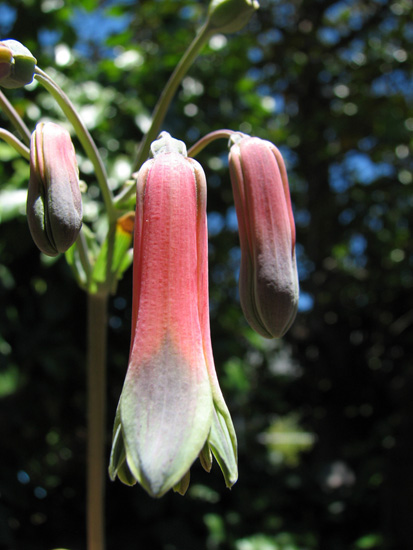
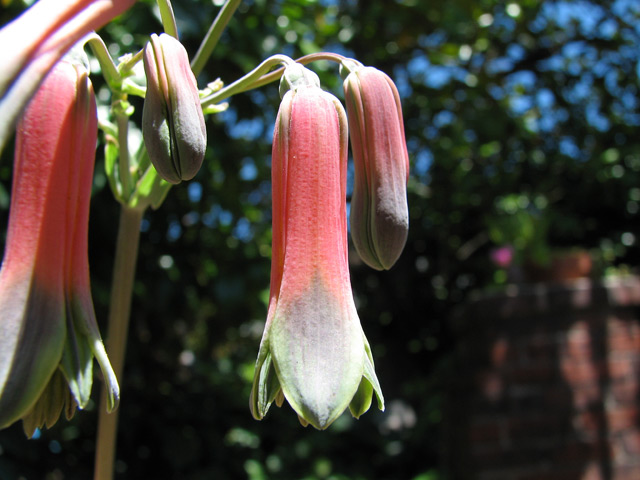
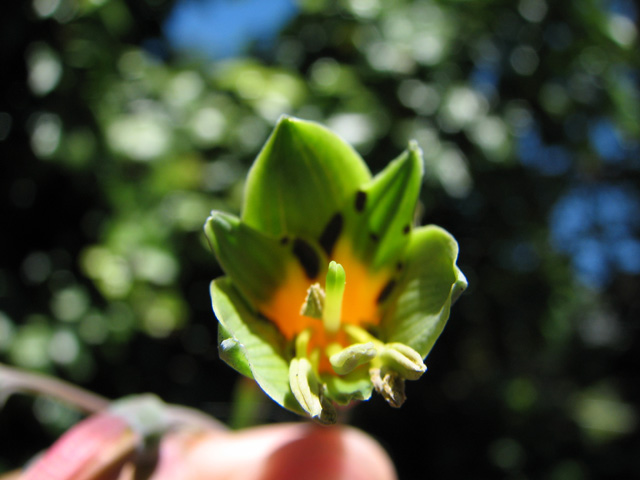
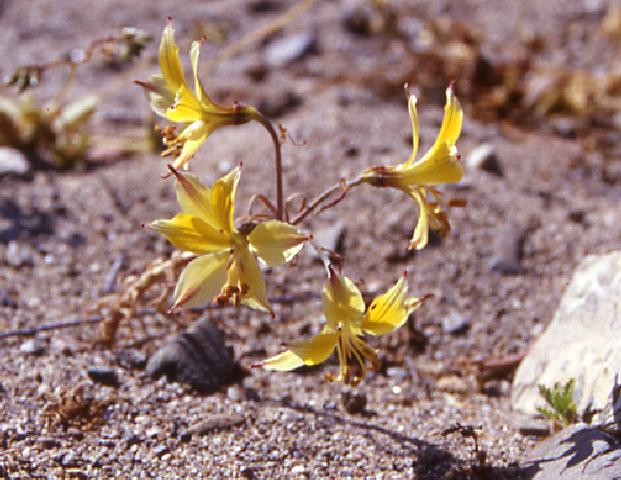
Alstroemeria kingii Phil. was photographed near Carrizal, near north coast of Chile, growing in sand in a seasonal riverbed that had been inundated two or three months previously. This tiny species, only about 4-6 inches tall in flower, comes in various shades of cream to golden yellow. Photo by Jane McGary
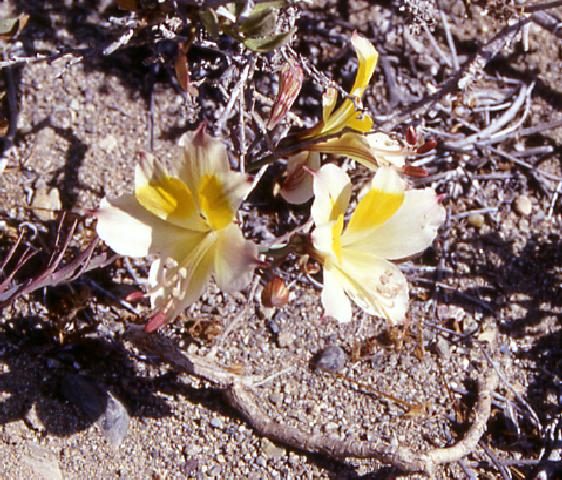
Alstroemeria leporina Ehr.Bayer & Grau was photographed by Jane McGary near Coquimbo, northern Chile. This medium-sized species is characterized by the lack of dark markings on the flowers and is restricted to interior valleys from Domeyko to Andacollo at mid elevations. Height: about 1-4 ft tall.
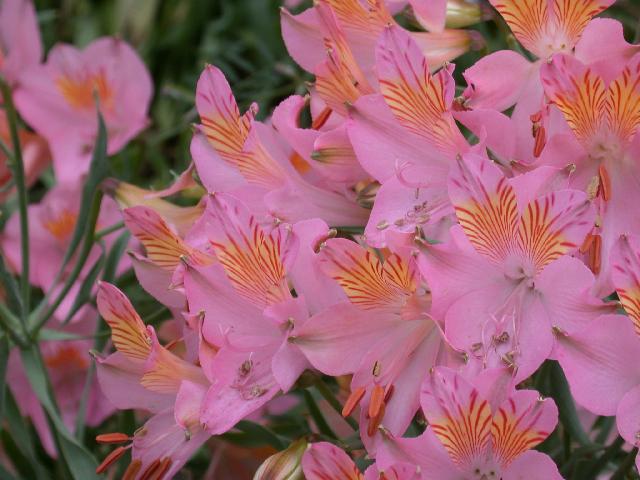
Alstroemeria ligtu L. is from the Andes in Chile. There are 4 subspecies: ligtu 50 cm tall with pink flowers streaked with dark red, ssp. incarnata 1 m tall with large pink flowers, ssp. simsii 1.6 m orange red streaked red on a gold background, and ssp. splendens.
Alstroemeria ligtu ssp. incarnata Ehr.Bayer (tentatively identified) shown grown from seed collected in the wild at low elevation in the Andean foothills of central Chile. This very large, showy species is growing in a large sand-and-gravel berm in a garden in NW Oregon, where it readily survives temperatures down to 15 °F and self-sows freely. The tentative ID is based on the twisted leaves and long upper-inner tepals. Photo by Jane McGary
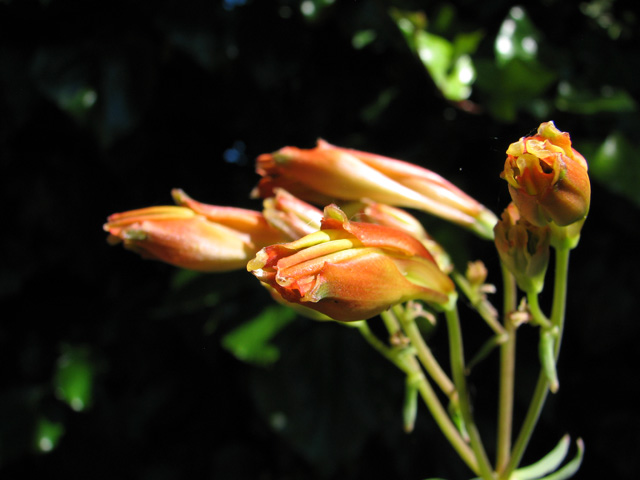
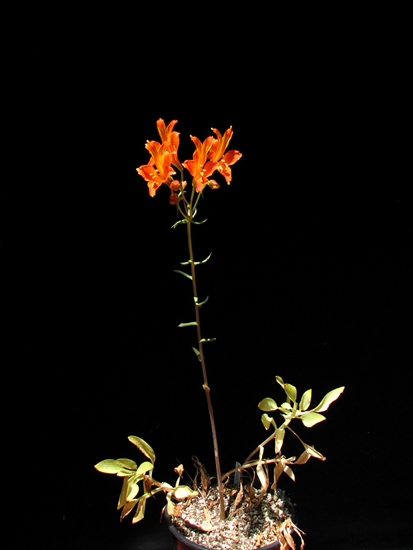
Alstroemeria ligtu ssp. simsii (Spreng.) Ehr.Bayer is native to central Chile. The plants below were grown by Nhu Nguyen from seeds which were planted in the fall and sprouted in 6 weeks. It takes 2 years to flower from seeds. Photo 5 by Jane McGary shows a wild plant of this subspecies in the Maipu canyon southeast of Santiago, Chile.

Alstroemeria ligtu hybrids see Alstroemeria Hybrids
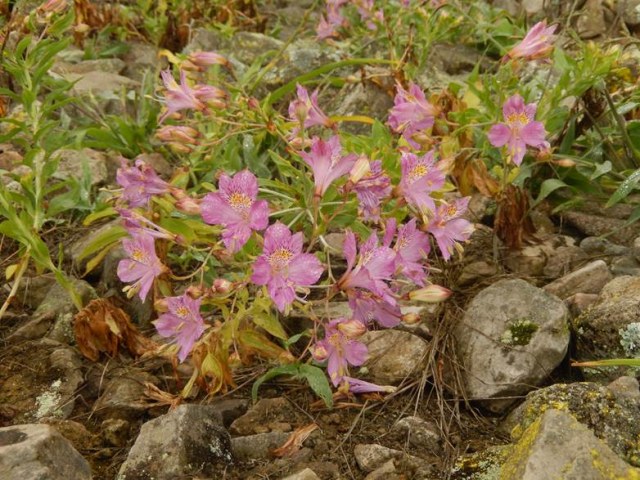
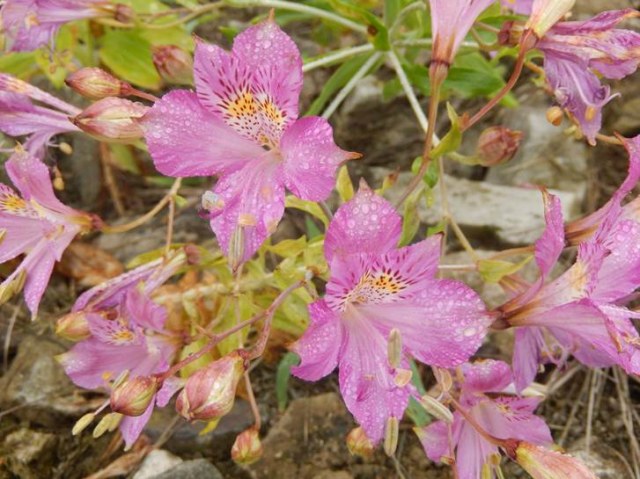
Alstroemeria lineatiflora Ruiz & Pav. can be found both in Peru and Chile from 50 to 3000 m. The inflorescence is an erect thyrse with 2-10 pink flowers. Height range: 1-3 ft. The pictures were taken near the coast of Lima in October 2015. This species is considered by Plants of the World Online to be a synonym of Alstroemeria chorillensis Herb. Photos by Norton Cuba.
Alstroemeria magnifica Herb. was photographed by Eugene Zielinski spring 2011. It was growing along Route 5 between La Serena and Huasco, Chile. Height: about 60 cm tall. This species includes ssp. magnifica, ranging from south of Chungungo to the Las Cardas range on coastal plain and Coast Ranges, Coquimbo Region; var. sierrae (Muñoz) Muñoz-Schick (no longer recognized as a variety by Plants of the World Online), characterized by deep, rich coloration and ranging from Quebrada Honda to the Los Porotitos hills, Coquimbo Region; var. tofoensis Muñoz-Schick, found only on peaks of El Tofo near Punta Totoralillo, Coquimbo region; and ssp. magenta (Ehr.Bayer) Muñoz-Schick, a richly colored flower with shorter, less pointed inner upper tepals, found from the area of Fray Jorge National Park north to Papudo. Ssp. magenta is most frequently found in cultivation. All species are coastal and should be considered only marginally frost-hardy. All are large, robust plants, usually seen growing in rocky soils in scrub and grassland.
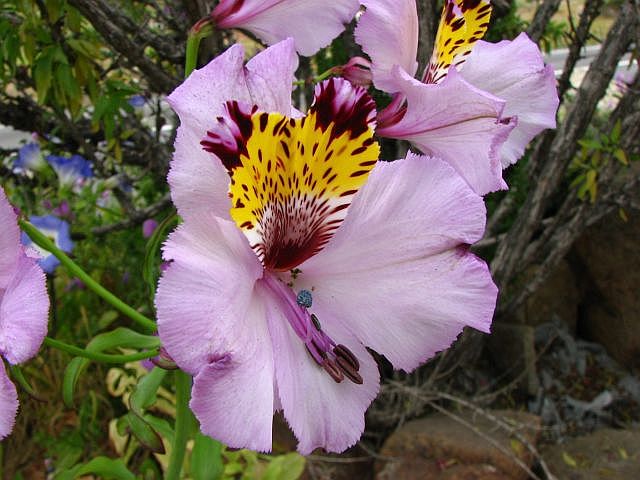
Alstroemeria magnifica ssp. maxima (Phil.) Ehr.Bayer in cultivation, grown from JJA seed, flowering six months after germinating in the cold days of February. Flowers are about 3 inches in size and the plants 24 inches high. Follows the typical pattern of growing in Winter and Spring, flowering at the start of Summer and then going dormant through the hottest part of the year. Photos by David Pilling
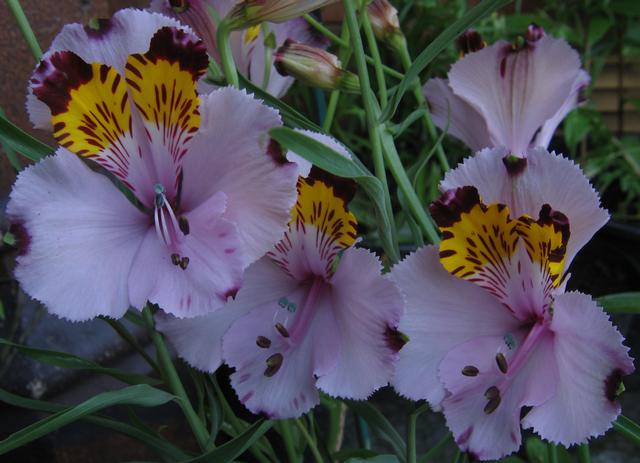
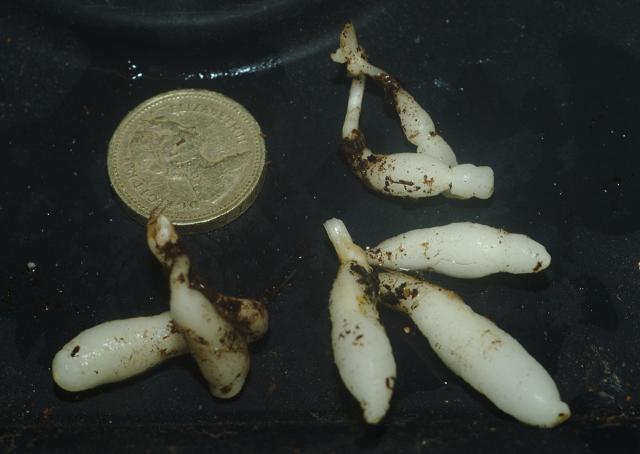
Alstroemeria pallida Graham was photographed in the canyon leading up to Lago del Laja in the central Chilean Andes. This variable, low-growing but large-flowered species is common in the mid-elevation hills of this region and grows in loose, rocky soils. Height: to about 20 cm. Photo by Jane McGary who is growing seedlings from this population in a bulb frame in northwestern Oregon, where they flower in late June. She believes it should be hardy in USDA Zone 8 outdoors.
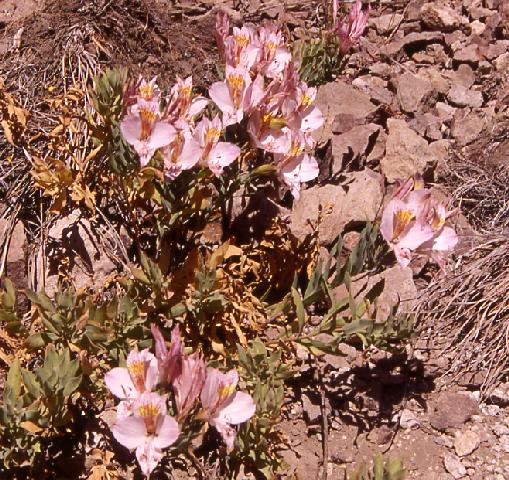
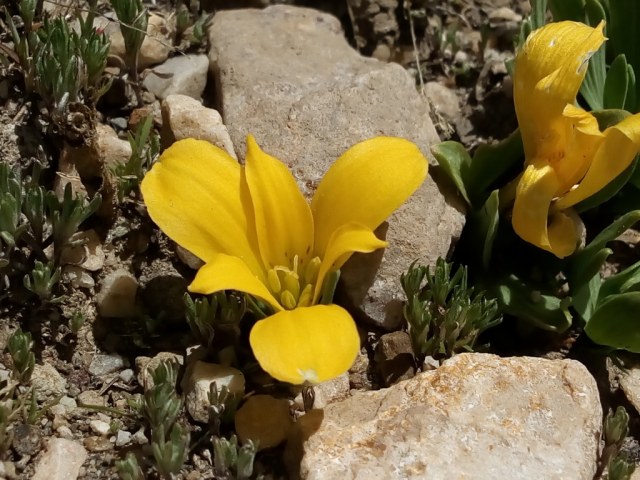
Alstroemeria patagonica Phil. is one of the southernmost species, a very small plant with stems about 4-8 inches long and somewhat lax, and bright golden yellow flowers. Jane McGary has seen it growing in sandy "blowouts" on hillsides in Patagonia, where the soil was extremely dry when the plants were dormant. It is hardy to at least 20 degrees F, but should probably be protected from repeated freezing and thawing while moist. It flowers in early June and is summer-dormant. Height: 1-3 ft. Photo by Jane McGary shown in cultivation, grown from seed obtained from the Alpine Garden Society exchange.
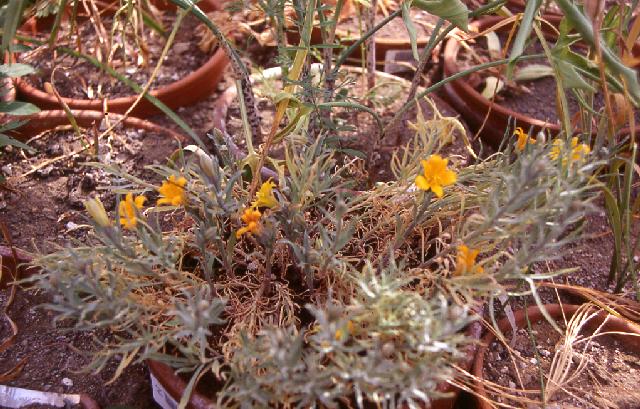
Alstroemeria pelegrina L. is a species from Peru and Chile that grows to 60 cm. In Chile it grows in dry areas near the coast and is often shaded by nearby shrubs. The photos below were taken near Pichidangui, Chile spring 2011 by Eugene Zielinski. The plants grew in a rocky area close to the shore, and were usually less than 12.5 cm (5 inches) tall.

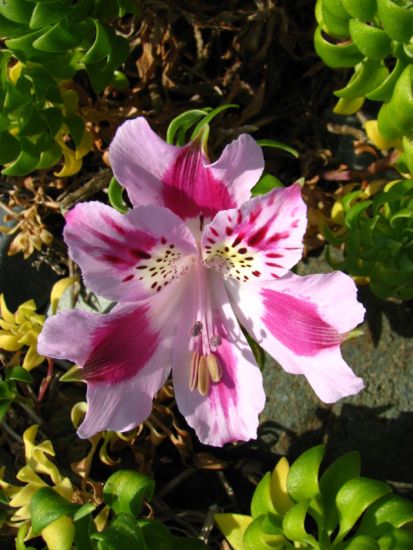
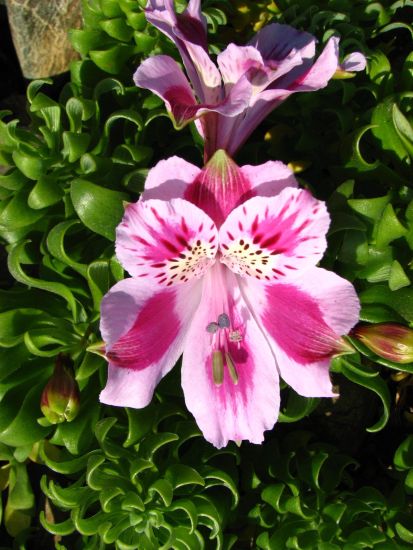
Alstroemeria philippii Baker is a species from Chile that grows in coastal areas. Height: about 60 cm. Photo 1 from Eugene Zielinski was taken spring 2011 between Huasco and Carrizalillo. Photo two was taken by Diane Whitehead of plants in cultivation grown from Flores and Watson seed, F & W 10575, collected in Chile Atacama/Coquimbo area, Coastal Semi-Mediterranean Desert Zone rough gulleys 250 m. The seeds were sown in December 2003 in a warm room. About one-quarter of them germinated in nine days, the other three-quarters remain ungerminated. Seedlings were placed in a sunny window, where each plant quickly grew a single long stem which by April were a metre long. One flowered at the beginning of May 2004, 19 weeks from germination - a single terminal bloom, pictured here. Photo 3 from Jane McGary shows plants grown from F&W8689, flowering in June in a bulb frame in NW Oregon. Although extremely frost-tender, this winter-growing species stays short (about 6 inches/15 cm) and flowers better when grown as hard as possible; it should be lifted and taken indoors if temperatures go below about 28 °F.
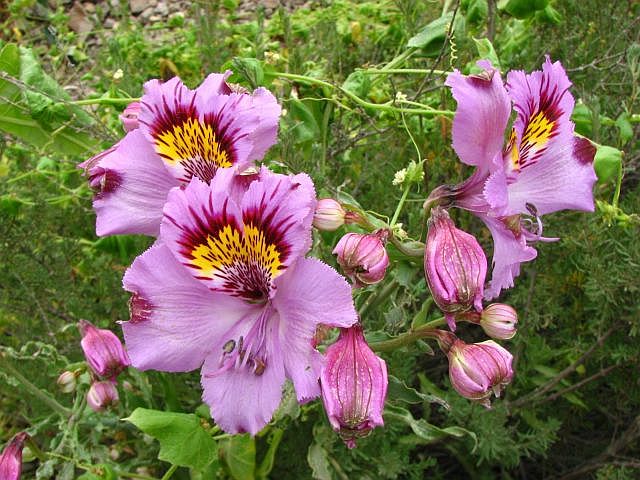
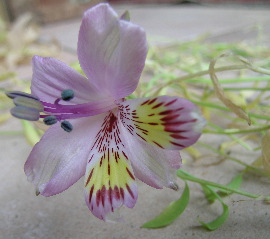
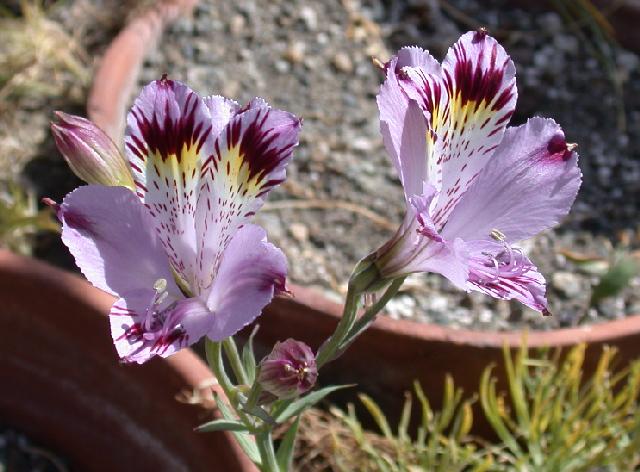
Alstroemeria philippii var. albicans Muñoz-Schick is similar to the type except in its white or very pale base color and slight differences in markings. Its entirely coastal range overlaps that of the type. Plants of the World Online in 2021 considers it to be a synonym of the species. Photographed in Aguada Tongoy by Jane McGary.
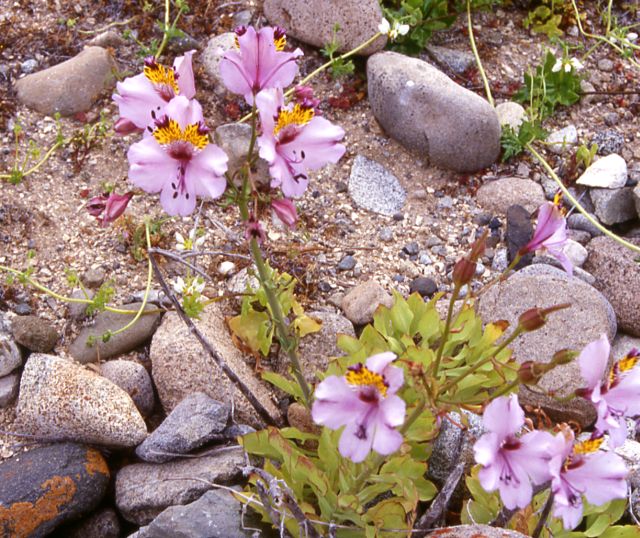
Alstroemeria plantaginea Mart. was photographed in Serra da Piedade, Brazil. Plants can grow up to 1.2 meters (4 feet) tall. Copyright: Tsuh Yang Chen.
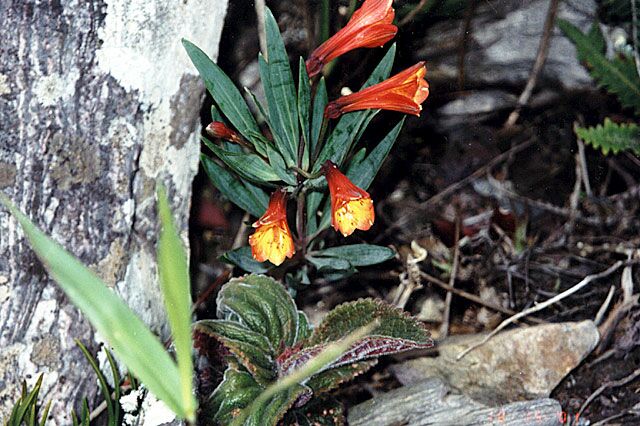
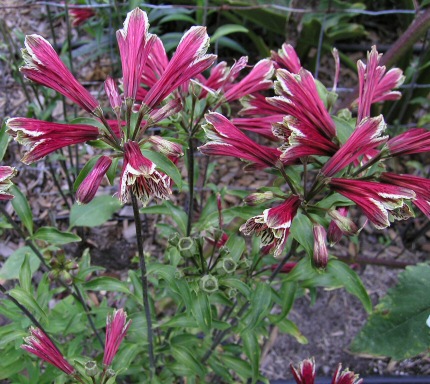
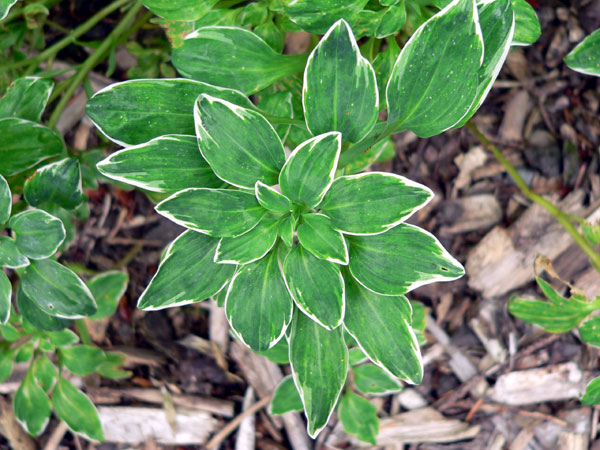
Alstroemeria psittacina Lehm. is probably the correct name for these photos of plants labeled Alstroemeria pulchella. It is often grown under the incorrect name. It is native to Brazil and has flowers that are dark red marked with green and blotched dark purple. This plant also can be weedy in some gardens and not survive in others. Height: about 90 cm. The first photo from Mary Sue Ittner is of some growing in the Mendocino Coast Botanical Gardens, flowering August 2004. The second, from Susan Hayek shows a form with variegated foliage. The leaves seem to be infected by one of the Alstroemeria viruses. Alstroemeria pulchella has been named three times by different people. All three are now considered synonyms by Plants of the World online. Alstroemeria pulchella H.Vilm. is a synonym of Alstroemeria aurea Graham. Alstroemeria pulchella Sims is a synonym of Alstroemeria ligtu subsp. simsii (Spreng.) Ehr.Bayer. Alstroemeria pulchella L.f. is a synonym of Alstroemeria pelegrina L.
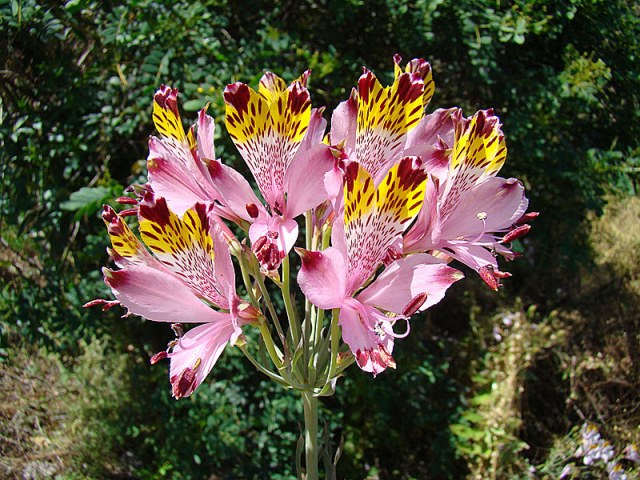
Alstroemeria pulchra Sims is from central Chile. As well as the type there is subsp. maxima which is over 1 m high and typically grows in tall grass and scrub (see Alstroemeria spectabilis). Photo courtesy of Dick Culbert from Gibsons, B.C., Canada, via Wikimedia Commons and shared under a creative commons CC By 2.0 license.

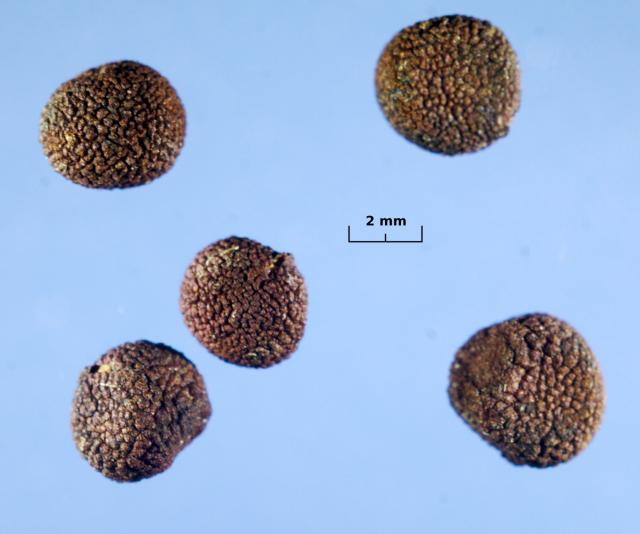
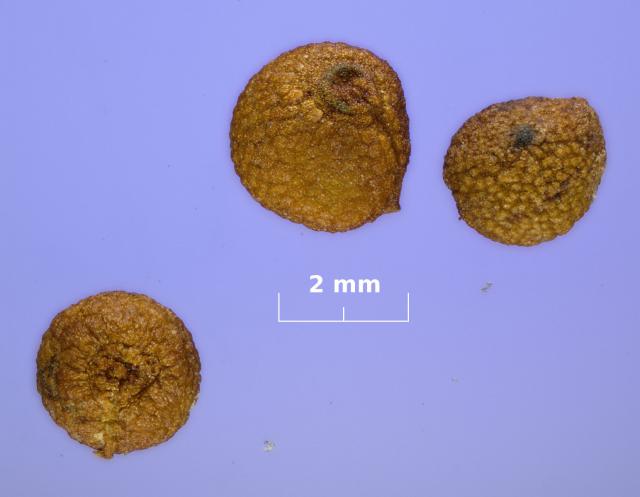
Alstroemeria pygmaea Herb. is a small species from Argentina, Bolivia and Peru. Height: 30 cm. The first photo from iNaturalist taken by Daniel Montesinos T in Peru in March and shared under a CC BY-NC license. Seed photo by David Pilling.
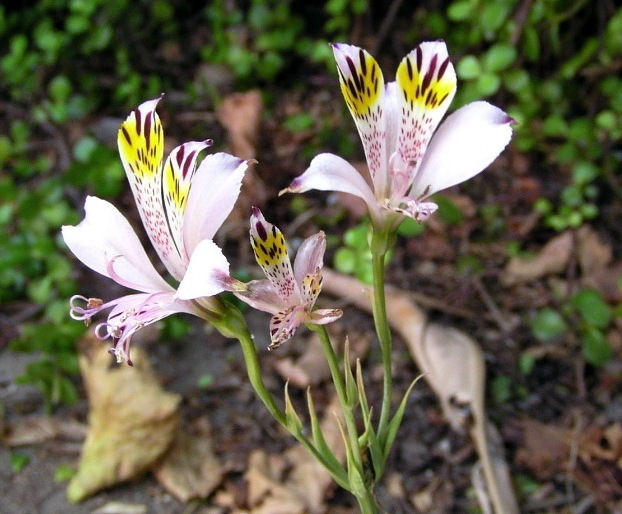
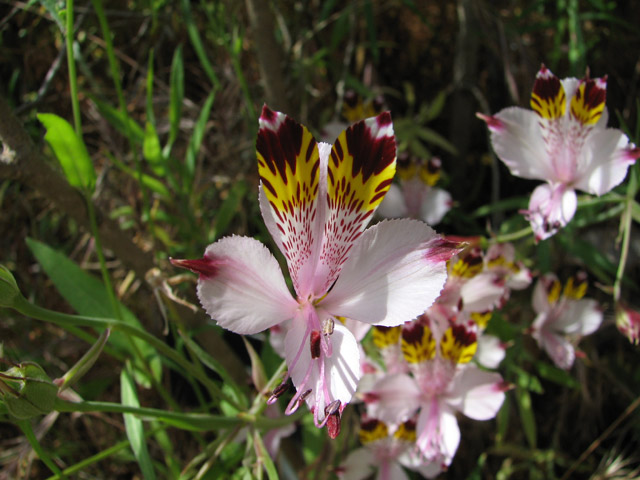
Alstroemeria spectabilis Ravenna was named in 1988 by Ravenna. Its native range is central Chile. Some experts consider it to be Alstroemeria pulchra subsp. maxima. Photo 1 was taken in July 2003 by Lee Poulsen of a plant grown in California from seed supplied by Seeds of Distinction who say it is a Chilean species. It is still in a 4-inch pot and the flower stems are about 12 inches tall. It seems to grow all year round. Photographs 2-3 were taken by Nhu Nguyen from the UC Botanical Garden.

Alstroemeria umbellata Meyen was photographed flowering in a bulb frame in northwestern Oregon, where it is kept dry in summer. The plants are in a large mesh bin plunged in sand and topped with coarse chunks of lava rock. The seeds from which these plants were grown were collected by the grower in the Quebrada (canyon) del Morado east of Santiago, Chile, in 1996. This population was growing on a steep talus slope, rooted in sand below about 12 inches/30 cm of broken dark rock. The sand was slightly moist even in midsummer. The steep slope and constant traffic of ore trucks just below it probably minimized browsing by goats, which had destroyed most of the other palatable plant life in the area. Height: 1-3 ft. tall. Photo by Jane McGary
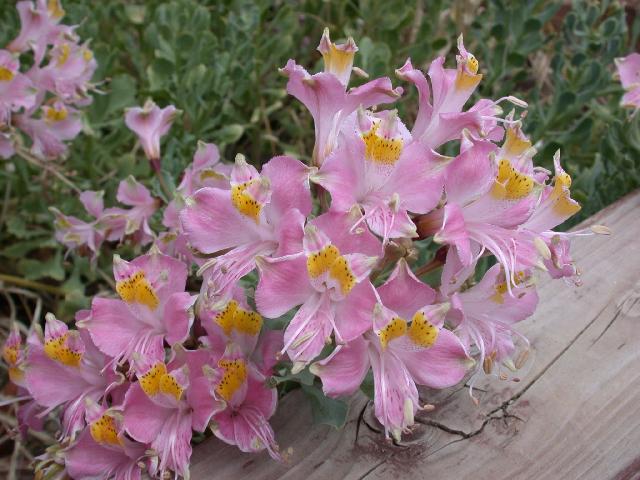
Alstroemeria violacea Phil. is native to coastal sites in northern Chile. It is a species of delicate appearance with purple flowers that are not heavily marked. It is considered by Plants of the World Online to be a synonym of Alstroemeria paupercula Phil. Height: about 5 ft. Photographed near Taltal, Chile, in 2002 by Jane McGary
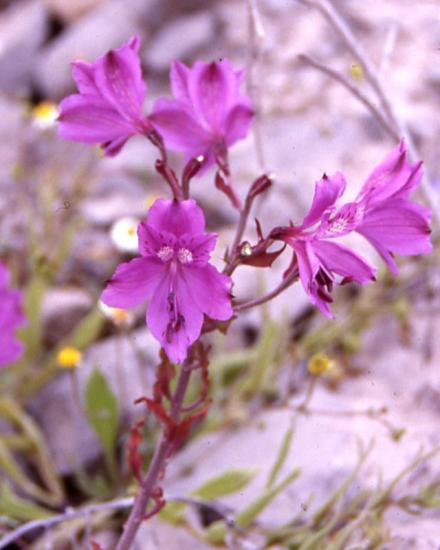
Alstroemeria viridiflora Warm. is distributed in southern Brazil. The Brazilian Flora 2020 project describes the flowers as yellowish, reddish, pinkish, greenish with the tepals spotted and the stamens included. Height: to about 4 ft. Photos by Alessandro Marinello
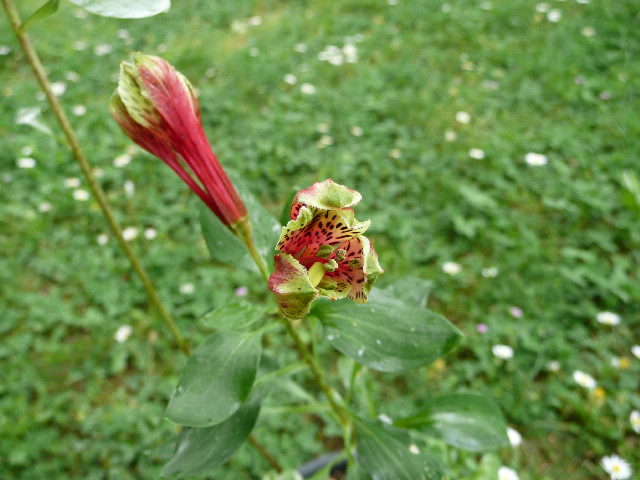

Alstroemeria werdermannii Ehr.Bayer has a limited distribution on the coast of Atacama and Coquimbo regions, northern Chile. The flowers are rather small and narrow, and the leaves are distinctively wavy and densely placed on the stems. Height: 40 cm. This Alstroemeria grows in deep sand on stabilized dunes and can be best seen near Huasco, where the illustrated plant was photographed in 2002 by Jane McGary.
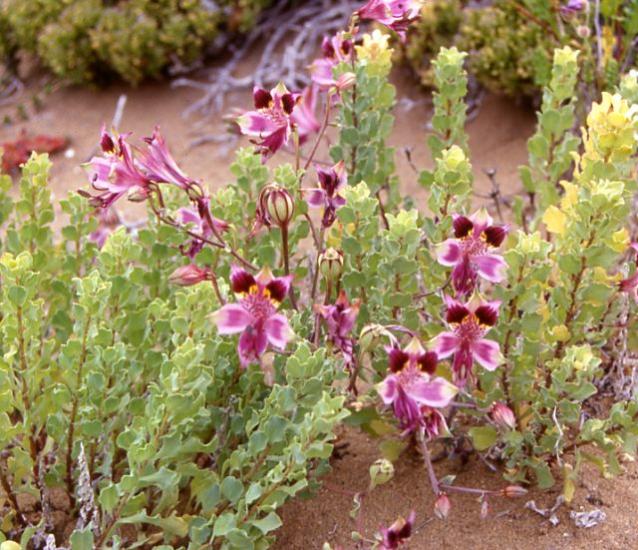
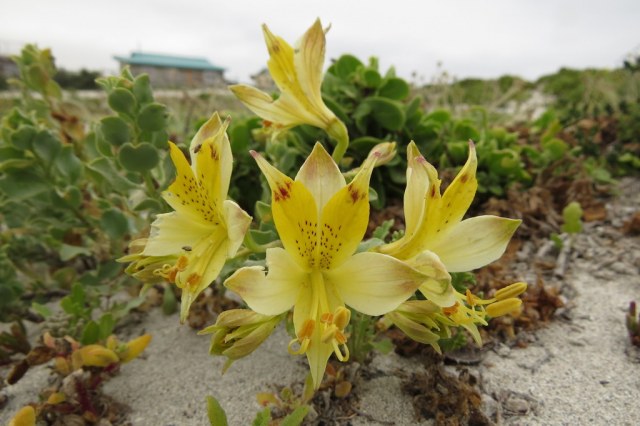
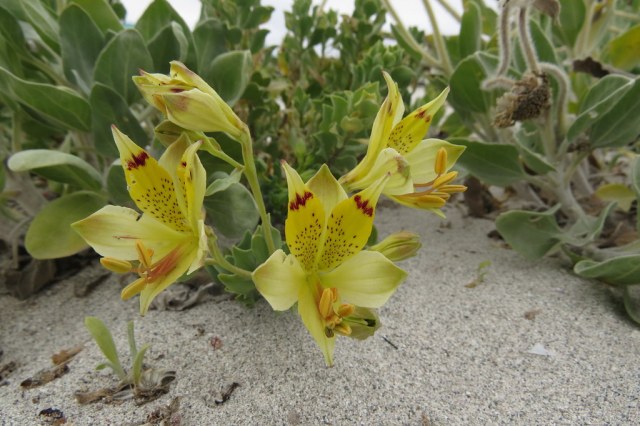
Alstroemeria werdermannii ssp. flavicans (Muñoz-Schick) J.M.Watson & A.R.Flores is a yellow-flowered form. Photos from iNaturalist taken by Nicolás Lavandero in Coquimbo, Chile in May and shared under a CC BY-SA license.