Cyclamen species i through z are found on this wiki page.
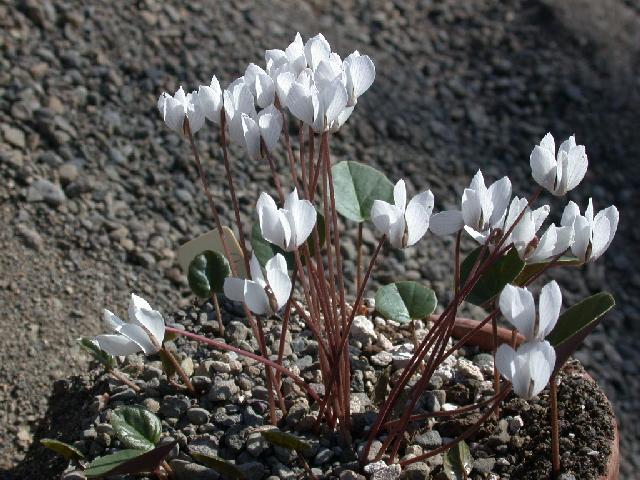
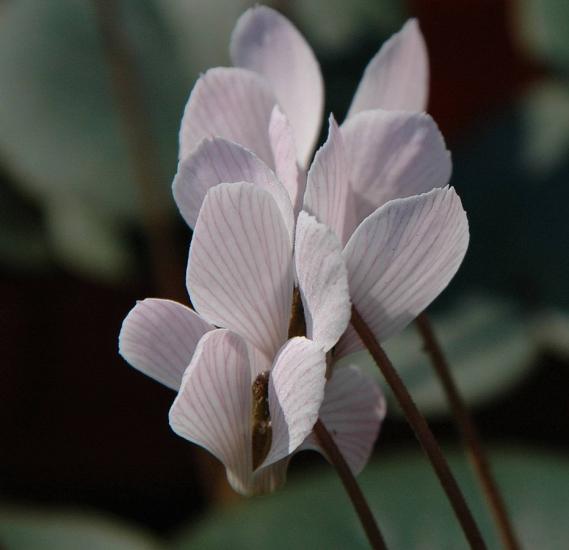
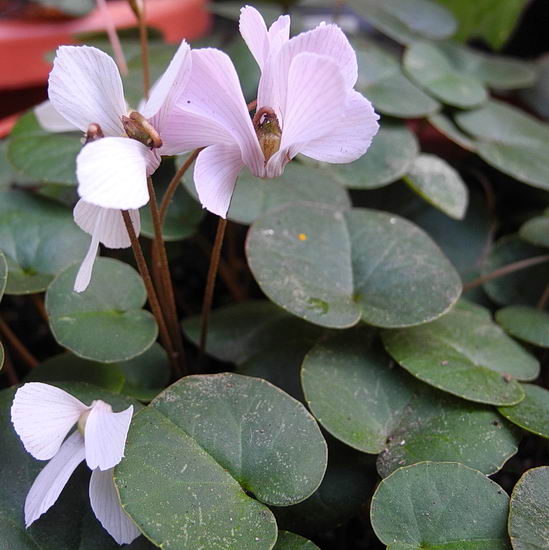
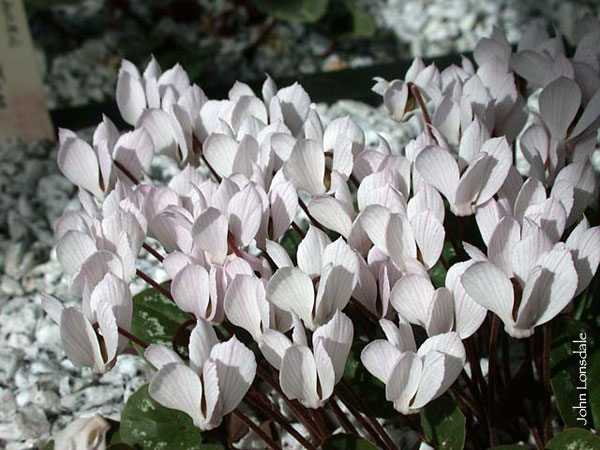
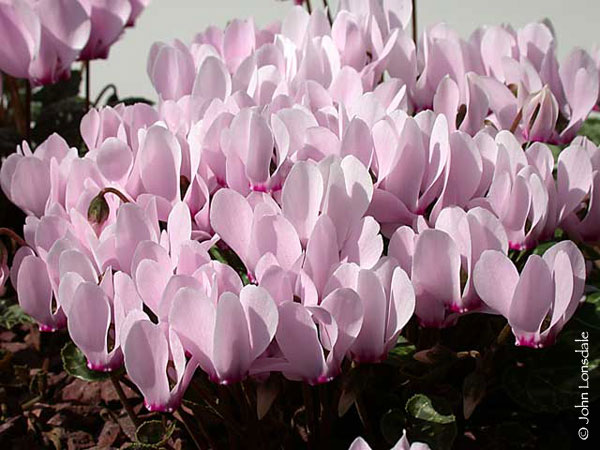
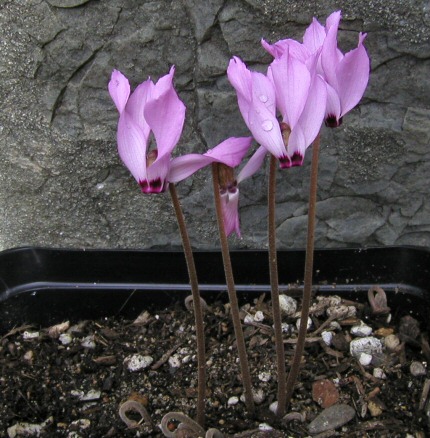
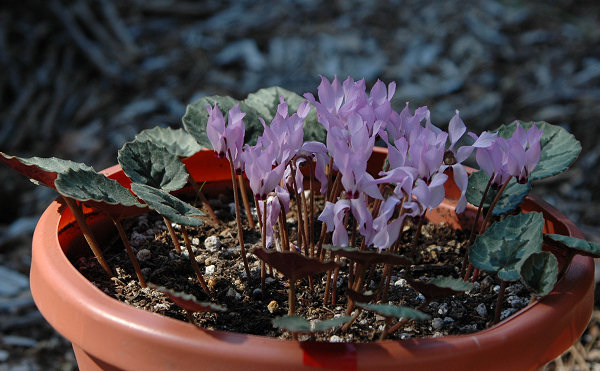
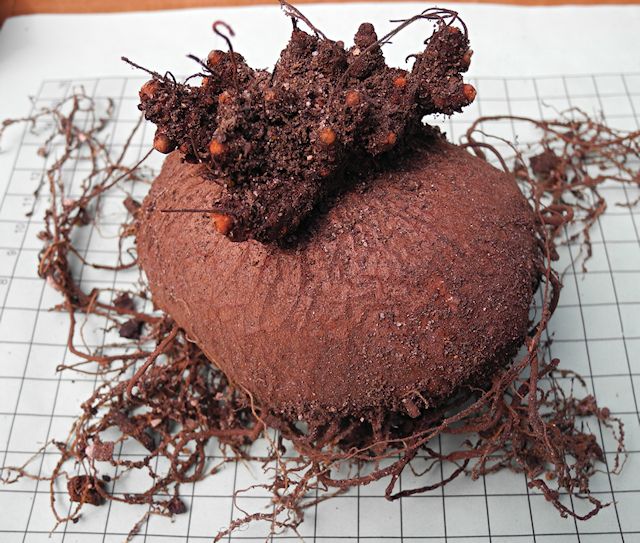
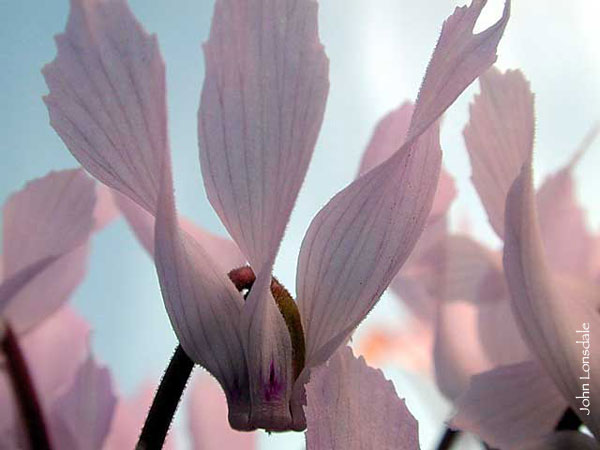
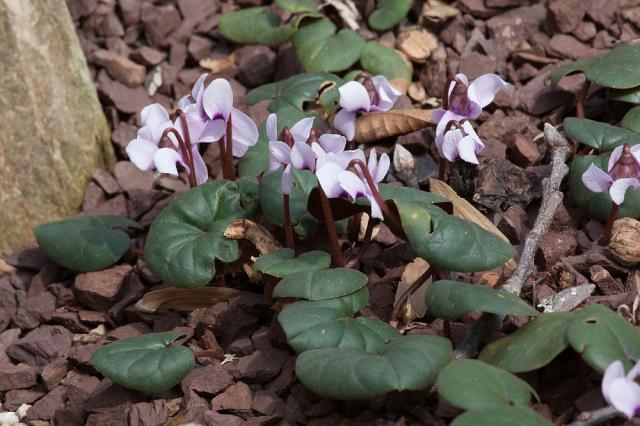
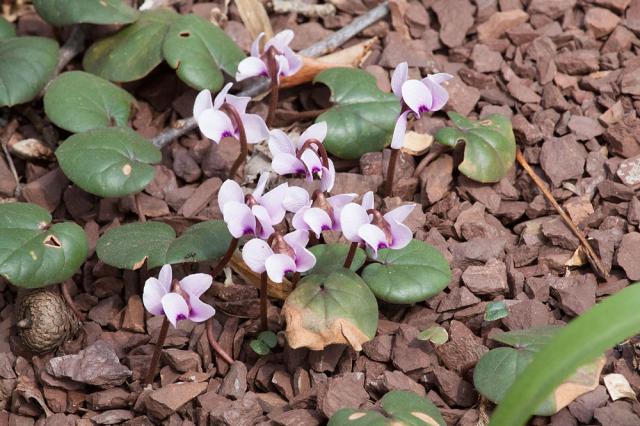
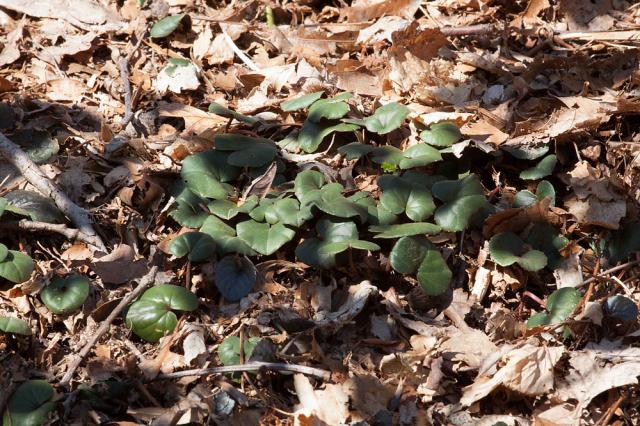
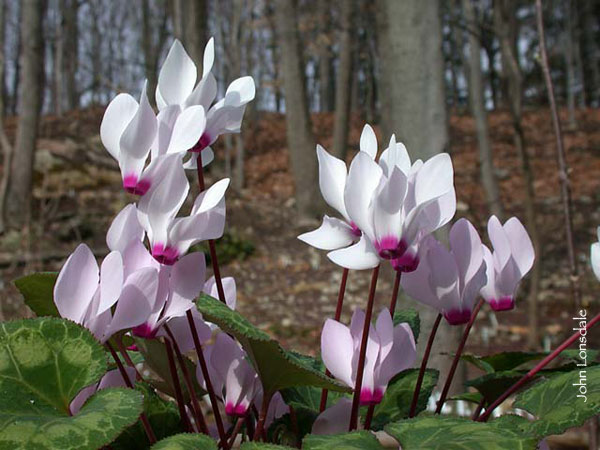
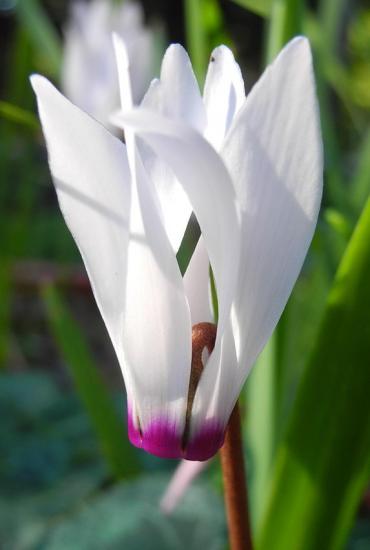
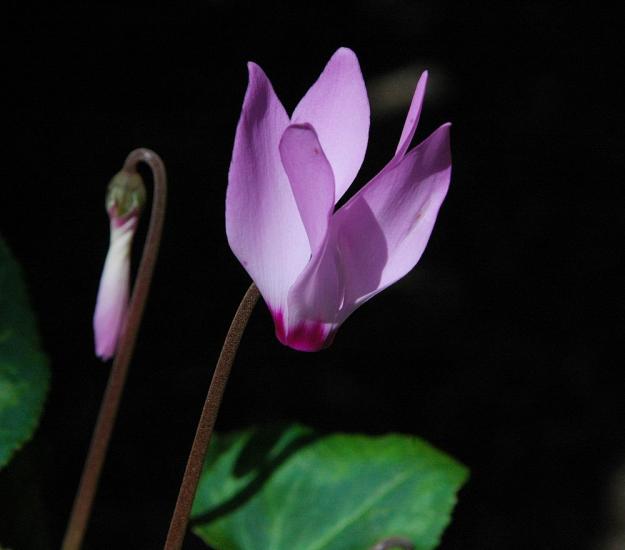
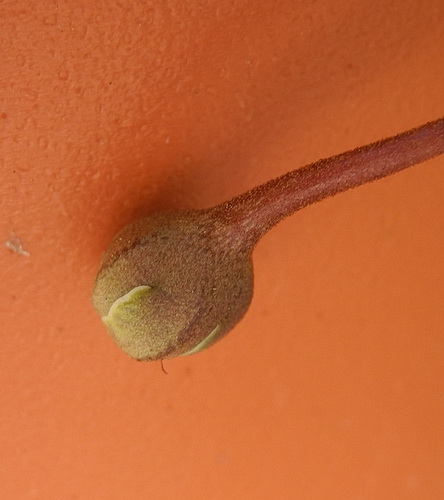
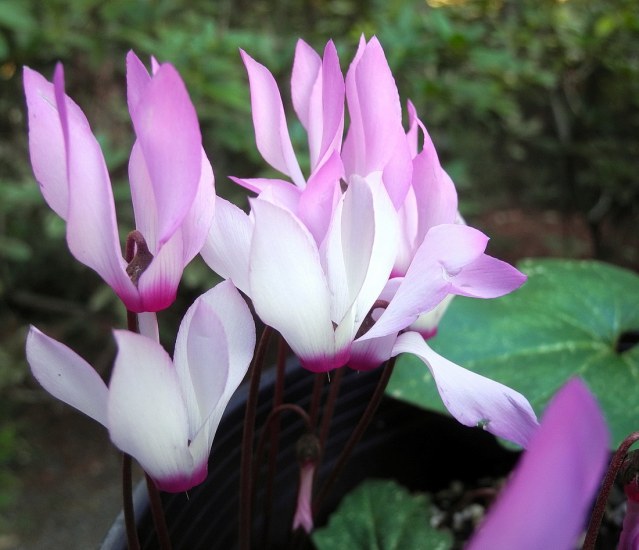
Cyclamen intaminatum (Meikle) Grey-Wilson comes from western Turkey, where it grows mostly in deciduous oak woodland sites among roots and rocks in partial shade. It is one of the smaller species so is usually grown as a container plant, even though it is winter-hardy down to at least 20 degrees F. Flowers are white to pale pink with pale grey veins and no blotch and appear with the semi-mature or mature leaves in fall. The green leaves are plain or marked with an irregular hastate pattern in grey-green or pewter. Tubers are small and depressed-globose to 3.5 cm (1.4 in) and larger in cultivated plants, smooth and velvety at maturity and root from the center of the base. The plants shown in photo one from Jane McGary were grown from seed and were four years old from sowing. Photos two and three are from Mary Sue Ittner. The last three photos are from John Lonsdale.
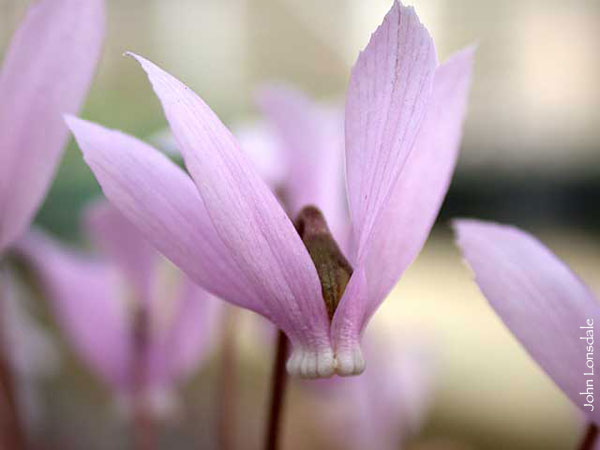
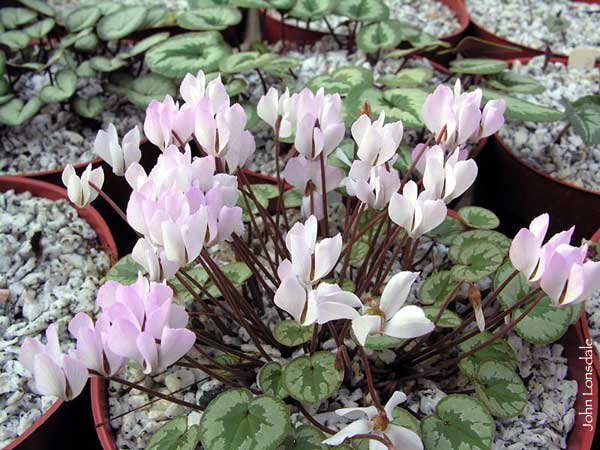
Cyclamen libanoticum Hildebr. comes from a very small area in Lebanon where it grows amongst rocks and tree roots. Leaves are heart shaped, dull grey or blue green above with indistinct grey or white marbling. Flowers appear with the mature leaves in winter, have a peppery smell, are white turning pink with an irregular magenta blotch towards the base of each petal with a central stripe extending into the mouth. Tubers are subglobose to depressed globose, velvety brown when young, corky and fissured when mature, to 4.5 cm (1.8 in) and root mostly from the center of the base. The first photo was taken by Jim Shields and the rest by John Lonsdale
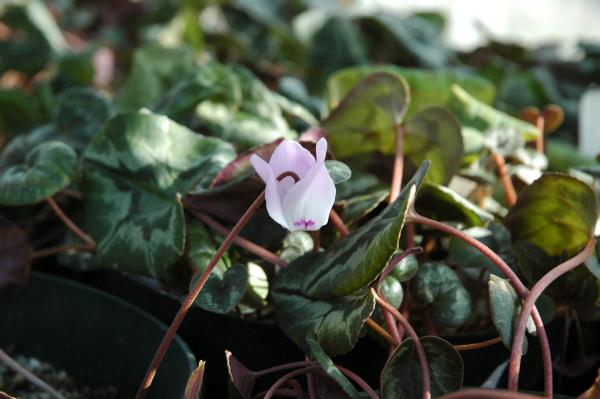

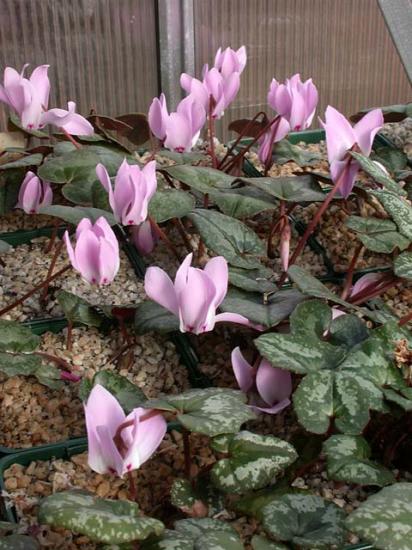
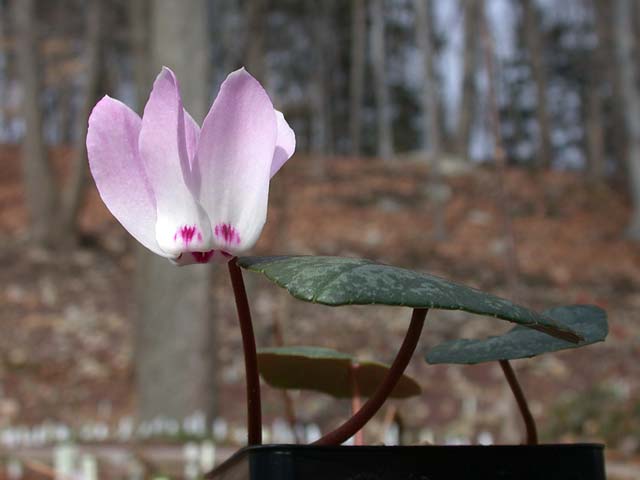
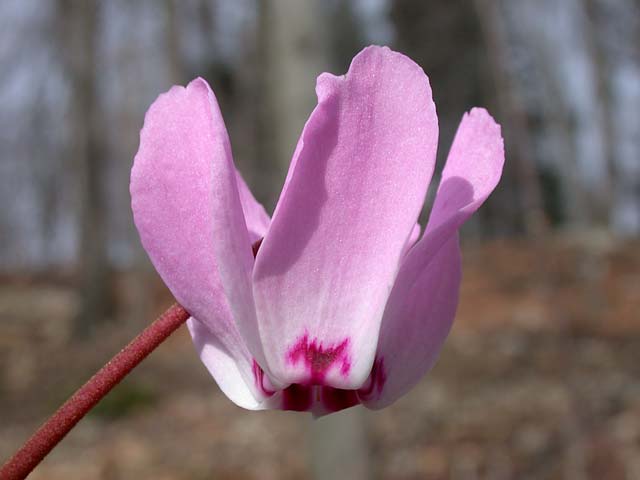
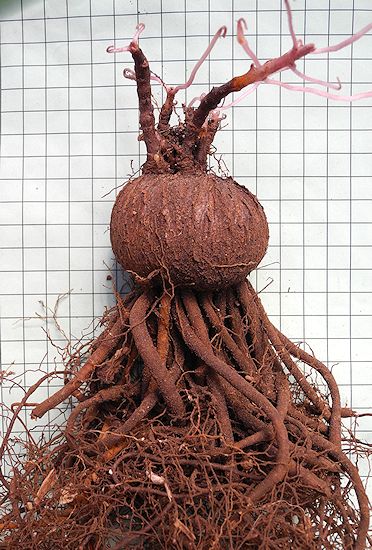
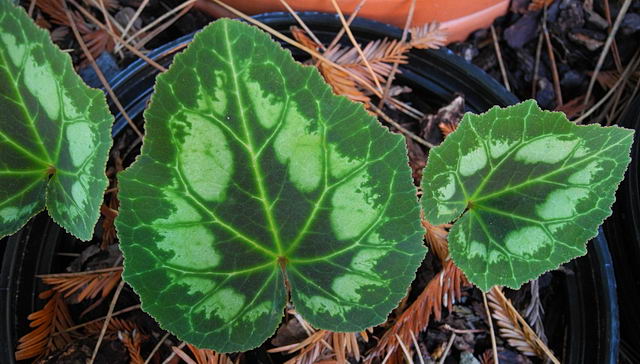
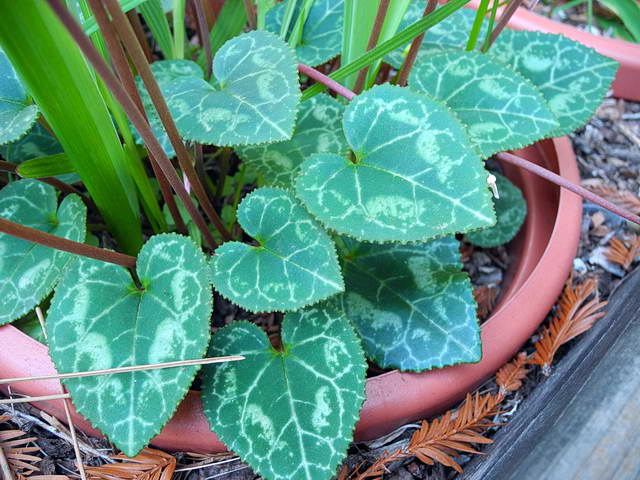
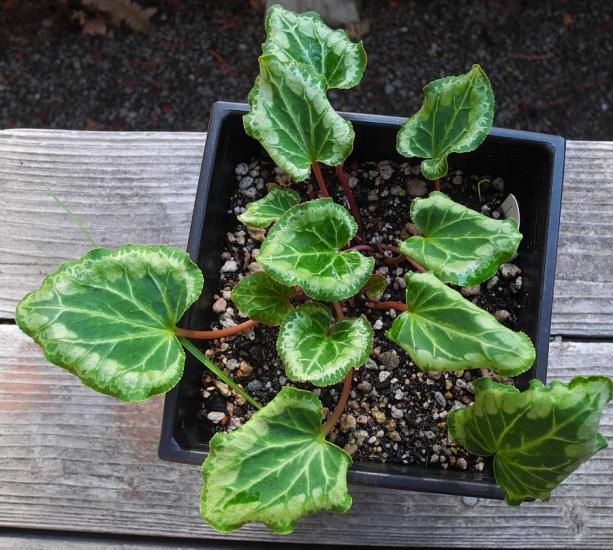
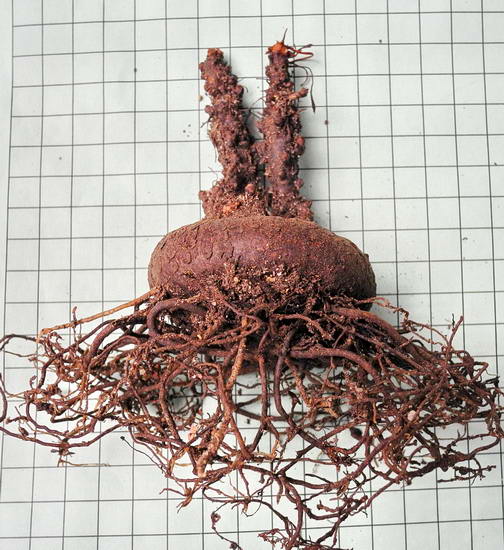
Cyclamen maritimum Hildebr, syn. Cyclamen graecum ssp. anatolicum Ietsw., syn. Cyclamen pseudomaritimum Hildebr. is found in Turkey, Rhodes, and Cyprus where it grows in woodland or scrub in sandy and rocky places. It has leaves with beaded and lobed margins, green but often marked with a pale central zone in paler green, pewter or silver. The white to pink sweetly scented flowers have small poorly developed auricles and dark basal solid blotches at the base of each petal that do not usually extend along the veins. The first photo is from Hans Joschko. The next two photos were taken by John Lonsdale. The last photo from Mary Sue Ittner shows a tuber on a 1 cm grid and illustrates the anchor roots. It has not flowered for her after many years of growing it in a pot and she has read that with the deep thick roots it is often grown in a very deep pot and water during bud formation encourages flowering.
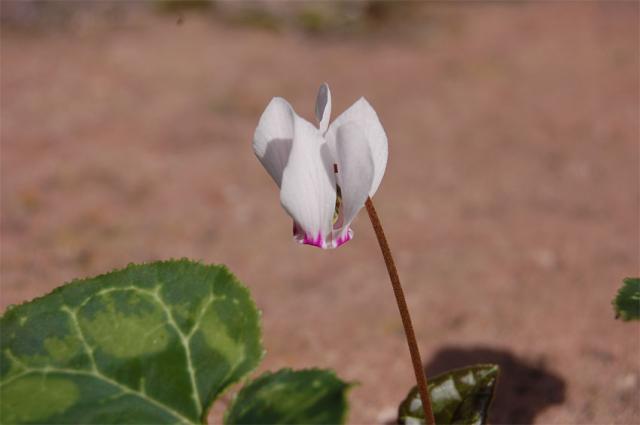
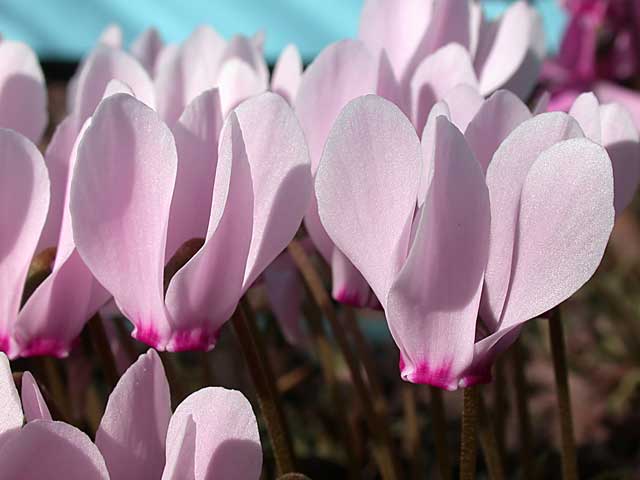
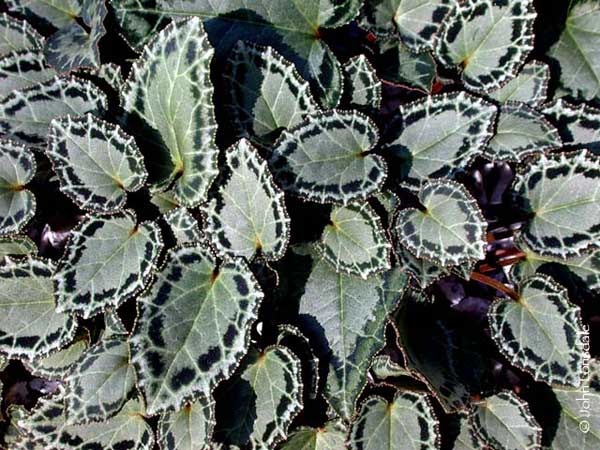
Some of the different beautiful leaf patterns are illustrated below. Photos from John Lonsdale.
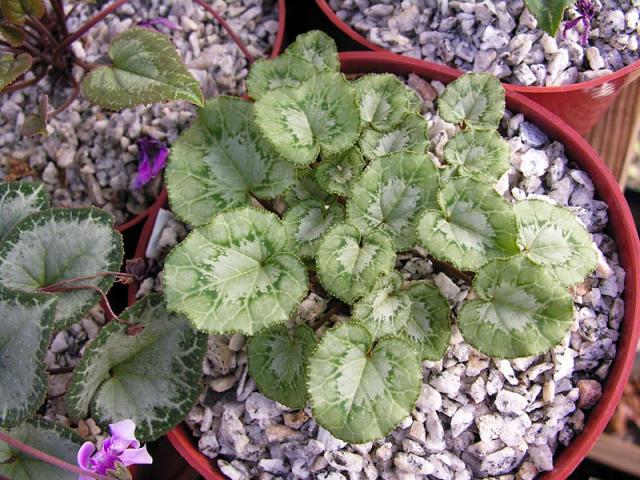
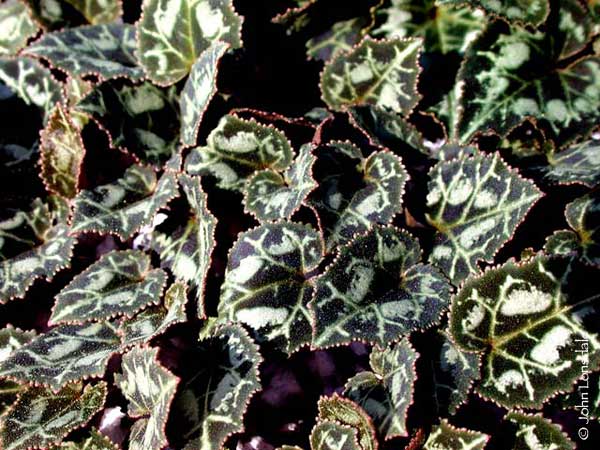
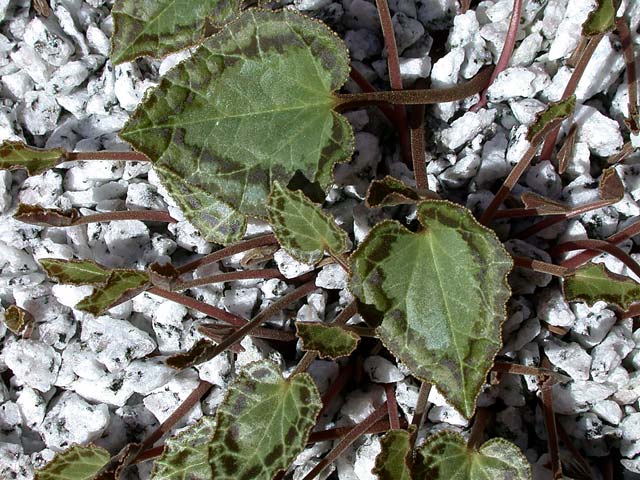
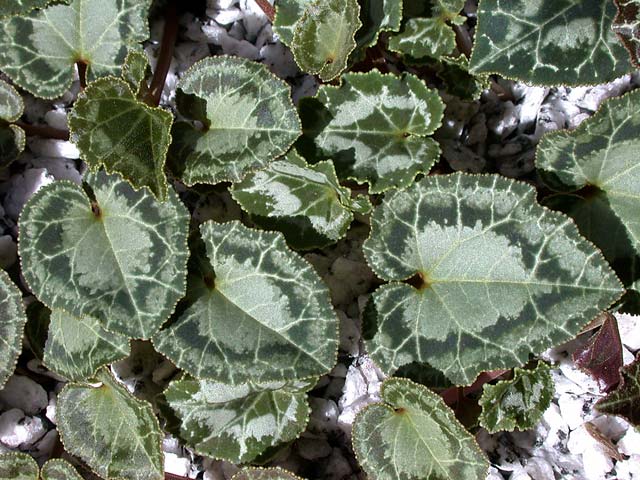
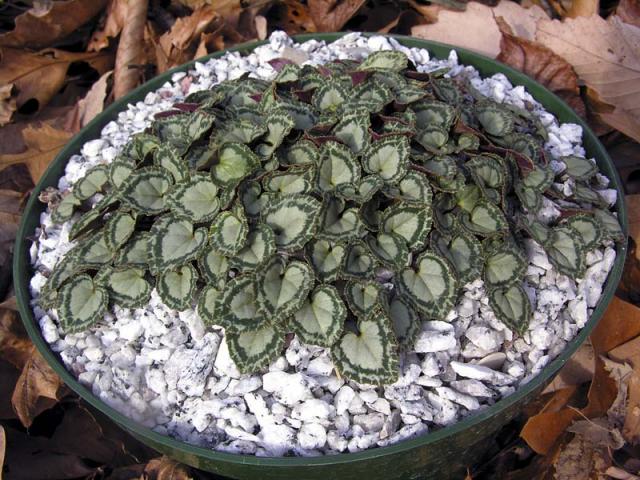
Cyclamen mirabile Hildebr. is an autumn blooming species very similar to Cyclamen cilicium. It is found in woodland and hilly rocky places in southwest Turkey. It has pale to deep pink flowers with toothed petal lobes and a stain around the mouth. The heart-shaped leaves, which appear about the same time as the flowers have a hastate pattern in grey-green, cream or silver and scalloped margins. Sometimes the new leaves are flushed pink. Tubers are depressed-globose and to 6 cm (2.3 in), rarely larger, corky and fissured when mature, and rooting from the lower surface. Photos 1-5 from Mary Sue Ittner. Pictures three and four taken a year later of a plant grown from the same seed batch as the ones above shows flowers in a close-up and a more developed plant with beautiful leaves. Photo 5 shows the "rarely larger" tuber on a 1 cm grid. The last photo is from John Lonsdale.


Cyclamen mirabile 'Tilebarn Anne', a selection from by Peter Moore, has pink flowers and bright silvery leaves with etched leaves, flushed pink at first. Photos from John Lonsdale.
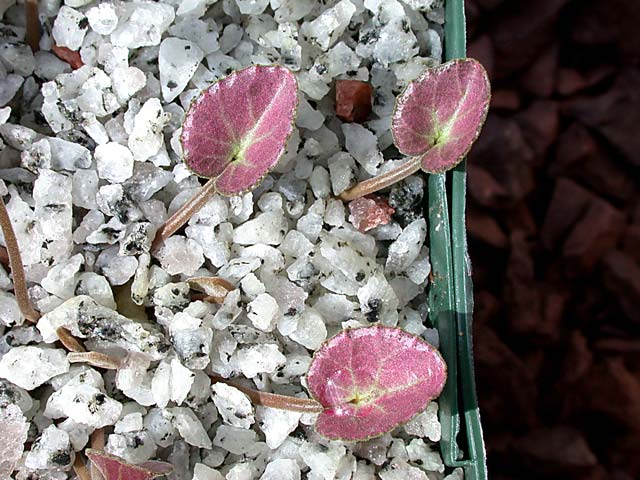
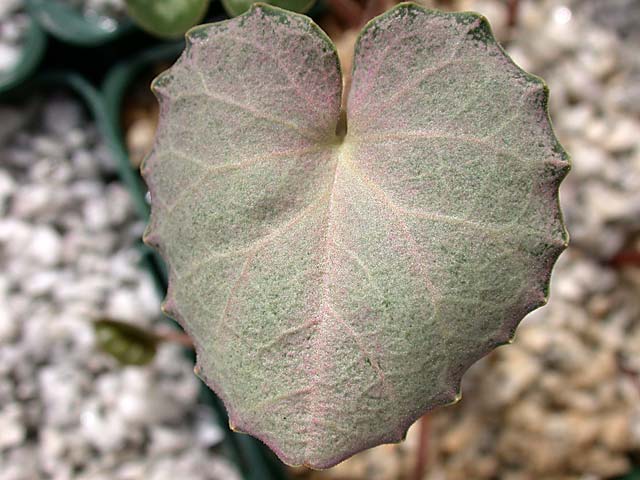
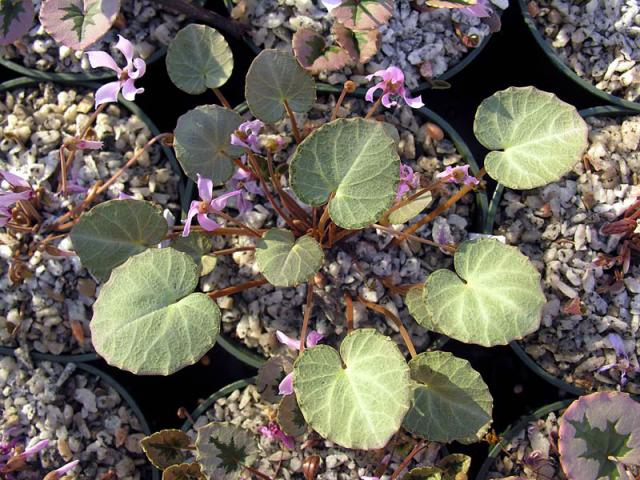
Cyclamen mirabile 'Tilebarn Jan' was selected from seed over several generations from Peter Moore to produce plants with white flowers, a pink nose, and petals with a serrated margin. Leaves are flushed pink as they unfurl. Photos from John Lonsdale.
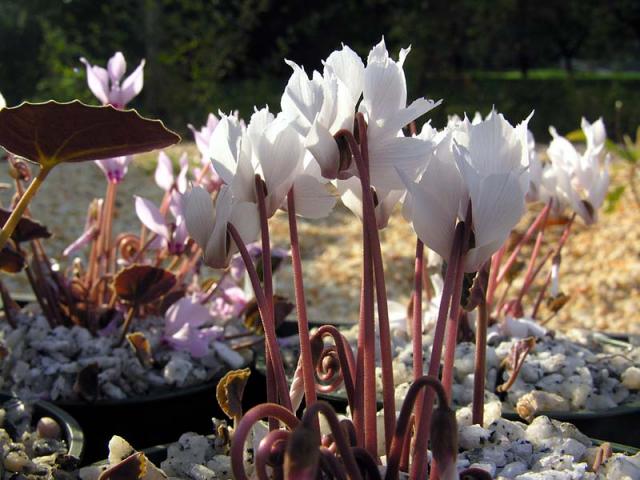
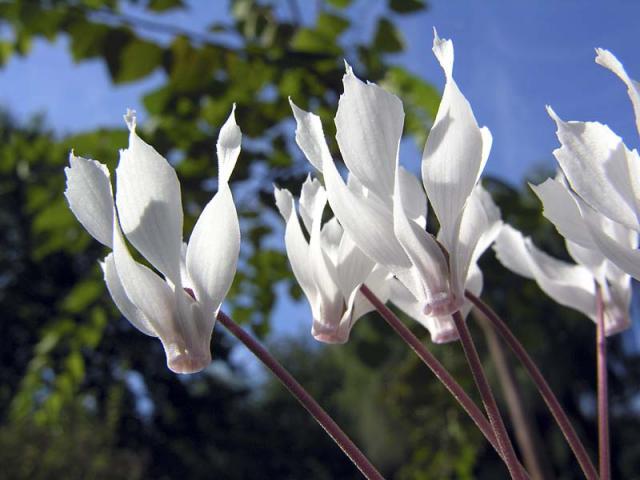
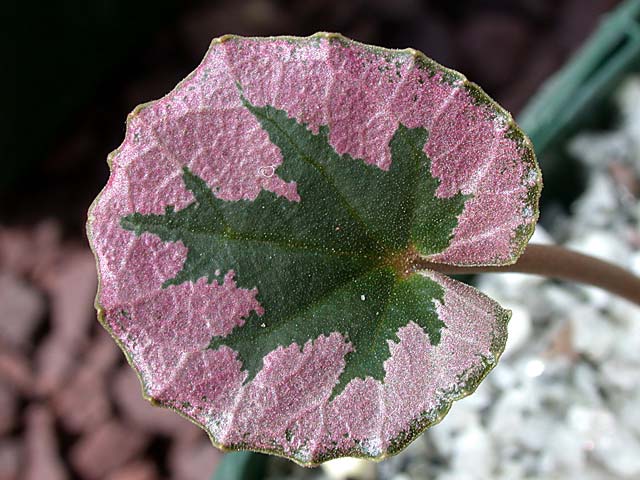
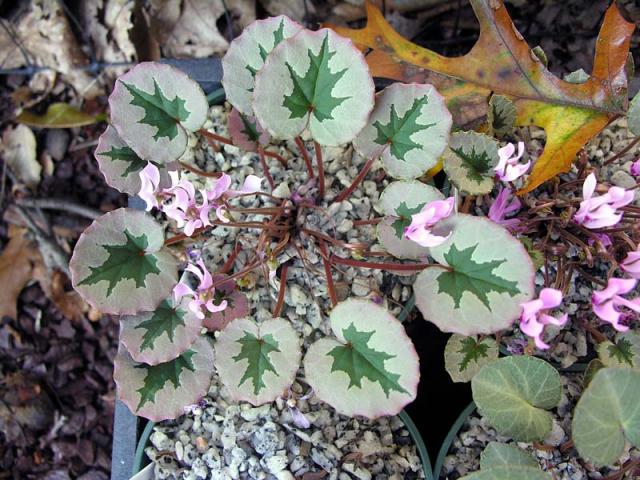
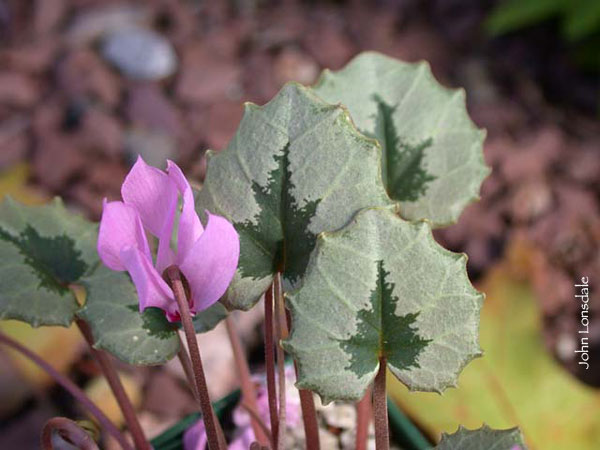
Cyclamen mirabile 'Tilebarn Nicholas', a selection from Peter Moore, has leaves with a green tree shaped center surrounded by a silver band. The young leaves have a pink tinge that fades with time. First photo from Mary Sue Ittner and the rest from John Lonsdale.

Cyclamen parviflorum Pobed. is an alpine plant growing at an altitude between 1200-2400 m (3,950-7,900 ft) in coniferous mountain woodlands of Northwest Turkey. It has small dull dark unmarked green leaves and pink flowers with a purplish blotch at the base of the petal appearing with the mature leaves. Tubers are globose to depressed globose, 3 cm (1.2 in), sometimes larger, smooth, brown and velvety when mature and root from the center of the base. Photos from John Lonsdale.
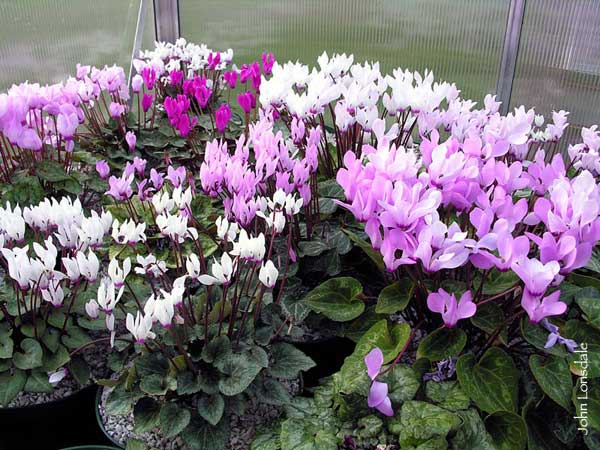
Cyclamen persicum Mill is the species used for all the large-flowers cultivars that are available for purchase. It is from the eastern Mediterranean where it grows in open rocky areas and in scrub. It flowers in winter or early spring with mature leaves. Flowers are fragrant, plain white, white with a carmine mouth, or pinkish carmine, twisted, without auricles on the base. Photos 1-2 by John Lonsdale. Photos 3-5 were taken by Mary Sue Ittner. The last one shows the fruit (hanging over the pot).
Leaves are variable, heart-shaped with a finely toothed unlobed margin and various shades of green with a pale or darker hastate pattern. Tubers are depressed-globose with a rough corky surface when mature. They root from the lower surface and can grow to 15 cm (6 in) in diameter. The first photo below of leaves was taken by John Lonsdale and the rest by Mary Sue Ittner show a few different leaf patterns and tubers on a 1 cm grid.

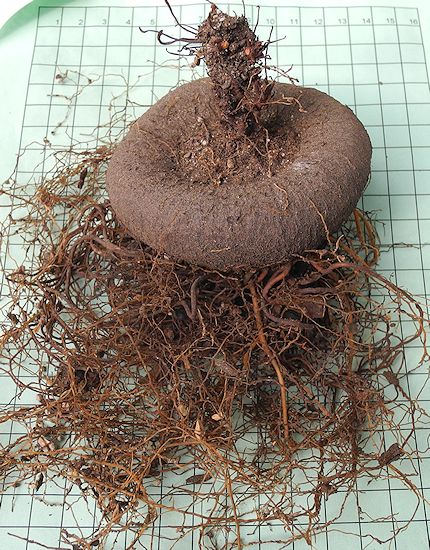
Photos below from Hans Joschko show a form that blooms in autumn.


Judy Glattstein writes: "here are a couple of images of my Methuselah Cyclamen persicum. My parents were visiting my sister and her family in Israel in 1973. They found a tuber fallen out on a roadside where some work was being done. They brought it home for me - things were easier in those days and yes I had an import permit. It has lived under grow-lights and now in my greenhouse. So it is over 50 years old, quite sizeable." The first photo is from 2014 and the second was taken in 2020.
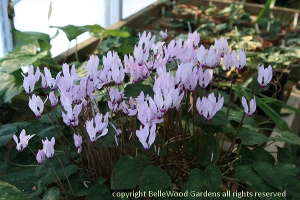
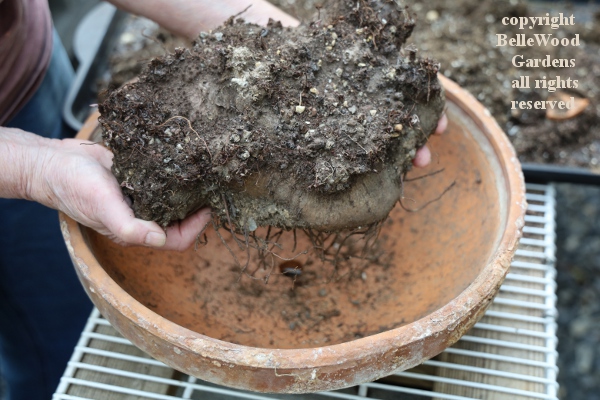
Cyclamen pseudibericum Hildebr. is a very attractive species from Turkey that grows in a small area of the easternmost region of the Mediterranean north of the Syrian border in an area with a moister climate than some of the surrounding areas. It is found in coniferous forests or deciduous scrub in deep leaf litter or sometimes in more open rocky areas and screes. It has purplish carmine large fragrant non auricled flowers with a dark stain around the mouth and a white rim and flowers with mature leaves from March to May. The dark green heart shaped leaves have toothed margins and sometimes are beautifully marked with a hastate pattern, speckling, or blotching of silver and green. Tubers are subglobose to depressed globose to 7 cm (2.8 in) and are smooth when young becoming corky and fissured with age and root from the base. The first four photos including a tuber on a 1 cm grid were taken by Mary Sue Ittner. In her northern California garden flowering occurs earlier, January to February. The last two photos were taken by John Lonsdale.
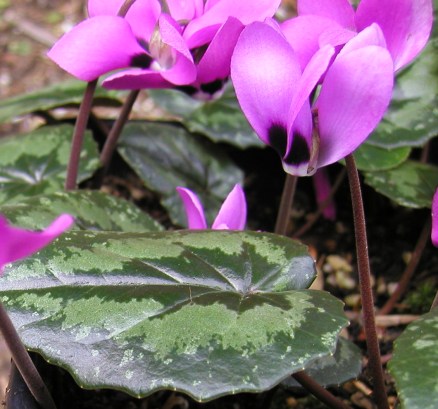
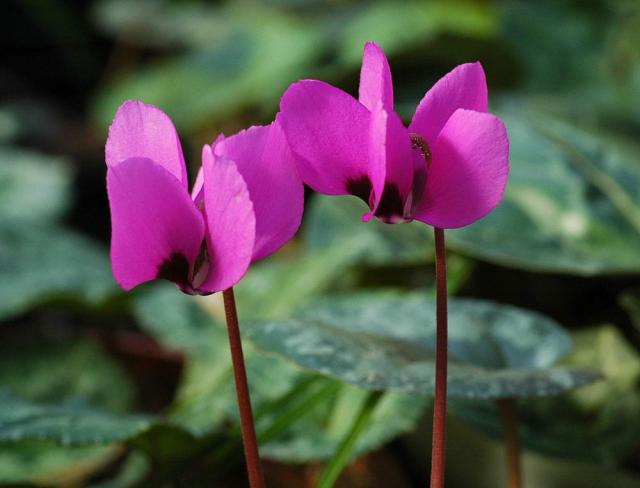
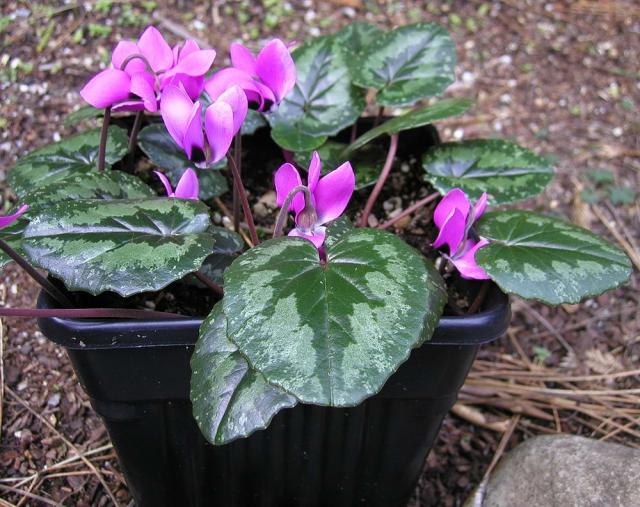
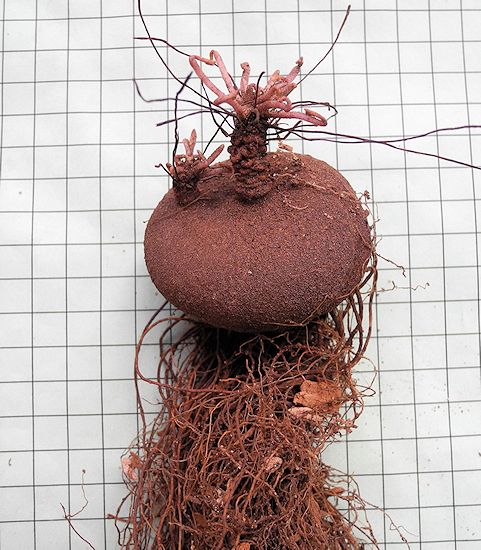
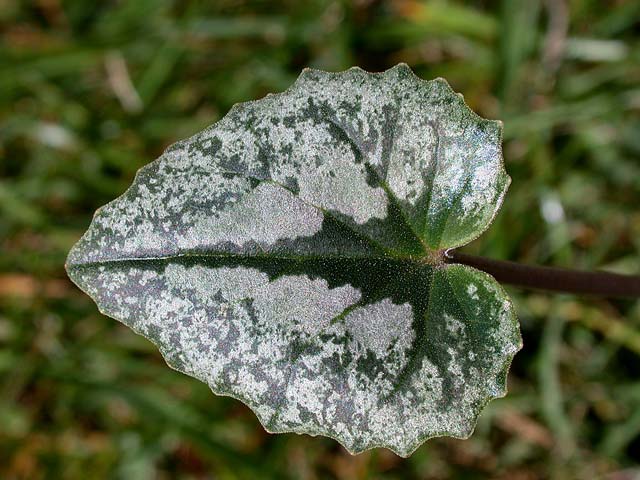
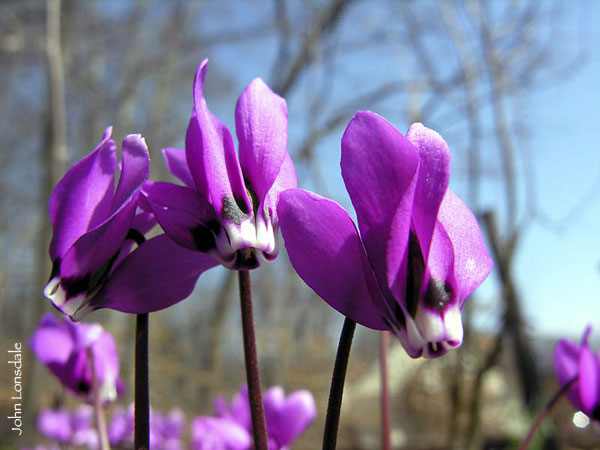
Cyclamen purpurascens Miller, syn. Cyclamen europaeum Linnaeus, is found in woodland where it grows on moist rocky slopes rich in leaf mold and in deep to dappled shade at altitudes between 250-1,300 m over a broad European distribution. The nicely scented flowers appear from late summer to late autumn and are pale to deep carmine, generally darker with no to small auricles around the mouth. Pedicels curl from the top downwards as fruits develop. Leaves are round to heart or kidney shaped, as wide as long, with an untoothed or slightly toothed unlobed margin, shiny green and plain, or with a marbled zone in paler green, cream or silver. This species is often evergreen, with new leaves appearing as it loses its old leaves in late spring to summer. Tubers are rounded, becoming knobbly as they age, to 6 cm (2.3 in) across, and root from all over the sides and base. There are two recognized subspecies: Cyclamen purpurascens ssp. immaculatum (Hrabetová) Halda & Soják and Cyclamen purpurascens ssp. purpurascens.
The first photo was taken by Mary Sue Ittner who did not find it as easy to grow and flower as some of the other species she grows. It was plagued by mites. She read that it benefits from being kept cool and not allowed to dry out in summer, being planted deeply (see contrasting note below), and being well mulched. The second photo was taken by Hans Joschko. He wrote: These plants grow without any problems in my garden from many different locations: Lake Lugano (Italy), Lake Garda (Italy), the woods near Vienna (Austria), Savoyen (France), Istria (Croatia), and Lake Plitvice (Croatia). The rest of the photos were taken by John Lonsdale.
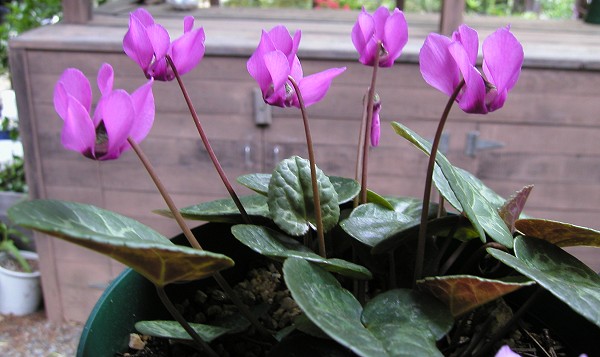

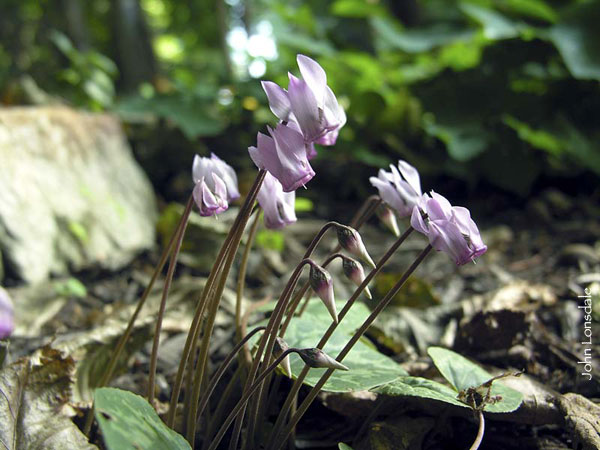
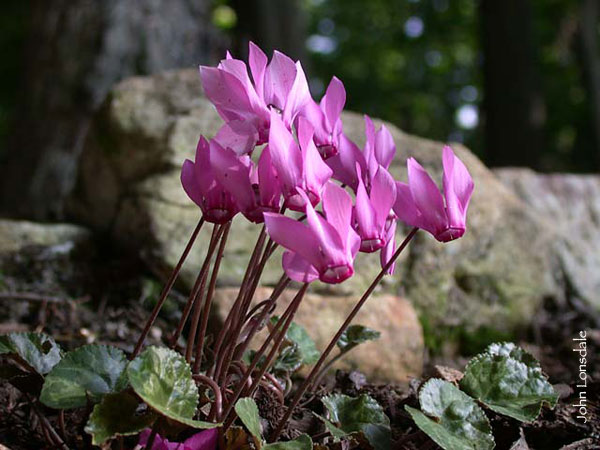
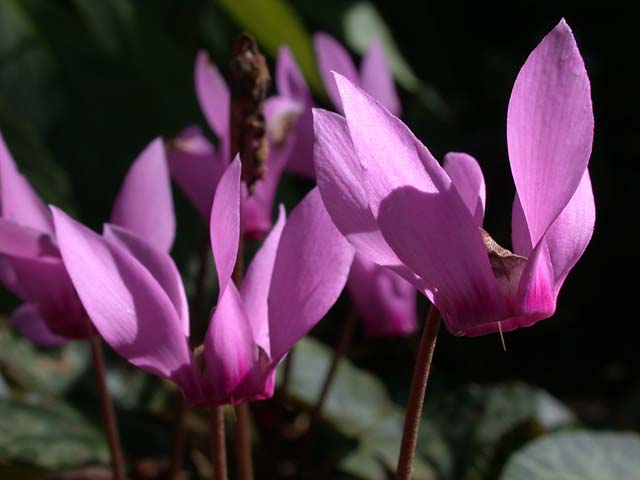
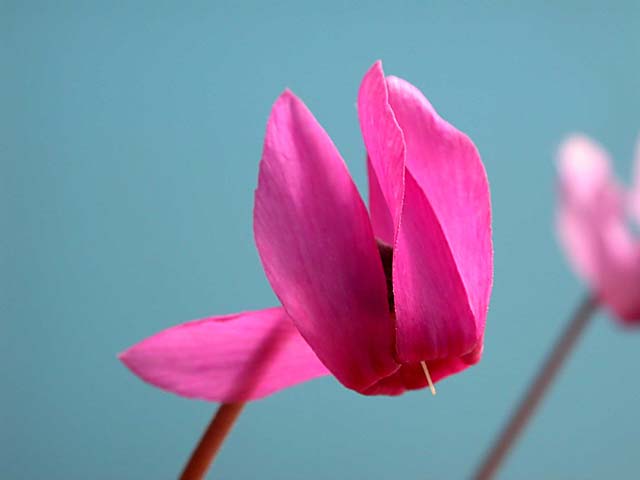
Photos below from John Lonsdale illustrate the variety of leaves in plants he has grown and in the last the pedicel coiling around the forming fruit.
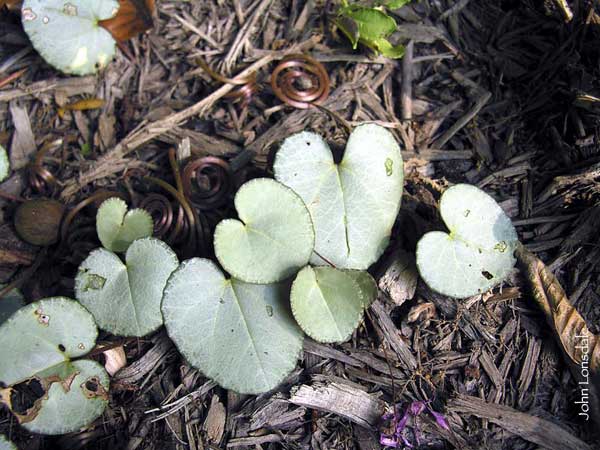
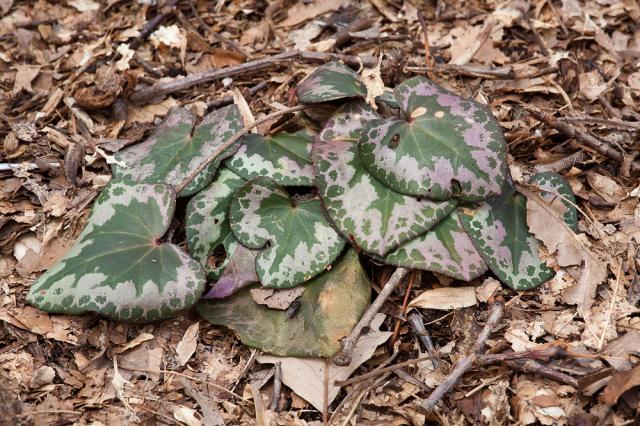
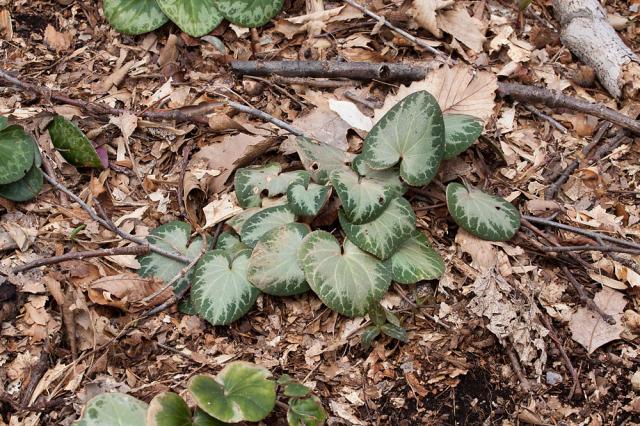
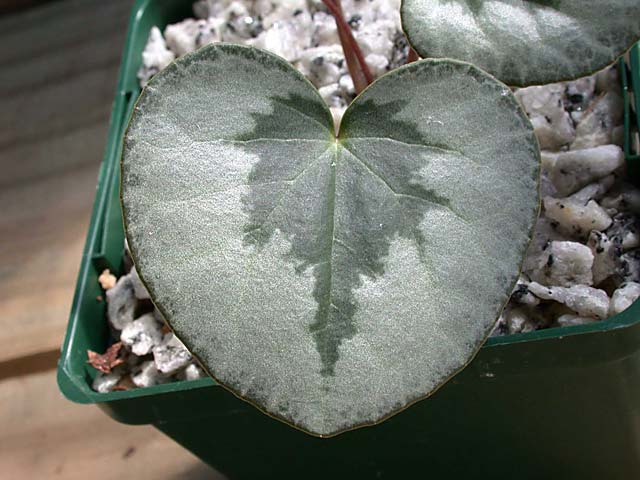
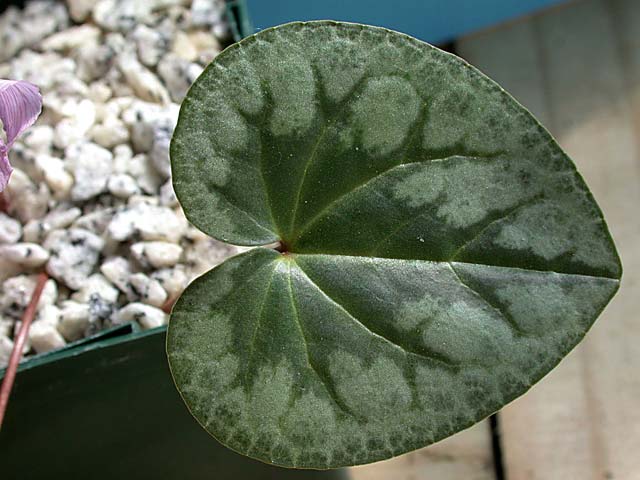
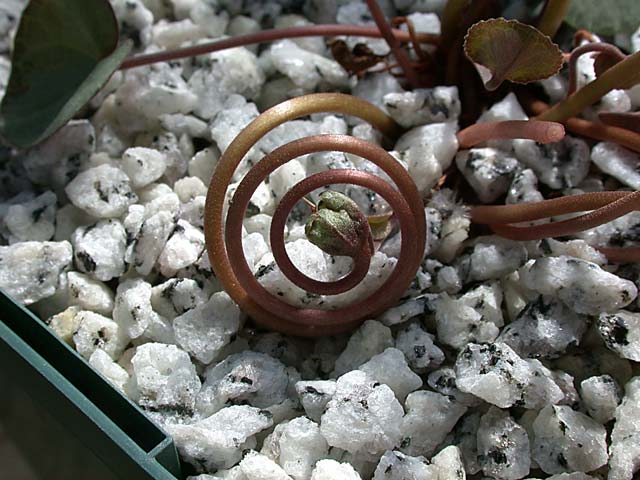
The first photos below by Giorgio Pozzi, September 2009, are from wild specimens collected and grown in the garden. In northern Italy they need to be planted not too deeply, in a very soft and rich compost in the ground or in pots where it is easier to collect the seed capsules that form inside the coiled stems. The first photo illustrates plants with a tuber that is partly out of the ground and in the second there are seed capsules. The third photo from Erutuon under the Creative Commons Attribution-Share Alike 3.0 Unported license shows the tuber.

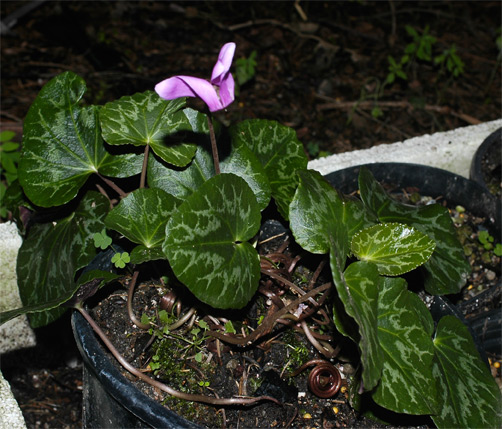
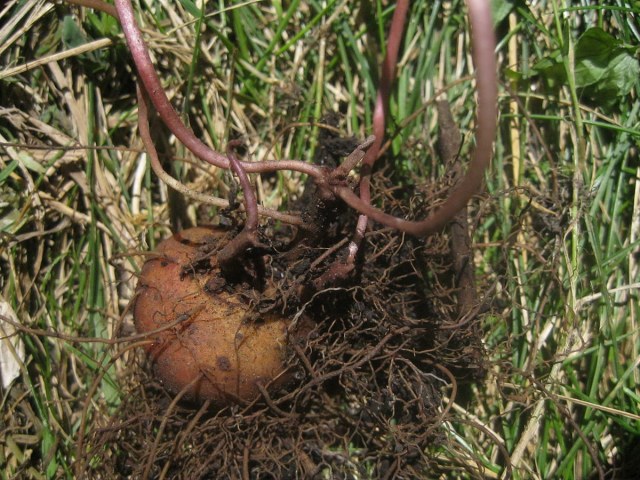
Photos below were taken by Mary Sue Ittner in Northern Italy.
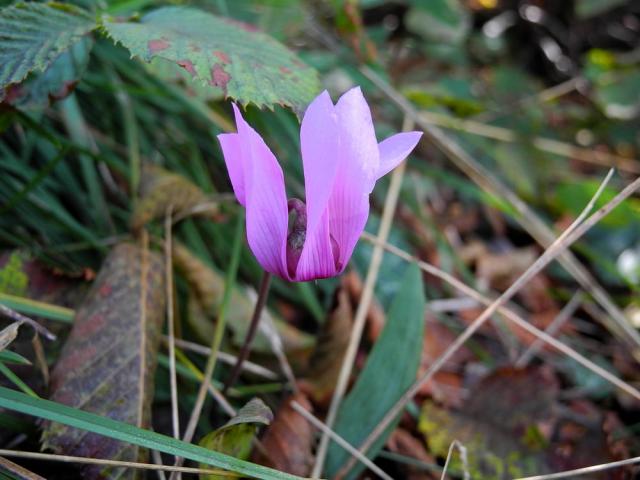
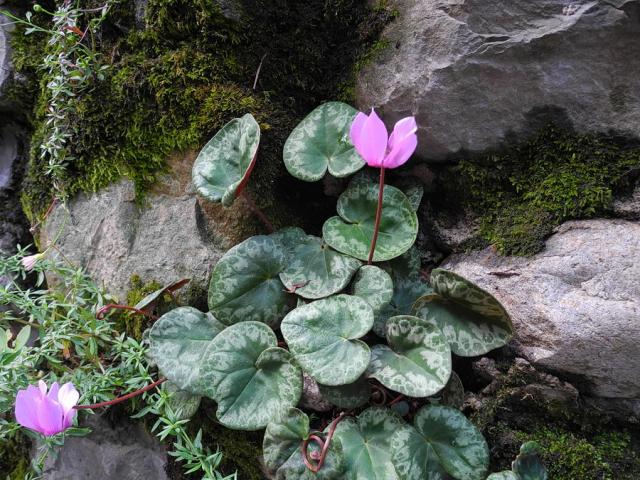
In 2022 both of the forms below are considered to be synonyms of Cyclamen purpurascens ssp. purpurascens.
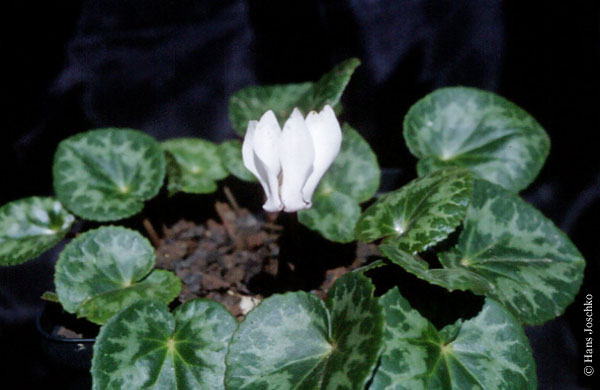
Cyclamen purpurascens forma album Grey-Wilson is a white form that has only been found in the wild a few times over the years. Photo by Hans Joschko who writes: "I have two of this really rare plant, and I hope that it multiplies well in the future."
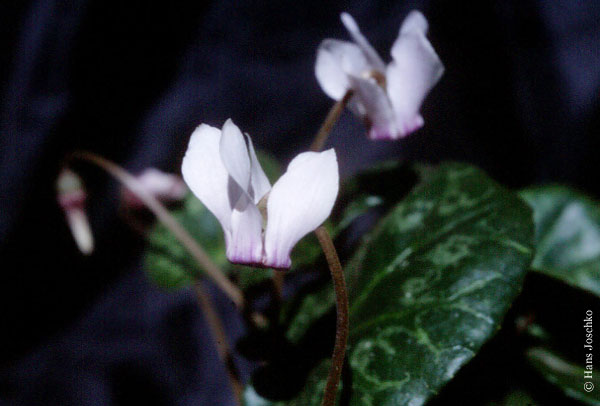
Cyclamen purpurascens forma carmineolineatum named by P.A.H. Hendrikx in 2000 is a new form that closely resembles C. purpurascens forma album Grey-Wilson. It is distinguished from the latter by the presence of a distinct carmine zone around the mouth. Photo from Hans Joschko who writes: "I have found only one plant of this type in a large population of Cyclamen purpurascens in the French Alps (Savoyen) opposite Mt. Blanc."
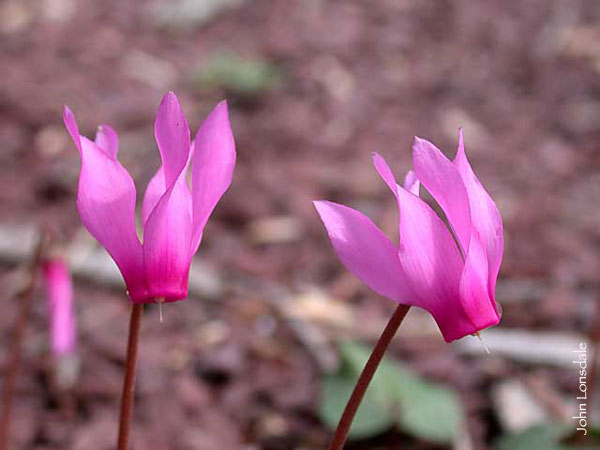
Cyclamen repandum Sm., a species from southern Europe, is one of the last species to break dormancy, sometimes not until winter. The leaves are heart shaped with a narrow and deep sinus making them almost triangular. They are angled and lobed and often toothed. Flowers often appear with or soon after the leaves and are white to pale or deep pink, often with a pink or purplish red zone around the mouth, or carmine magenta or reddish purple. Flowers are without auricles at the base, with a protruding style and twisted petals. Tubers are depressed-globose to 6 cm (2.3 in) or larger, velvety and deep chestnut brown but corky with age, rooting from the center of the lower surface. Photos by John Lonsdale and Mary Sue Ittner. The last two photo shows different sized tubers on a 1 cm grid. In spite of the signs of new shoots when repotting, it will be months before any signs of life appear above the surface. In Mary Sue's California garden leaves don't usually show until December. In 2015 there were still flowers (without leaves) as late as October. Ants must be spreading the seeds around as a lot of plants are appearing in the ground and other pots, even ones that are not close to other Cyclamen repandum plants.
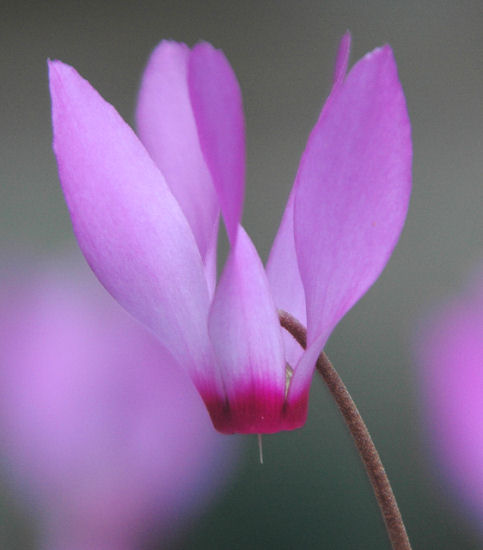
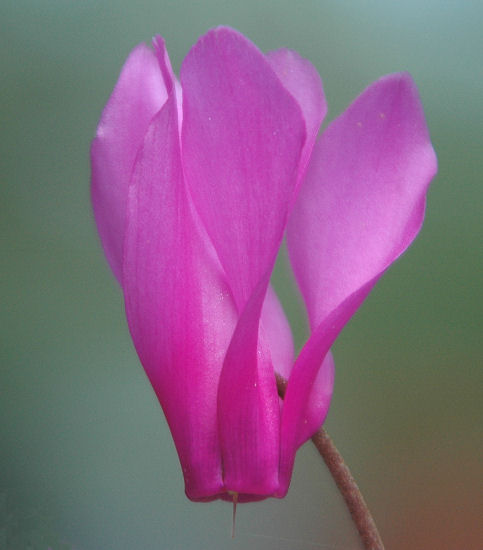

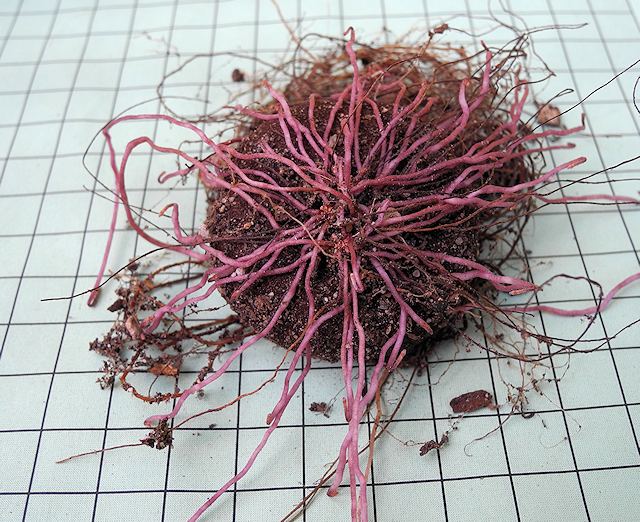
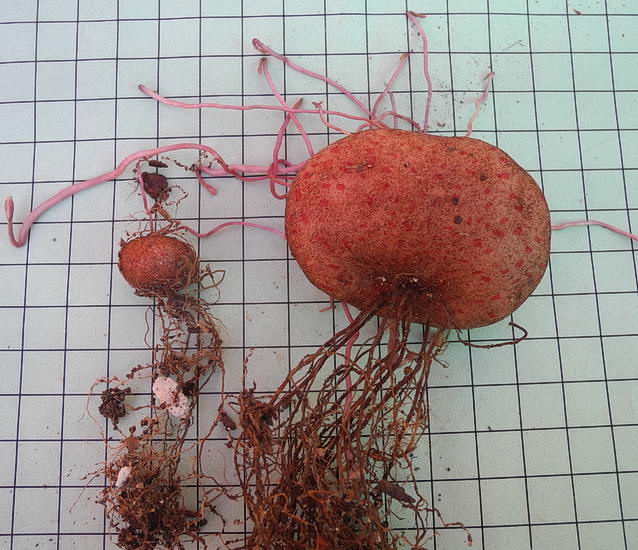
Cyclamen repandum var. baborense Debussche & Quézel is geographically considerably separated from var. repandum and is endemic to the Petite Kabylie of Algeria. It is very similar to var. repandum, though it differs in having larger leaves and flowers, typically flowering in June.
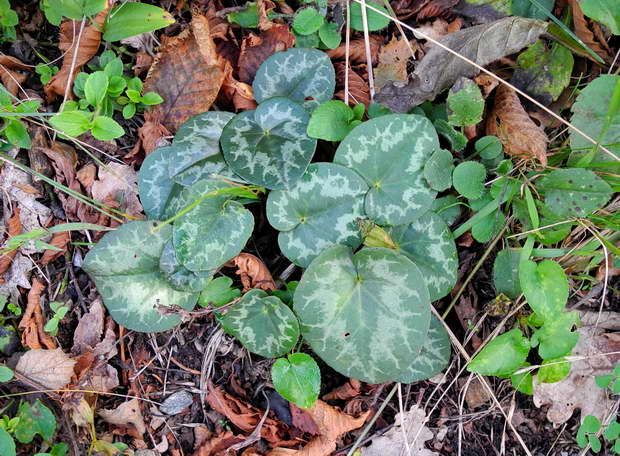
Cyclamen repandum var. repandum grows in dappled shade in leaf litter, rock crevices, or at the bases of trees. Leaves are longer than broad, green with a grey-green or silver hastate pattern, but without flecking. Flowers are carmine-pink or carmine-magenta. The first two photos by Mary Sue Ittner are of plants grown from seed not designated by subspecies that fit the description for this species. Flowering usually starts in Northern California in February. The next two photos from Hans Joschko are of a white form, sometimes identified as 'Album' or forma album.
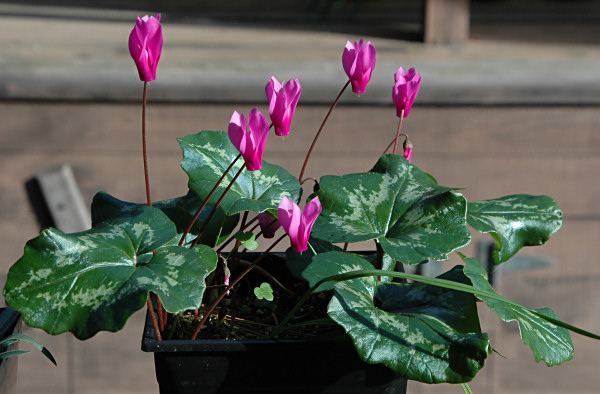
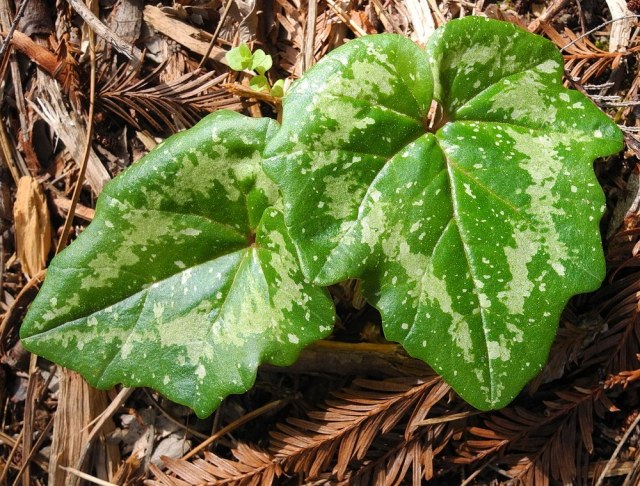
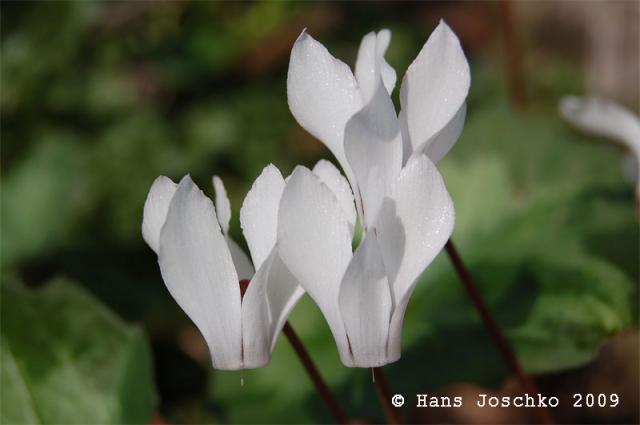
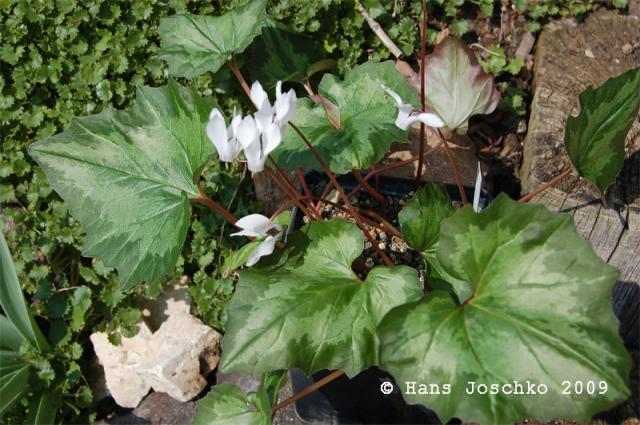
Cyclamen rhodium R.Gorer ex O.Schwarz & Lepper, syn. Cyclamen repandum ssp. rhodense (Meikle) Grey-Wilson, is restricted to the Greek islands of Rhodes and Cos where it is found on mountain slopes in shaded and semi-shaded places. Leaves are longer than broad and speckled in part or dashed in addition and flowers are white or white flushed pink with a pink mouth. Photos from Mary Sue Ittner and John Lonsdale.
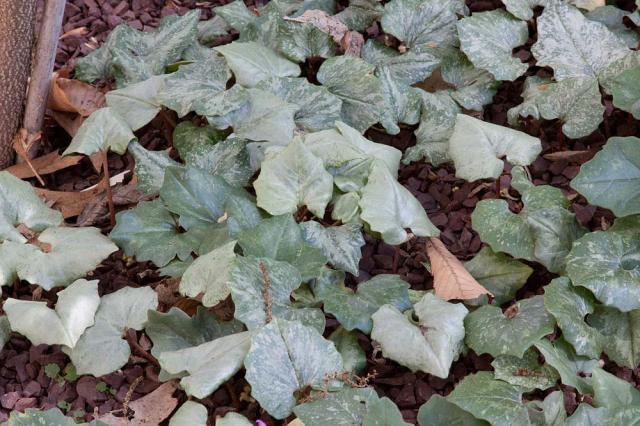

Cyclamen rhodium ssp. peloponnesiacum (Grey-Wilson) J.Compton & Culham, syn. Cyclamen repandum ssp. peloponnesiacum Grey-Wilson, from Greece has silver splashed leaves or sometimes speckled leaves that are as broad as long or broader and pink flowers with a deeper carmine-pink zone around the mouth or intense carmine-magenta. First photo from Mary Sue Ittner of plants blooming in Northern California in February. The other photos were taken by John Lonsdale.
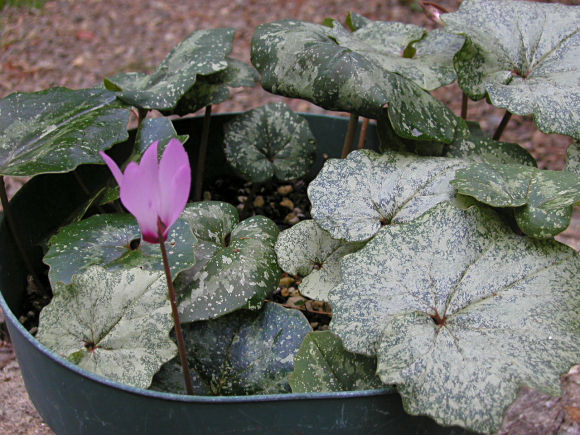
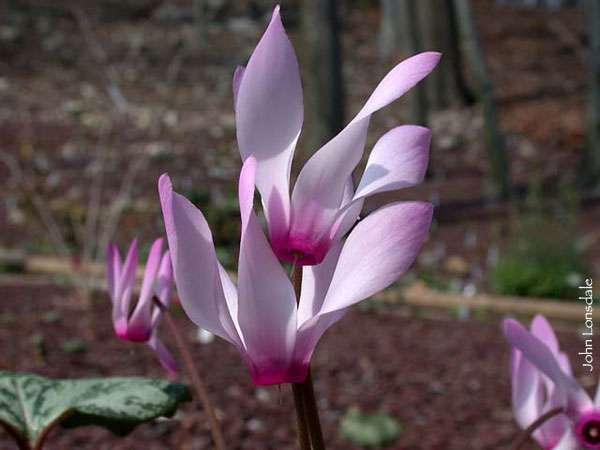
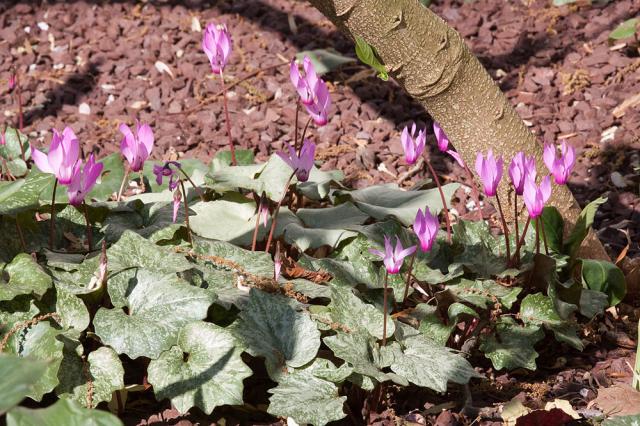
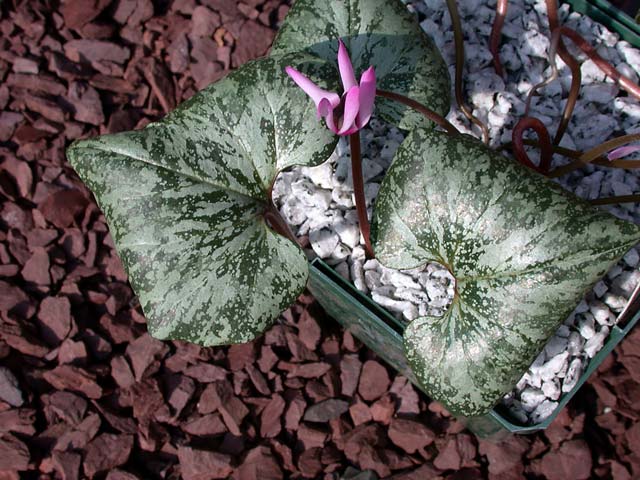
Photographs were taken in Greece by Antigoni Rentzeperis.
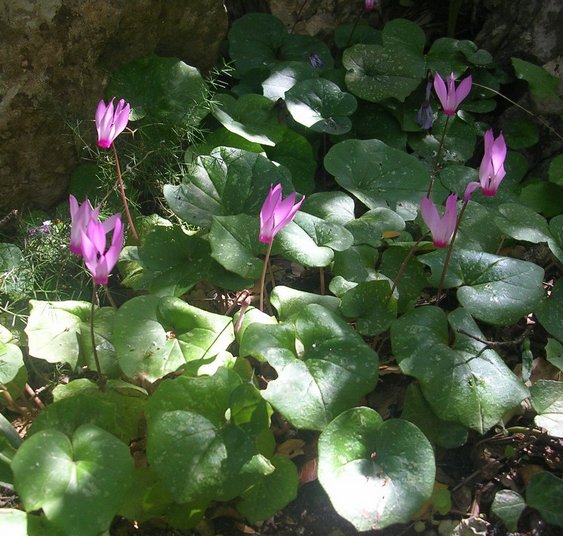
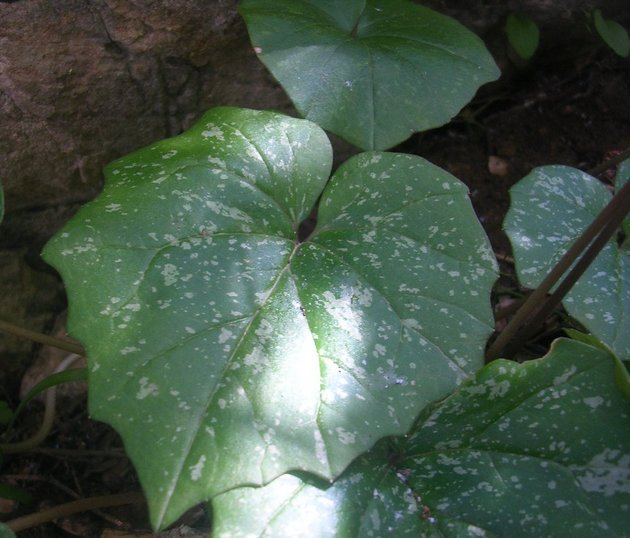

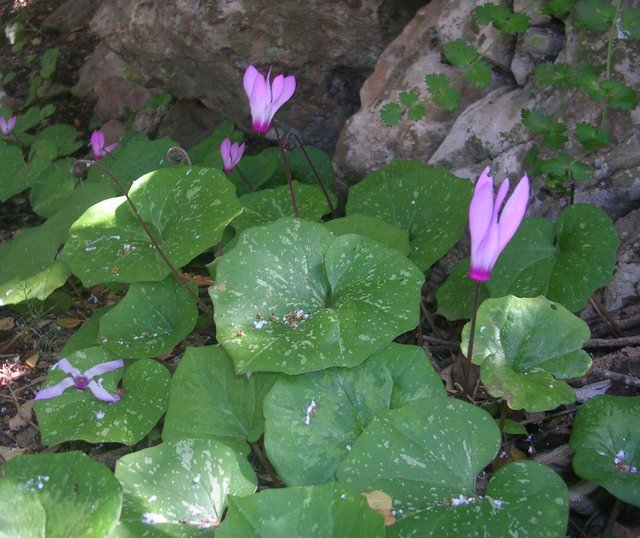
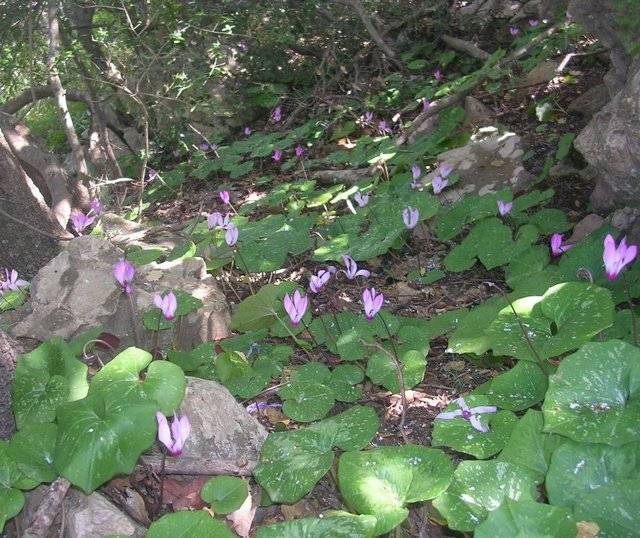
Cyclamen rhodium ssp. vividum (Grey-Wilson) J.Compton & Culham, syn. Cyclamen repandum var. vividum (Grey-Wilson) Grey-Wilson, syn. Cyclamen repandum ssp. peloponnesiacum var. vividum (Grey-Wilson) Kit Tan, is from Greece and has deep carmine-magenta flowers and leaves that are plain or marked with flecks sometimes overlaying a weak hastate pattern. It is found in open, rocky areas (gullies, open scrub and sunny banks). Tubers are often deeply buried and protected from harsh conditions.
Cyclamen rohlfsianum Asch. is the most tender species, originating in Libya. It is autumn flowering with the flowers appearing with the young or semi-mature leaves. It has large lobed leaves that are usually wider than long and are deep green with silver patterns. The fragrant pink flowers have a deeper magenta zone towards the base with small auricles and are distinctive as they have a protruding cone of stamens. The pedicels coil from the base upwards as the fruit develops as in Cyclamen graecum. The tubers are round when young, becoming uneven and knobbly with age, eventually to 20 cm (8 in) with a corky surface, rooting irregularly from the lower sides, occasionally from the base. The photos below show the flowers. The first three were taken by John Lonsdale and the last by Dylan Hannon.

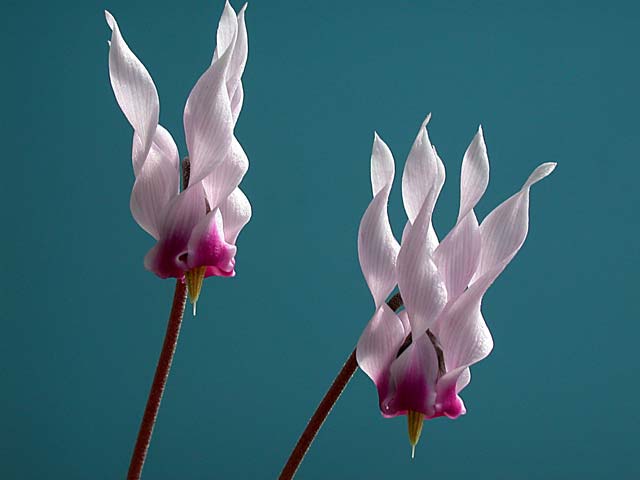
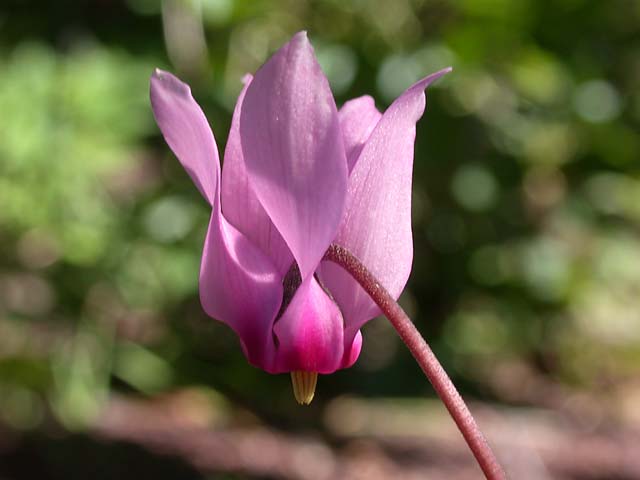

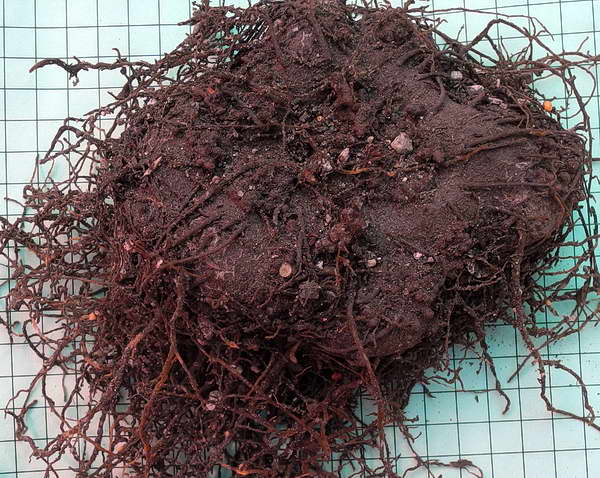
Photos 1-3 were taken by Dylan Hannon of plants started from seeds from the Cyclamen Society in 1993. He comments that it only gets better with age and is a very reliable pot subject. It is kept dry all summer. Under tree cover it has withstood brief spells in the upper 20s °F without blinking. Each of his photos shows the top of the tuber at different stages. The first shows the fruit with pedicels coiling from the base upwards, the second flowers with leaves starting to emerge, and the last shows leaves with the fruit still present and opening with seeds spilling out. The final photo from Mary Sue Ittner shows the tuber on a 1 cm grid.
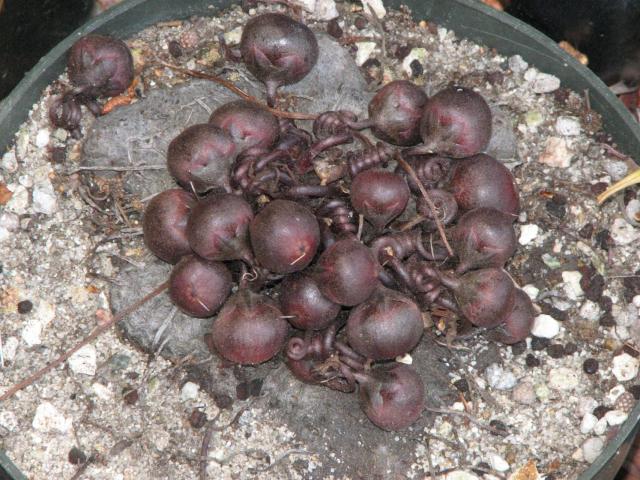
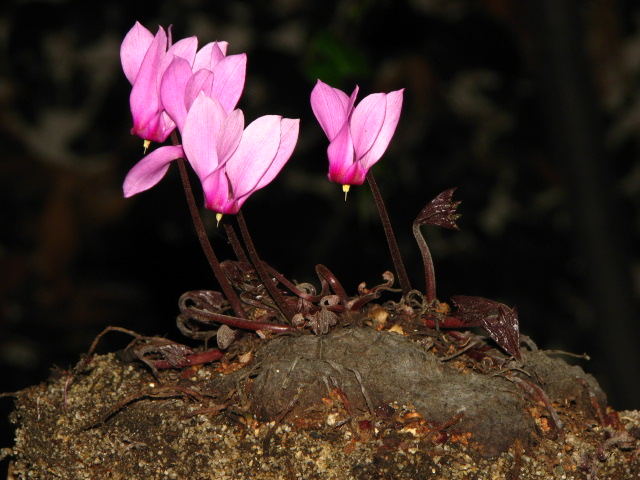
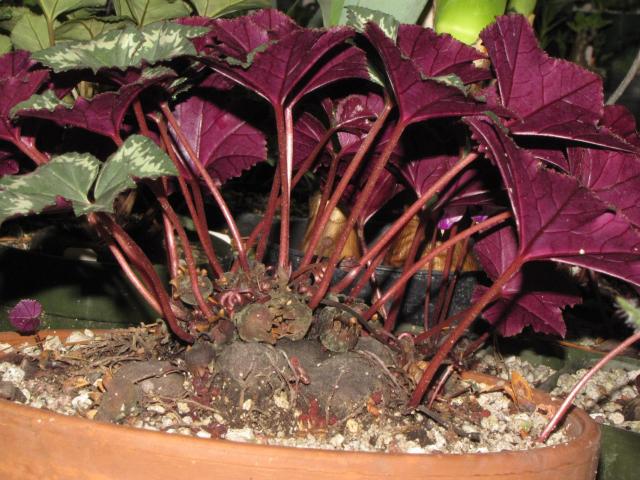
The photos below were taken by John Lonsdale, Mary Sue Ittner, and Dylan Hannon showing various leaf forms of the species. That the seedlings showed variation is interesting since selfing in plants usually does not produce much apparent variation.
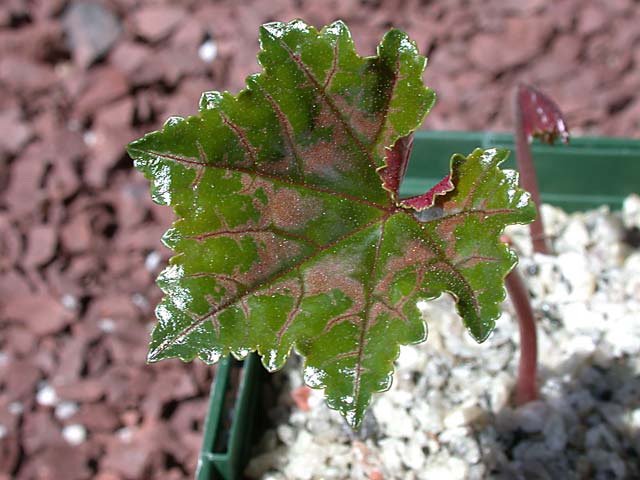
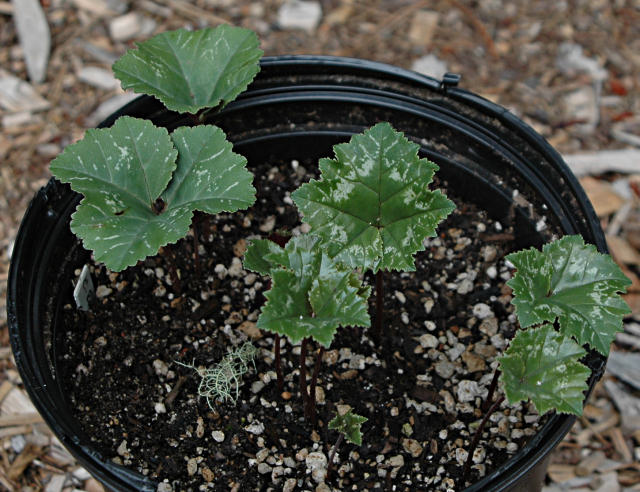
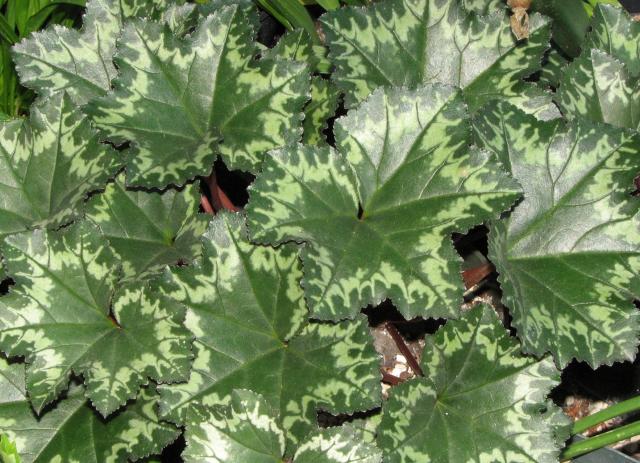
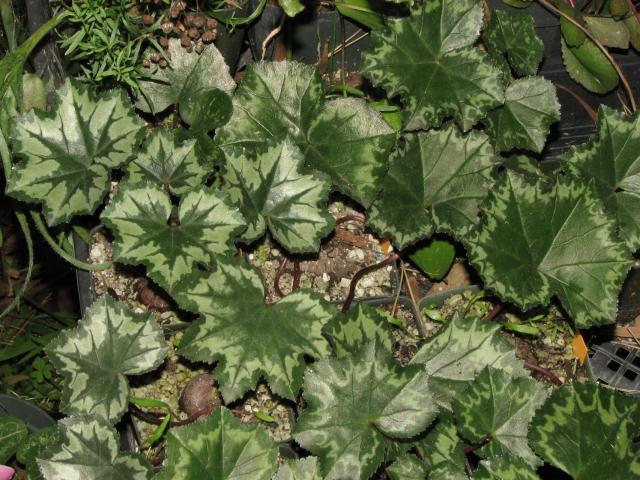
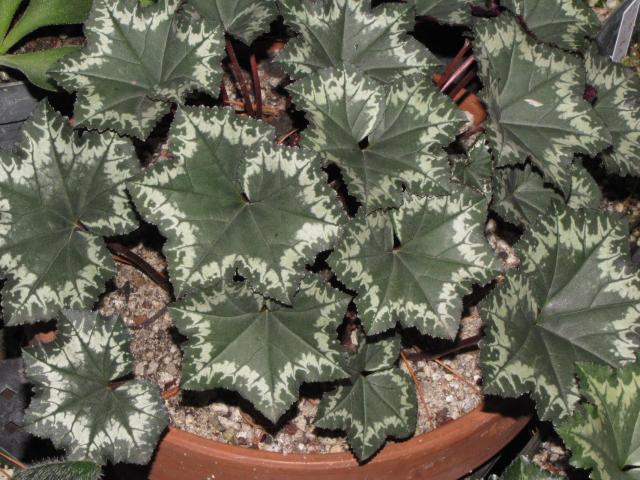
Cyclamen somalense Thulin & Warfa is native to Somalia where it grows in limestone rock crevices in shade from 1,250-1,600 m (4,100-5245 ft). The climate for this species is hot and dry during the summer and cold with mists and showers during the winter. Leaves are wider than long and heart to kidney shaped with a coarsely toothed margin and are deep green with a silver hastate pattern in the center above and are purple beneath. Flowers appear in autumn with mature leaves and are not held high above the foliage and are small, pale pink with carmine around the mouth, twisting and without auricles. The tuber is subglobose from 3 cm (1.2 in) to 6 cm (2.3 in) with 2-3 rounded to oblong swellings. It is covered in corky skin and roots from the base of the tuber. Photos and more information can be found on the Cyclamen Society webpage.
Cyclamen trochopteranthum O.Schwarz, syn. Cyclamen alpinum