Marah is a genus in the Cucurbitaceae family. There are 7 species in North America, 5 of which occur in California. Plants grow from an immense manlike underground tuber which is the reason behind one of the common names, Manroot. Although most species are deciduous, they grow rapidly as a vine with tendrils with both male and female flowers growing from the leaf axils. The male flowers are usually clustered in groups and the female flowers solitary. The fruit is not edible, but looks like a small melon and is the source of another common name, Wild Cucumber. All of the species have more or less spiny fruits.
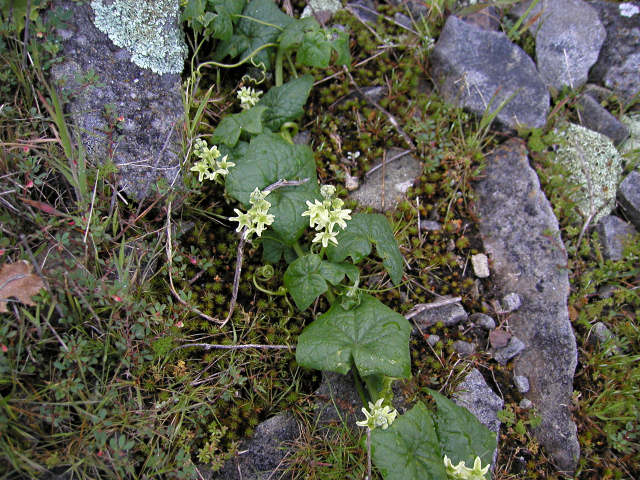
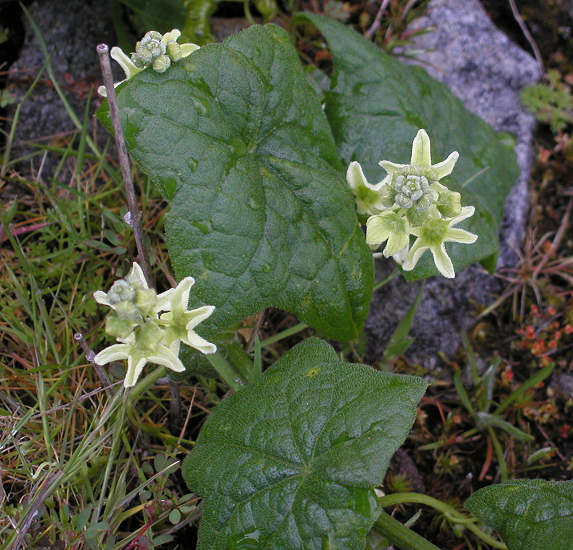
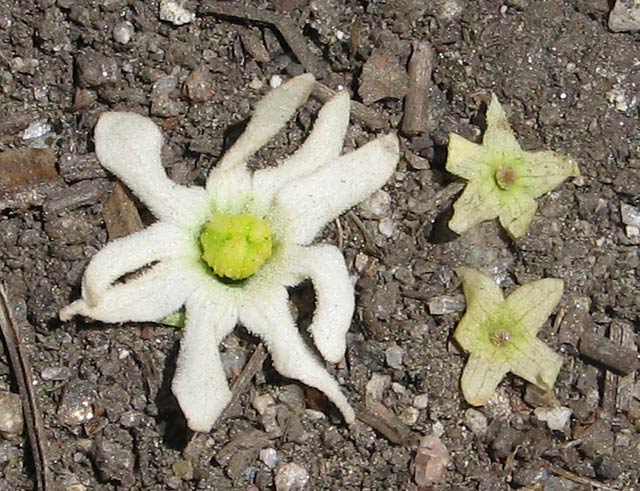
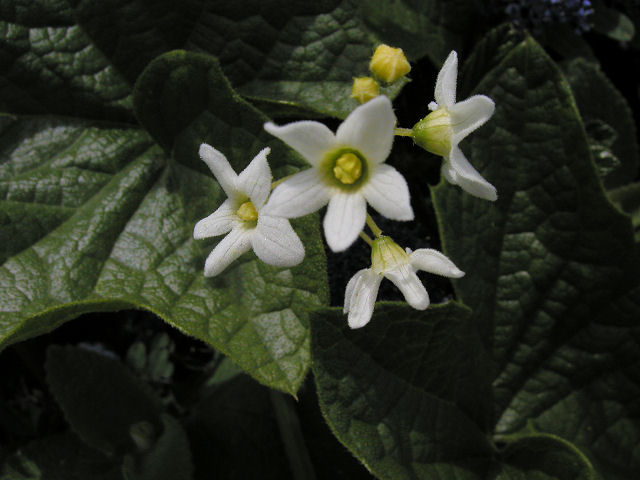
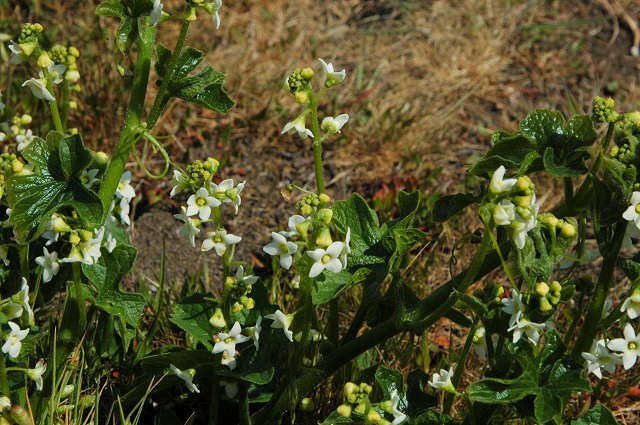
Marah fabacea (Naudin) Greene grows along streams and embankments and in shrubby and open areas. It has yellowish-green or cream-colored flowers or occasionally white (those found inland) rotate (spreading, with a short or non-existent tube) flowers. The fruit is globe-shaped with a spiny surface. It is found in California in the Sierra Nevada and the Coast Ranges. Previously known as Marah fabaceus, this note in the Jepson Interchange for California Floristics explains the name change: "Correspondence 1 indicates that Marah is properly treated as feminine. [Therefore, spelling of epithet corrected to Marah fabacea (Naudin) Greene, from Marah fabaceus (Naudin) Greene previously in this Index, 15 Feb 2011.]" Resources on the Internet often use the previous name. I believe these pictures taken on the bluff at Salt Point State Park are this species although Marah oregana also grows in the park. Height range: up to 6 m. Photos 1-2 were taken by Mary Sue Ittner. Photo 3 by Nhu Nguyen shows a comparison in size of flowers from M. oregana (left) and two M. fabacea (right).
Marah horrida (Congdon) Dunn grows on dry slopes in the western Sierra Nevada foothills (California), south to Los Angeles. The male flowers are bell-shaped and the divided leaves have jagged points on the margins. The fruit is oblong and spiny. Previously known as Marah horridus, this note in the Jepson Interchange for California Floristics explains the name change: "Marah is properly treated as feminine. [Therefore, spelling of epithet corrected to Marah horrida (Congdon) Dunn, from Marah horridus (Congdon) Dunn previously in this Index, 15 Feb 2011 .]" Resources on the Internet often use the previous name. Height: to about 10 ft. long. Photo taken in Kern County by Mary Sue Ittner.
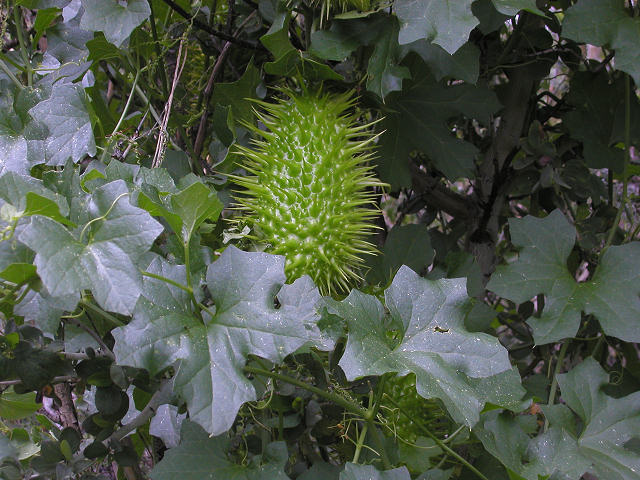
Marah macrocarpa (Greene) Greene is found on dry slopes from Santa Barbara, California south to Baja. The male flowers look like flat stars and the fruit is oblong and densely spiny. Previously known as Marah macrocarpus, this note in the Jepson Interchange for California Floristics explains the name change: "Correspondence 1 indicates that Marah is properly treated as feminine. [Therefore, spelling of epithet corrected to Marah macrocarpa (Greene) Greene, from Marah macrocarpus (Greene) Greene previously in this Index, 15 Feb 2011.]" Height range: 15-20 ft. Johannes-Ulrich Urban holds a fruit he found in southern California. Photo by Bob Rutemoeller.
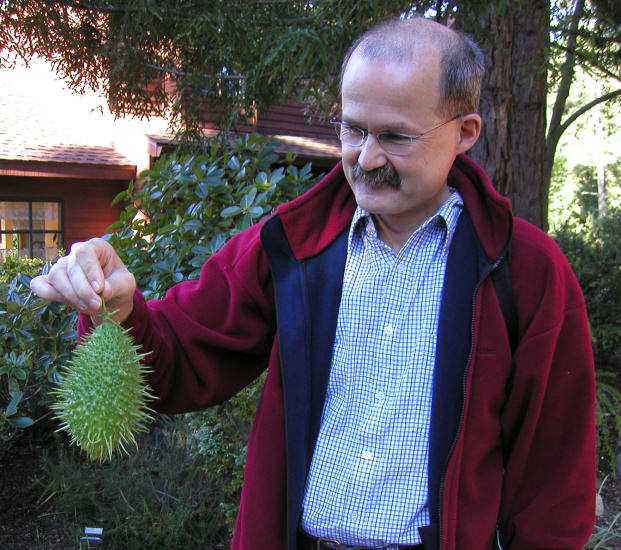
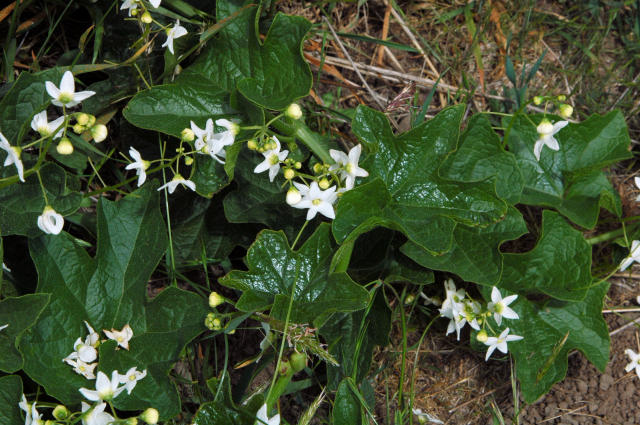
Marah oregana (Torr. & A.Gray) Howell grows on slopes, in canyons and hilly areas and the edge of forests from San Francisco Bay area, California, north to British Columbia. Flowers are white, small, and bell-like. The fruit is tapered to a beak, often striped dark green with prickles sparse to dense. This species was found growing on Table Rocks in Jackson County in Oregon by Travis Owen. Previously known as Marah oreganus, this note in the Jepson Interchange for California Floristics explains the name change: "Correspondence 2 indicates that Marah is properly treated as feminine. [Therefore, spelling of epithet corrected to Marah oregana (Torr. ex S. Watson) Howell, from Marah oreganus (Torr. ex S. Watson) Howell previously in this Index, 15 Feb 2011.]" Resources on the Internet often use the previous name. Height range: to about 20 ft. Photos taken 1-3 taken by Bob Rutemoeller and Mary Sue Ittner of what we believe is this species growing near the ocean in sandy open spots in Mendocino County, California. The last picture from Mary Sue Ittner was taken near Ferndale, California, in a habitat this species is usually found in. The last photo from Calflora was taken in coastal Mendocino County, California by Asa B. Spade and is shared under a CC BY-NC license and illustrates why one of the common names is coastal man-root.


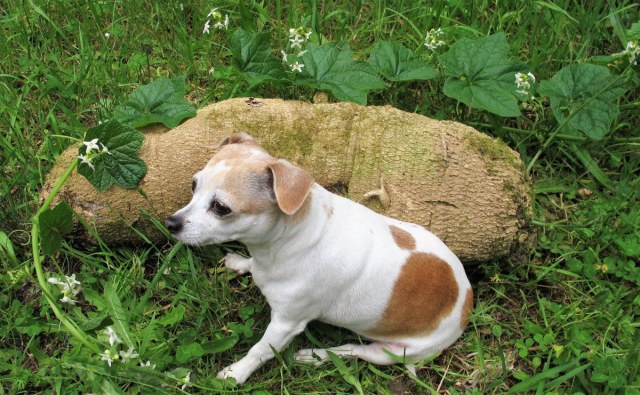
Marah watsonii (Cogn.) Greene is native to northern California from the Inner Coast Range north of San Francisco and east towards the Sierra Nevada Foothills. Height range: to about 20 ft. The photo below was taken by Nhu Nguyen of plants growing near Lake Berryessa, Napa County.
