Corallorhiza Gagnebin is a genus in the Orchidaceae family from North and Central America. It is commonly known as coralroot because its rhizome branches are short and scaly and resemble a marine coral. These plants are more or less dependent on orchid associated fungi called orchid mycorrhizae. The latest evidence shows that these fungi are not necessarily saprobic (where they gather nutrients from the surrounding organic matter and giving it to the orchids), but are mycorrhizal. The orchids are in fact parasites of these fungi which are symbiotic with trees. In other words, ectomycorrhizal fungi are symbiotic with trees where they obtain mineral nutrients for carbons fixed through photosynthesis. The orchids behave like a parasite that steals the carbon from the fungus. This fascinating symbiosis is complex and is one of the hottest topics of mycorrhizal research as of 2008.
Corallorhiza maculata Raf. is found in shaded coniferous forests from California to British Columbia, also in the eastern United States and New Mexico. It has red brown to pink spotted petals and a white spotted lip. The species can be variable, some with spots and some without. Height range: up to 2 ft. The first photo by Bob Rutemoeller was taken in Kruse Rhododendron State Park and the next two photos by Mary Sue Ittner in Mendocino County. The last three photos were taken by Nhu Nguyen in Tilden Park, Berkeley, California, under some native oaks in spring.

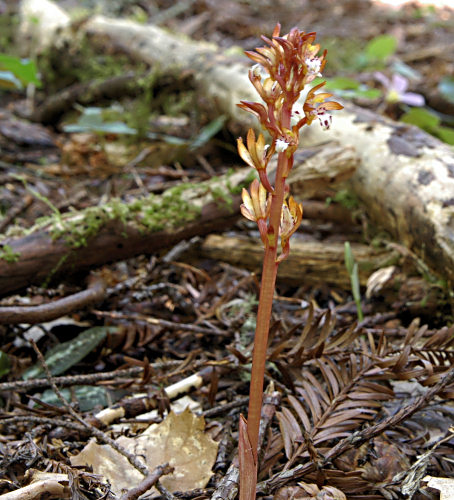
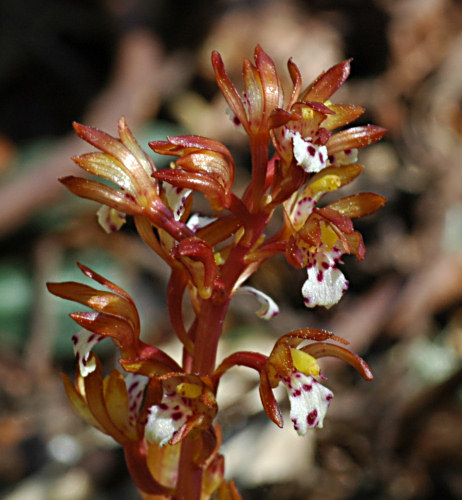
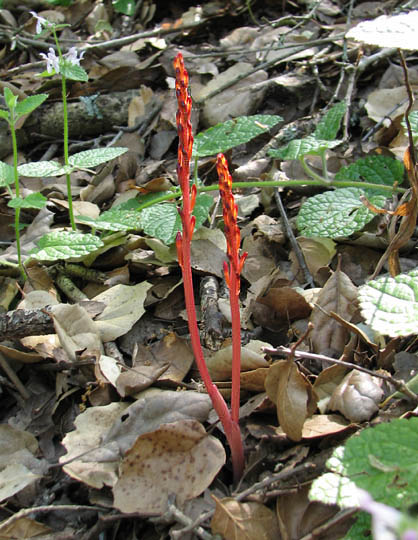

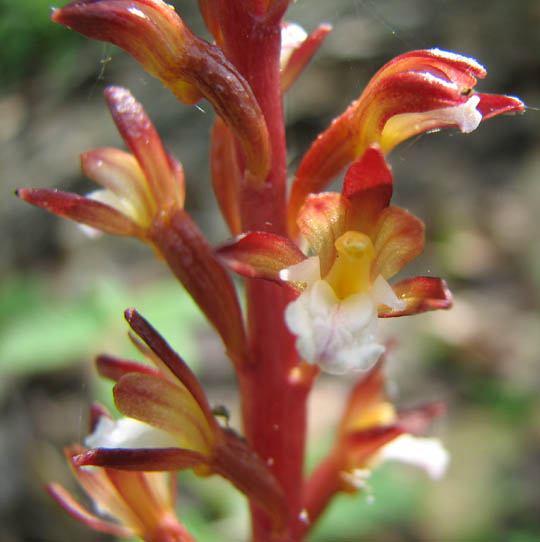
Corallorhiza mertensiana Bong. is found in shaded to open mixed-evergreen or coniferous forests in decomposing litter. It has reddish stems and pink flowers with yellow or dark red veins. Height range: 15-50 cm. Photos taken by Bob Rutemoeller and Mary Sue Ittner in Kruse Rhododendron State Park and Salt Point State Park, California. The last three photos show a clump that included plants with white flowers. Unfortunately, the conditions were not very good for photographing the flowers. Thanks to Meighan Mararchuk for helping to improve those images.
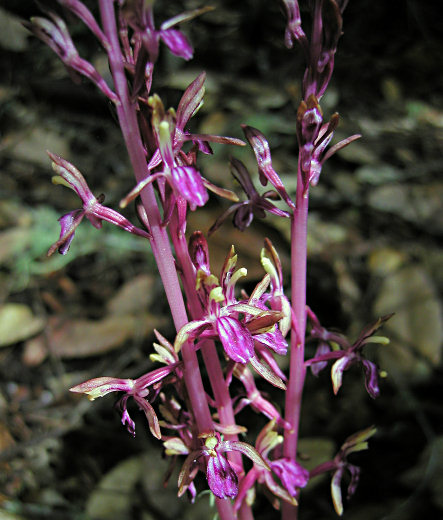
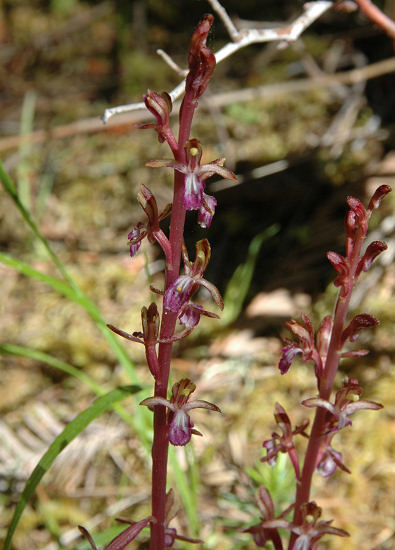
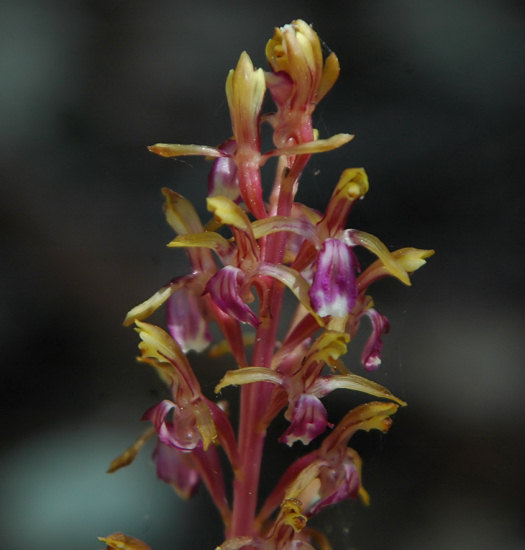

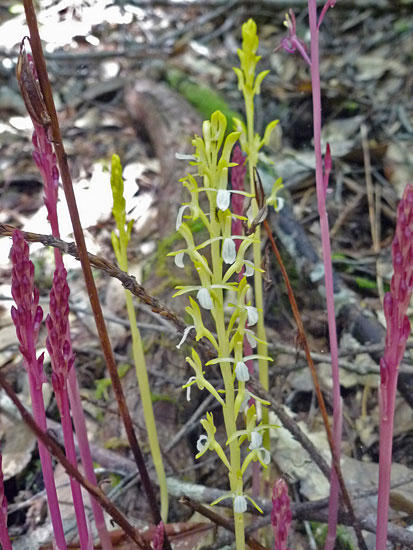

Corallorhiza striata Lindl. is found in rich, shaded woods below 2500 m in North America. It has seven to 30 pinkish yellow to white flowers that are distinctly tinged and striped with purple. Height range: to about 60 cm. Photographed by Meighan Mararchuk near Nakusp in southeastern British Columbia, Canada.
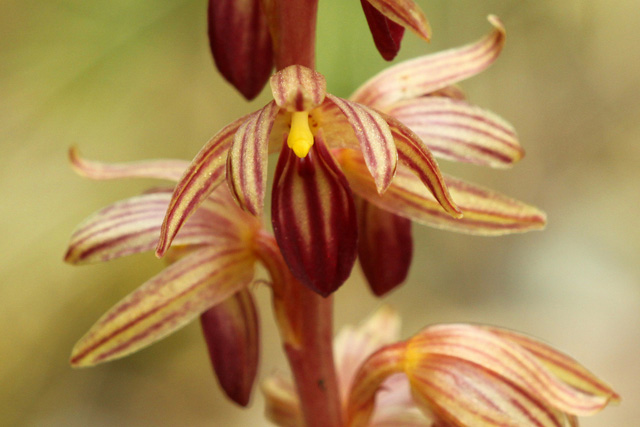
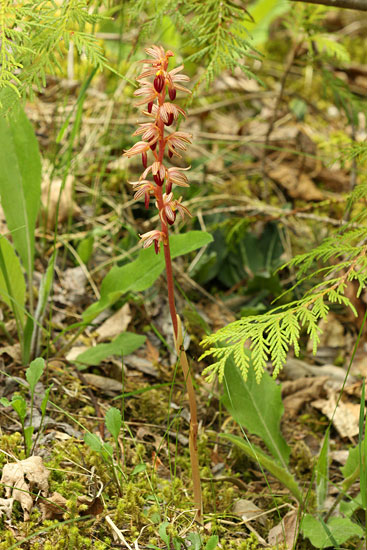
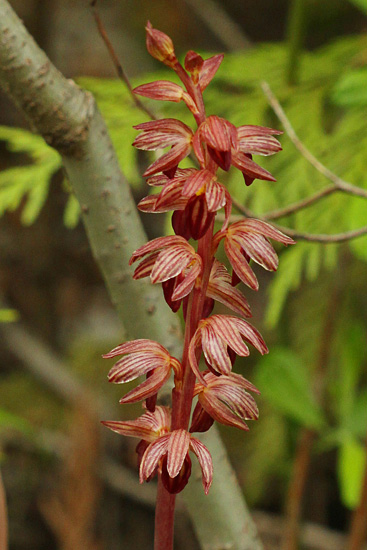
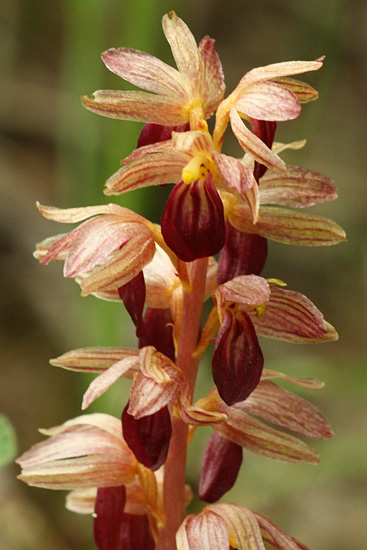
Corallorhiza trifida Châtel. is found in wet, open to shaded coniferous forests in northern and western North America but is also distributed in Eurasia. It has a greenish yellow stem and yellowish-green to white flowers with a white labellum and grows from 10 to 25 cm high. Photos from iNaturalist were taken by Jared Shorma in Colorado in July, Lucian Vazquez in Maine in May, and er-birds in Vermont in June, and shared under a CC BY license.


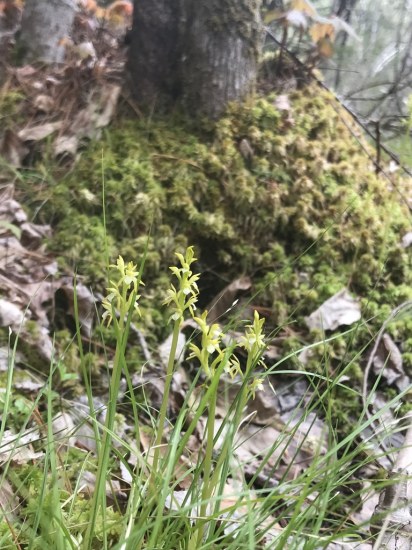
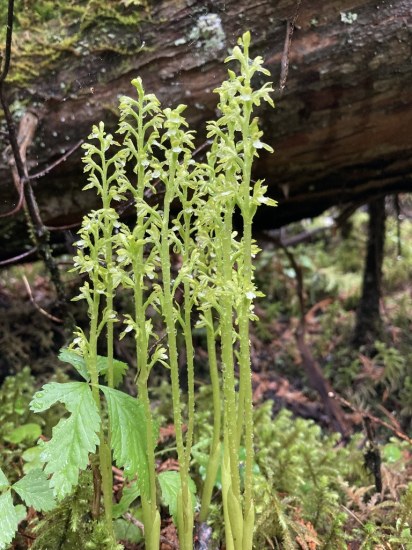
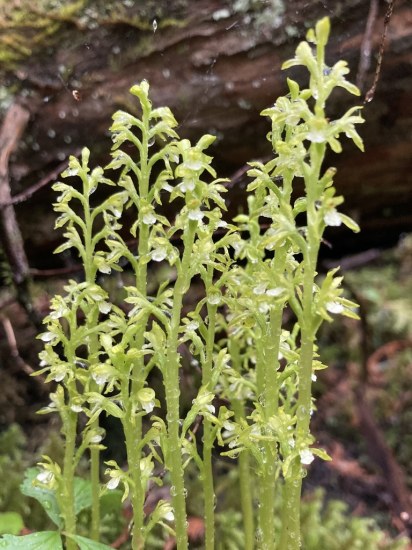
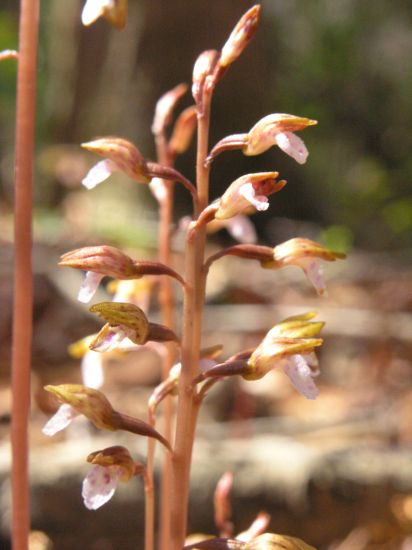
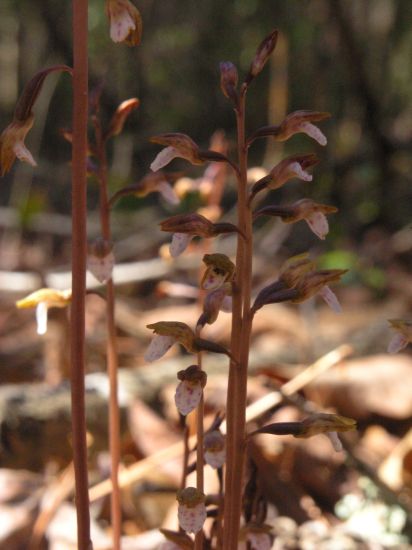
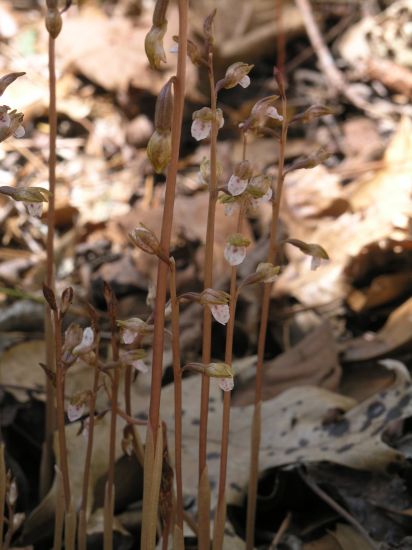
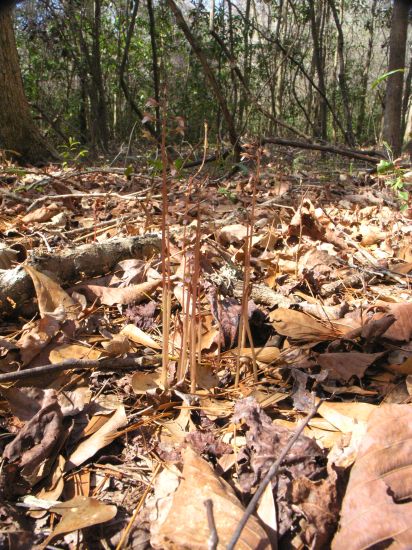
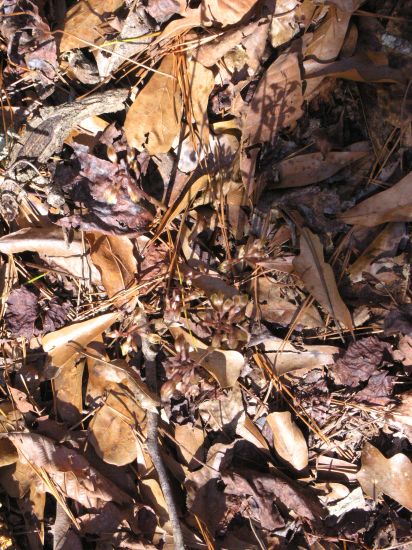
Corallorhiza wisteriana Conrad is found in mixed deciduous forests in the southeastern United States. Its survival is based through a relationship with a fungus or fungi which decompose forest litter; the plants have no foliage or photosynthetic parts. Flowers appear variably in January and February in the Florida panhandle where these photos were taken. Note the camouflaged nature of the flowers. Height range: 10-50 cm. Photos by Alani Davis.
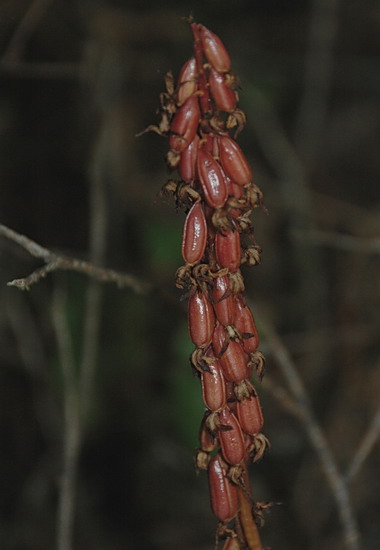
Below is a picture of seed pods taken by Bob Rutemoeller of either Corallorhiza maculata or Corallorhiza mertensiana. Both grow in the area where they were seen.