Bulbine Wolf is a genus in the Asphodelaceae family. It is closely related to Bulbinella but has flowers that are "bearded" with hairy stamens. Many of the species are not geophytes. We will be listing ones on this page that are tuberous, rhizomatous, or bulbous and perhaps some that are not. Distribution of the more or less 73 species is from tropical and southern Africa and also Australia. Leaves are linear to lanceolate and often succulent or fleshy. Flowers are small, mostly yellow (rarely white, orange or pink).
Bulbine abyssinica A.Rich. grows in rocky grassland and on stony flats and slopes from the western Karoo, South Africa to tropical Africa. Growing from 40 to 80 cm, it has linear succulent leaves in a basal rosette with broad membranous margins at the base, a simple or branched rhizomatous rootstock, and a densely crowded raceme of short lasting yellow flowers. Flowering takes place in late spring or summer, after good rainfall. The first three photos were taken at Gaika's Kop on a grassy slope that had burned within the past year. The fourth picture showing a plant in seed was taken in a very dry area near Cradock. Photos taken by Mary Sue Ittner, Bob Rutemoeller, and Cameron McMaster in the Eastern Cape.
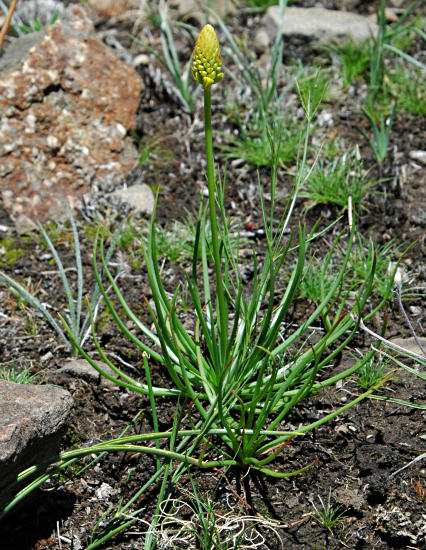
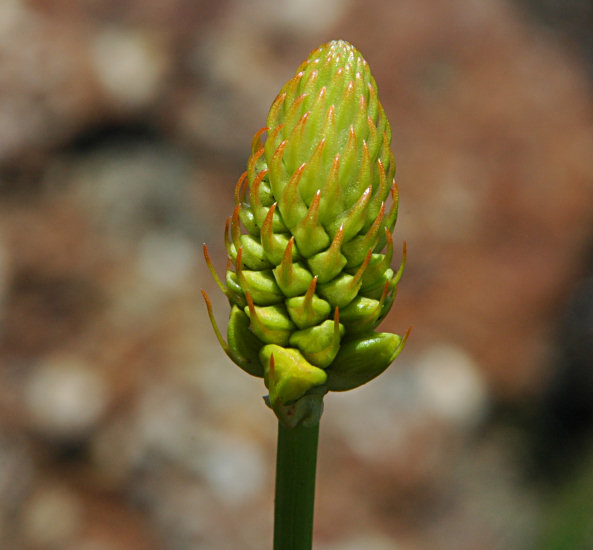
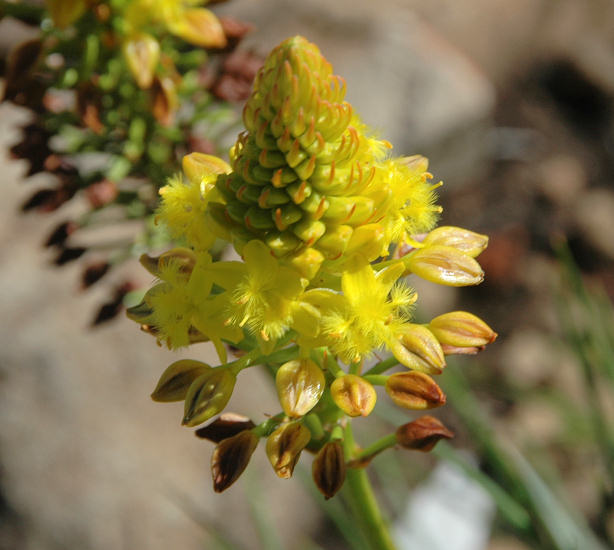
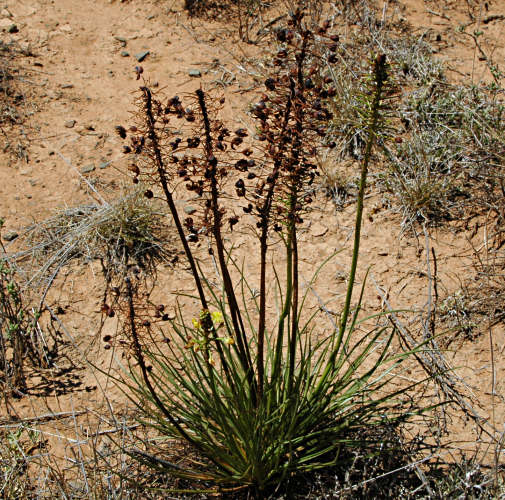
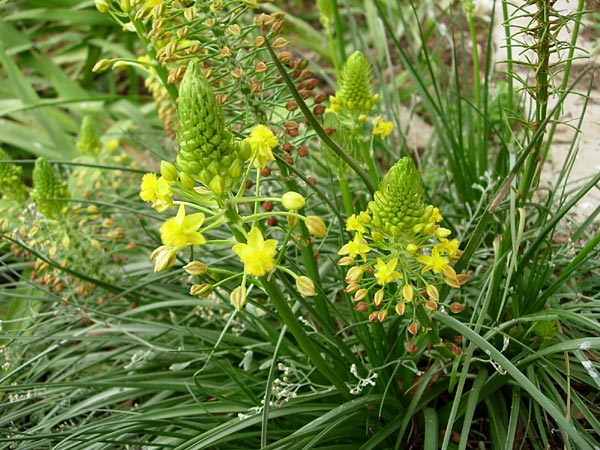
Photos below by Bob Rutemoeller were taken (in the rain) on a stony flat near Andriesberg.
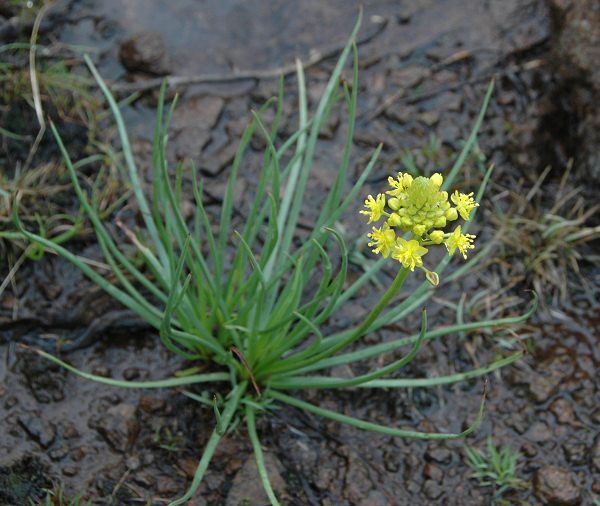
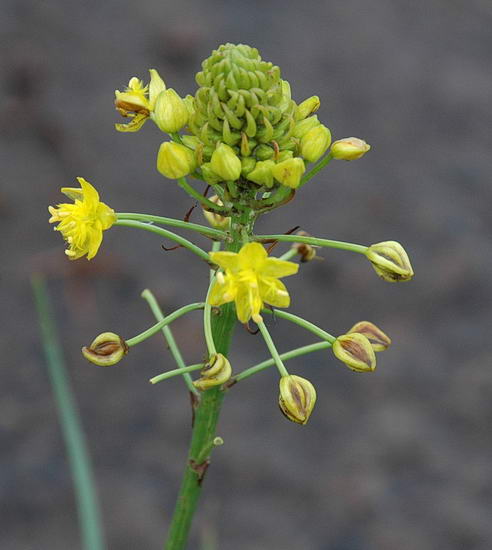
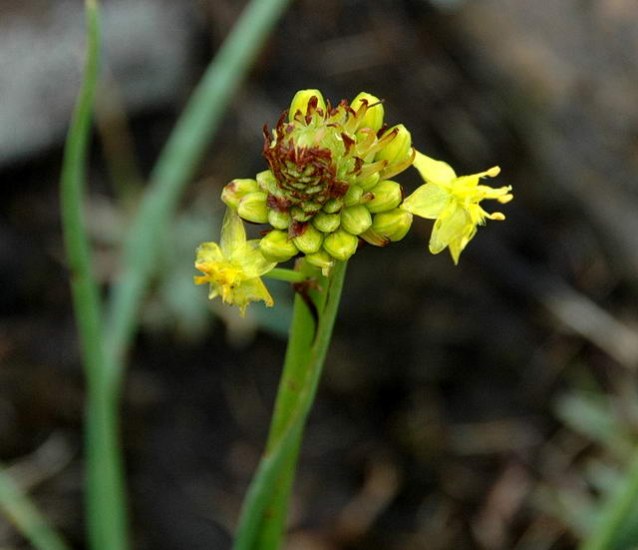
Bulbine alooides (L.) Willd. is from the western Cape and Namaqualand where it is found or rocky flats. Growing from 20 to 40 cm high, it has 6 to 12 basal succulent leaves emerging at flowering and many small yellow flowers with fluffy filaments in a crowded raceme. It flowers March to May. It is quick to flower from seed and dies back afterwards. Photos by Mary Sue Ittner.
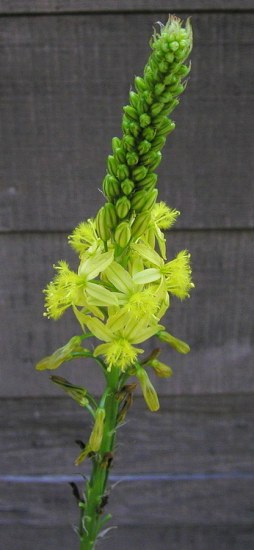
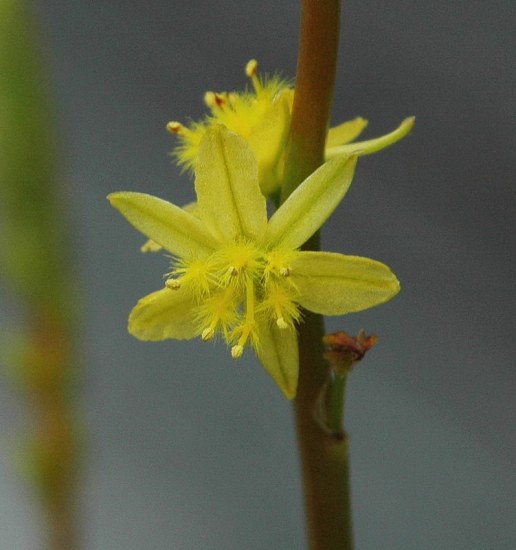

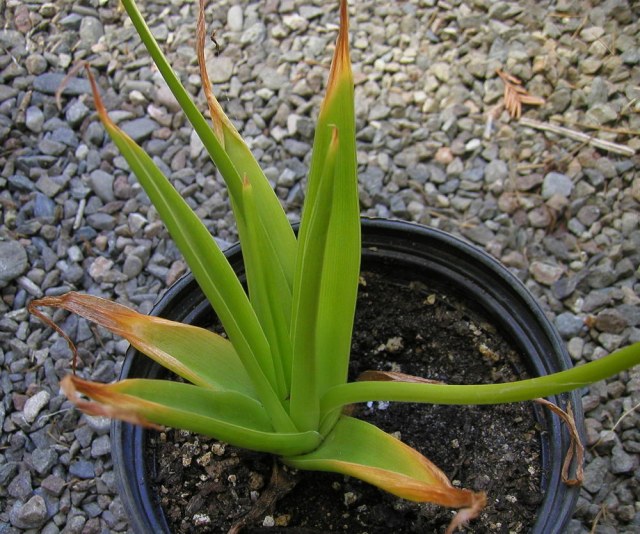
Bulbine alveolata S.A.Hammer is native to Northern Cape Province, South Africa. It is a winter grower and summer dormant plant. The leaves are delicate with mottled clearing. Grow the plant in a very well-draining mix with low organic matter (max 1:1 organic inorganic). It likes to stay moist throughout the winter growing season. Once the plant drops its leaves and starts to flower, water only sparingly until the plant goes completely dormant. Once that happens, stop watering until the fall when rain resumes. In the Bay Area, it does not like to be in full sun nor does it like to be too wet. Height range: 30-45 cm. The photos below were taken by Nhu Nguyen. Photo 2 shows the diminutive nature of this plant in a 2.5 inch (5 cm) pot. Photo 3 shows the thickened tuberous structure.
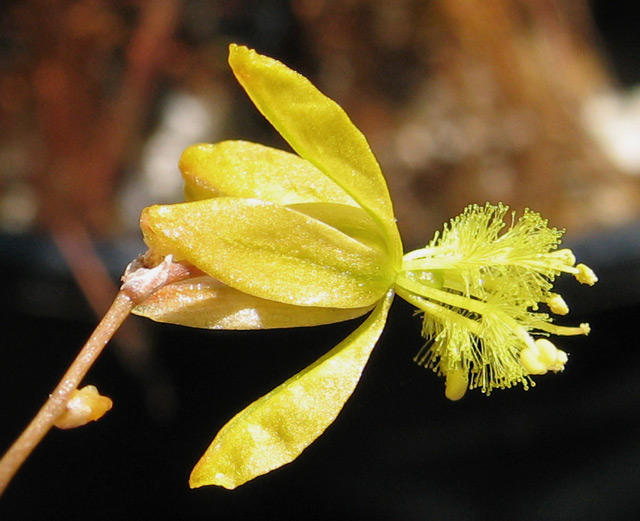
Bulbine bruynsii S.A.Hammer is a succulent geophyte, distinguished by its highly succulent, erect, wrinkled, and rugose leaves, usually appearing in pairs, with horizontal ridges containing translucent windows. The larger, primary, leaf may be up to 6 cm long. It possesses a napiform tuber that allows it to survive the summer dormant period underground when the leaves dry off, and can produce offshoots forming secondary tubers, allowing the plant to form clonal colonies over time. It flowers during the winter rainy season from June to September with 8-20 sweetly scented flowers on a 20 cm peduncle. It is endemic to a very localized area within the Succulent Karoo biome in Namaqualand, near Kotzesrus, west of Bitterfontein, preferring well-drained, saline, rocky, and sandy soils. The species was described by Steven Hammer and named in honor of Dr. Peter Bruyns, who collected the type specimen. Due to its limited distribution, specialized habitat, and threats from habitat loss and illegal collection, Bulbine bruynsii is listed as Critically Endangered. Habitat photos by Rob Skillin.


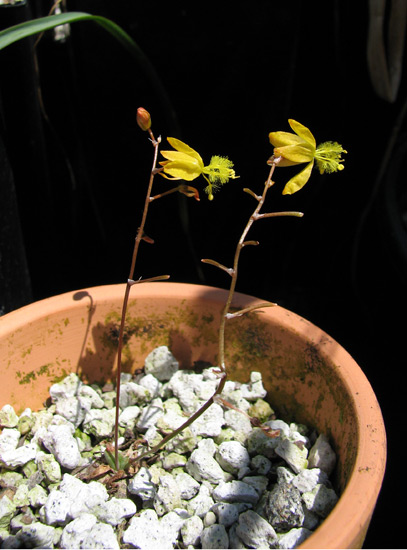
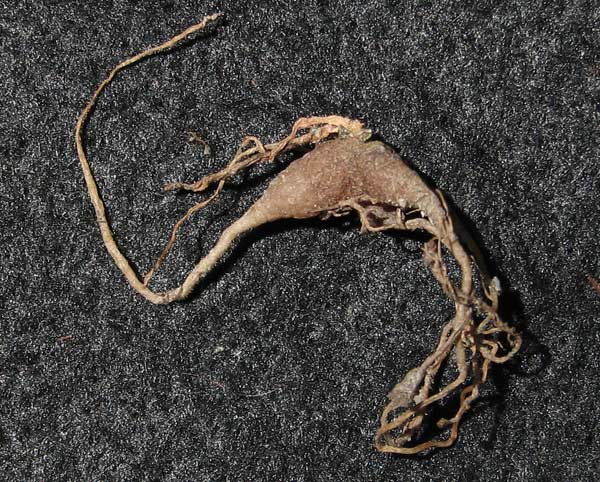
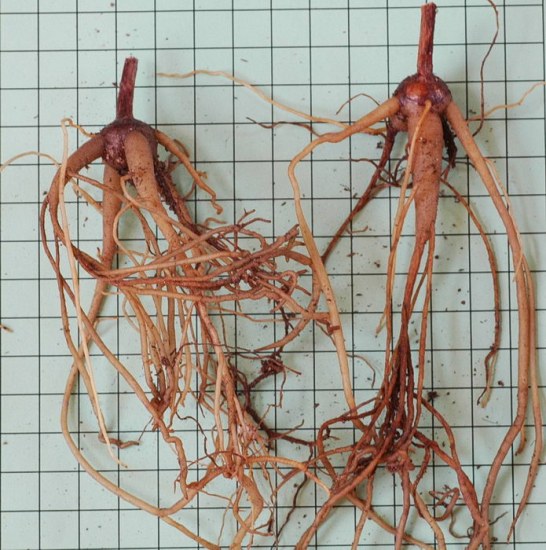
Bulbine bulbosa (R.Br.) Haw. is a species from Australia that is a dwarf perennial with a rootstock that is bulb-like with a tuber below. It has linear succulent leaves that are poisonous to stock and yellow flowers. It grows in forested areas, in sub-alpine regions, and exposed coastal locations. In cultivation it grows well in a container in dappled shade to full sun. Height range: 25-75 cm. Photos by Mary Sue Ittner showing the flowers and the rootstock on a grid of 1 cm squares.
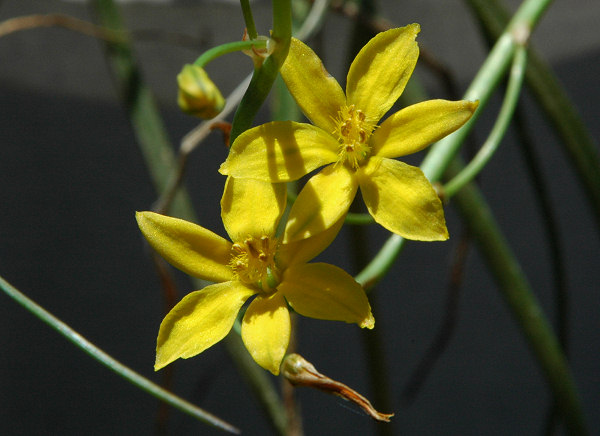
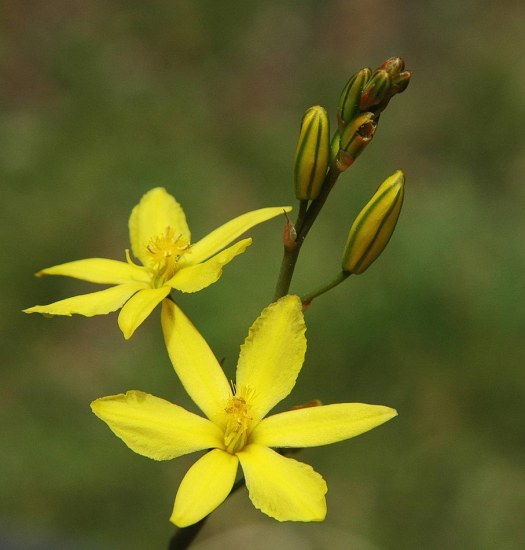
Bulbine dactylopsoides G.Will. is an exceptionally succulent member of the genus. It consists of 2-3 (4) extremely thick, distichous, fluid-filled leaves coated in a waxy bloom, arising from a relatively small, fleshy tuber. The upper two-thirds of the leaves are a greyish pink, while the lower third is white and tapers towards its base. Overall length of the longest leaf varies from 30-80 mm. During the August to September flowering season, an unbranched, 110-300 mm tall inflorescence carries as many as 34 flowers, which are typical of bulbines, having bearded filaments. Fibrous stolons radiate from the tuber, from which additional plants develop, thus forming discrete, clustering, clonal colonies.
The species is only known from the SW corner of the Knersvlakte in the Western Cape Province of South Africa, where it is rare and infrequently seen. It grows on gently sloping hillsides covered by a coarse pebbly quartz pavement. Climatic conditions are difficult; it is very arid, with the winter rainfall season bringing only sparse rains, supplemented by occasional fogs, and with temperatures reaching 40 °C in the dry summers. The area is a rich habitat for succulent plants, including several other Bulbine species, species of Argyroderma and Conophytum, the very common Phyllobolus digitatus, Othonna intermedia, Oophytum nanum and Tylecodon pygmaeus, amongst others. Graham Williamson described the species in the journal Aloe (41(2&3)) in 2004.
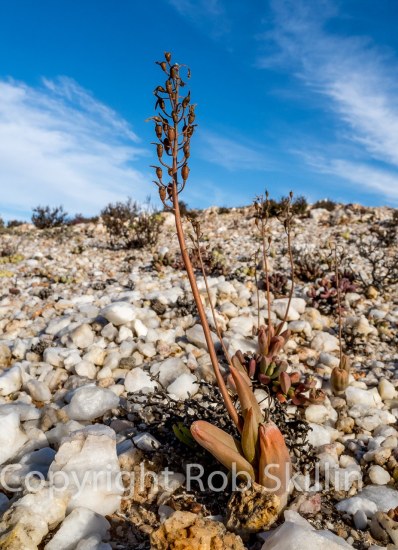
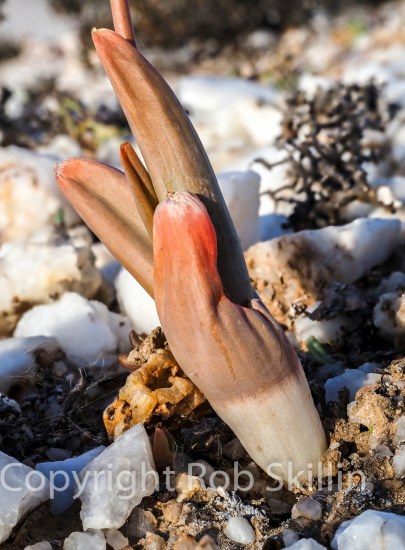
Below are habitat photos of plants by Rob Skillin, taken in 2025. Photo 1 shows a plant with the flowers on its tall inflorescence having been successfully pollinated and now in fruit, Photo 2 is of a group of plants in a small colony, no larger than 30 cm across, and Photo 3 is a closer view of a single plant, showing the leaves beginning to deflate due to its oncoming dormancy.

Bulbine falax Poelln. is a summer-deciduous perennial in the form of a prostrate rosette which reaches a diameter of 10 cm. The leaves are windowed in a tessellate pattern, the roots are tuberous and the flower stalk (peduncle) is up to 30 cm tall. Flowers are typical of bulbines, having yellow recurved petals and bearded filaments. Flowering occurs during August and September, prior to its dormancy period. It ranges from the eastern Knersvlakte in Namaqualand to northeast of Garies, preferring quartz patches with hard, loamy, granitic soils. It was first described by German botanist Karl von Poellnitz in 1944. Habitat photos by Rob Skillin.


Bulbine favosa Schult.f., syn. Bulbine filifolia Baker, is found on sandy and limestone flats and slopes from the western Cape to Zimbabwe. It is a tuberous species from 15 to 50 cm high, with few linear to filiform leaves usually dry at flowering and yellow fragrant flowers in a lax raceme. Photo from Cameron McMaster.
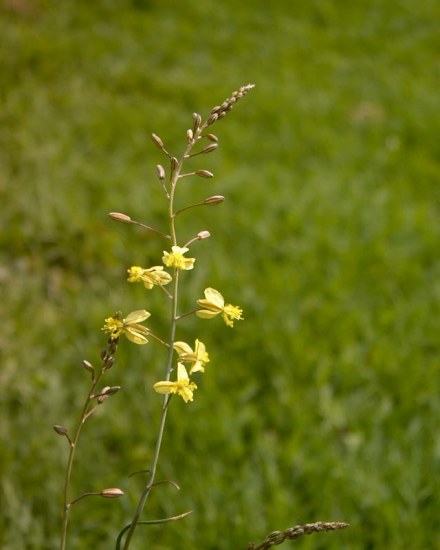
Bulbine flexuosa Schltr. Is a tuberous geophyte with a single (-3) glabrous, filiform (threadlike) leaf. The tubers may be solitary or clustering. Flowers are borne on one or two racemes of 10 – 20 cm. height at the beginning of the winter growing season. The pedicels are persistent and remain green long after flowering and fruiting. Plants are found in sandy soil on rock sheets and rocky slopes. The species is found in the mountains east of Clanwilliam (Pakhuisberg), Western Cape, RSA, ranging north to southern Namaqualand (Wallekraal, inland from Hondeklipbaai). The original publication was by Rudolf Schlechter, a German botanist and taxonomist, in 1898.
Photos by Rob Skillin of plants on the Gifberg, Namaqualand. The first photo is of the filiform leaf emerging from a shrunken tuber in early May before the rains have arrived. Photo 2 is of a flower and fruits, also in May.


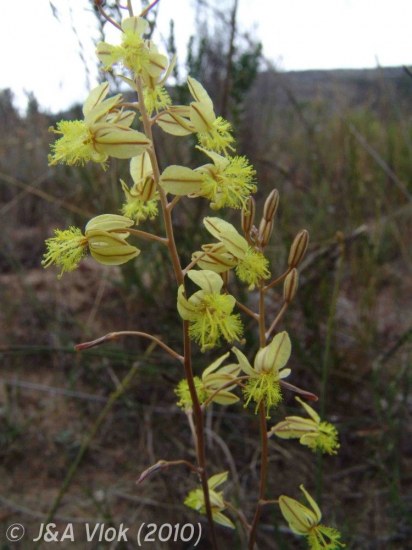
Bulbine foleyi E.Phillips is found on mainly shale flats and slopes from the Western Karoo to Clanwilliam and Albertina. It is a tuberous species from 8 to 40 cm with soft linear to filiform leaves, dry at flowering and fragrant yellow flowers in a long dense raceme from late spring to summer (October to February). Photo from the book Plants of the Klein Karoo courtesy of Jan and Anne Lise Schutte-Vlok.
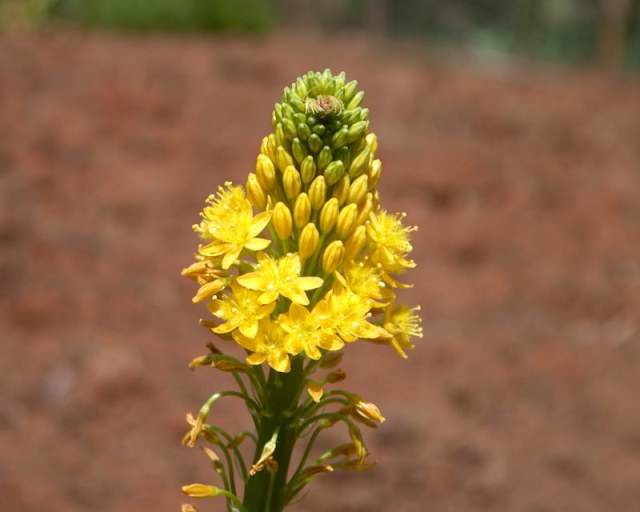
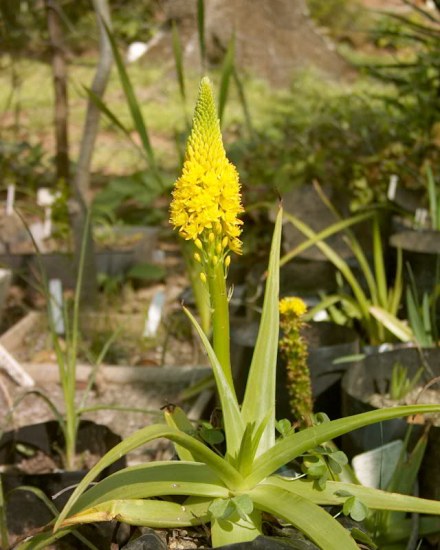
Bulbine latifolia (L. f.) Spreng. is found in grassland, amongst rocks and in rock crevices and on river banks from 300 to 1700 m from the Southeastern Cape to Mpumalanga. Growing from 30 to 60 cm, it has a thick rhizome with thin wiry roots, lanceolate leaves in a rosette, and yellow flowers in a dense, elongate raceme from August to November. Photos from Cameron McMaster.
Bulbine lolita S.A.Hammer is an exceptionally diminutive, but remarkably beautiful member of the genus. According to some, it is the smallest known succulent monocot; a rosette of less than 15 mm in diameter consisting of 12 – 16 leaves at maturity, which are terete and tapering to a point with windows in a tessellated pattern. 12-20 richly scented flowers, with 2-3 tufts of hairs on the filaments, are borne on a stretched corkscrew-spiraled peduncle reaching a height of 12 cm. Bulbine lolita inhabits a highly restricted area in the SW portion of the Knersvlakte in Namaqualand, south of Nuwerus. It is summer-dormant in this winter-rainfall area, the leaves dying back to the tiny tuberous root at that time. It was discovered by John Lavranos, and subsequently described by Steven Hammer in 2006. Photo by Rob Skillin.

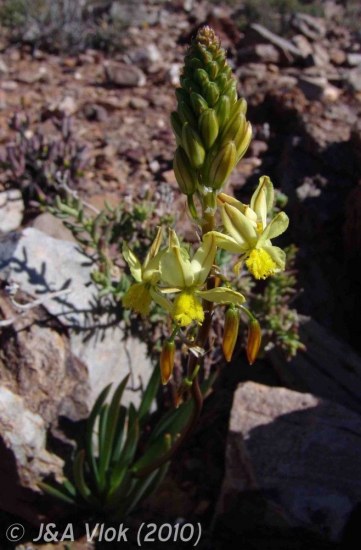
Bulbine longifolia Schinz is a tuberous species found on rocky slopes over a wide distribution from Namaqualand, the Northwest and Southwest Cape and the Karoo at altitudes from 100 to 1220 meters. Growing from 15 to 20 cm, it has a few lanceolate leaves developed at flowering and flowers in a lax raceme from August to October. It is similar to Bulbine praemosa, but smaller. Photo from the book Plants of the Klein Karoo courtesy of Jan and Anne Lise Schutte-Vlok.
Bulbine mesembryanthoides Haw. is a tuberous geophyte, with highly succulent leaves containing truncate, translucent tips that function as windows for subsurface photosynthesis. The specific epithet is often misspelled as mesembryanthemoides, but the correct spelling, from Adrian Hardy Haworth’s 1825 description, is as given here. There are two recognized subspecies.
Subspecies mesembryanthoides is two-leafed in younger plants, but becomes a rosette of up to 4 leaves with age. In shaded locations or on early growth the leaves have acute apices, which become truncate due to apical withering as the plants mature. As many as 3 peduncles (flower stalks), of up to 22 cm (8.5 in) in height, carry as many as 30 flowers, which have single tufts of hairs on the filaments. This taxon ranges from the southern Knersvlakte in the Western Cape of South Africa, to the Little Karoo and east to Uitenhage – Graaff-Reinet in the Eastern Cape. Plants are often found growing together in clusters.
The first two photos are from the book Plants of the Klein Karoo courtesy of Jan and Anne Lise Schutte-Vlok. The next three photos by Rob Skillin of plants, all from the same population, on Droekraal farm west of Vanrhynsdorp showing 1) a younger plant with a drawn-out leaf tip, 2) somewhat older plants with apices withering and becoming more truncate, and 3) a mature plant with a fully truncate leaf tip.
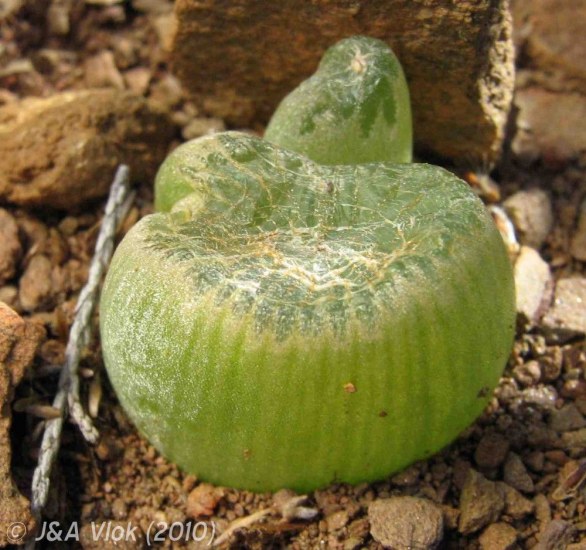


Subspecies namaquensis G.Will consists of a single, large leaf, ca 12 mm (0.5 in) in diameter, which is always truncate, never acute, and level with the ground. A second, smaller, typically vestigial leaf is present but usually not observed. There is one peduncle no taller than 10 cm (4 in), carrying 1 – 6 flowers, which usually have a double tuft of hairs on their filaments. This subspecies grows further north, from a line roughly through Springbok to Komaggas in Namaqualand, extending northwards into the southern Richtersveld. Plants occur singly, tending not to cluster.
Photos of subsp. namaquensis, showing 1) a plant and its inflorescence from south of Lekkersing, 2) a close up of the truncate main leaf of a plant from Umdaus (NW of Steinkopf), 3) an atypical cluster of 3 plants from SE of Port Nolloth, 4) a plant with an unusually large secondary leaf (growing with Conophytum hians), also from SE of Port Nolloth, 5) side view of a plant with the soil eroded away showing the light filtering down into the leaf through the upper surface (Umdaus), and 6) a flower illustrating the double tufts of hairs on the filaments, from near Komaggas. Photos by Rob Skillin.


Bulbine narcissifolia Salm-Dyck occurs singly or in colonies (the latter especially in overgrazed areas) on poor soils in grassland in southern Africa from the eastern regions of the Western Cape, through the Eastern Cape, KwaZulu-Natal, Lesotho, north to Ethiopia. It has gray green strap shaped, sometimes twisted, semi succulent leaves, a dense spike-like inflorescence of yellow flowers in spring and summer, and a rhizomatous base. It is suitable for cultivation as it is both frost and drought tolerant and copes with a wide range of temperatures. Height: 30 cm. The first two photos by Bob Rutemoeller were taken at Naude's Nek in the Eastern Cape and the second two in Andriesberg. The last by Cameron McMaster is a close up of the flowers.
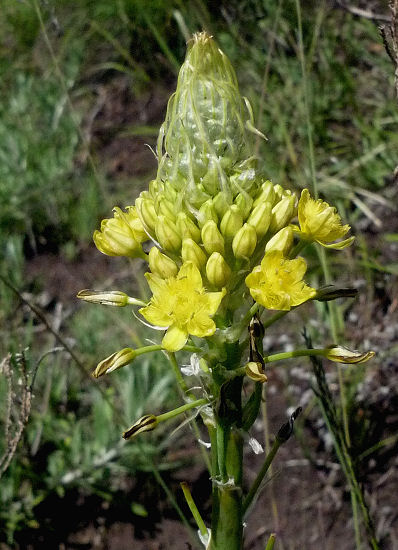
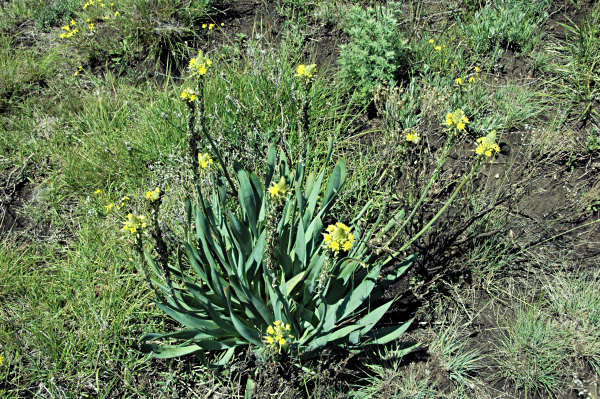
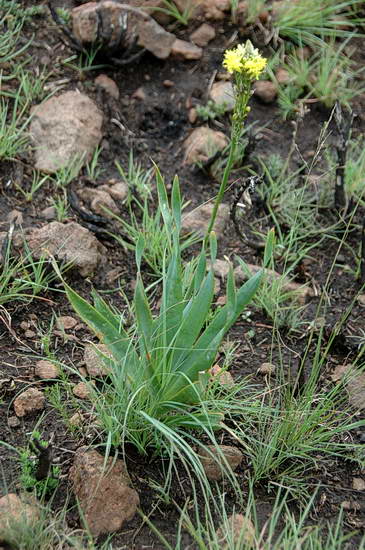
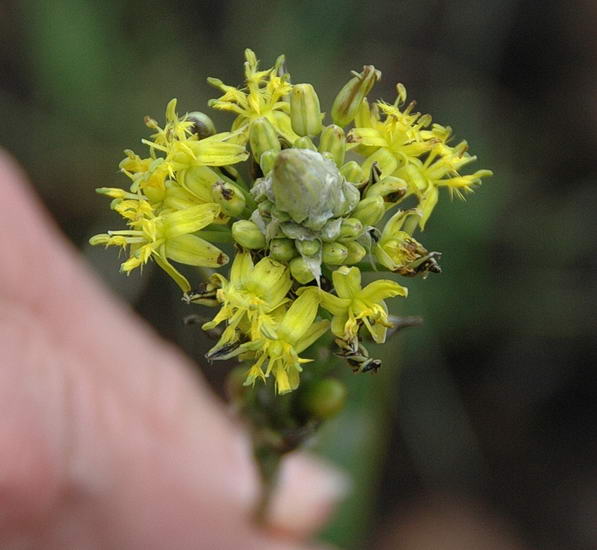

Bulbine praemosa Spreng. grows from a flat based tuber and spreading roots. It is 40 to 60 cm tall (including the inflorescence) with deeply channeled and tapering succulent leaves surrounded at base by a short fibrous neck and yellow to salmon flowers compacted at the tips with fluffy stamens borne in a lax raceme. It is found on sandy soils and red sandy loam soils from Namaqualand to the Little Karoo. It flowers from June to October. First photo from Rod Saunders. Second and third photos by Rob Skillin.
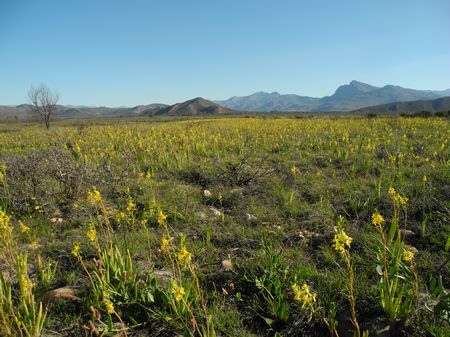


Bulbine rhopalophylla Dinter is native to the lower-most reaches of the Gariep River Valley (Orange River Valley) in South Africa, extending from there into the Sperrgebiet (Forbidden Diamond Area) of Namibia, having been recorded from the Boegoeberg, ca 94 km NW of Alexander Bay. This is an area characterized by exceeding low rainfall; Alexander Bay annually records only 4-5 cm (1.5 – 2 in) of rain. However, there are also pervasive wet fogs which supplement the moisture available to vegetation. Bulbine rhopalophylla inhabits flats and slopes of well-drained, mineral-rich soils such as sand, quartz gravel and micaceous schist. The species was described by the German botanist Kurt Dinter in 1931, the specific name referring to the club-shaped leaves. The photo was taken by Rob Skillin on sand flats adjacent to Alexander Bay.
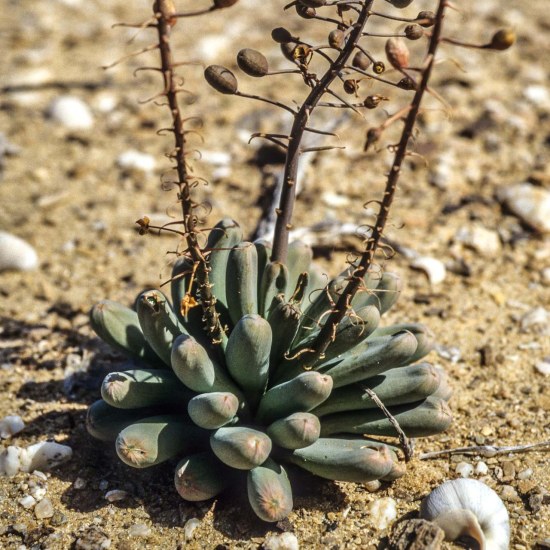
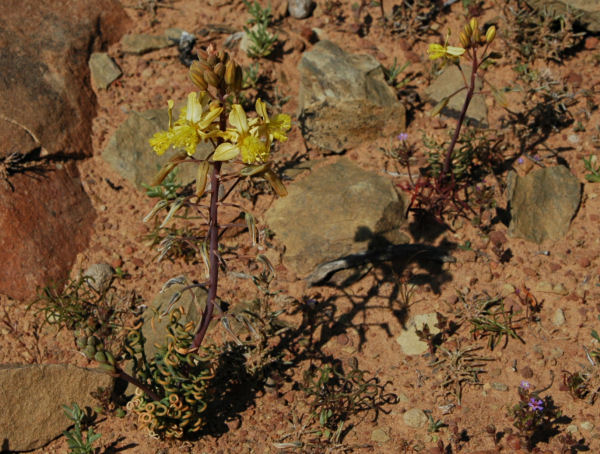
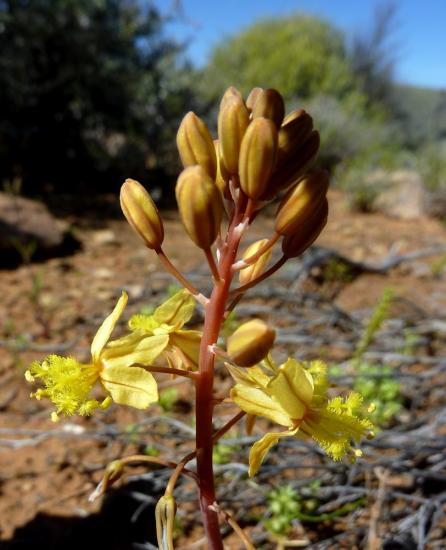
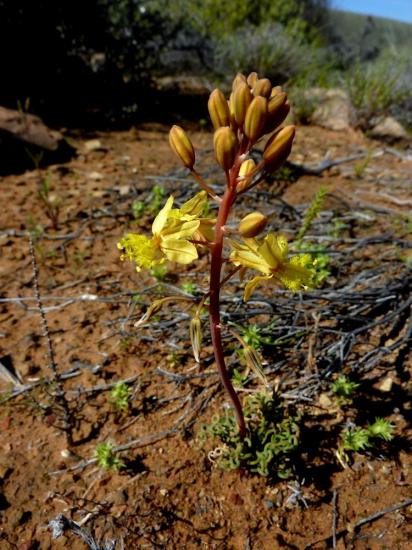
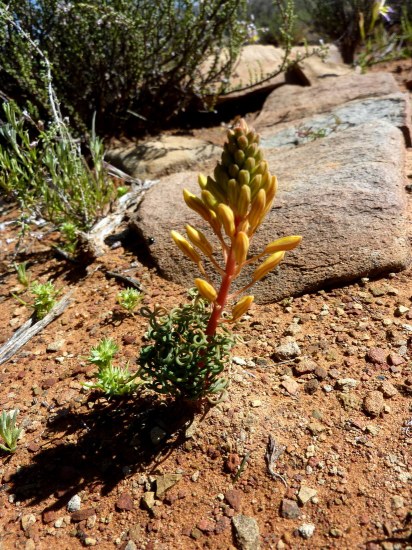
Bulbine spp. The first two photos were taken in the Komsberg by Bob Rutemoeller and Mary Sue Ittner in September 2006. The next three photos were taken by Mary Sue Ittner. The first was taken in Calvinia and the next two in Namaqualand.
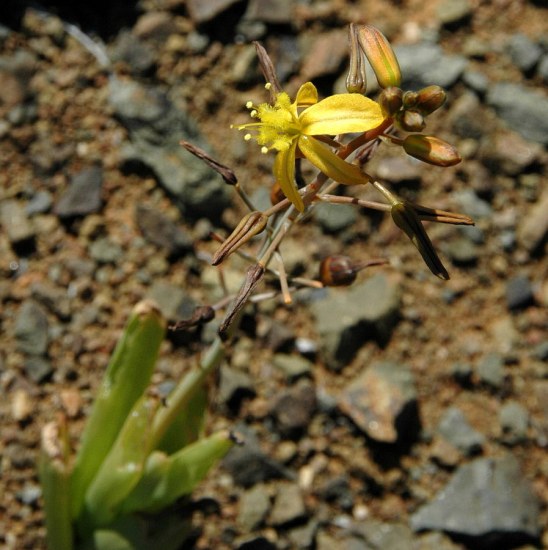
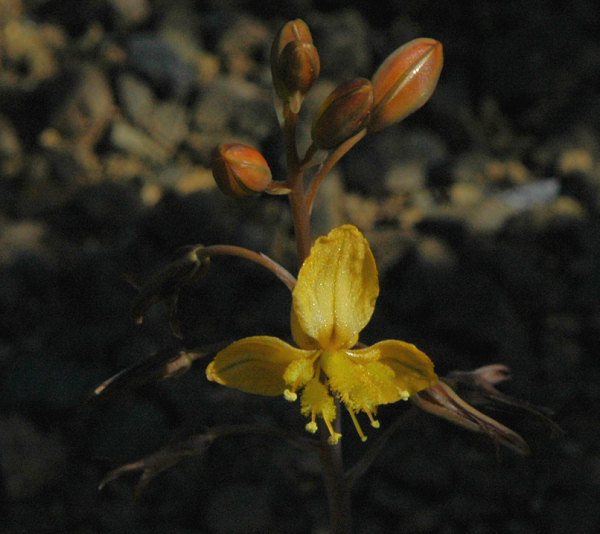
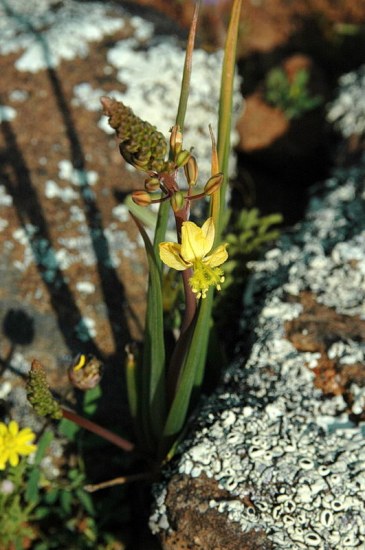
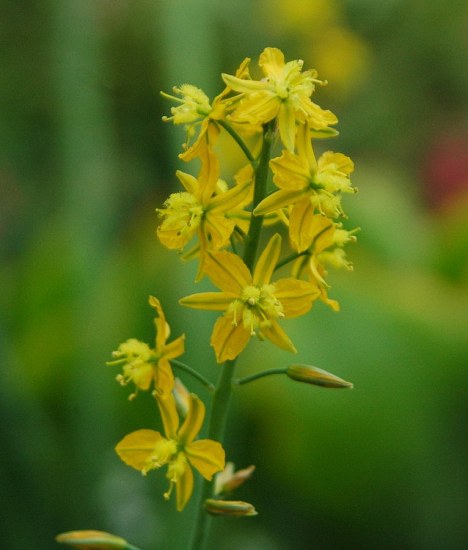
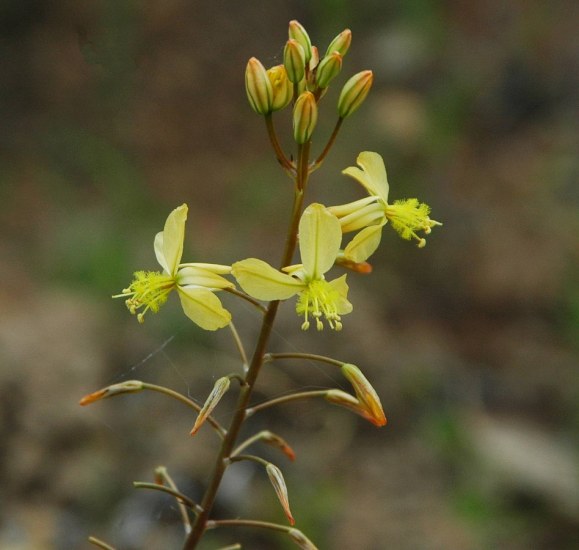
Bulbine sp. unidentified, and possibly undescribed. I came across this species in two different locations on the Rooiberg quartz fields, ca 8 km NE of Eksteenfontein, Richtersveld, RSA. Flowering in August, 2024. Habitat photos by Rob Skillin.


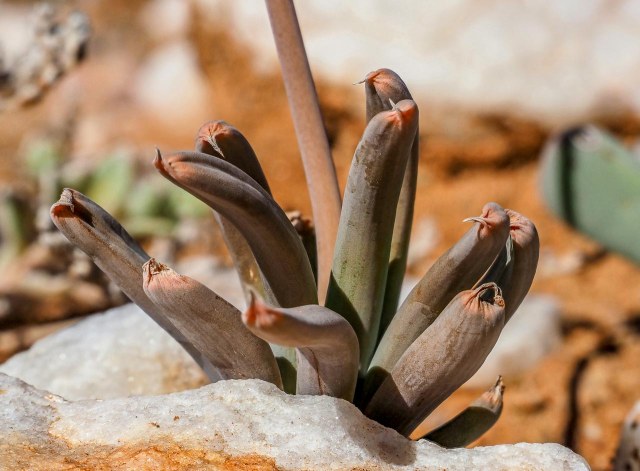
Bulbine sp. DT6147 ‘Sparkle Plenty’ is an undescribed geophyte collected in Namaqualand SE of Garies by Derek Tribble. It is a rosette of a couple dozen upright, thin succulent leaves with reddish bases. The upper portions of the leaves are light green with a remarkable metallic glint. Approximately two dozen flowers are borne on a single reddish peduncle, have strongly reflexed petals with a single broad green stripe on the abaxial (exterior) side and a thin green stripe on the adaxial side, and sparse tufts of hairs on the filaments. Flowering occurs towards the end of the winter growing season, after which the leaves die back to the rootstock to wait through the dry summer for the next wet season. Photos by Rob Skillin


Bulbine succulenta Compton is a rare species that grows on gravelly clay flats from Namaqualand to the western Karoo. It grows to 60 cm high from a lobed tuber that is covered by a hard casing that forms a thick fibrous collar around the base. This species has succulent leaves with blunt tips that become erect with the cylindrical raceme of yellow flowers. It flowers winter into early spring. Leaves die back rapidly with the onset of warmer weather and reappear after a good rain in autumn. The first two photos taken September 2011 near Nieuwoudtville by Cameron McMaster. The last photo from the book Plants of the Klein Karoo courtesy of Jan and Anne Lise Schutte-Vlok.
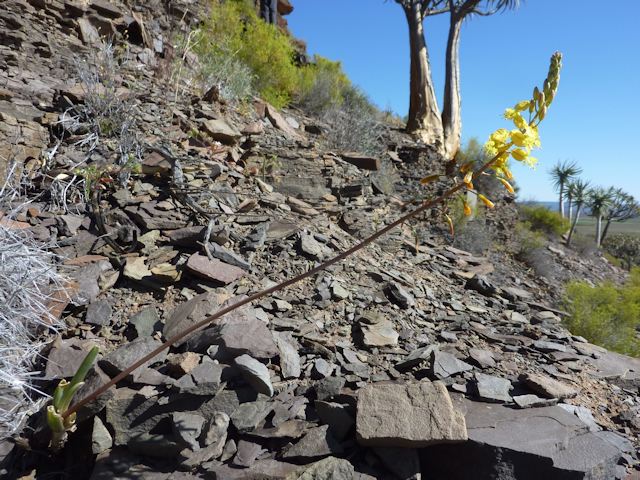
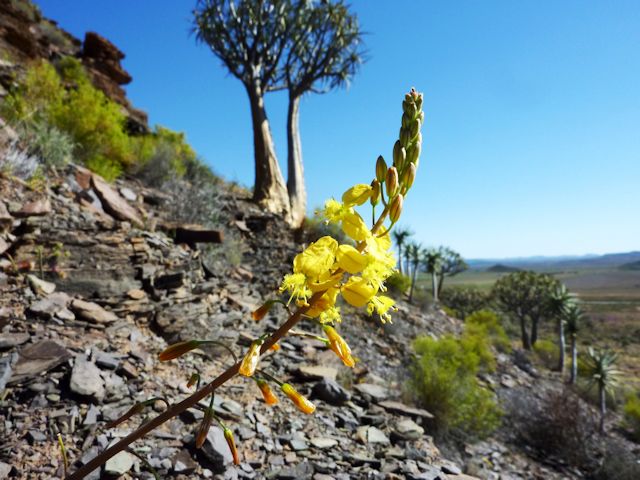
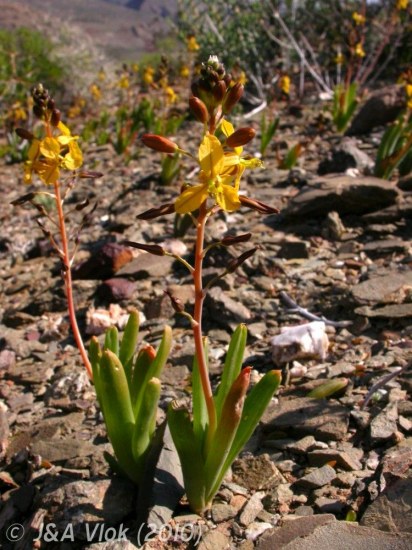
Bulbine torta N.E.Br. is found in rocky dry places in Namaqualand and south into the Cederberg. It grows from a flat based tuber and has twisted or coiled thread-like leaves and yellow to light orange flowers with fluffy yellow stamens. In the wild it blooms July to September. Height: 8-25 cm. Photos taken different Septembers near Middelpos in the Roggeveld by Mary Sue Ittner and Cameron McMaster.