On these pages photos of North American Allium species will be featured. There are approximately 130 taxa in North America, almost half of which occur in California as the center of diversity. Besides a few species that are widely grown, namely Allium cernuum (nodding onion), the Californian Allium unifolium (popularized by the Dutch bulb trade) and the lesser known Allium stellatum (prairie onion), the North American onion species have been largely ignored by the horticultural world. There are also about 15 species native to Mexico, similarly rare or absent from horticulture. Eastern American species generally need a cool - cold winter dormancy period with some to lots of rain. Western American species, especially those in the Pacific States follow a Mediterranean pattern where they need a moderately cold wet winter and a cool dry summer.
Taxonomically, there have been few changes in American species. A recent phylogenetic study by Nguyen et al, 2008 found that North American alliums are distinct from European species and those occurring in the California Floristic Province (CFP) are distinct from eastern American species. California holds a wide variety of species whose forms are distinctive in leaf morphology. Species related to Allium falcifolium form falcate leaves whereas species related to Allium jepsonii form a single leaf from which the inflorescence emerges on the side. Many CFP species have also adapted to a special type of soil called serpentine which is very high in minerals such as magnesium, making it toxic to many plants. Some Allium species are so adapted that they can only be found on serpentine soil in the wild.
American alliums from A-F are found on this wiki page. See American alliums G-Z for the other American alliums.
Allium abramsii (Ownbey & Aase ex Traub) McNeal is a California species found in the higher foothills of the central Sierra Nevada. It has rose-purple flowers. Height range: 10-20 cm. Photos by Mary Sue Ittner
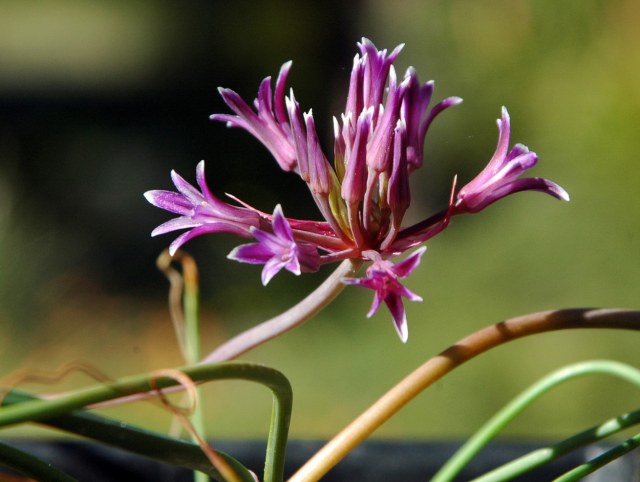
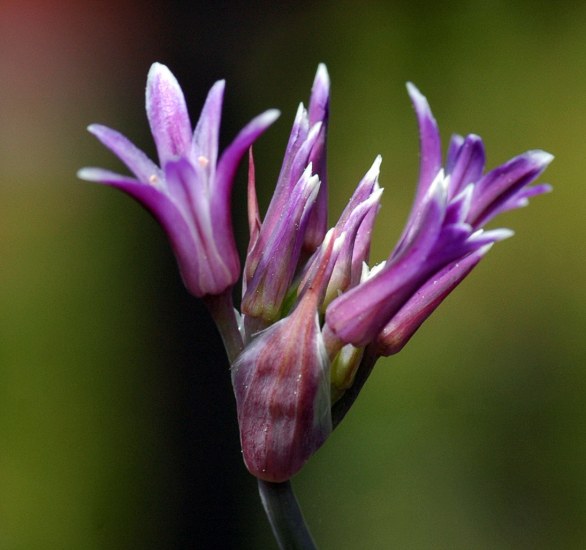
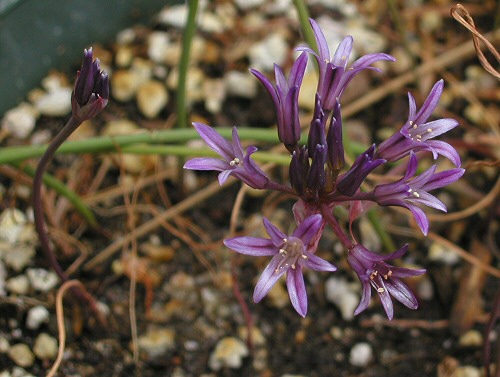
Allium acuminatum Hook. is native to the Western United States and Canada. It has bright rose to purple urn like flowers in open umbels and blooms May to July. It has sharply pointed tepals, the outer recurved and the inner with enrolled margins and is sometimes known as the Tapertip Onion. Another common name is Hooker's Onion. Height range: 15-30 cm. Photos 1-3 by Mary Sue Ittner. The last photo was taken by Richard Haard.
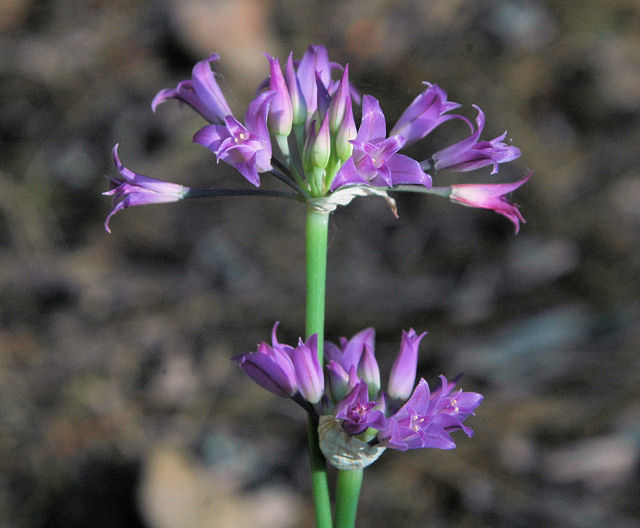
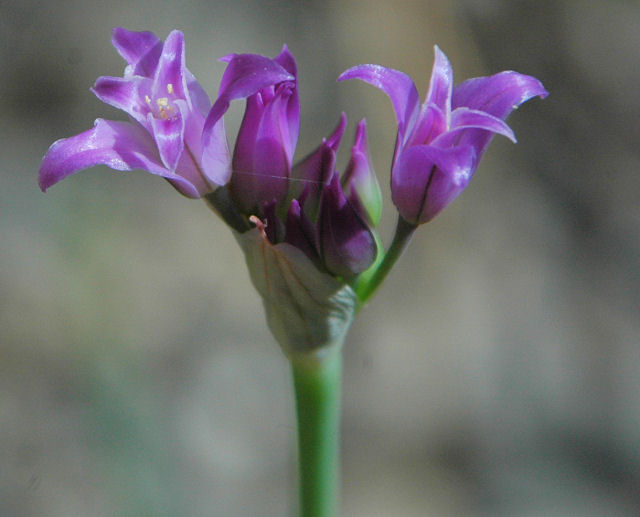
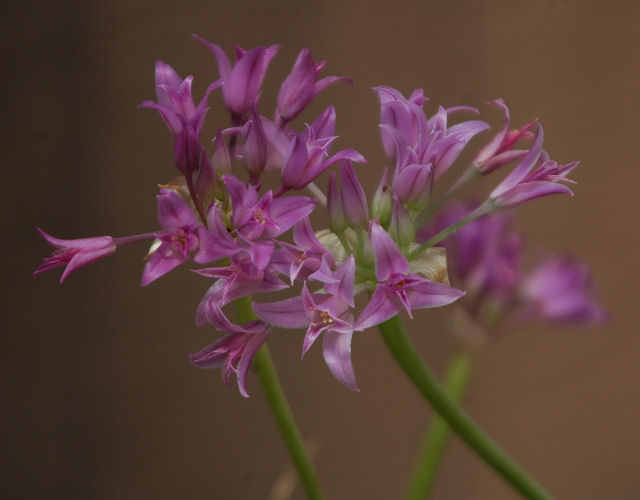
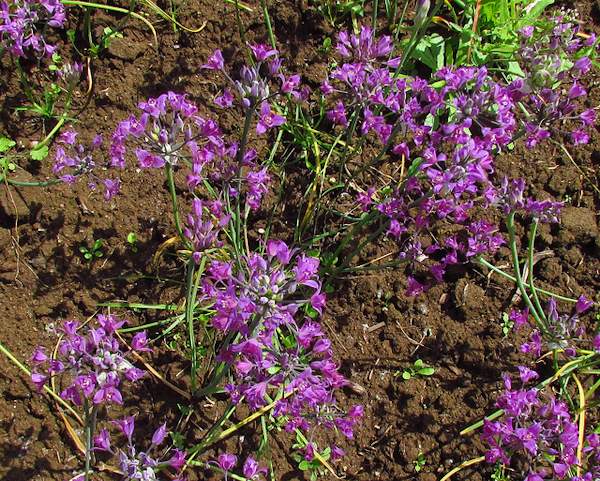
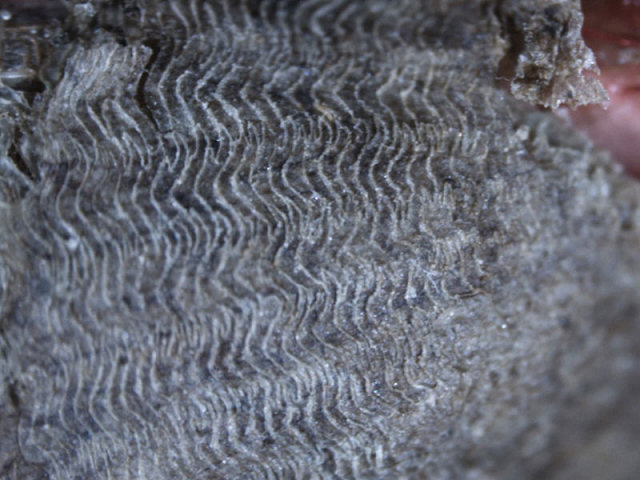
Allium amplectens Torr. is common in hot dry openings west of the Sierra Nevada in California and occasionally in Oregon, Washington, and southwest Canada. It is a variable species, with some plants forming small inflorescences, while others form much larger ones. Flowers range from white to pink in color. Height range: 20-50 cm. Not all forms of Allium amplectens are easy to grow. Photos 1-2 taken by Mark McDonough shows a pink form that is very easy to grow under normal garden conditions (eastern US), and produces a profusion of light pink starry blooms in May. Collections from arid regions are growable if planted in raised sand or clay beds. Photos 3-6 were taken by Nhu Nguyen of a form that needs a dry summer. Photo 3 show plants taken at the Tilden Botanic Garden. The last photo shows the texture of the bulb scale important in identification of many American alliums.
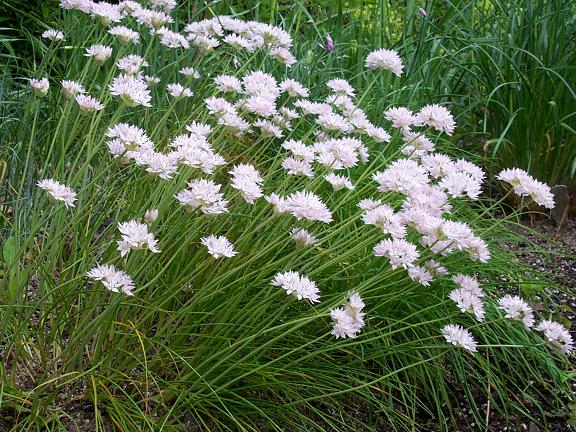
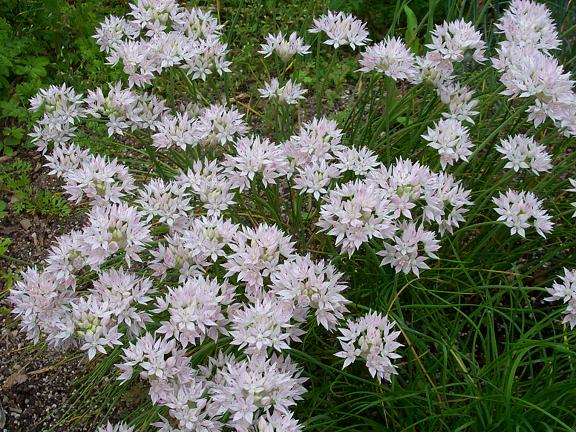
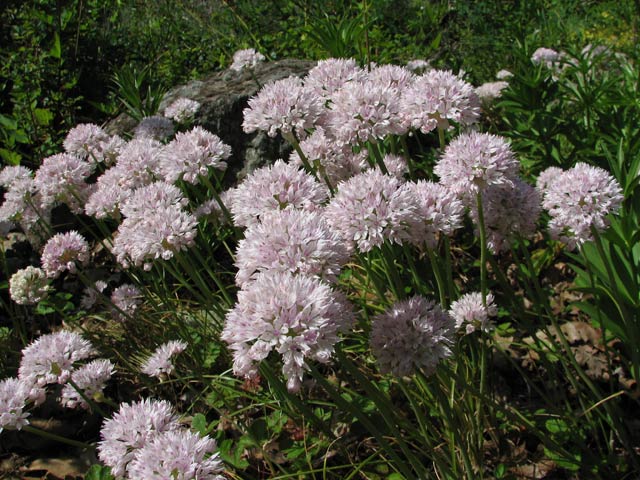
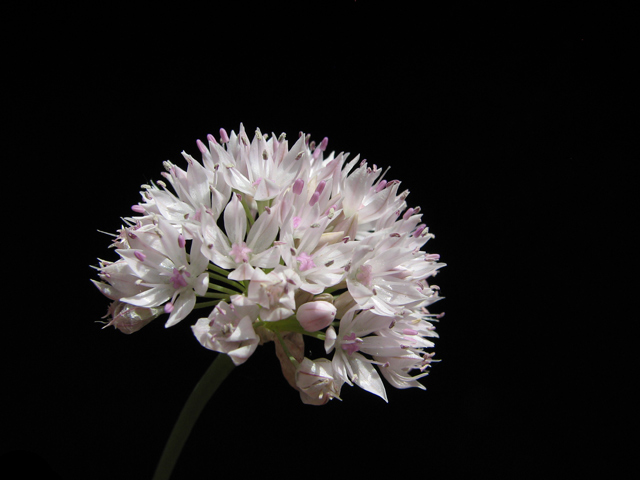
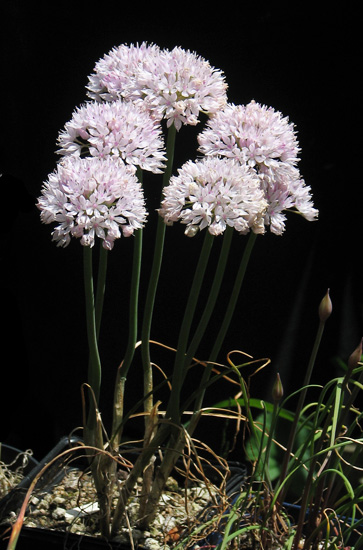
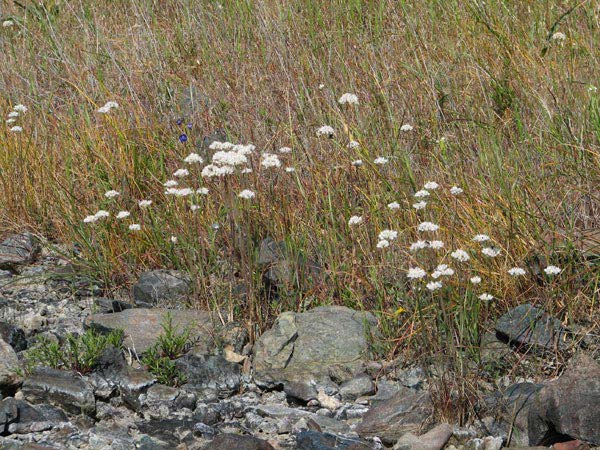
The first two photos were taken by Nhu Nguyen. The first is a habitat shot (Lake County, CA) showing this species growing near a stream bed. This form is able to grow on serpentine soil. The second shows a white form of this species which requires a dry summer dormancy. The last three photos by Mary Sue Ittner shows plants photographed in April 2005 at Pinnacles National Park and plants flowering in the Vina Plains Preserve in April 2006.
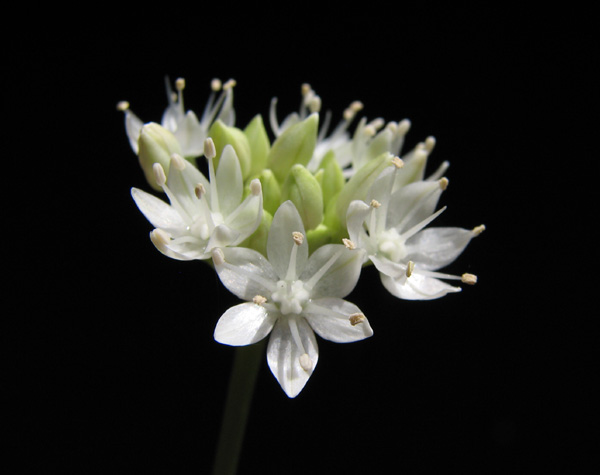
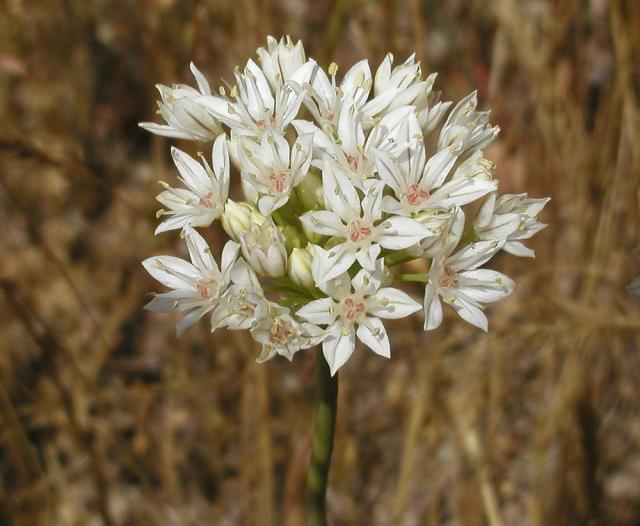
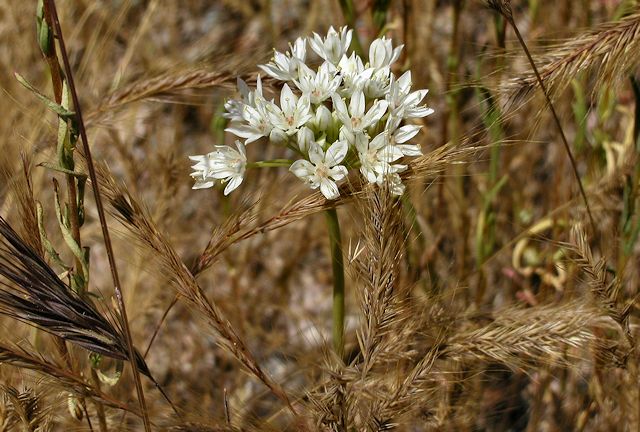
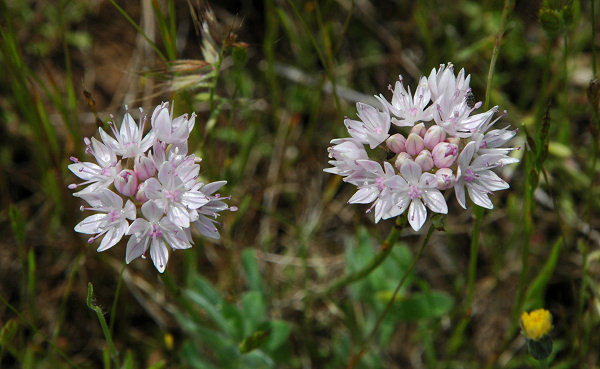
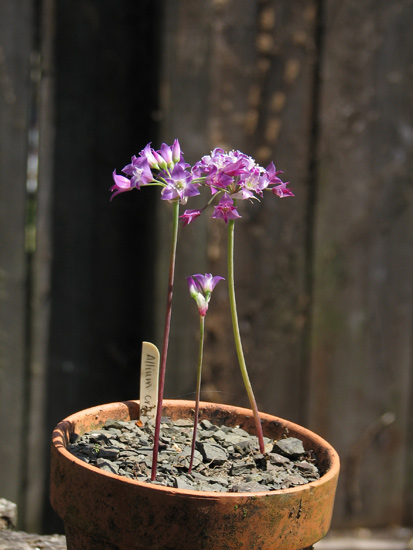
Allium amplectens 'Graceful' is an easily grown adaptable selection. Here are photos taken by Travis Owen showing plant in various stages of growth. The first photo shows the leaf bract towards the base, possibly a helpful characteristic to identifying the species.
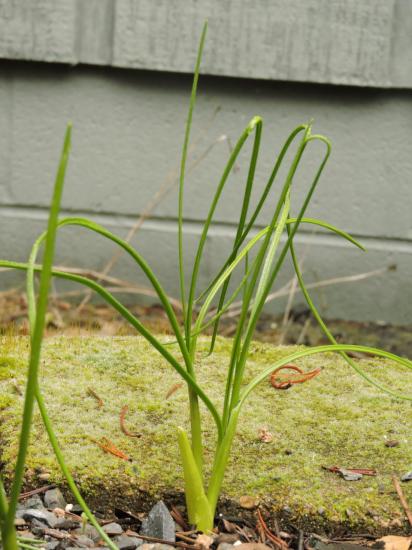
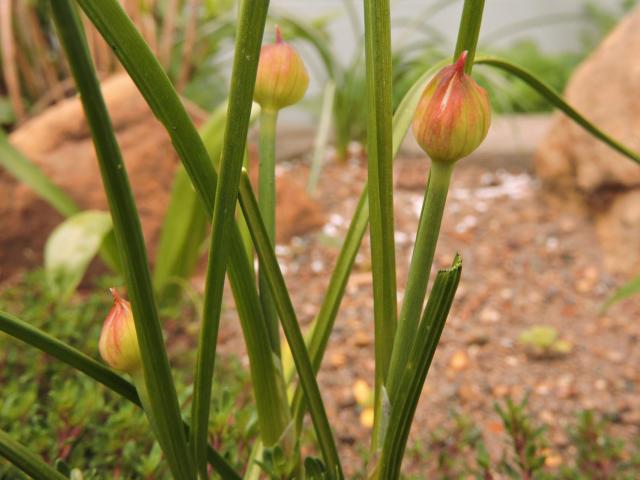
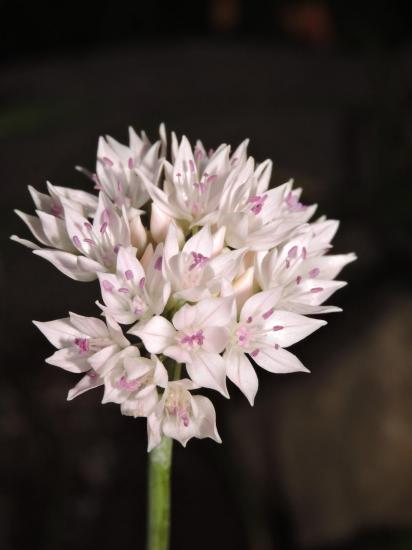
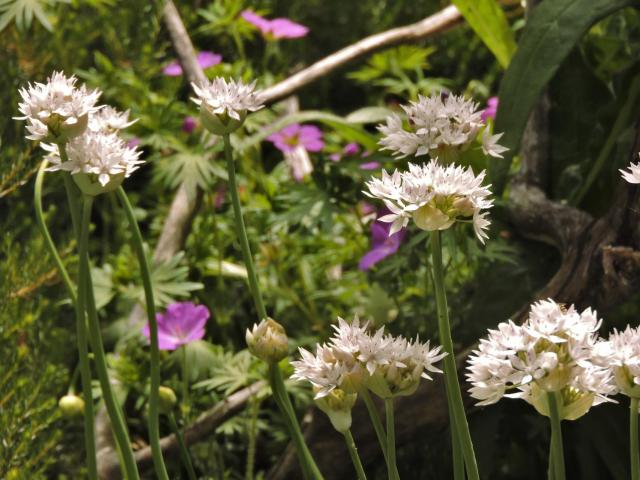
Allium bolanderi S.Watson (syn. Allium stenanthum Drew) is a small onion growing in decayed granitic soil under native oak trees in California and Oregon. Height: about 20 cm. The bulbs are smooth, elongated, and less than 1/2" in length. Bulbs are connected to the plants by delicate white rhizomes. It requires a very dry summer with absolutely no water. Photos are taken by Nhu Nguyen. The 1st photo shows a darker form of the species. The 2nd photo shows an in situ shot in Yolo County, CA, where it was growing among poison oak.
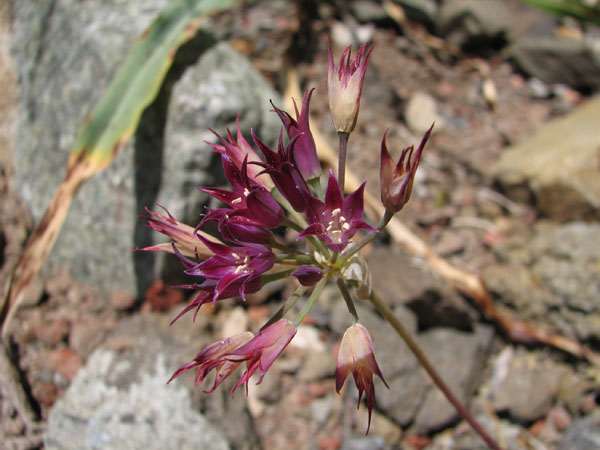
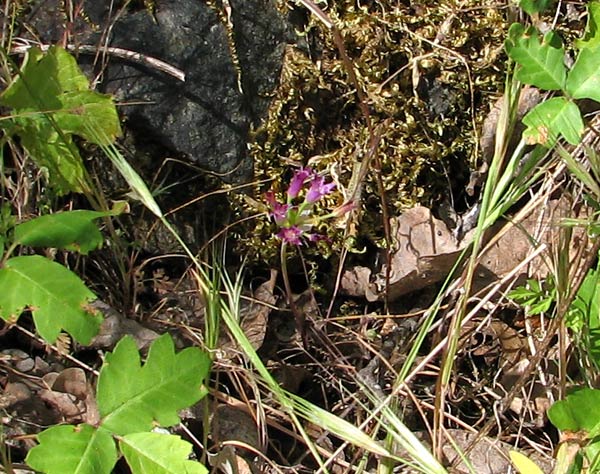
The photos below were taken by Nhu Nguyen. The third and fourth photos are closeups of the flowers and inflorescence. They also show the powdery quality of the underside of the tepals. Photos 4-5 show the bulbs dividing from two to four bulbs. The last photo shows the bulb lying in the ground horizontally. The remnants of the rhizome can be seen on top of the bulb.
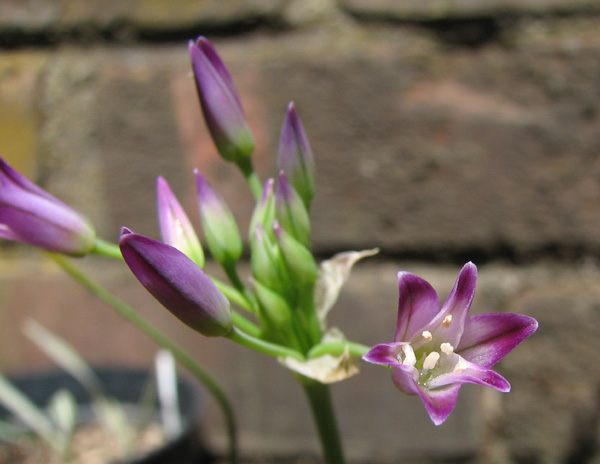
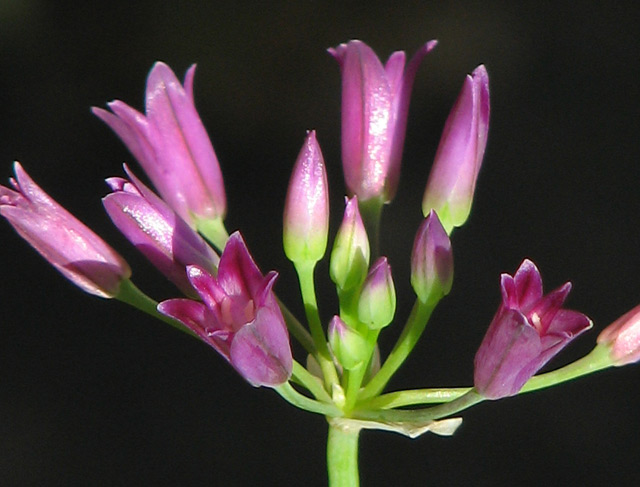
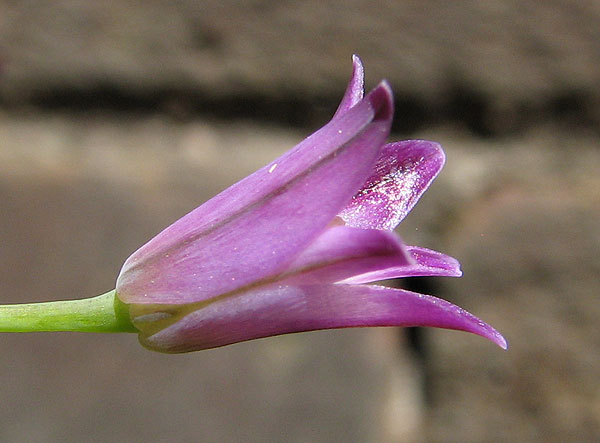
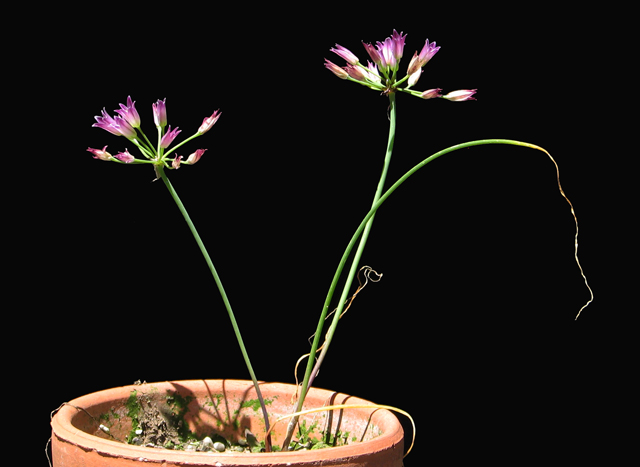
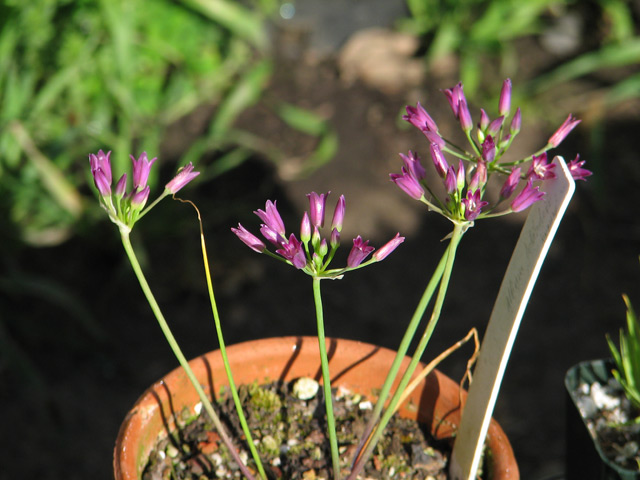
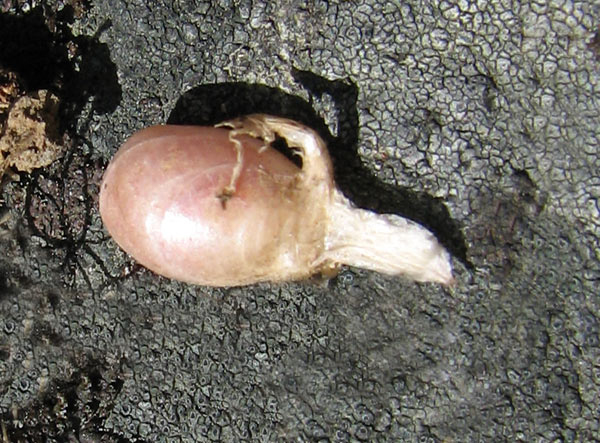
Allium bolanderi var. mirabile (L.F.Hend.) McNeal (syn. Allium mirabile L.F.Hend., Allium roguense M.Peck) is a small white flowered variety native to Southern Oregon and Northern California. It bloomed in June in Rogue River, Oregon. Photos by Travis Owen.

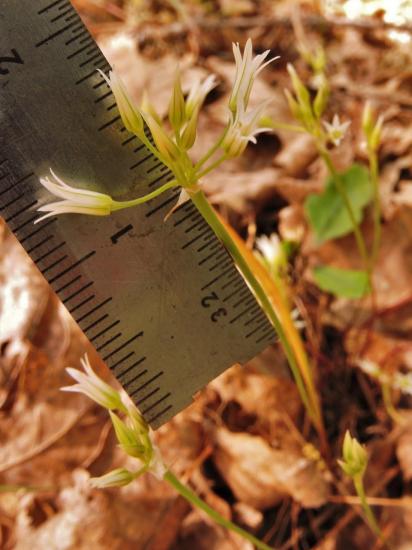
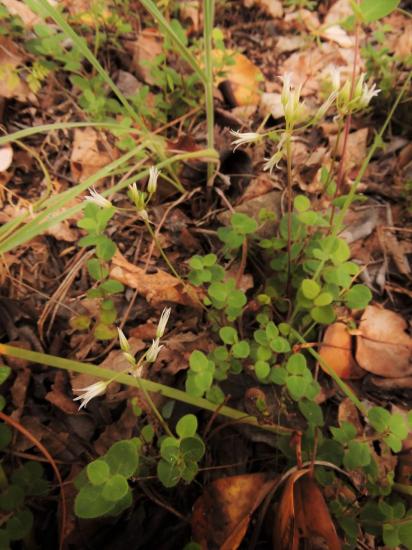
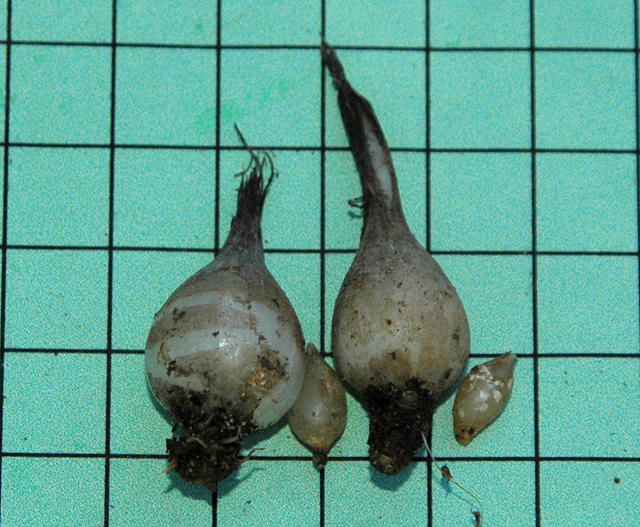
Allium campanulatum S.Watson - an odd species, but one that I like nonetheless. It flowers in early spring, preferring clay soil in a raised bed, in full sun. The flowers are nearly at ground level and typically show a two-toned flower, the center of each flower being pale compared to the deeper ends of the tepals. The stems are very brittle and easily broken. The flowers are different from most other American alliums in that they open completely where the tepals lay on a flat plane. Height: 20-30 cm. They are found in California, Nevada, Oregon and Washington states. The mother bulb produces numerous offsets. First photo by Mark McDonough, second photo by Nhu Nguyen at the UC Botanical Garden. The last two photos were taken by Mary Sue Ittner including a picture of the bulbs on a 1 cm grid.
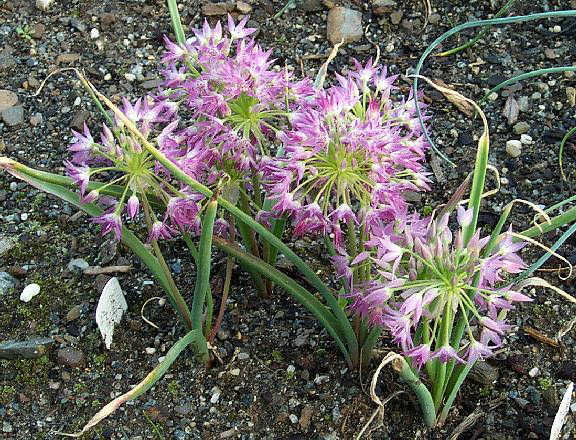
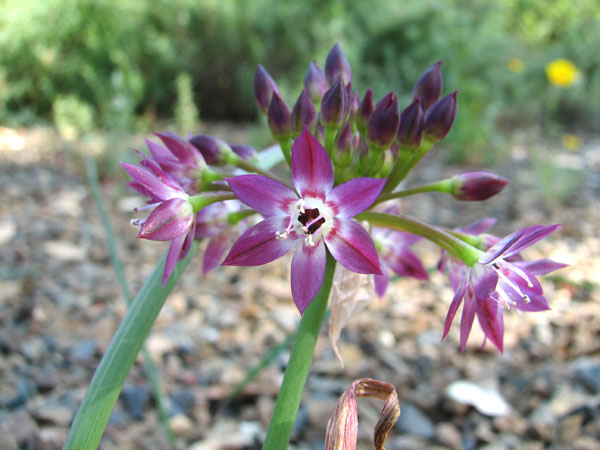
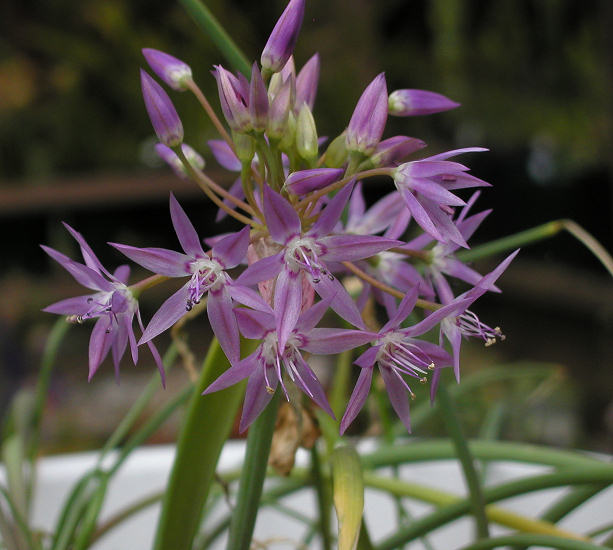
The photos below were taken in habitat by Nhu Nguyen on July 17, 2009 in the high Sierra Nevada near Sonora Pass. In this area there are two slightly different color forms. Both of these are found on sandy soil in full sun.


Allium canadense L. "red bulbil form from Texas" - Typical Allium canadense is best avoided as a weed because most of the flowers are replaced by bulbils, and aside from being ugly, the bulbils drop off and start new plants. Over the years I've kept just this one form with its white red-tipped bulbils, occasionally sputtering forth a white bloom or two. With the green sprouting tips to the bulbils, I thought the plant had a whimsical appearance and was thus appealing. Each year I would cut the stems off, then bag and discard the promiscuous propagules. Now I wish I had kept a few, because last summer a wild animal dug up and ate the clump! (there are foxes in the yard, and they've taken to digging and eating some alliums, particularly A. paniculatum). Photo by Mark McDonough.

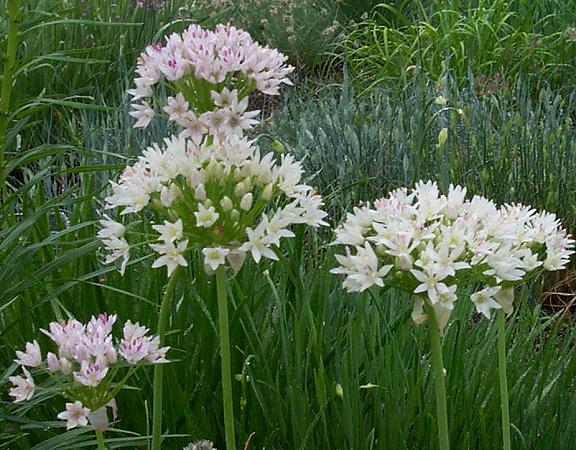
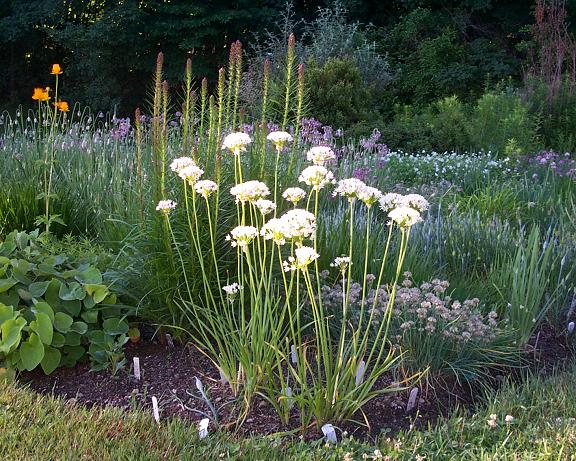
Allium canadense forma florosum - This is a rare non-bulbilliferous form of the weedy A. canadense, the type species being weedy on account of the many bulbils that replace the flowers. The plants shown here were collected by Thad Howard in Texas, found in a couple locations growing amongst millions of the normal weedy types. This name, proposed by Thad Howard, has not yet been published, yet this is a highly ornamental form with large heads of white to barely tinged pinkish flowers, and rarely 1-3 obscure bulbils. In the second "garden view" of the same plant, you can see what a fine statement it makes in the garden, growing to about 30" (75 cm) tall, flowering in June. Photos by Mark McDonough.
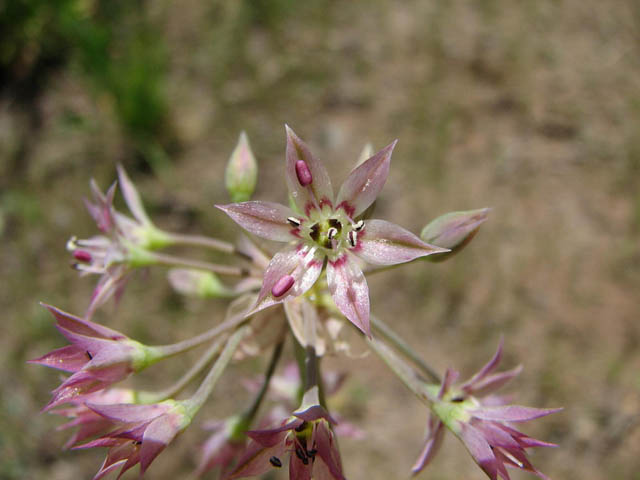
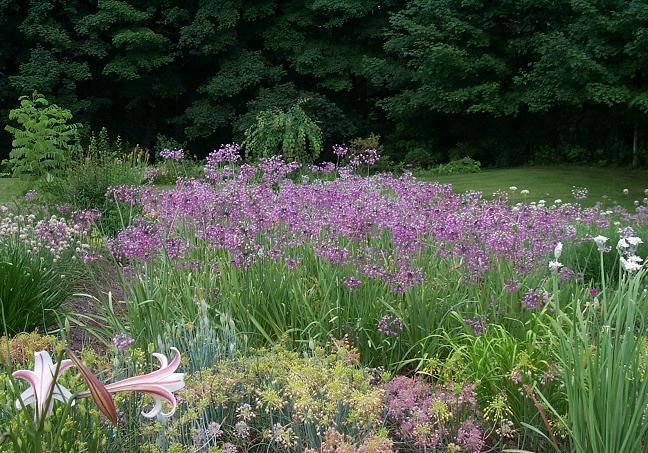
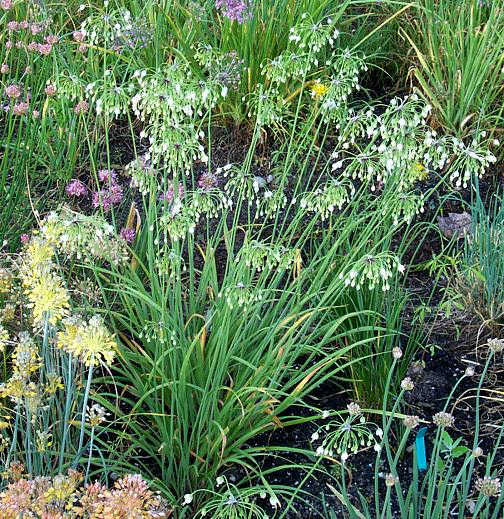
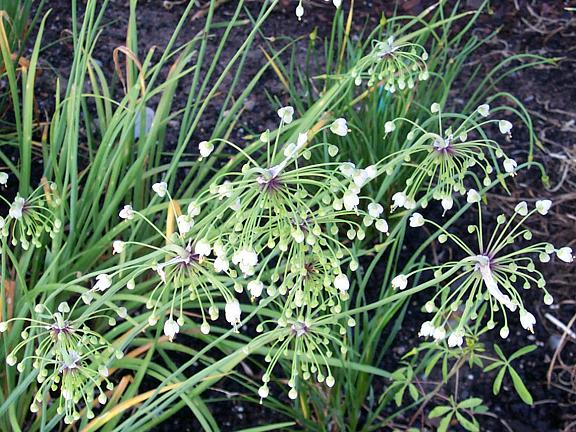
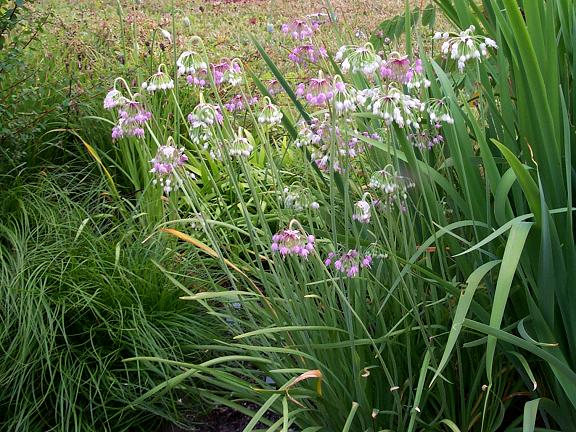
Allium cernuum Roth, the nodding onion, hails from most states within the USA (and up to Canada) and therefore is extremely variable. Height range: 30-45 cm. The first 4 photos of a massed planting from Mark McDonough. In the first view, we see prolific blooms on a tall rose purple form of the "nodding onion" flowering in late June. In the lower left corner of the photo is Lilium formosanum var. pricei. In the second we see 4 nodding buds. It is clear why the "nodding onion" received such a common name, when one views the drooping buds. In this view the buds are just breaking through the bud spathe. The third is a similar view to the preceding, but here the flowers are open, showing nice pink rotund florets, hanging downwards. The final shot is a "good pink form" - the tall stems growing up through the invasive Campanula takesimana. The last two photos from Travis Owen are of a seed grown Allium cernuum, flowering for the first time in July of 2015.

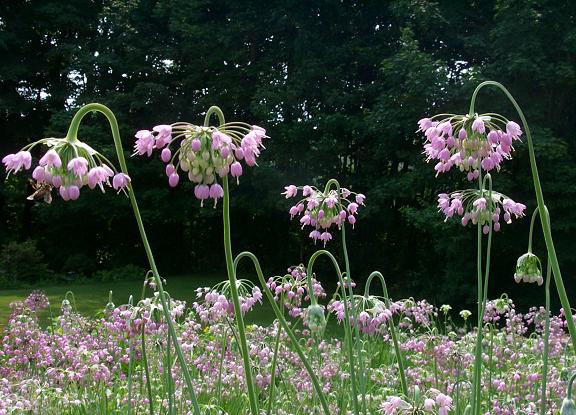
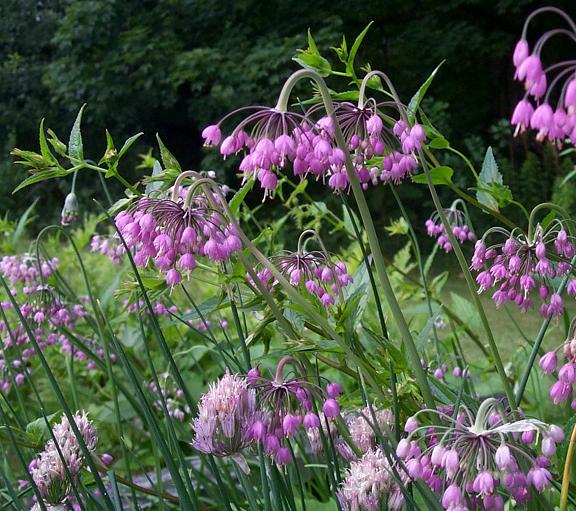
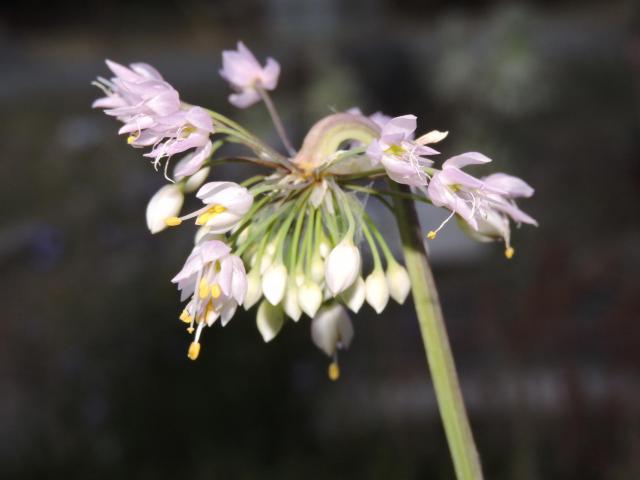
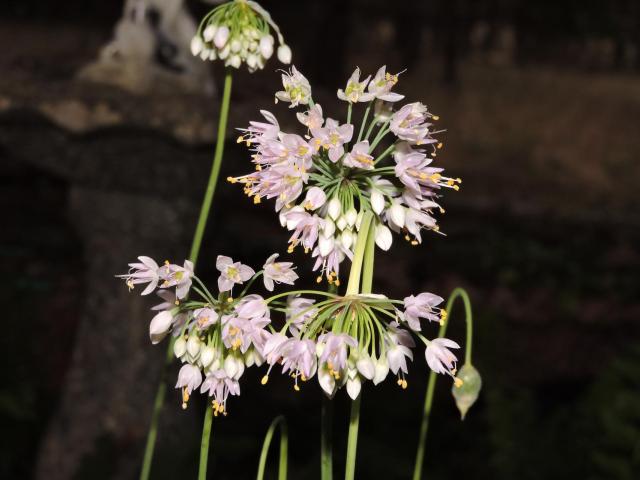
Allium cernuum 'Leo' - one of my favorite cultivars, with tall, stiff stems to 30" (75 cm) or more, topped with clusters of white flowers (sometimes showing a tinge of pink in cool weather) that are denser than normal. Also distinctive in it's late flowering, in full bloom in mid August. The foliage is also shorter and neater than most cernuum forms... could have some A. stellatum blood in it. In the last two close-up views of the flowers the very short and tight "crook-necked" buds, the later than normal flowering period, along with the sideways disposition of the inflorescence, indicates some A. stellatum influence. Photos by Mark McDonough.
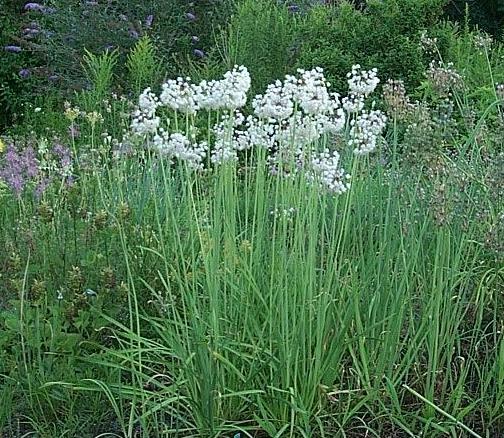
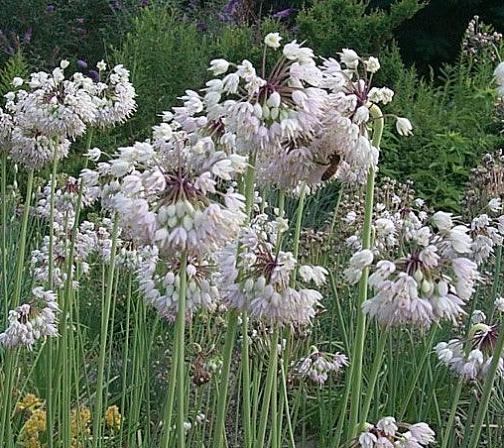
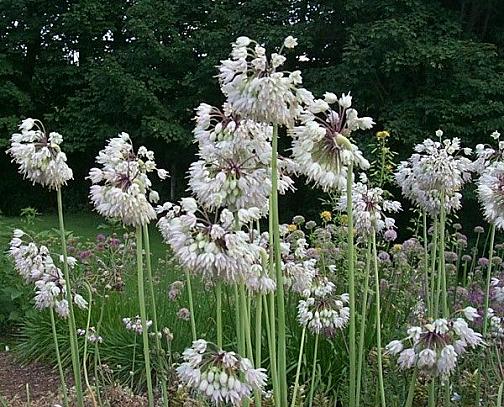
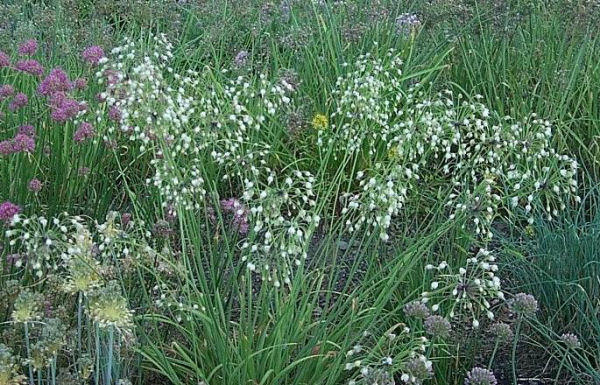
Allium cernuum 'Oxy White' (syn. A. oxyphilum) - I've tried photographing this delicate beauty for years but never really captured the essence of this fine plant. From southeastern USA, once regarded as a separate species (A. oxyphilum), most authorities now regard this as merely a form of A. cernuum , as do I. It's a most airy and delicate plant, with slender stems, and thread-thin pedicels holding little white flower droplets. In the last photo, seedlings of A. cernuum 'Oxy White' show lots of variation and a tendency back towards normal cernuum appearance. Photos by Mark McDonough.
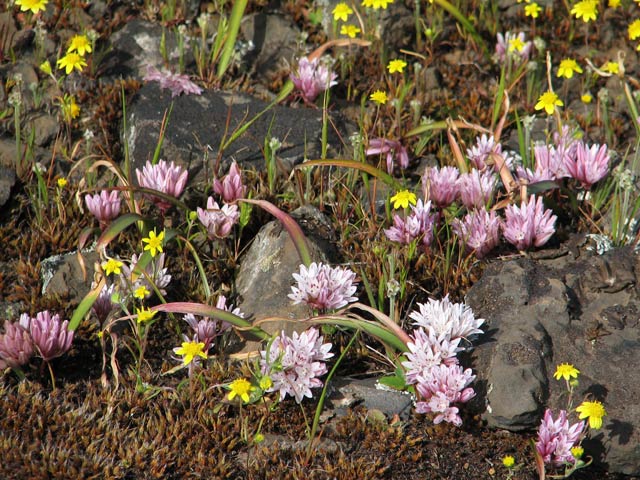
Allium cratericola Eastw. is a lovely little onion restricted to California. It is most often observed in the wild in Table Mountain in Butte County. The inflorescence stays appressed to the ground. In California, it tends to bloom much earlier than other onions, often times forming seeds by the middle of April. It can tolerate a variety of substrates including serpentine, volcanic, and granitic sediments. The key to cultivation is that the medium must be well drained with some organic matter. It likes being in full sun. Winter water is necessary, but a dry summer dormancy is extremely important. Photos by Nhu Nguyen. Photo 1-2 were taken at the Tilden Botanic Garden.
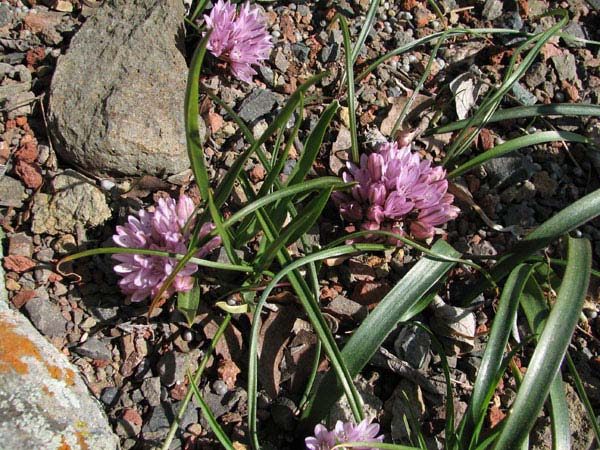
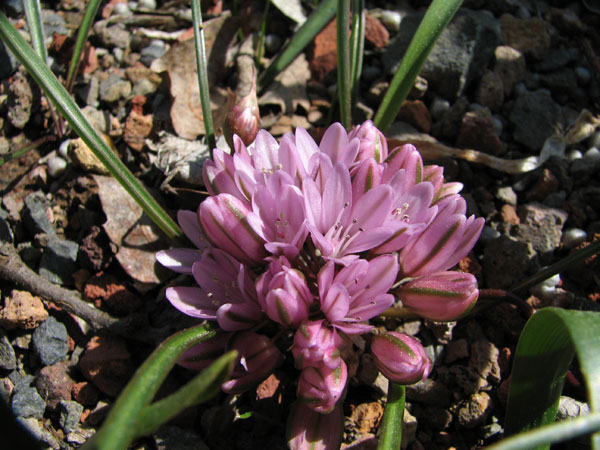
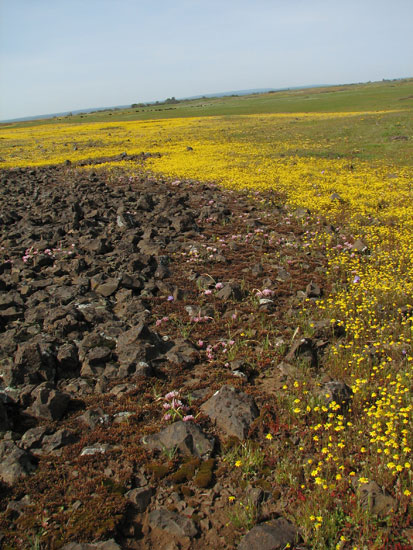
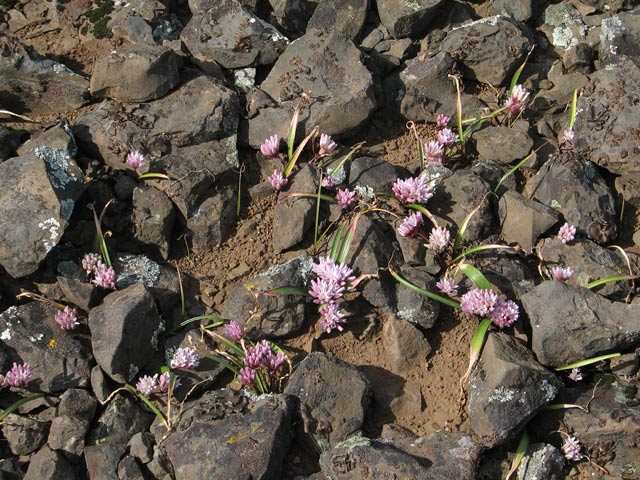
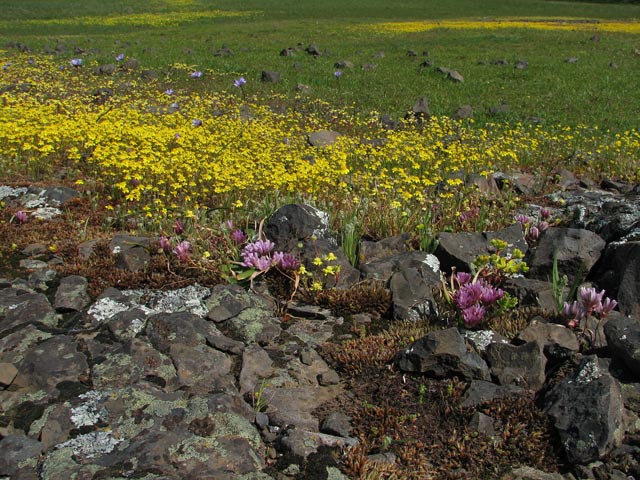
The photos below were taken on Table Mountain in Butte County. They show various color forms and this species growing with other geophytic friends.

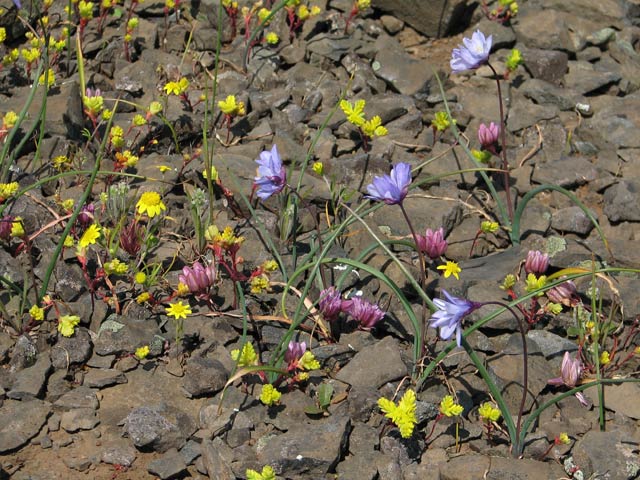
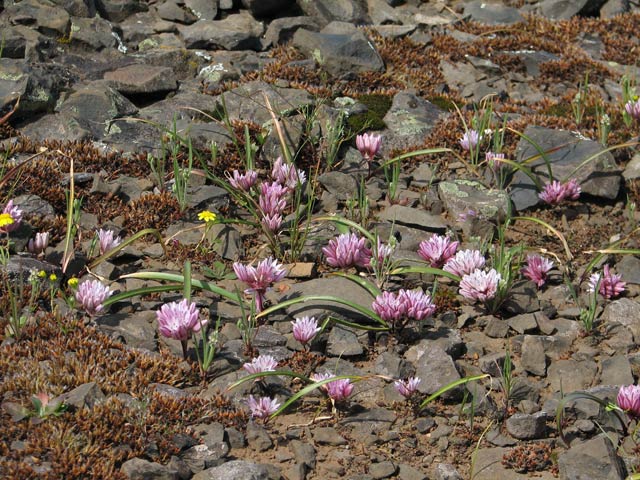
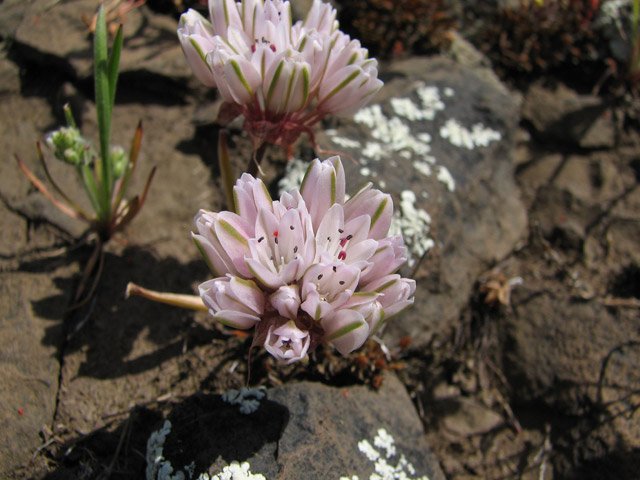
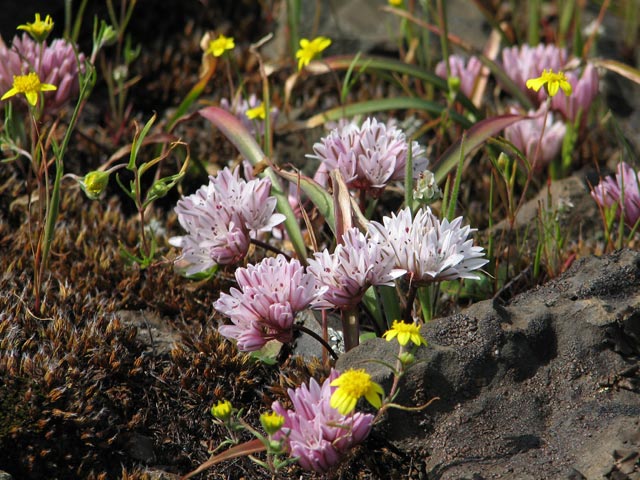
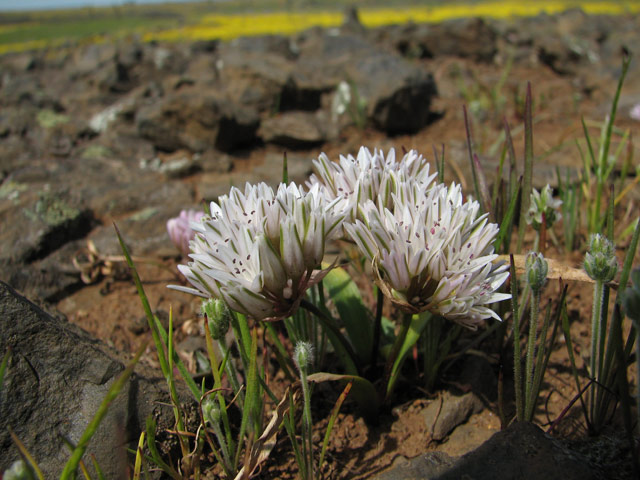
Allium crenulatum Wiegand or Olympic Onion is a species native to Oregon and Washington states and British Columbia. The species is variable in its Oregon range and tend to be more uniform in the more northern range. Plants flower from late May to July on talus slopes and clay soils, including serpentine. Height: to about 20 cm. Photos by Kathleen Sayce taken on Saddle Mountain in NW Oregon.
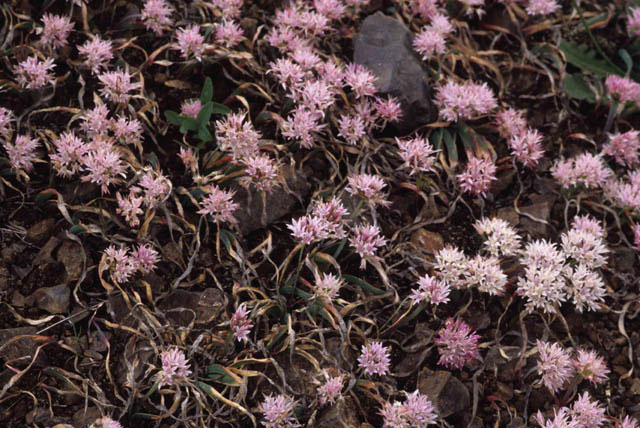
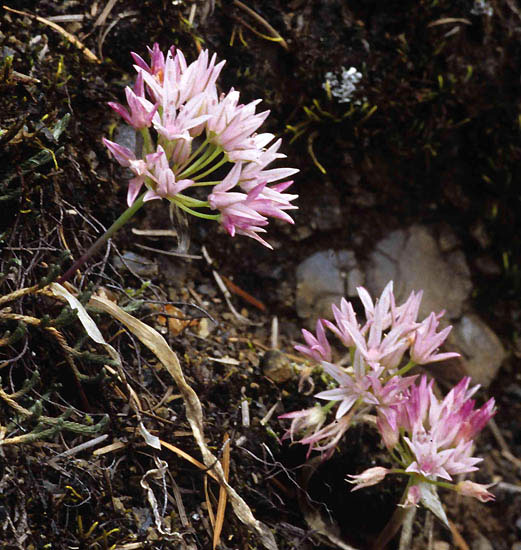
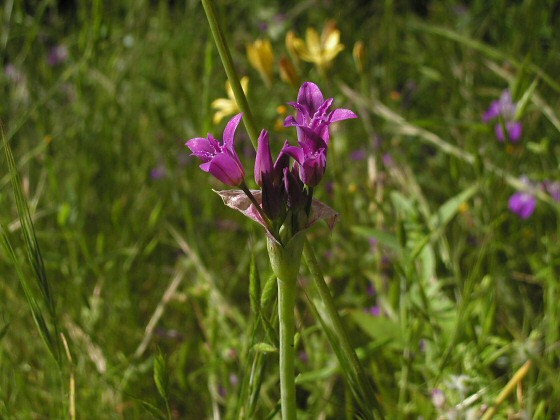
Allium crispum Greene is a species that grows in the coast ranges of California south of San Francisco in clay and serpentine soils. This is a long blooming Allium. The photos below were taken in situ by Mary Sue Ittner April 2005 in an especially wet year. Height range: 10-20 cm. Photo 1 shows a flower in bud in Pinnacles National Park and photos 2-3 are of flowers blooming along a bank on Jolon Road in Monterey County. Photo 3 shows it with a light colored Collinsia heterophylla Buist ex Graham. Photo 4 taken at Figueroa Mountain.
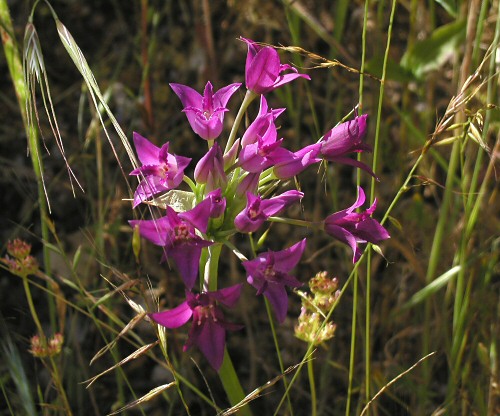
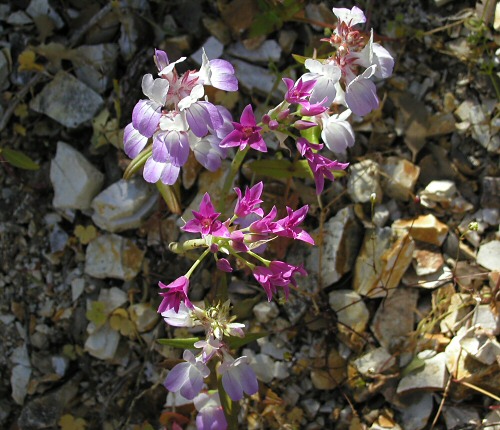
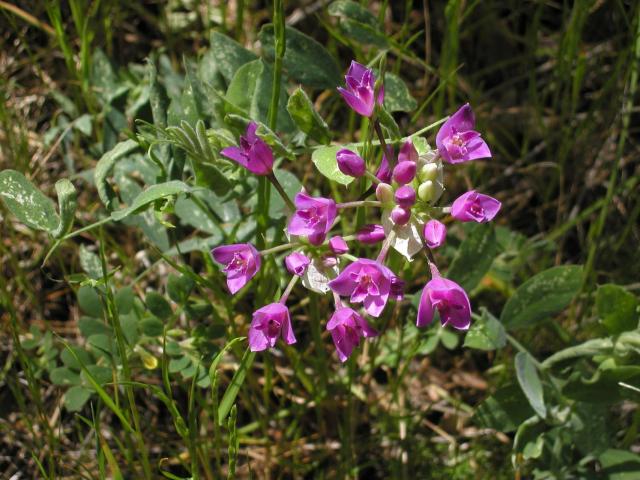
The photos below are of cultivated plants. Photo 1 was taken by Mary Sue Ittner in 2004 showing flowering plants she is growing. Photos 2-5 were taken by Nhu Nguyen. Photo 2 shows the crinkled edges of the petals, thus giving this species its specific ephithet, crispum.
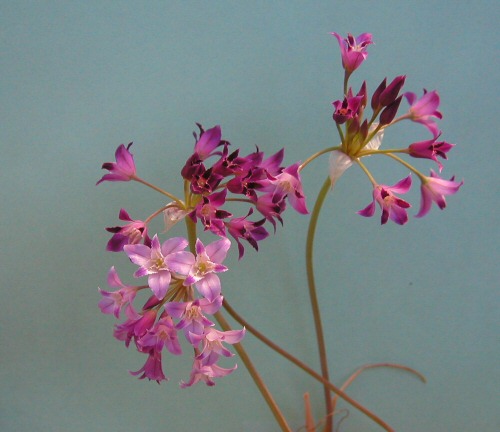
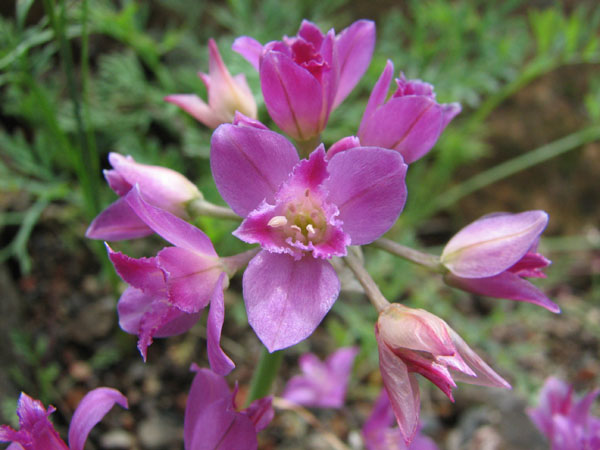
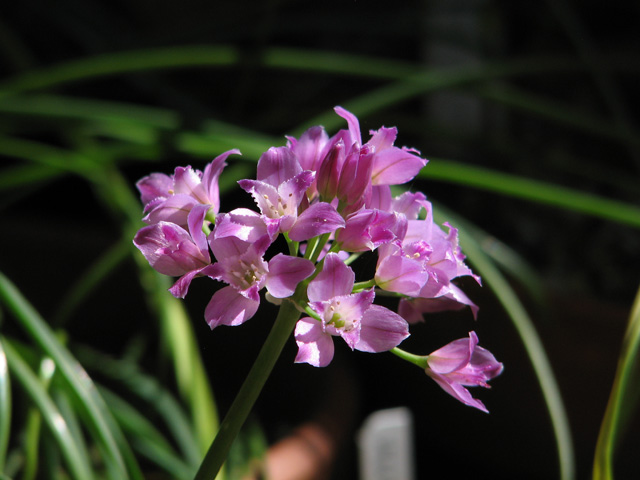
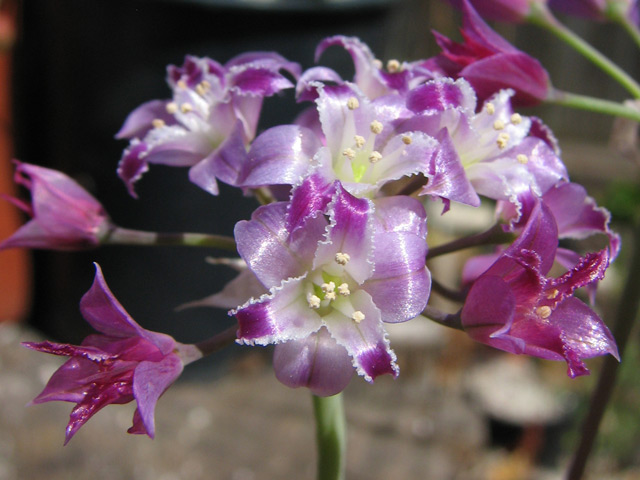
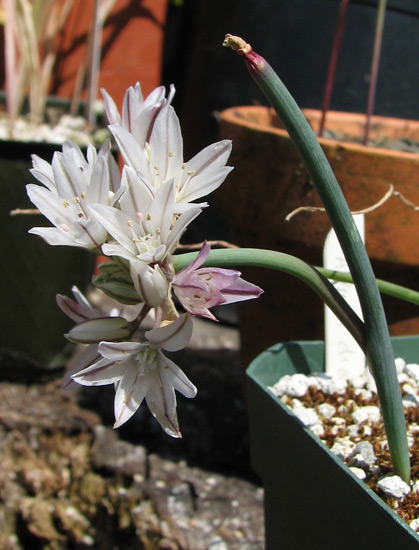
Allium diabolense (Ownbey & Aase ex Traub) McNeal (syn. Allium fimbriatum var. diabolense Ownbey & Aase) is a California species found south of San Francisco Bay in the Inner South Coast ranges where it is often found growing in serpentine. It has white flowers with pink midveins and one leaf. Height: about 20 cm. Photos 1-2 were taken by Mary Sue Ittner of plants growing on Figueroa Mountain in Santa Barbara County.
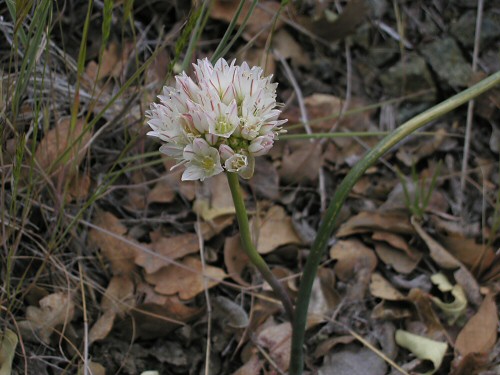

The photos below were taken by Nhu Nguyen of plants in cultivation. Photos 1-2 were taken at the UC Botanical Garden.
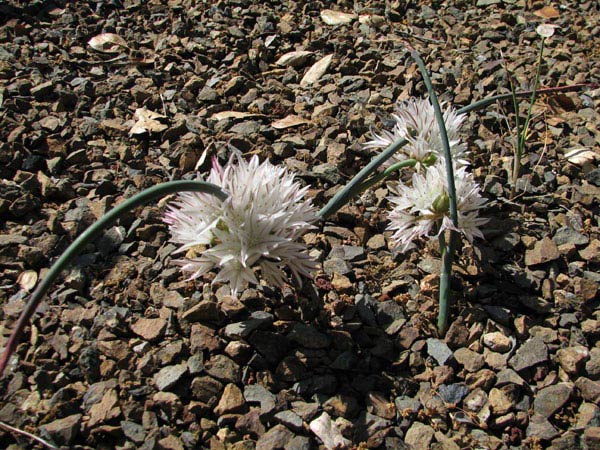
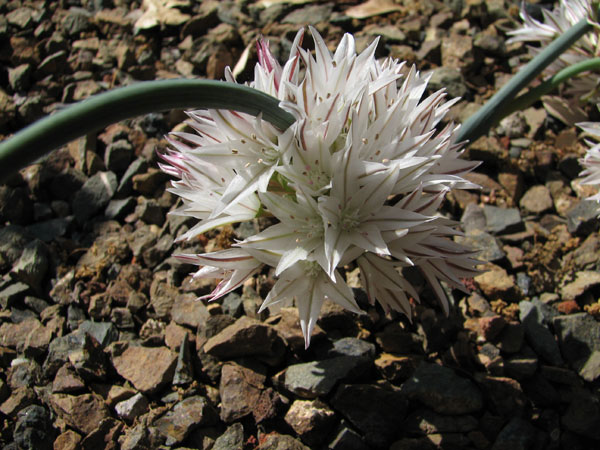

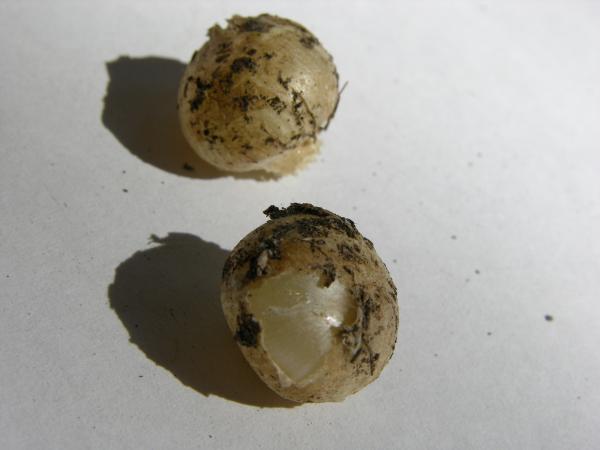
Allium dichlamydeum E. Greene grows near the coast in Northern and central California. The inflorescence is medium pink. The Flora of North America describes the bulbs as having a herringbone pattern. See the Flora's description of Allium dichlamydeum. The herring bulb pattern is on the bulb coat and this is often partly or completely missing if the bulb is dug up. The underlying bulb is white. Therefore the zigzag/herringbone pattern may not be readily apparent and in any case is more easily visible with a hand lens. Height range: 10-30 cm. Photo of bulbs by Ken Gilliland.
Since they grow on cliff faces where there is little soil, their bulbs do not bury very deep. It is one of the latest blooming of the Californian onions. These pictures by Bob Rutemoeller show it growing on the Mendocino Sonoma Coast in bud on a coastal bluff, in bloom in the same spot a few weeks later, and a close-up. The fourth picture shows it growing in a wild rock garden where it would be difficult for predators to get it, and almost two months after the first pictures in mid July 2003 it is still in bloom, now with Dudleya farinosa (Lindl.) Britton & Rose blooming at the same time. The final picture is a close-up of the two plants in bloom in another year.
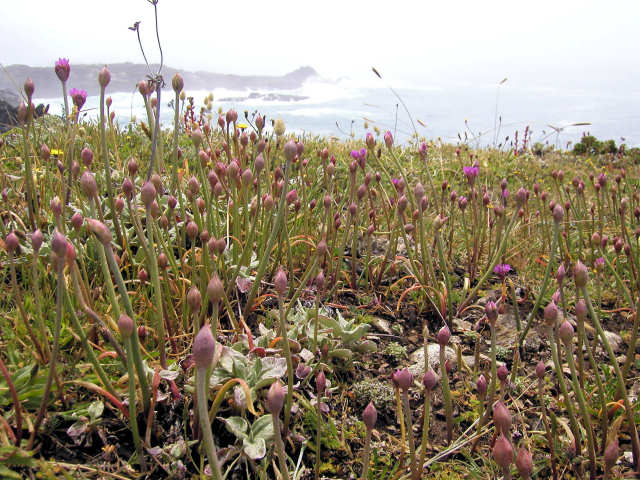
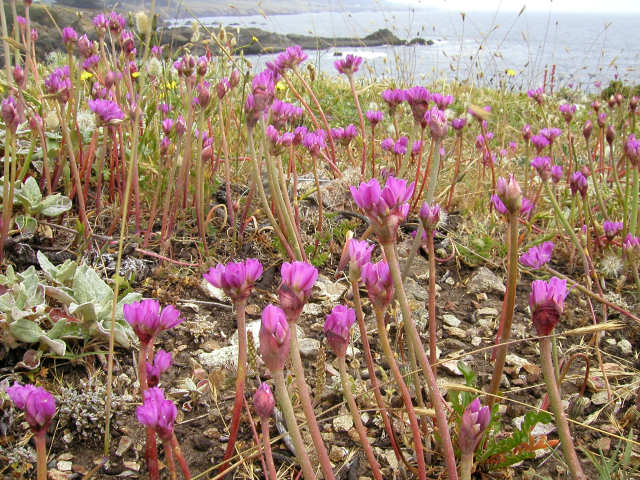
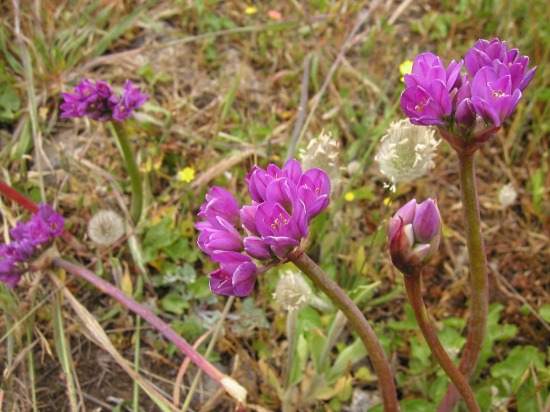
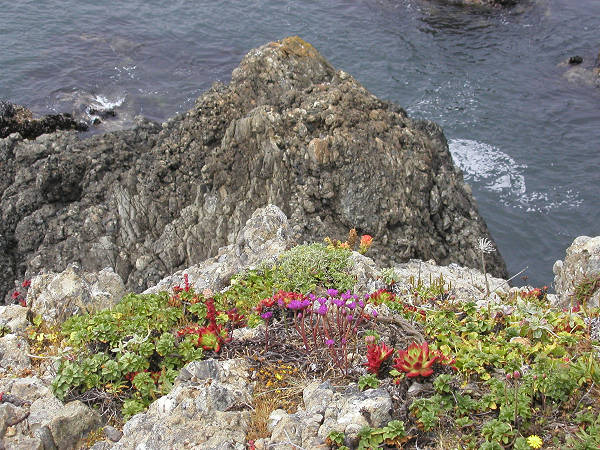

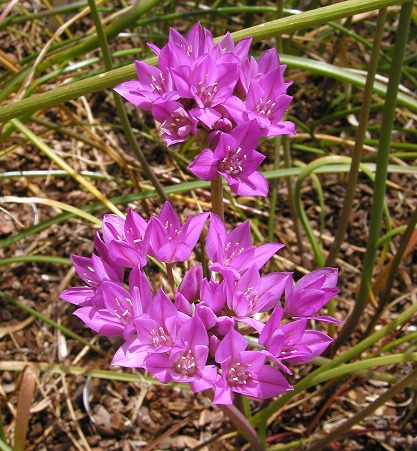
Photo 1 below shows the plants growing in a raised bed in Mary Sue Ittner's garden. Photos 2-3 by Mark McDonough show two views of this species growing in his Massachusetts garden. Photos 4-6 were taken by Nhu Nguyen of plants growing in a small pot in California. The bulbs divide well and produces a wonderful show.
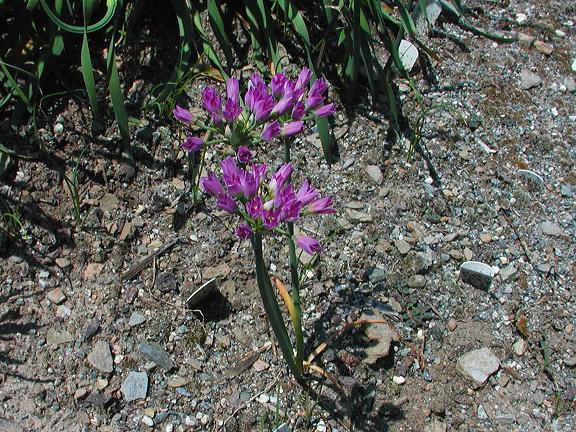
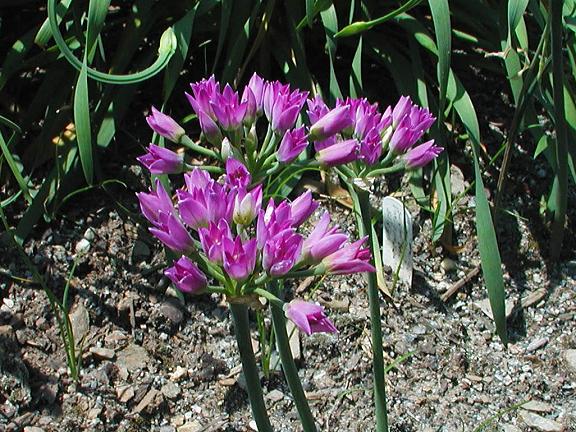
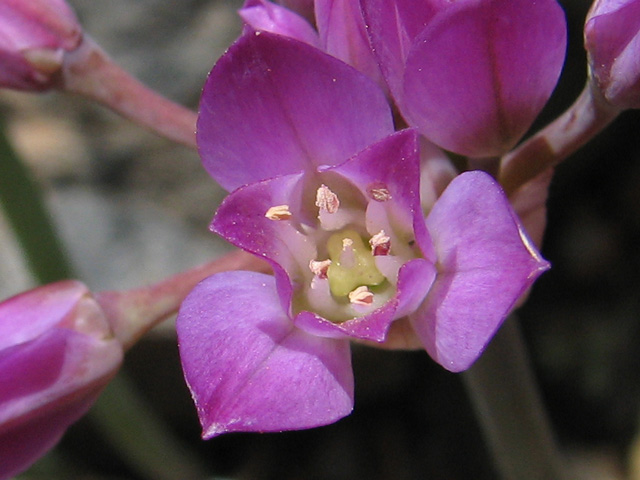
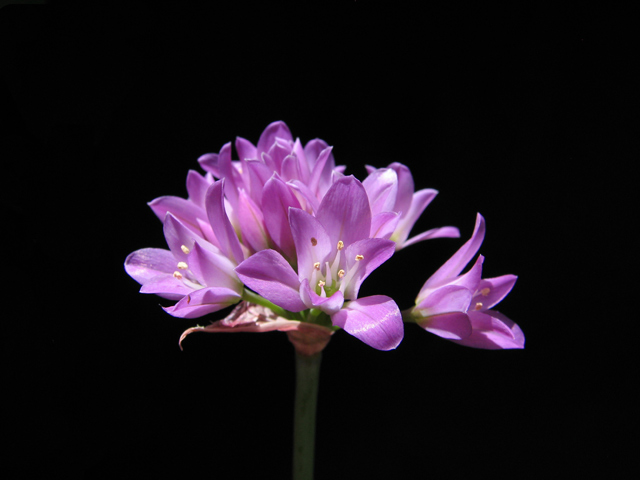
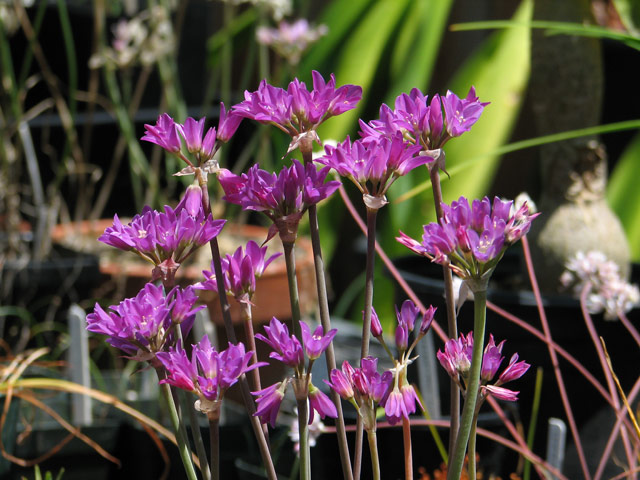
Photos below by RH. Photos three and four originally obtained as Allium falcifolium Hook & Arn. Photo four shows flowers going over and becoming pointier as they wilt, this had created some confusion for the grower.
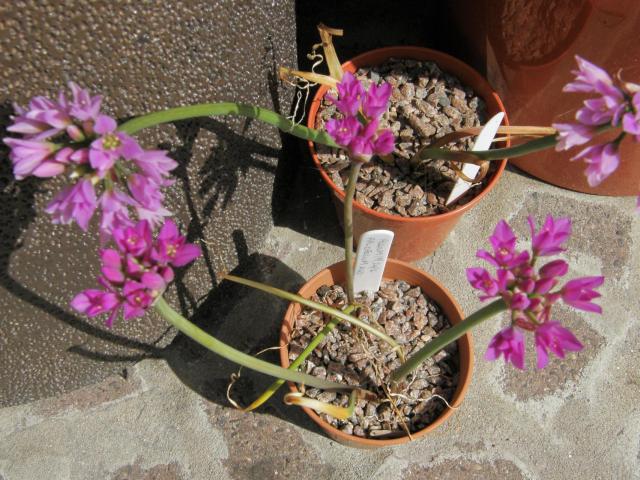
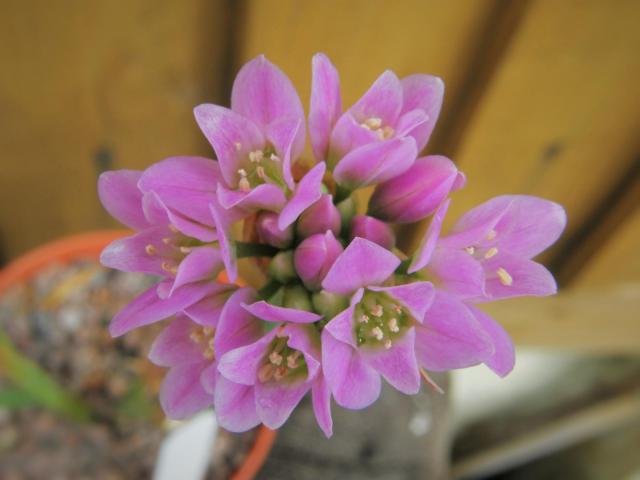
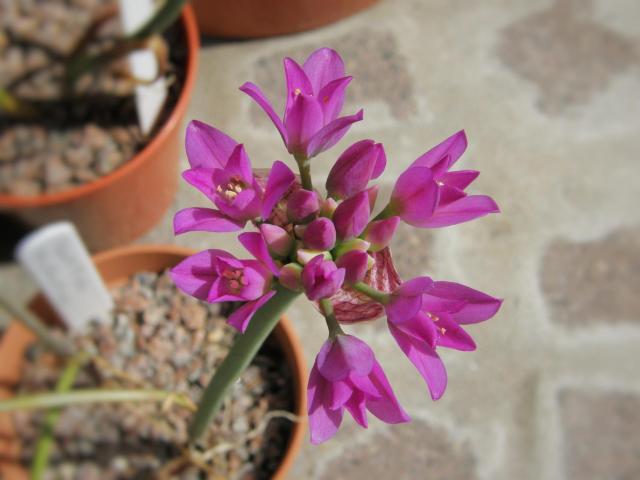
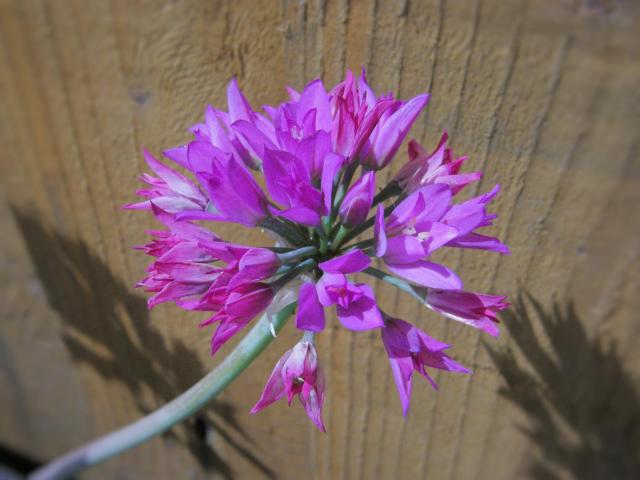
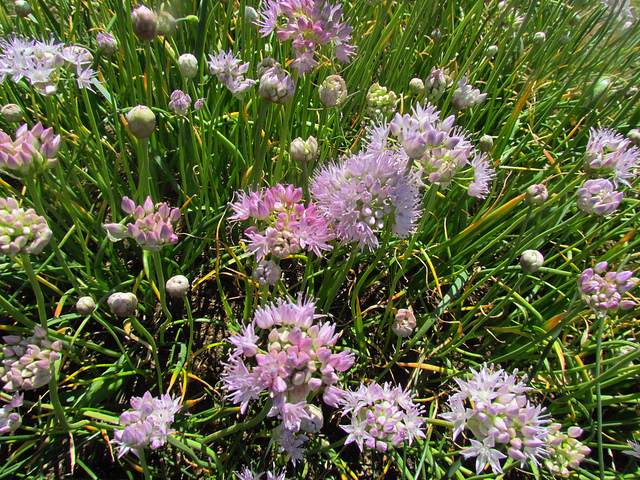
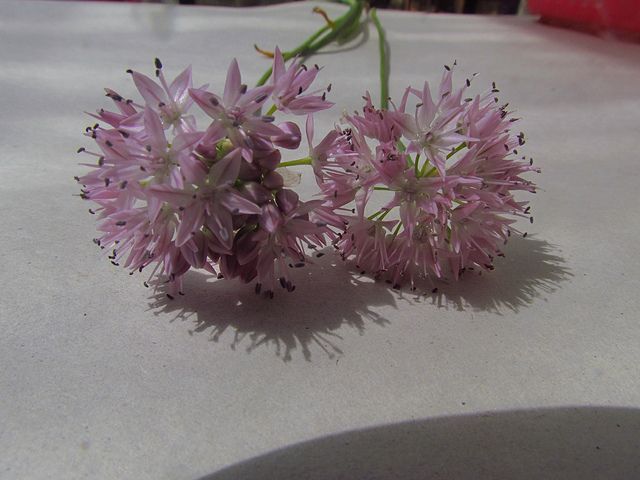
Allium douglasii Hook. is native to Washington and northeastern Oregon. This variable species prefers vernally wet soil in shallow depressions or moist slopes. Height range: to about 25 cm. Photos by Richard Haard.
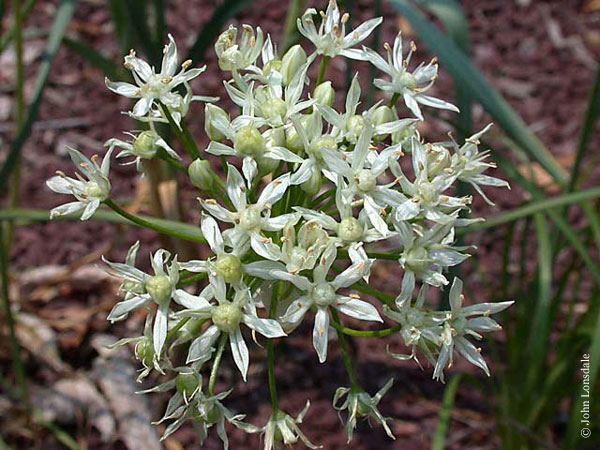
Allium eulae Corey ex T.M.Howard (synonym A. fraseri var. eulae (Ownbey) Shinners), is native to Texas where it is endemic to the Texas Highland Lake region, growing in seepy places, although hardy in more northern climates and growing well in normal well drained garden soil in full sun. Height: to about 40 cm. Photo by John Lonsdale.
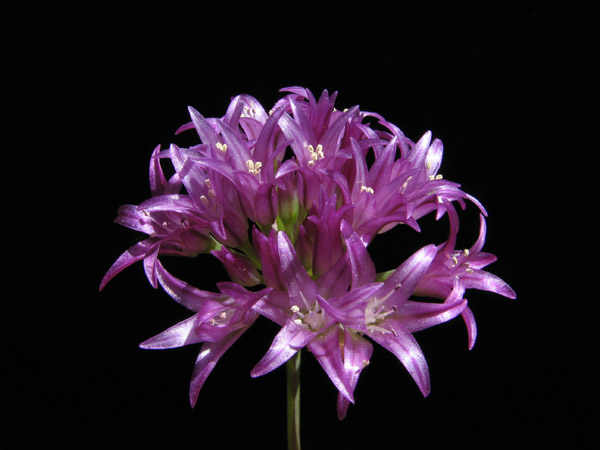
Allium falcifolium Hook. & Arn., Scytheleaf Onion, occurs on serpentine soils and outcrops from San Francisco Bay to Oregon. It is often found on slopes with excellent drainage. It is also never found too far away from oak trees, relying on the organic matter from decaying oak leaves. The hummus contents can range from 50% - 20% in the wild. The reddish or yellowish green stem is flattened such that it is thick in the center and thin along the edges. There are usually two leaves which are curved like the blade of a scythe. The flattened stem is no more than 5 cm and topped with a flower cluster of 10 to 30 bright rose-purple or maroon flowers. Individual plants in a population may be pale pink or white with darker midveins. Height range: 10-25 cm. The first photo is of a specimen grown by Nhu Nguyen. The next three photos were taken by Mary Sue Ittner and the last photo by Jane McGary.


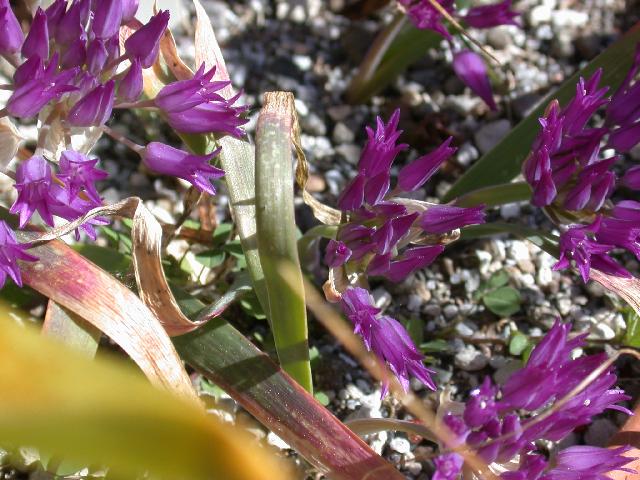
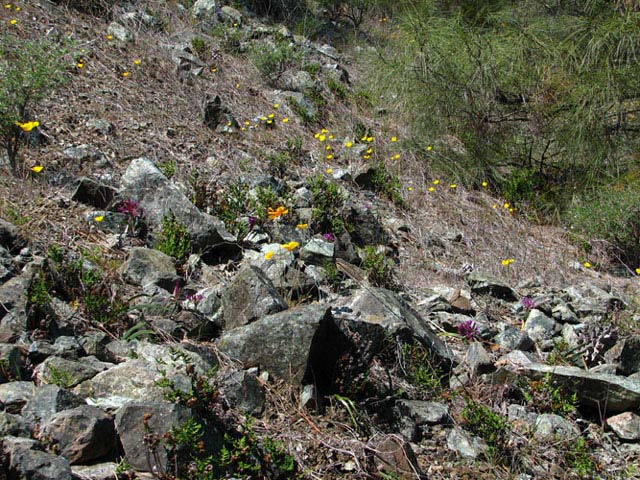
Habitat photos from Nhu Nguyen are shown below. Photos 1-2 show the habitat in Napa County where they flower with Eschscholzia caespitosa Benth. amongst the serpentine rocks. Photo 5 illustrates the sickle shaped leaves.

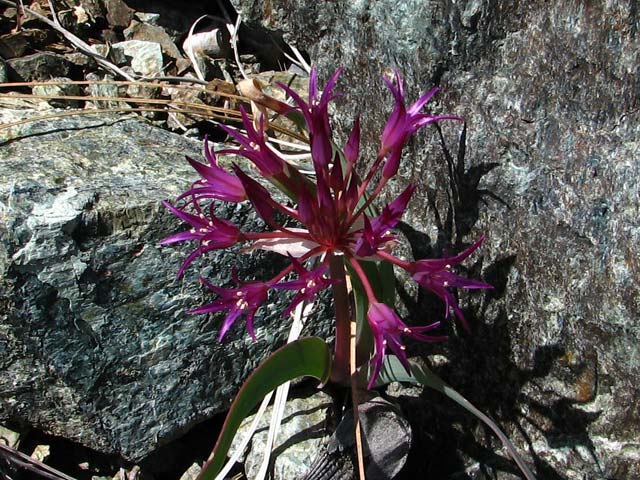
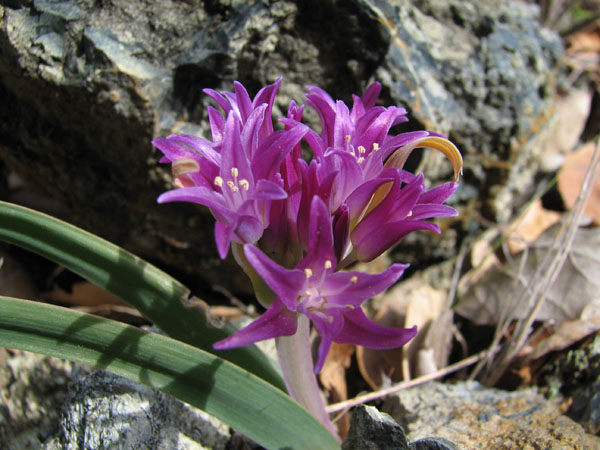
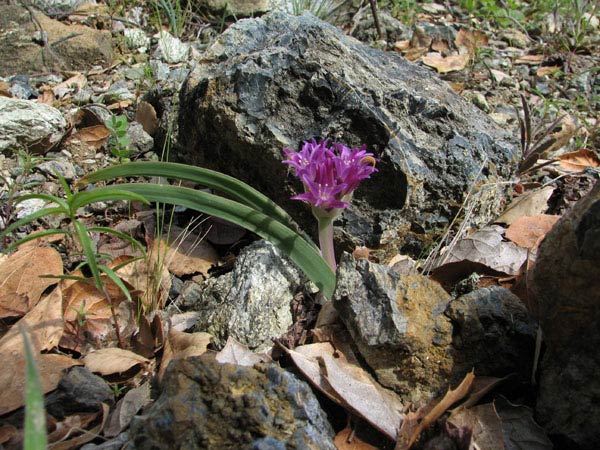
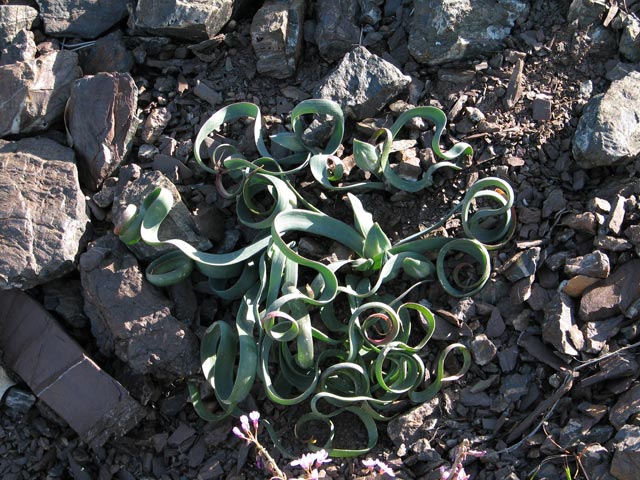
The photos below of a white/pink form were taken by Nhu Nguyen on Mount Diablo in Contra Costa County, CA. This form interestingly does not grow on serpentine. Photo 1 shows wonderfully curly leaves.
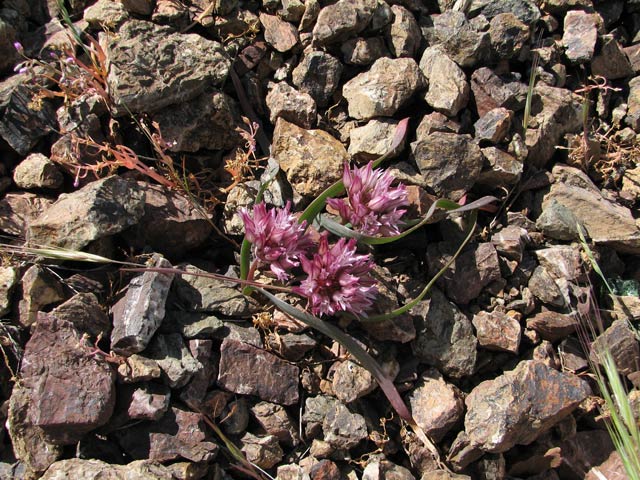
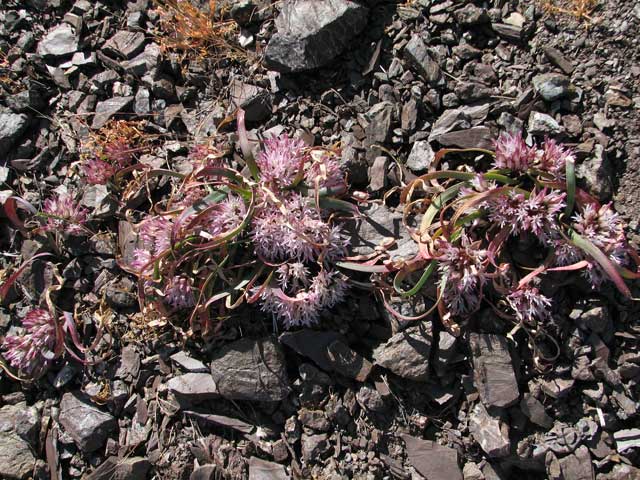
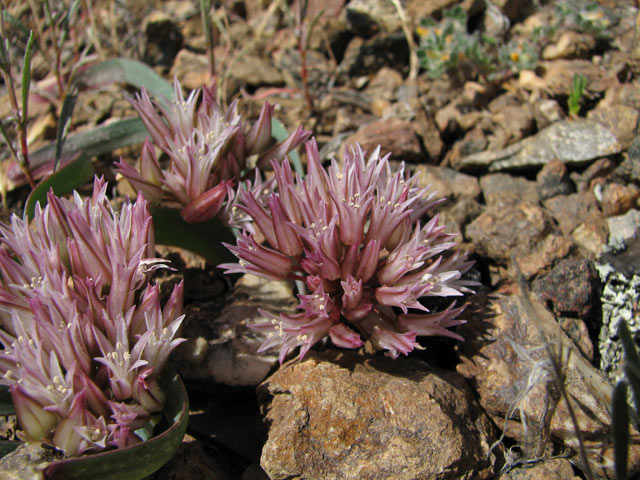
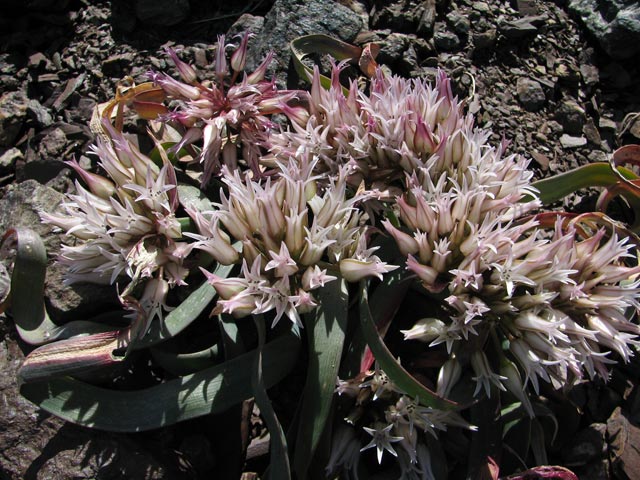
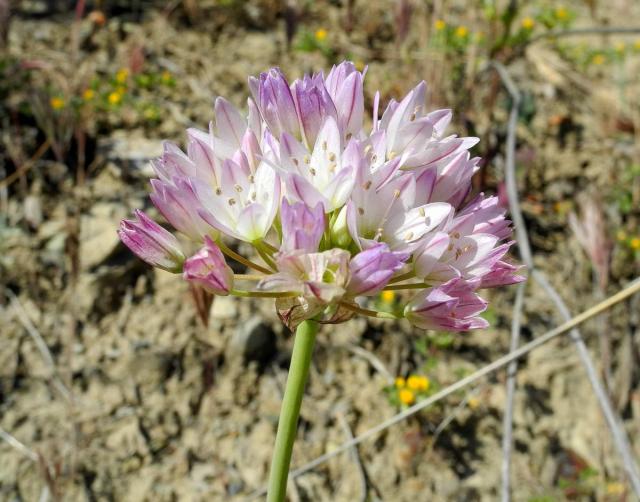
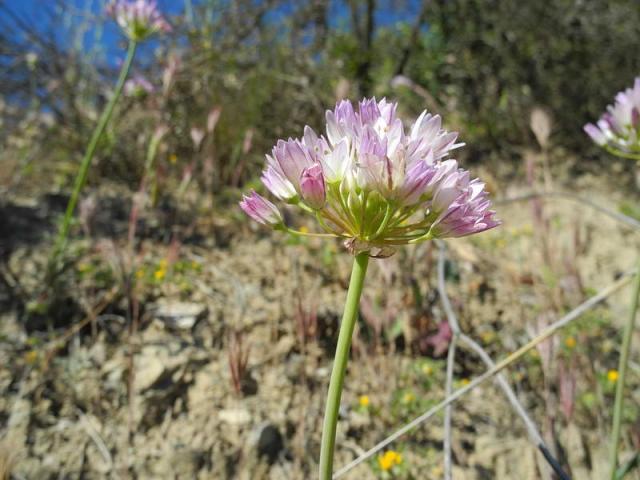
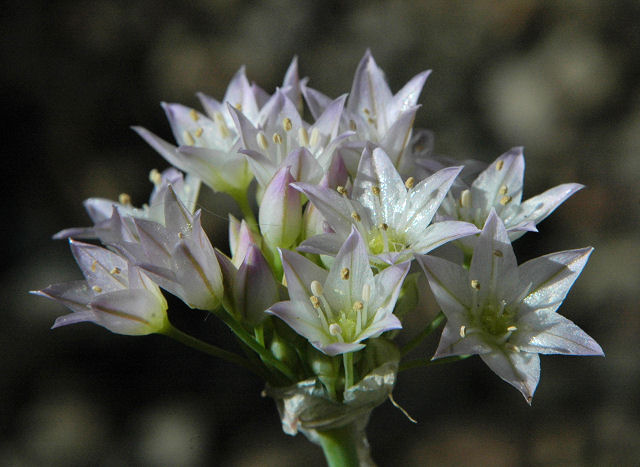
Allium fimbriatum S.Watson is restricted to California where it grows on dry, well-drained slopes. Height range: 10-37 cm. There are three varieties of the species accepted by the Jepson Manual and Flora of North America. A fourth, listed in Plants of the World Online, Allium fimbriatum var. denticulatum Ownbey & Aase ex Traub is considered by the Jepson Manual to be a synonym of Allium denticulatum (Traub) McNeal
Allium fimbriatum var. fimbriatum is distributed in California to Baja Mexico. It has rose purple flowers with flaring tips. It grows in gravelly volcanic or serpentine clays. The photos below were taken by Nhu Nguyen in Pinnacles National Park.
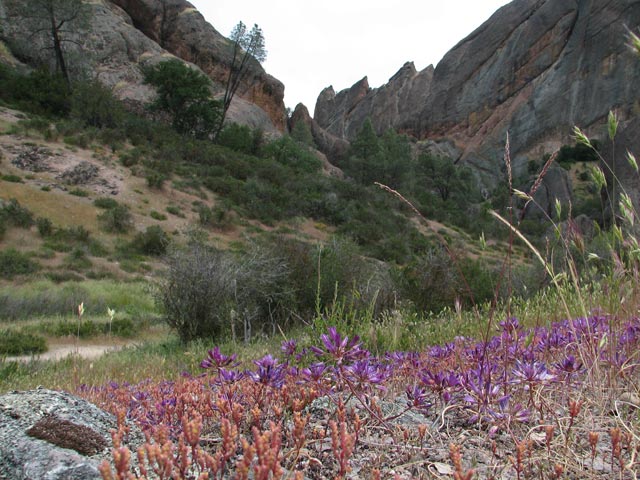
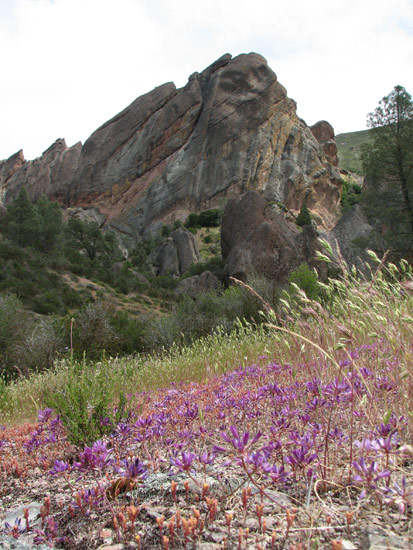
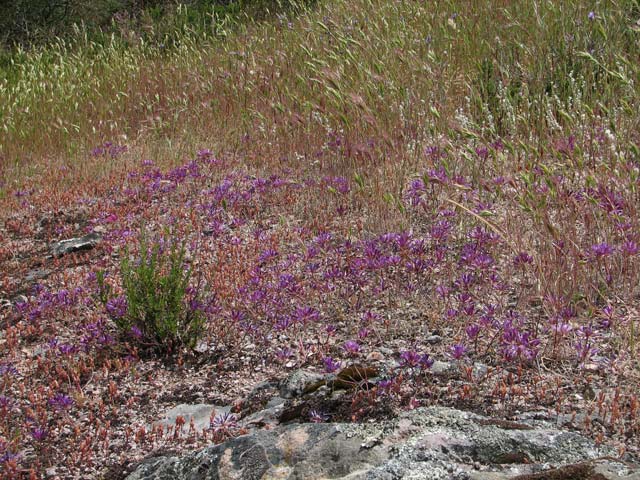
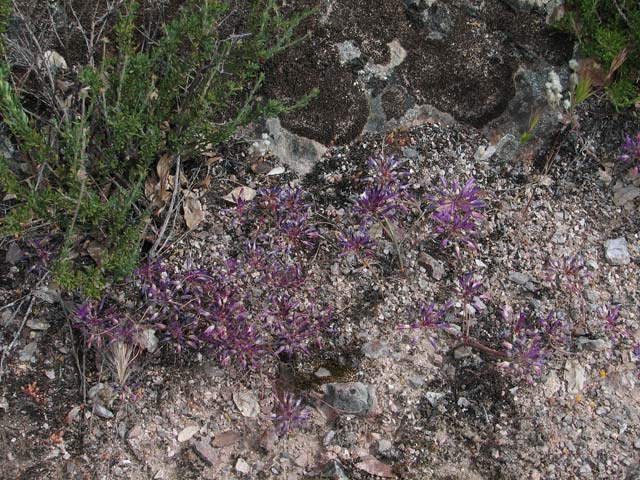
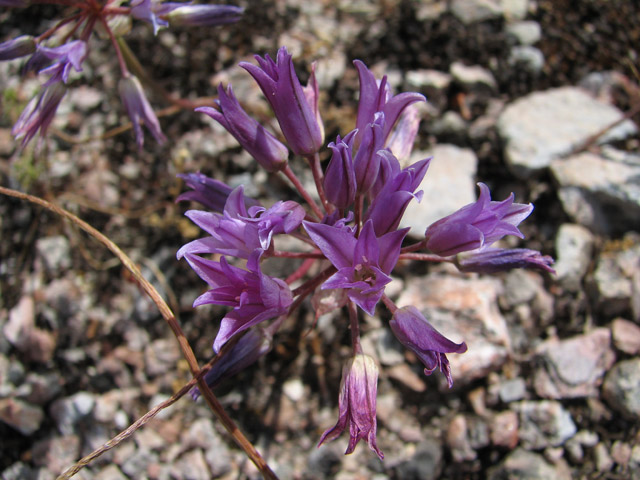
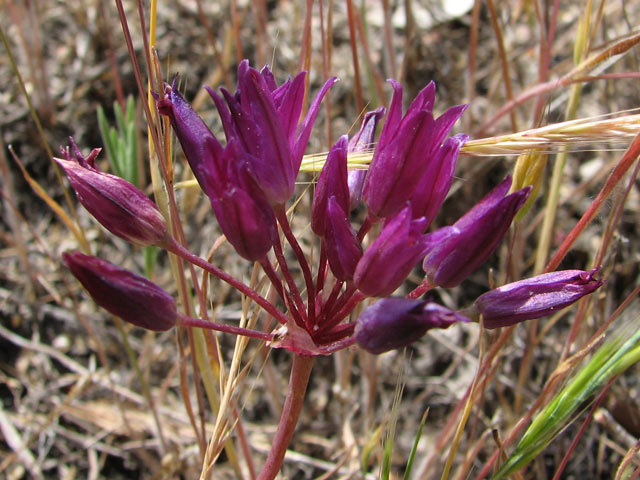
Allium fimbriatum var. mohavense Jeps. is only found in the Mohave Desert. It has flowers that are white to pink to light lavender.
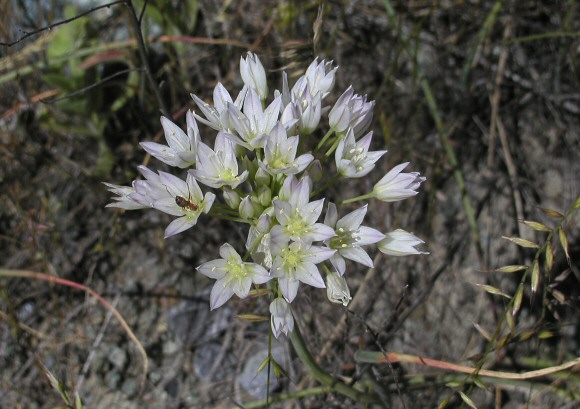
Allium fimbriatum var. purdyi (Eastw.) Ownbey ex McNeal is restricted to serpentine soil in the inner North Coast ranges (Colusa, Glenn, Lake, Napa counties). Flowers are white to pale lavender with darker midveins. The first three photos were taken by Nhu Nguyen. The second photo shows developing into seeds and the third photo shows a serpentine slope where they occur.
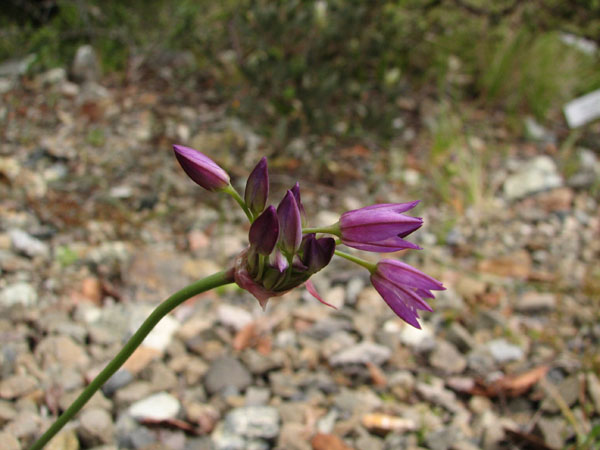
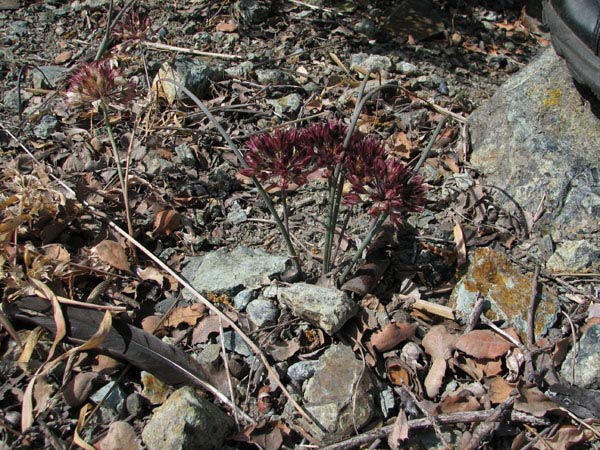
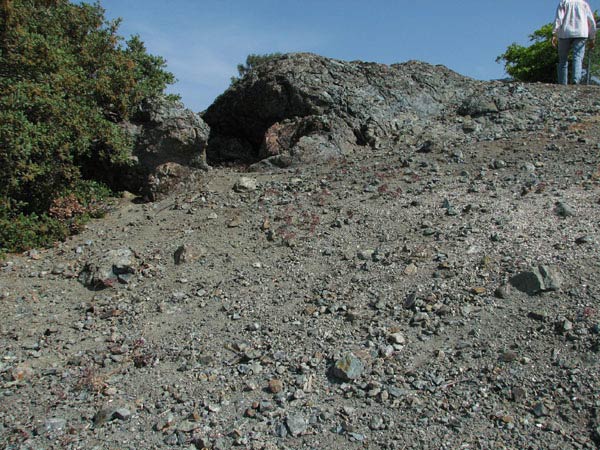
Photos below were taken by Mary Sue Ittner. The first three were taken along Bear Valley Road in April different years. They were growing along the bank next to the road. The last shows flowers of plants grown from seed collected in Lake Co. at 2150' in crumbly, flaky serpentine talus flats.
Allium index - All alliums - Allium flavum Relatives - American alliums G-Z - Big Ball alliums - Blue alliums - Chives - Domed alliums - Drumstick alliums - Rhizomatous alliums