Ammocharis is a genus in the Amaryllidaceae family from Sub-Saharan Africa that has 5 species.
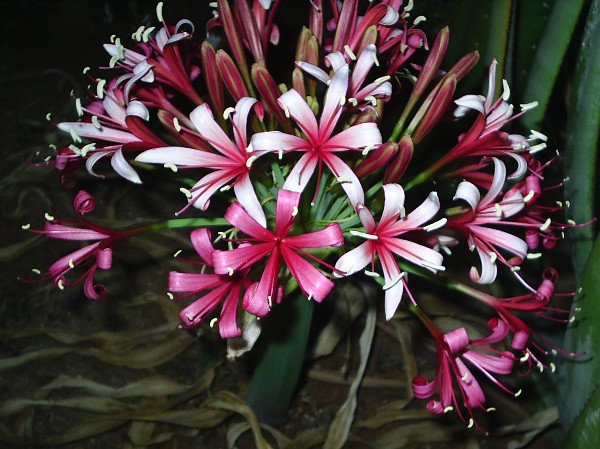
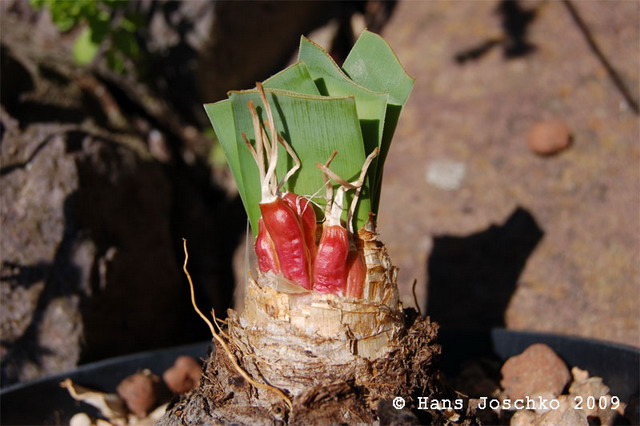
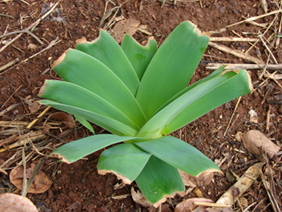
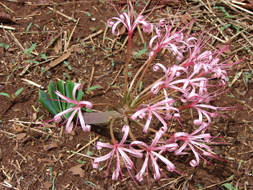
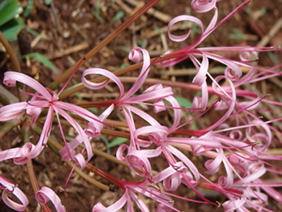
Ammocharis coranica, known as the Karoo Lily, occurs throughout the Karoo and its range extends into the eastern grassland of the summer rainfall area of South Africa at altitudes between 700 and 1500 metres on flats or in depressions which are seasonally wet, although its habitat is characterised by lengthy dry periods and severe droughts. It extends into Zimbabwe through to Kenya in east Africa. Leaves are arranged in a parallel fashion with the tip of the old leaves truncated, marked by the point where the plant goes dormant in the previous year. Cameron McMaster has provided extremely interesting information about this species in a PBS list post.
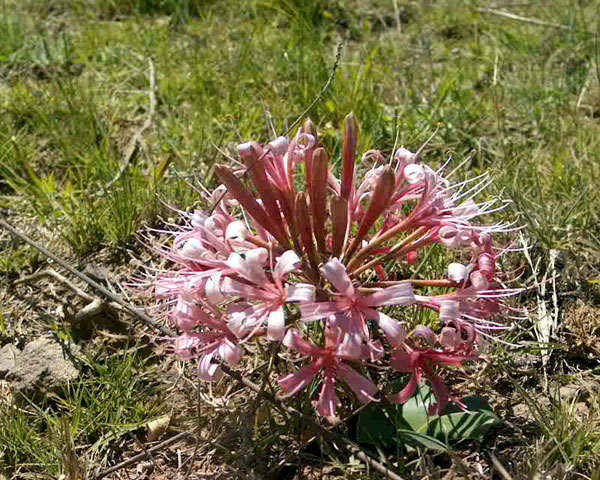
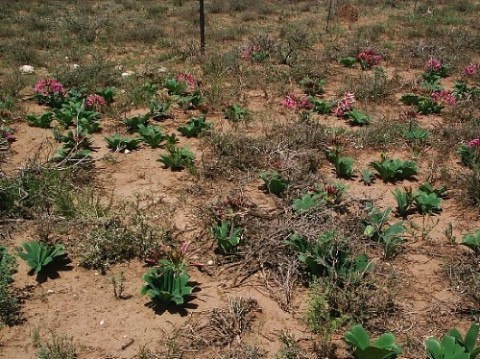
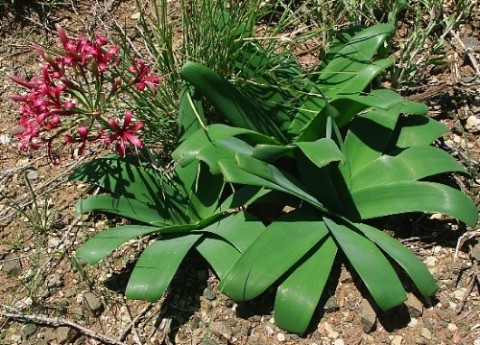
Photos below from Cameron McMaster show this species flowering after fire in grassland in the Cathcart District, flowering in habitat, growing in association with Nerine huttoniae in stony Karoo flats, and in fruit in the Willowmore district of the Karoo.
An unusual white-flowered form growing in the collection of the University of KwaZulu-Natal. Photo by Rogan Roth.
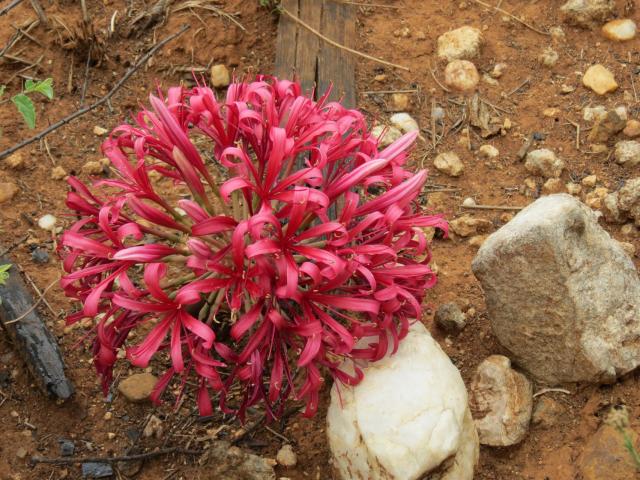
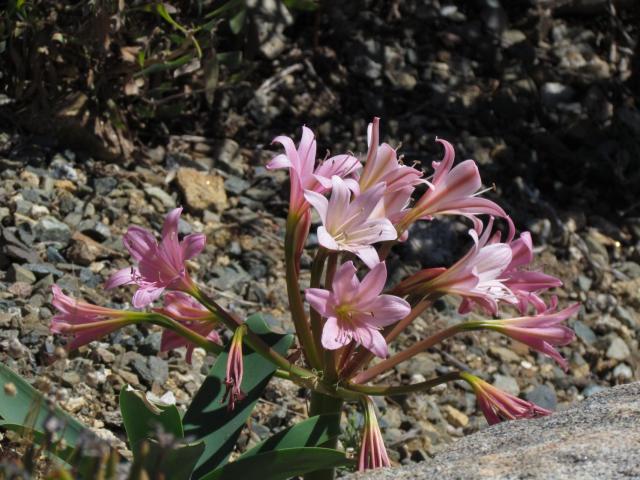
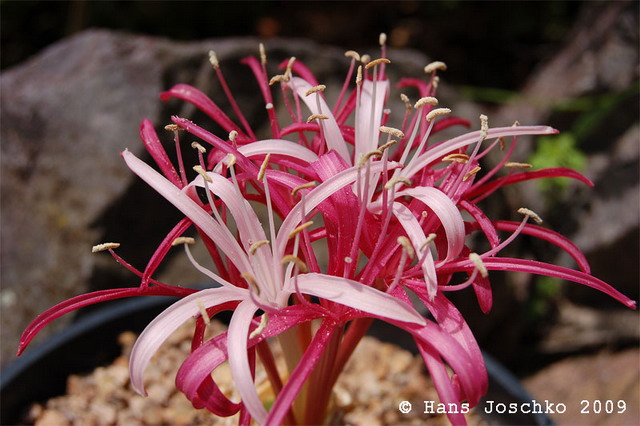
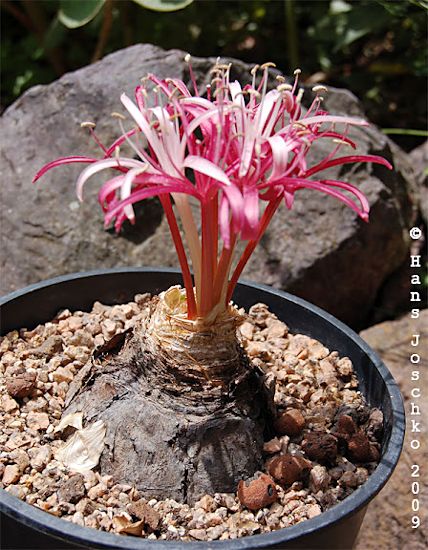
Photos below by Christiaan van Schalkwyk show this species in habitat, about 30 km west of Kimberley, South Africa. When in flower they form red pockets of colour in the veld. The flowers open from the outside inwards, about an hour before sunset. If watched closely one can see the actual opening (bursting!) of the buds. The last photo was taken late in the evening, just after the new flowers opened, and show the new lighter and the older darker flowers. This picture was taken in my garden, where the bulbs receive 25 minutes of sprinkler water every sixth day. They bloom regularly, some bulbs up to four times a season. They originally grew in a Kimberley suburb in association with Ipomoea bolusii, a Brachystelma sp., Boophane disticha, and other bulbous species in between grass. Unfortunately this area is now a high density housing complex.
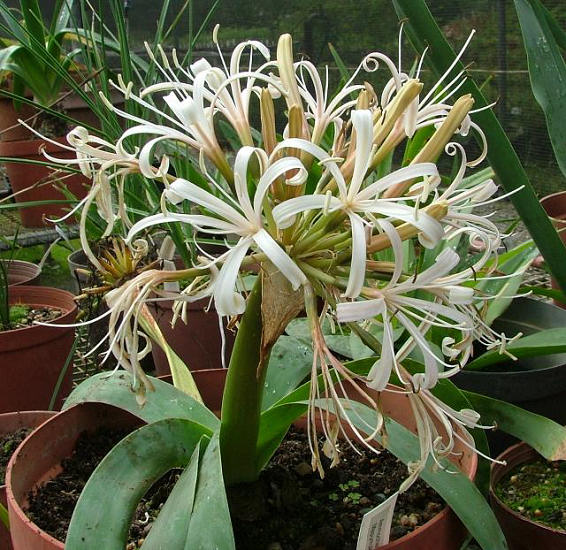
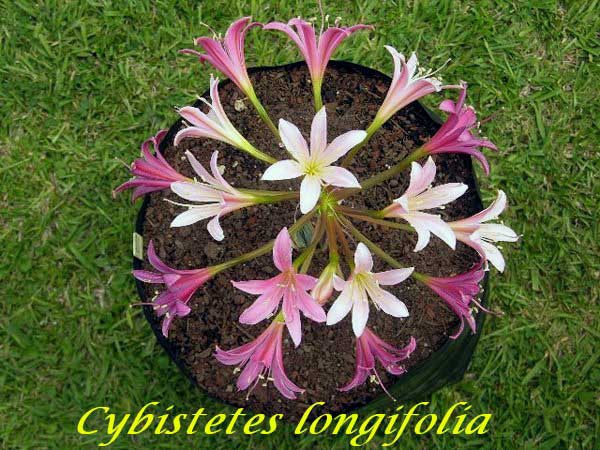
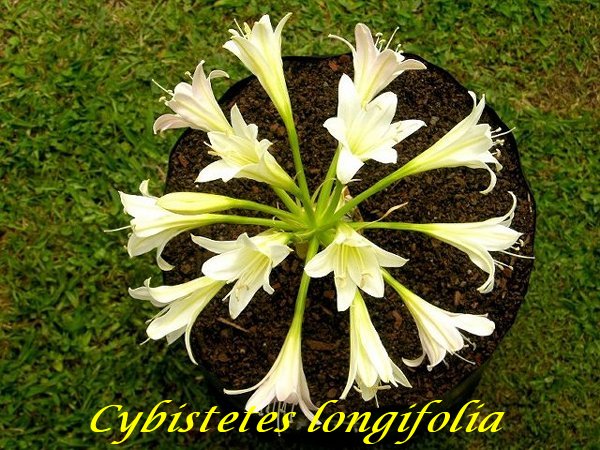
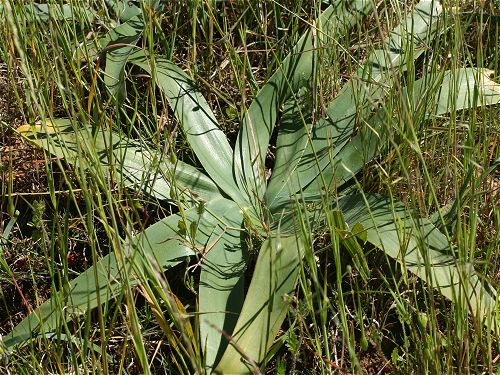
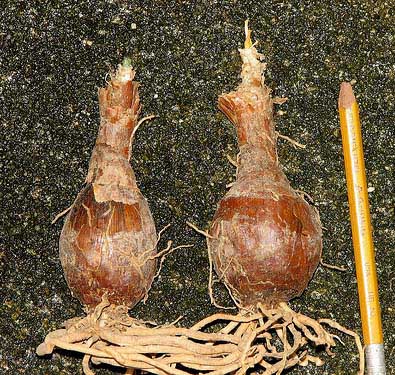
Ammocharis longifolia, syn. Cybistetes longifolia, once considered to be a single species in the genus Cybistetes, is a winter growing species found on sandy or gravelly floats in the northwest and southwest Cape of South Africa to Namibia. Flowers are ivory to deep pink. It has spreading leaves arranged in a rosette that have a cutoff appearance when mature but differs in having a specialized fruiting head in which the pedicels elongate, stiffen and spread, and radiate outward, turning it into a tumbling seedhead that drops seeds as the capsules open as it rolls. For more information about this species, see the SANBI reference.
The flowers of the first plant pictured below open whitish and then become pink-flushed, while the ivory coloured one often remains the same colour or fades to very pale pink. They are about 3 inches long, almost as wide, and strongly reflexed. There may be 20 or more of these sweetly fragrant flowers in a single umbel, which is borne on a fleshy stalk less then 12 inches(30cm) high. In the Cape they bloom during the summer months with the latest flowers appearing in the higher rainfall areas. The bulbs are quite large, the leaves are prostate on the soil surface and grow quite long. They prefer a well drained sandy soil with the bulb neck planted at soil surface and dry summers. The first two photographs from Bill Dijk. The third photograph of the leaves was taken by Andrew Harvie in the Tienie Versfeld Reserve near Darling.
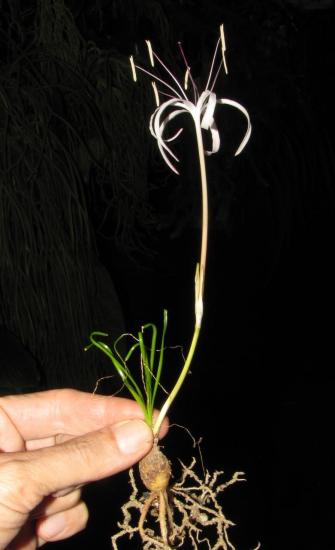
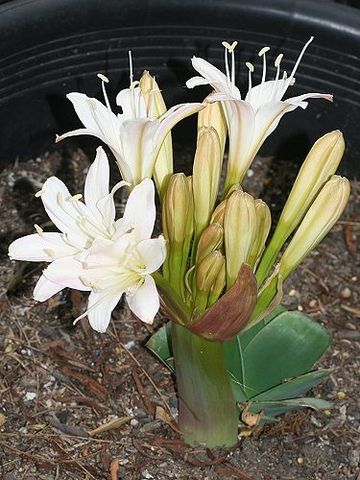
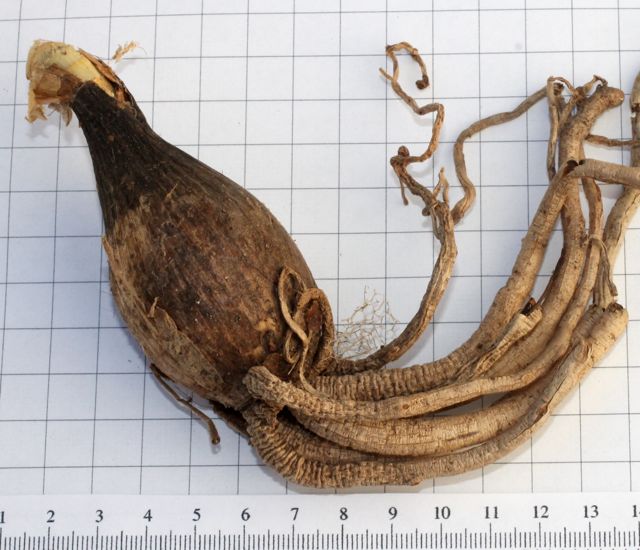
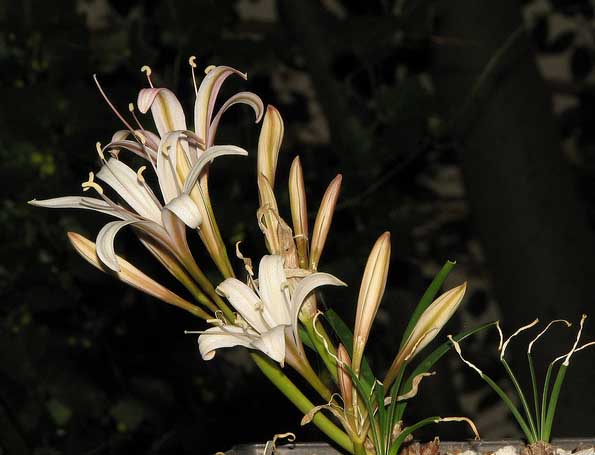
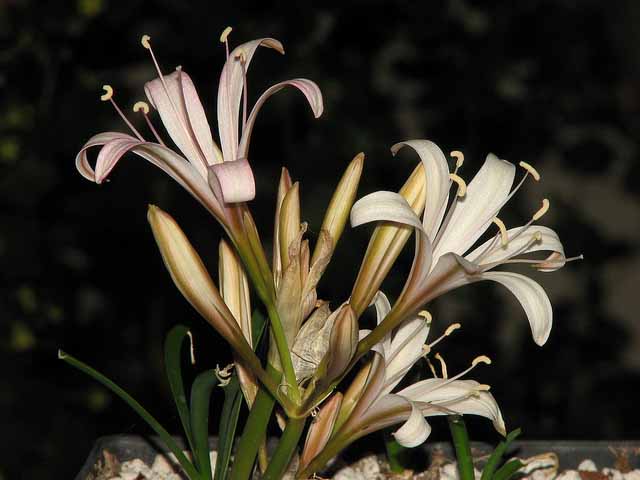
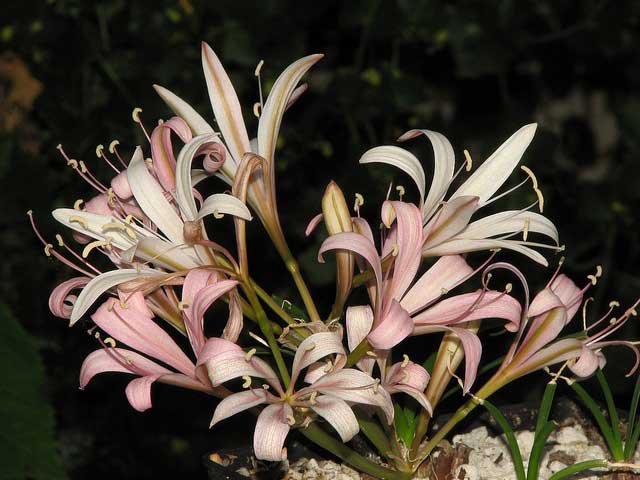
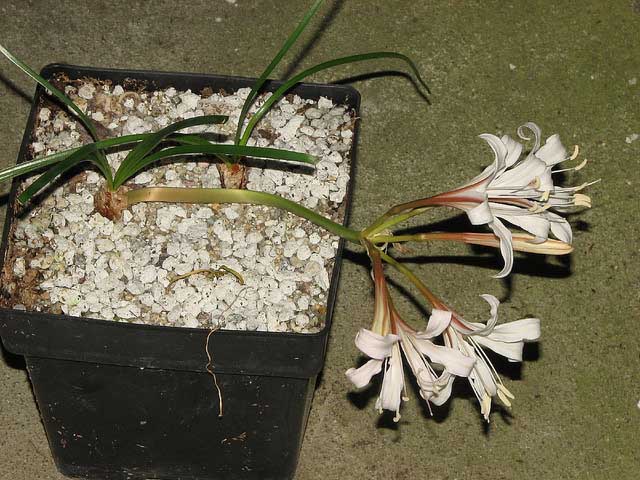
Ammocharis tinneana The range of this species includes a large number of sub-Saharan countries including Rwanda, Zaire, Chad, Ethiopia, Somalia, Sudan, Kenya, Tanzania, Uganda, Angola, Malawi, Mozambique, Zambia, Zimbabwe, Botswana, and Namibia. My plant was bought as a Kenyan form and it bloomed for the first time for us in mid-May of 2007 in Santa Barbara, California. It receives winter rainfall but acts as a summer grower. The flowers were sweetly fragrant and of a colour difficult to capture with a camera. Photo from Jacob Knecht.