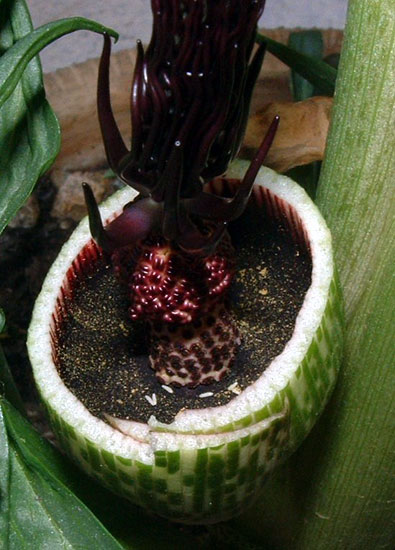
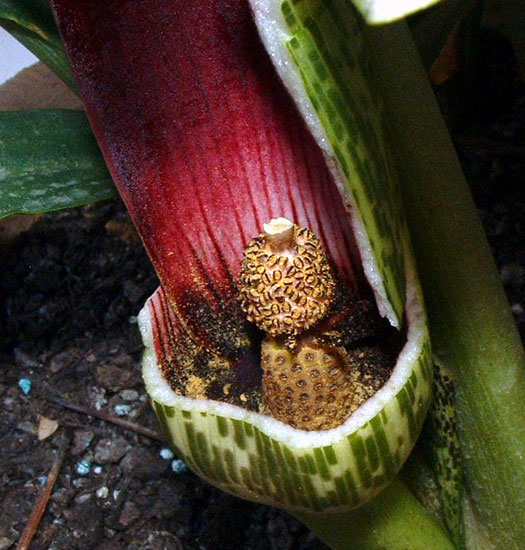
Helicodiceros Schott ex K.Koch is a monotypic genus of Araceae, sometimes lumped in Dracunculus, from which it visually differs by a different leaf shape.
The species, Helicodiceros muscivorus (L.f.) Engl., is endemic to Sardinia, Corsica, and the Balearic islands, dwelling on seashore habitats. Cultivation is easy in a Mediterranean climate, but, if you want to hold your reputation as a sane person, don't be so proud as to show it to your friends! Plants grow to about 30 cm. Photos below by Diana Chapman and Angelo Porcelli of flowers and leaves.
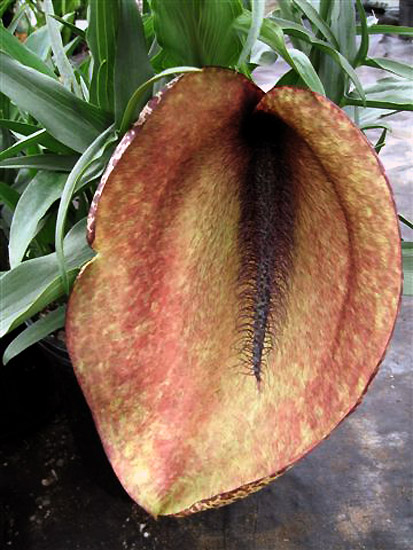
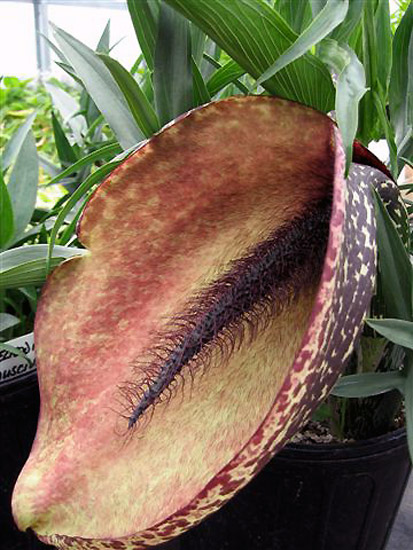
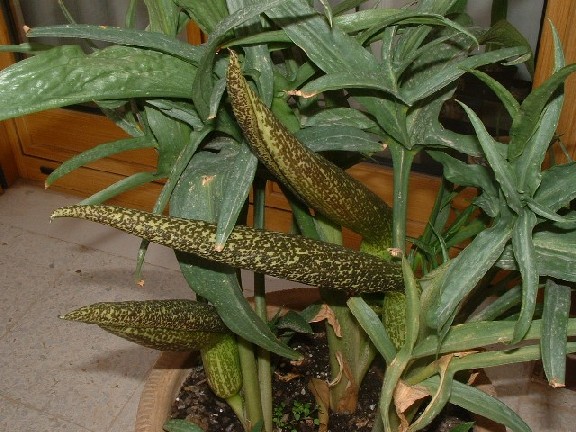
Photos and text by Angelo Porcelli describe the interesting pollination strategy. The first day of blooming only the female flowers are receptive, and their peak, which is about midday, is linked to the strong emission of a smell like rotting shellfish. The spathe won't unroll if the day is cloudy. Rather it waits until a warm and sunny day so that the smell can spread far and wide. Flies come from everywhere, invited to a macabre party. They wander around until they find the way to pass through the constriction, following the hairy spadix. At this point, they won't be able to get out of the enclosure at the base of the spathe and stay trapped for the whole day. The following day the male flowers are fertile, shedding pollen, and the female ones are already inactive. This is when the plant loosens the constriction, allowing the flies, well dusted with pollen, to escape - only to be trapped again in another plant, ensuring cross-pollination.