Narcissus is a genus in the Amaryllidaceae family native to Europe, North Africa and Asia. As a popular garden plant it has been hybridized heavily, and there are new ones being introduced every year. Among all of the attention focused on the hybrids, species Narcissus tend to be overlooked. That's a shame, since many of the species have a delicate charm of their own.
Unfortunately, the naming of species Narcissus is a mess. Bulb expert Brian Mathew reports that they can be difficult to classify, with various authors identifying anywhere from 26 species to more than 60. Because Narcissus have been in cultivation for so long, some plants believed to be species are known only in gardens, with no known wild populations to verify them. All of this confusion is reflected in commerce, where bulbs may be sold under a variety of different names. We've done our best to classify the following photos, but this page is definitely a work in progress. Please let us know if you find an error. The species A-B will be found below.
Note: The letter and number codes after each species name refer to Brian Mathew's taxonomy of Narcissus species, which you can read here.
Narcissus abscissus. 1b(B) - classic daffodils with large flowers. Cream petals and a yellow corona that does not expand at the mouth. Grows along the French-Spanish border.
Narcissus albescens. 1b(B) - classic daffodils with large flowers. Cream-colored flowers, origin unknown.
Narcissus albimarginatus. 1d(ii) - This species is endemic to Morocco, and possibly parts of Spain. This is a spring blooming jonquil-type with one to two flowers per umbel. The flowers are all yellow except for the white margin on the corona, thus the specific epithet, 'albimarginatus'. The flower is held on a relatively long floral tube, with a suggestively triangular flared cup, the flower pendant. The reproductive parts are held out beyond the protective cover of the corona. Photos by Rafa Díez Domínguez.
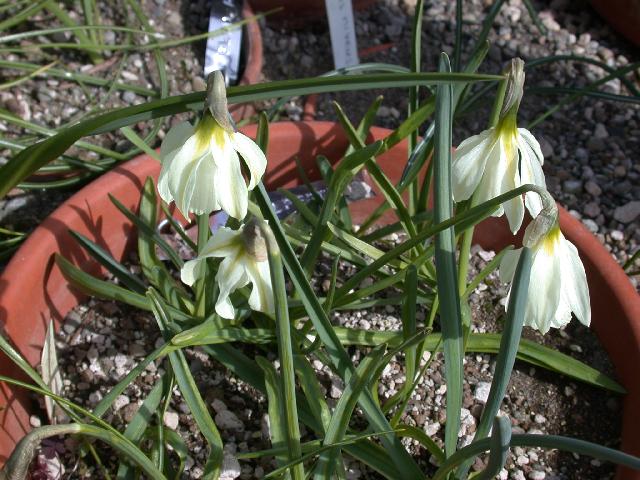
Narcissus alpestris. 1b(B) - classic daffodils with large flowers. White flowers, northwest Spain. It is reported to grow on steep, rocky slopes. The photo shows the typical drooping flowers. Said to be difficult in the open garden; these plants do well in a bulb frame in Oregon, watered occasionally during summer and kept moist fall through mid spring. This species is sometimes confused with N. moschatus, which also has cream colored drooping flowers. Photo by Jane McGary.
Narcissus assoanus (syn. N. juncifolius, N. requienii). 1d(i) is a green-leaved jonquil growing on limestone in rocky meadows and the Pyrenees in southern France and parts of eastern Spain, with a small population suggested to be naturalized Turkey. It grows to around one foot, often with multiple flowers (usually two). The flowers are entirely yellow with short bluntly pointed perianth segments and a cup less than half the length of the segments. N. assoanus is said to have a lemony fragrance. Named for the Spanish botanist Ignatius d’Asso. Photo 1 by Arnold Trachtenberg of a plant grown at Wave Hill. Photo 2 from Hans Joschko. Photo 3 of seed by David Pilling.
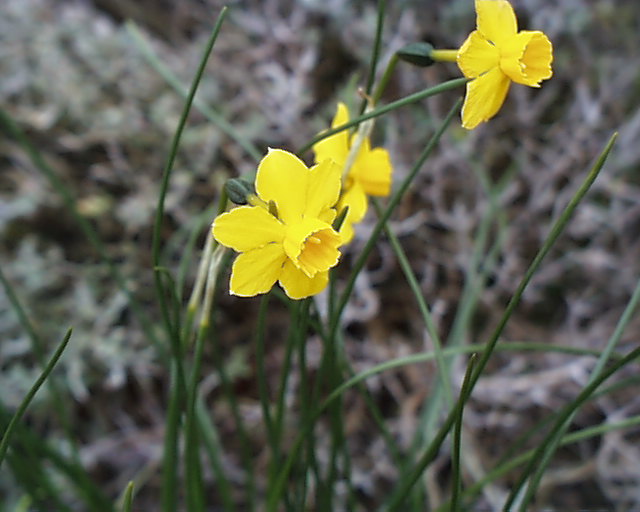
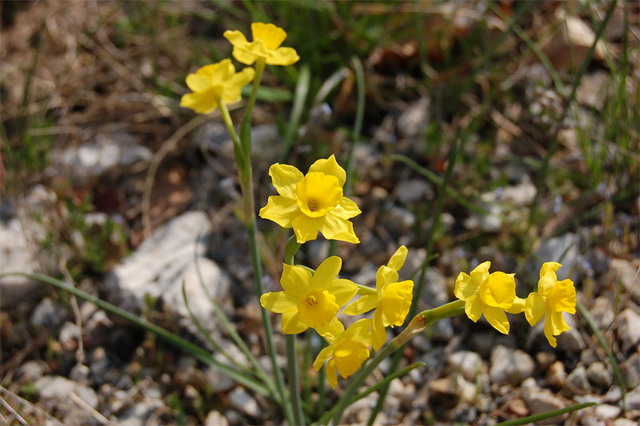
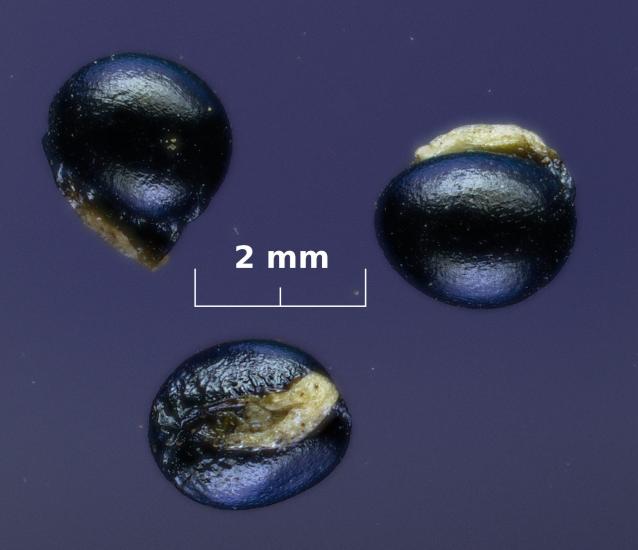
Narcissus assoanus var. pallens
Narcissus assoanus ssp. praelongus. Longer perianth tube, southern Spain.
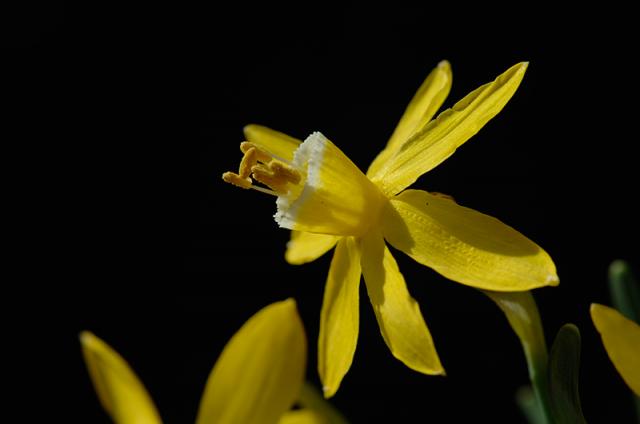
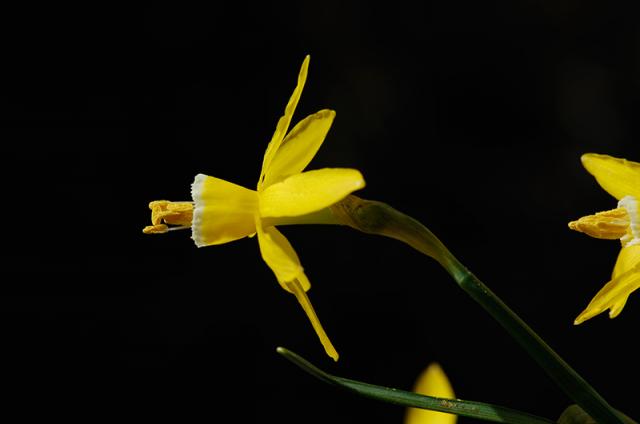
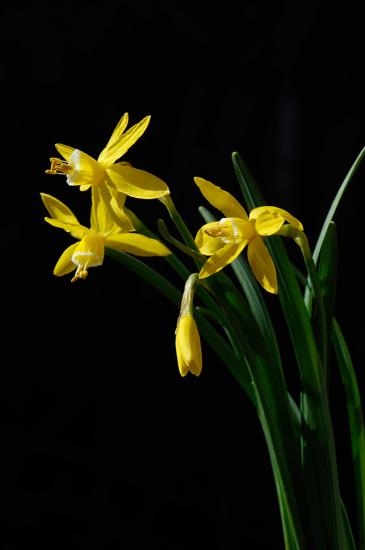
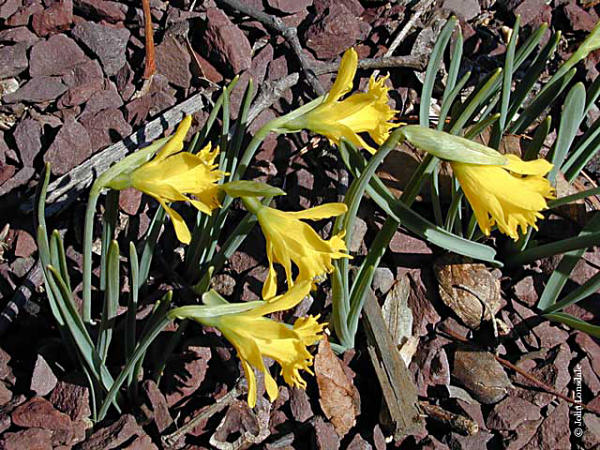
Narcissus asturiensis. 1b(A) - classic daffodils with small flowers. A miniature trumpet native to Spain and Portugal where it grows on higher slopes of mountains on acid soils. It has solitary pendent golden yellow flowers with a fringed corona restricted in the center, and flowers late winter to early spring. Height: 8-12 cm. Two photos by John Lonsdale.
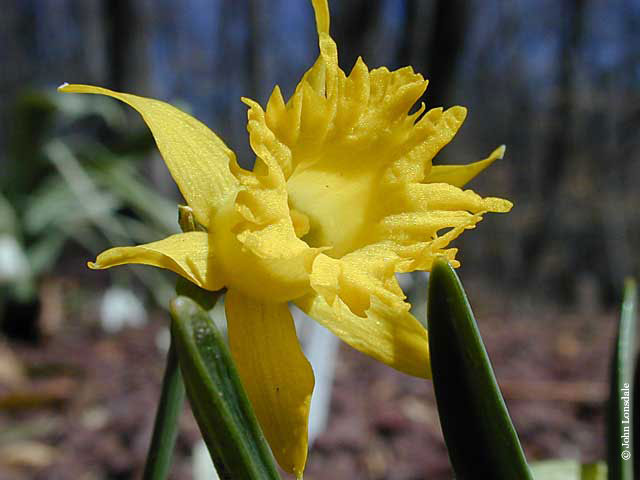
Photos of plants in habitat high in the Picos de Europa in June 2010, taken by Ralph Carpenter.
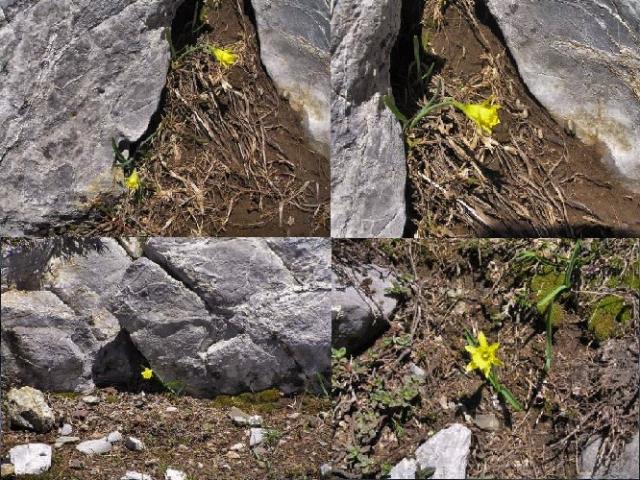

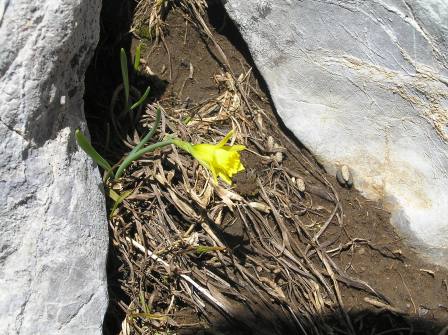
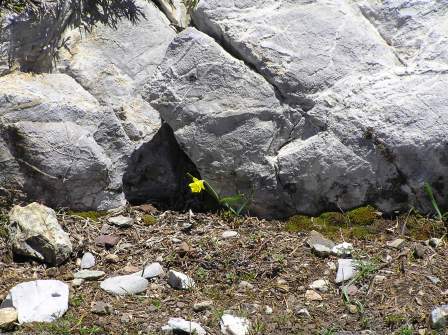

Narcissus asturiensis var. brevicornatus has a shorter corona.
Narcissus asturiensis var. villarvildensis is from north-central Spain.
Narcissus atlanticus. 1d(ii) - gray-green-leaved jonquils. Single cream-colored flowers, origin unknown. Height: to about 30 cm.
Narcissus aureus. 2a(i)A - colored tazetta-like flowers. Yellow petals and corona. Growing in France and Italy, this or N. bertolonii may be the source of the well-known Narcissus cultivar 'Soleil d'Or.'
Narcissus baeticus. 1d(i) - green-leaved jonquils. Longer, narrower perianth tube than N. assoanus. Spain.
Narcissus barlae. 2a(i)B - white tazetta-like flowers. Mathew says it probably should be merged with N. panizzianus.
Narcissus bertolonii. 2a(i)A - colored tazetta-like flowers. Characterized by the yellow perianth segments (petals) and deep yellow-orange corona (cup). Mathew believes this is probably the same species as N. aureus.
Professor S. Pignatti in his Flora d'Italia recognizes it as a valid subspecies of Narcissus tazetta, with a well defined range (Liguria, Tuscany, Corsica, Sardinia, northern Lazio, minor islands in front of Tuscany, as well as nearby France), with the other valid subspecies being ssp.tazetta (white perianth with pale yellow cup) distributed in the other regions of Italian peninsula, Sicily included. He also states that the two subspecies hybridize freely in a number of forms that don't warrant any status, most of them being just ancient horticultural forms from wild collected origin here and there in all Italy.
This species is listed by Kew as Narcissus tazetta ssp. aureus. It is thought to be the ancestor of historical tazetta hybrids with yellow petals such 'Grand Soleil d'Or.' Photo and most of the text by Angelo Porcelli.
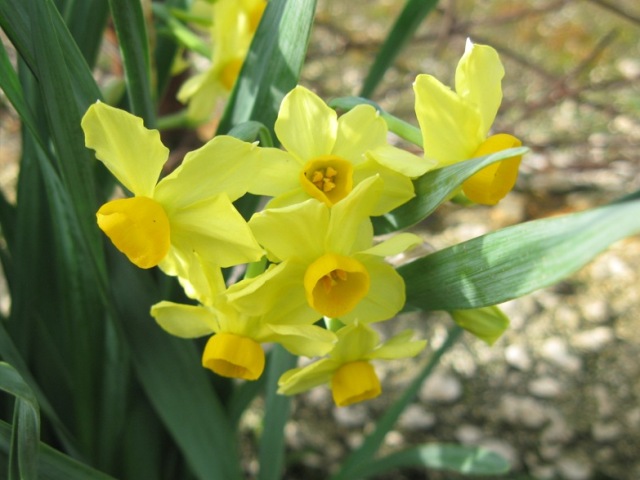
Narcissus bicolor. 1b(B) - classic daffodils with large flowers. Similar to N. abscissus, but pale yellow petals and a deep yellow corona. Height range: 30-40 cm. Unknown origin.
Narcissus blancoi (syn. N. cantabricus ssp. luteolentus). 3 - the hoop petticoats, big conical coronas. Yellowish flowers and dark brown spathes. Spain.
Narcissus broussonetii. 2b. Autumn blooming. Up to ten flowers in an umbel, white, with barely any corona. Gray-green leaves. Height: to about 40 cm. Found only in Morocco. It is distinctive in that it has a long corolla tube. There is no fragrance detectable in the specimens shown below, although Angelo Porcelli reports that his form has a sweet jasmine scent. Photos 1-2 by Nhu Nguyen taken at the UC Botanical Garden, photo 3 by Angelo Porcelli .
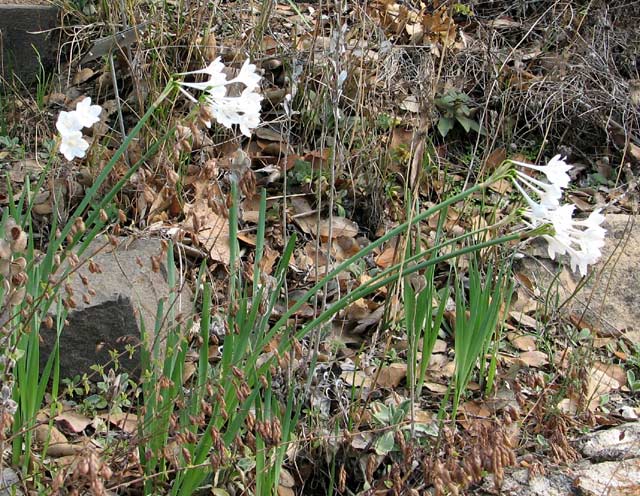
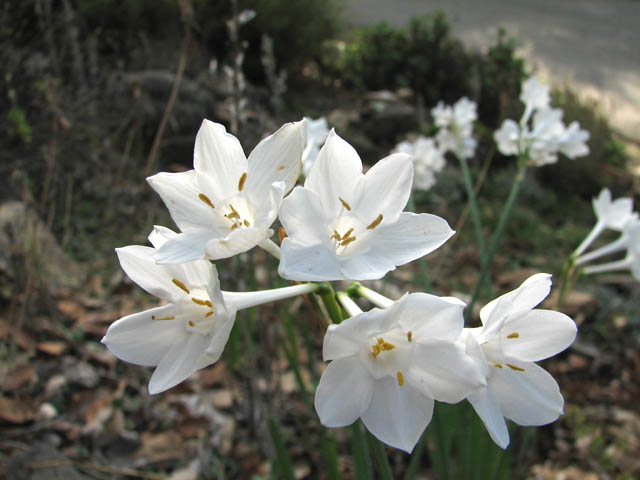
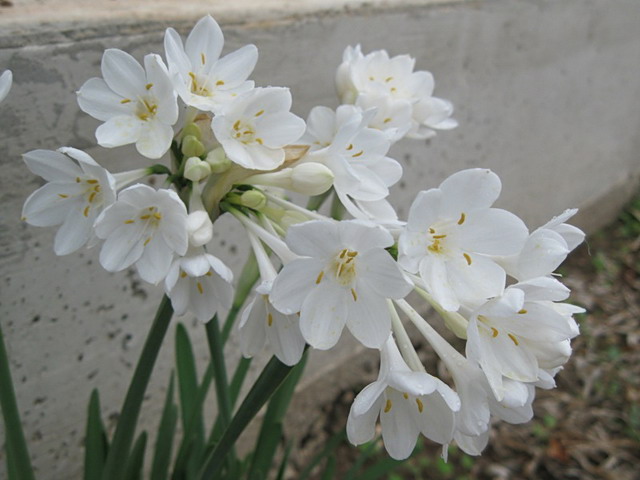
Narcissus broussonetii forma grandiflorus. Larger flowers; tetraploid.
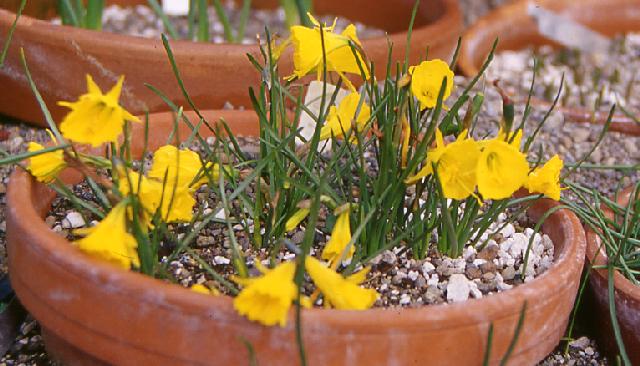
Narcissus bulbocodium. 3 - the hoop petticoats, big conical coronas. "They are among the quaintest and altogether fetching of bulbous plants." --Louise Beebe Wilder. Yellow flowers. Native to the Iberian Peninsula and northwestern Africa, has two subspecies and many varieties, the nomenclature of which is confusing to gardeners. The first photo was taken by John Lonsdale and the second by Jamie Vande who writes: "This is the typical commercial strain available in Europe, naturalised in my lawn."

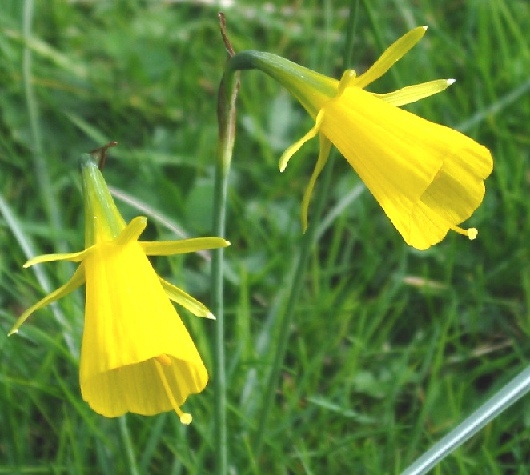
Narcissus bulbocodium ssp. bulbocodium. Pale to bright yellow. Photos below from Mary Sue Ittner of plants received as Narcissus bulbocodium var. tenuifolius (Salisb.) Baker which is now considered a synonym of ssp. bulbocodium.
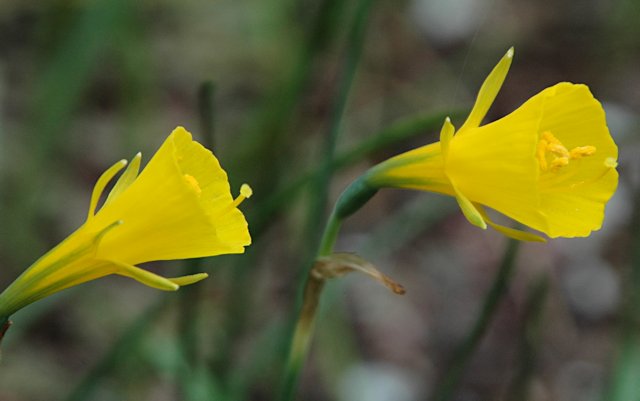

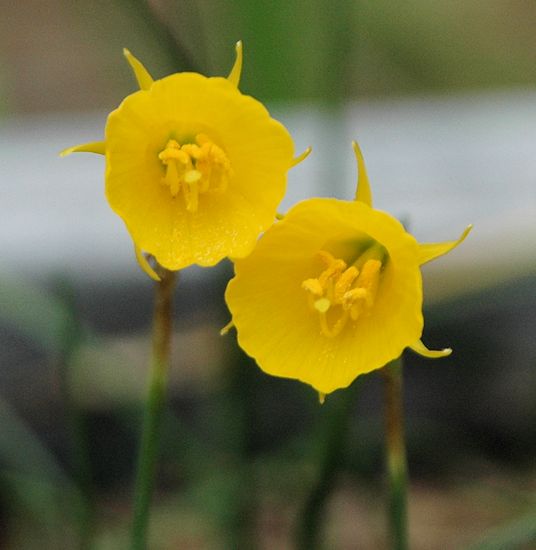
Narcissus bulbocodium ssp. bulbocodium var. bulbocodium. Petals up to two cm long. Spain, Portugal, France, and Morocco.
Narcissus bulbocodium ssp. bulbocodium var. citrinus (syn. N. lainzii). Lemon yellow, Spain. Height: about 15 cm.
Narcissus bulbocodium ssp. bulbocodium var. conspicuus. Another large-flowered form. Spain, Portugal, France. Photo by David Pilling of bulbs sold as Narcissus conspicuus.
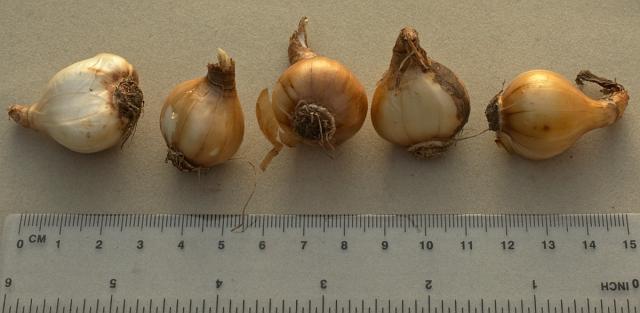
Narcissus bulbocodium ssp. bulbocodium var. ectandrum. Small plants, flaring yellow flowers. Spain.
Narcissus bulbocodium ssp. bulbocodium var. graellsii. Small plants with primrose-yellow flowers. Spain. Photo by John Lonsdale
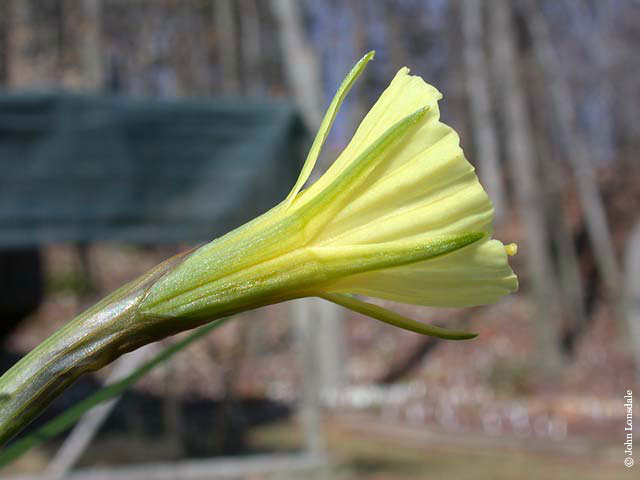
Narcissus bulbocodium ssp. bulbocodium var. nivalis. (syn. N. jeanmonodii, N. juressianus, N. subnivalis). A very small form (8 cm.) from the Atlas Mountains of North Africa, shown here flourishing in an uncovered raised bed in Oregon; it is a top choice for troughs and rock gardens. Photos by Jane McGary
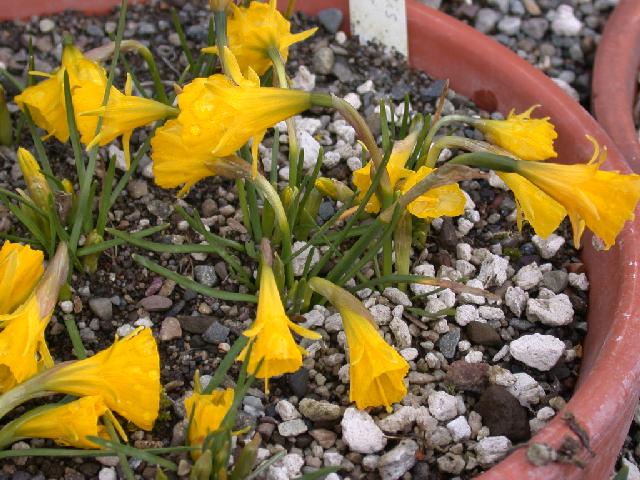
Narcissus bulbocodium ssp. bulbocodium var. pallidus. Wavy corona. A large-flowered, pale yellow form from the mountains of Morocco, growing very well in an unheated bulb frame in Oregon. The first photo was taken by Jane McGary and the second by John Lonsdale.

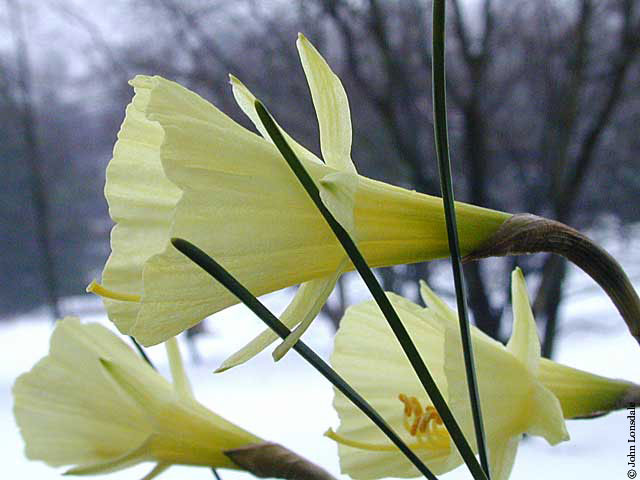
Narcissus bulbocodium ssp. bulbocodium var. quintanilhae. Larger flowers. Portugal.
Narcissus bulbocodium ssp. bulbocodium var. serotinus. Wider leaves. Portugal.
Narcissus bulbocodium ssp. praecox. Primrose yellow, Morocco. Photo by John Lonsdale.
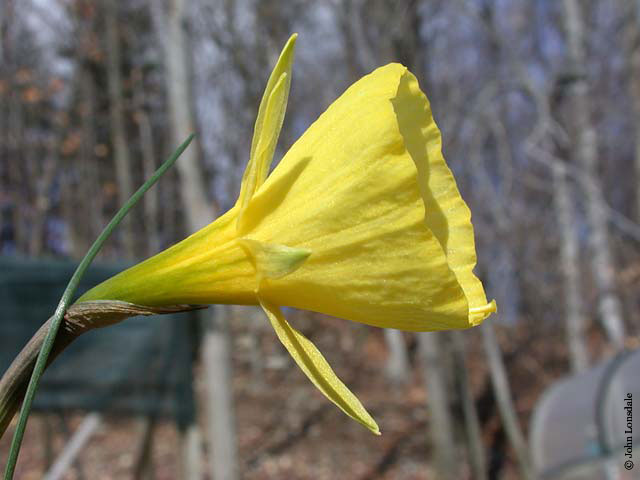
Narcissus bulbocodium ssp. praecox var. paucinervius. Three veins in the petals. Morocco.
Narcissus bulbocodium ssp. praecox var. praecox. Six veins in the petals. Morocco.
"Narcissus bulbocodium alpinus." This name is not recognized by Mathew. The plant identified was received misnamed from another gardener and proper identification is sought (please edit this entry if you know what it is). Photo from Jane McGary
Narcissus index - Overview of the Narcissus species - Narcissus Species A-B - Narcissus Species C - Narcissus Species D-J - Narcissus Species K-O - Narcissus Species P - Narcissus Species Q-Z - Narcissus hybrids - Division 1 - Division 2 - Division 3 - Division 4 - Division 5 - Division 6 - Division 7 - Division 8 - Division 9 - Division 10 - Division 11 - Division 12 - Miniatures