Narcissus is a genus in the Amaryllidaceae family native to Europe, North Africa and Asia. As a popular garden plant it has been hybridized heavily, and there are new ones being introduced every year. Among all of the attention focused on the hybrids, species Narcissus tend to be overlooked. That's a shame, since many of the species have a delicate charm of their own.
Unfortunately, the naming of species Narcissus is a mess. Bulb expert Brian Mathew reports that they can be difficult to classify, with various authors identifying anywhere from 26 species to more than 60. Because Narcissus have been in cultivation for so long, some plants believed to be species are known only in gardens, with no known wild populations to verify them. All of this confusion is reflected in commerce, where bulbs may be sold under a variety of different names. We've done our best to classify the following photos, but this page is definitely a work in progress. Please let us know if you find an error. The species c will be found below.
Note: The letter and number codes after each species name refer to Brian Mathew's taxonomy of Narcissus species, which you can read here.
Narcissus calcicarpetanus Fern.Casas 1b(B) - classic daffodils with large flowers. Yellow flowers, frilled corona. Spain. This species is considered by Kew in 2020 to be a synonym of Narcissus confusus Pugsley.
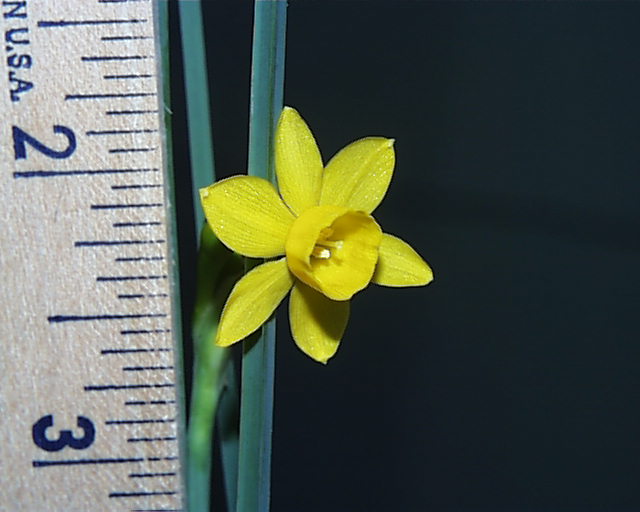
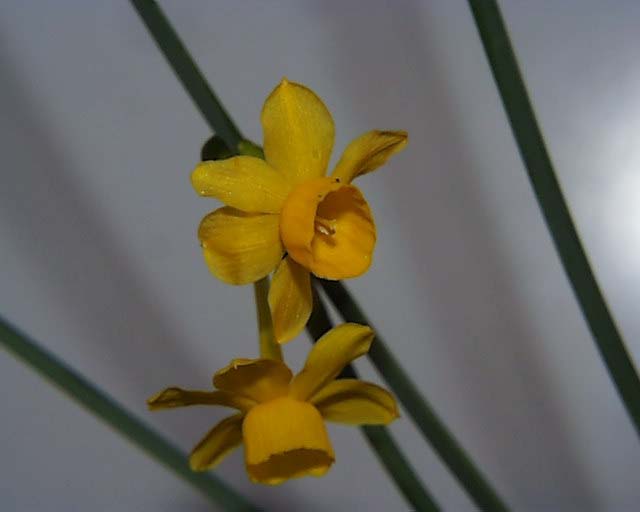
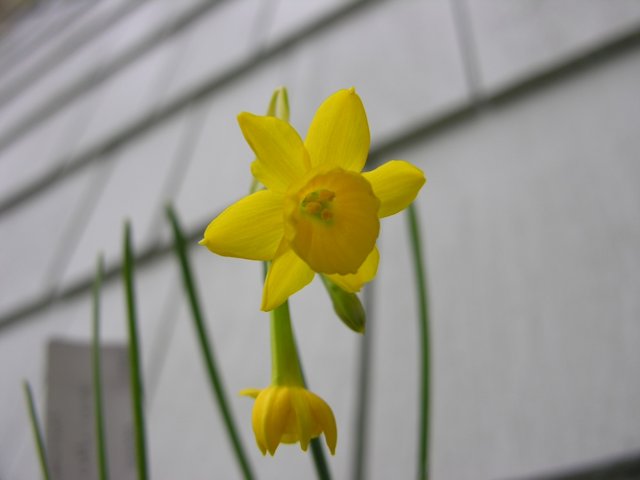
Narcissus calcicola Mendonça 1d(ii) This species can be characterized as having miniature daffodil-like open flowers to eight inches. Native to pockets among limestone in central Portugal, the rich orange-yellow flowers are less than an inch in diameter, with a cup less than 3/8". The perianth segments have an acute point, and are slightly reflexed. Up to five yellow flowers per umbel. As the name implies it grows in calcareous soil, due to the presence of limestone, but Henning Christiansen has shown the pockets of soil in which it grows have been found to be acid (pH near 5.9). Plant grown from seed and photographed by Arnold Trachtenberg.
Narcissus canaliculatus Guss. 2a(i)A - colored Narcissus tazetta like flowers. Petals white, corona yellow. Origin unknown. See also Narcissus 'Canaliculatus'. This species is considered by Kew in 2020 to be a synonym of Narcissus tazetta subsp. tazetta.
Narcissus canariensis Burb. 2a(i)B - white tazetta-like flowers. Small flowers with pointed petals. Canary Islands. This species is considered by The Plant List in 2020 to be a synonym of Narcissus tazetta subsp. canariensis (Burb.) Baker.
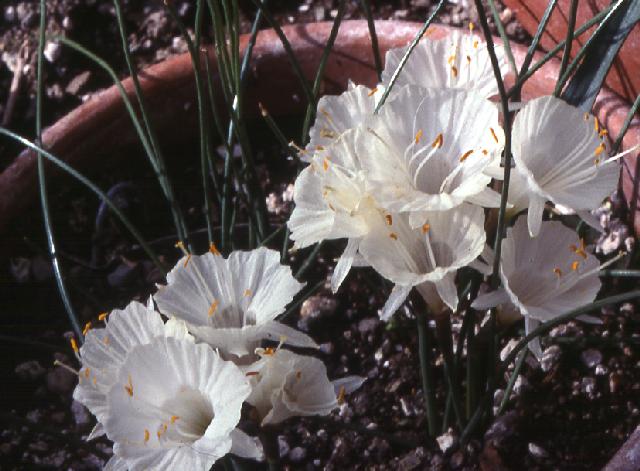
Narcissus cantabricus DC. 3 - the hoop petticoats, big conical coronas. White or greenish flowers. This species comes from southern Spain, the Balearic Islands, Algeria, and Morocco, and is extremely variable with several subspecies. The plant identified in the photo as "clusii" (not a valid taxonomic name) was grown from seed obtained from the Scottish Rock Garden Club exchange and is probably identical or very similar to plants grown in the UK under this identifying or "garden" name. It has upfacing pure white flowers on very short stems. The first photo by Jane McGary of this plant and the next two from Mary Sue Ittner of this species which blooms in the fall in Northern California, sometimes as early as October and continues until sometimes January.
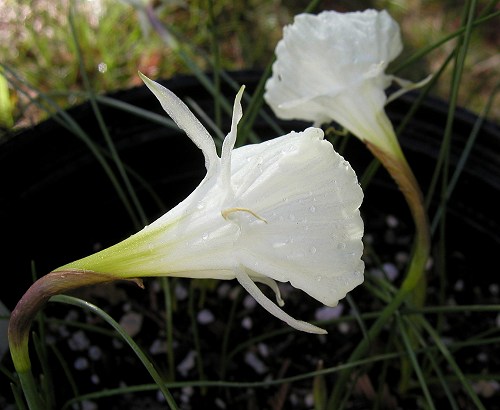
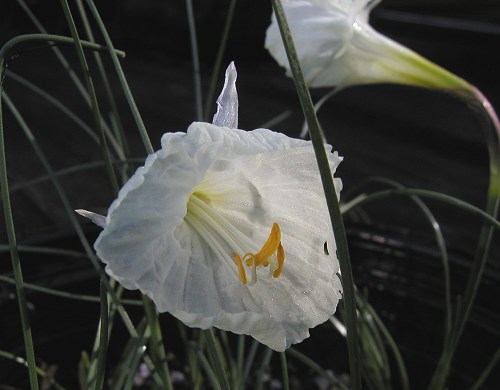
Two more identified by names that do not appear to be valid and photographed by John Lonsdale are first, one called 'eualbidus' and the second and third pictures, var. 'laciniatus.' Plants of the World Online lists a Narcissus cantabricus subsp. eualbidus M.Salmon as a synonym of Narcissus albicans (Haw.) Spreng. and Narcissus cantabricus subsp. laciniatus M.Salmon as a synonym of Narcissus cantabricus DC.
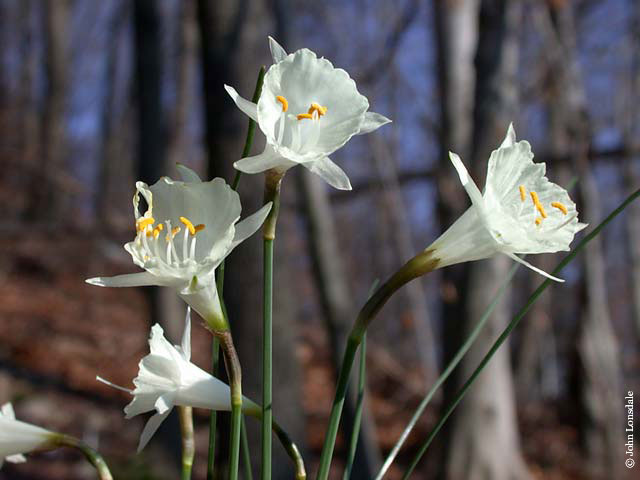

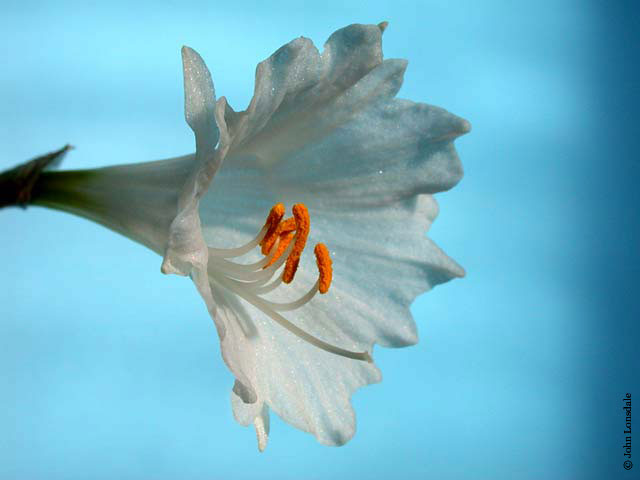
Narcissus cantabricus ssp. cantabricus. More than one leaf per bulb. From Spain. Photo by John Lonsdale
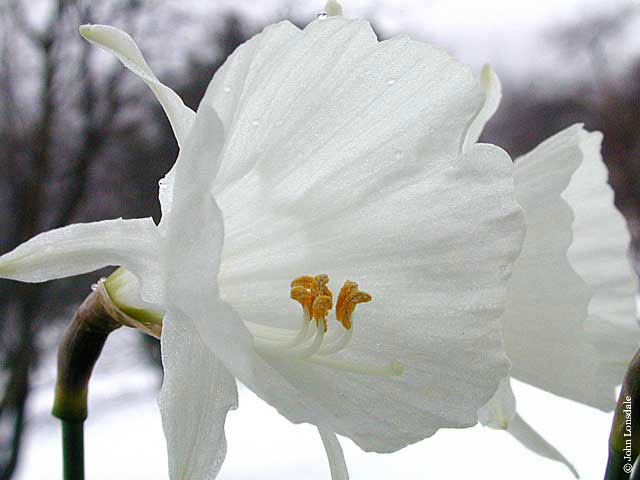
Narcissus cantabricus ssp. cantabricus var. cantabricus. Two leaves per bulb. Flowers bright white. Spain.
Narcissus cantabricus ssp. cantabricus var. foliosus. Three to eight leaves per bulb, flowers creamy white. Morocco. Photo by John Lonsdale
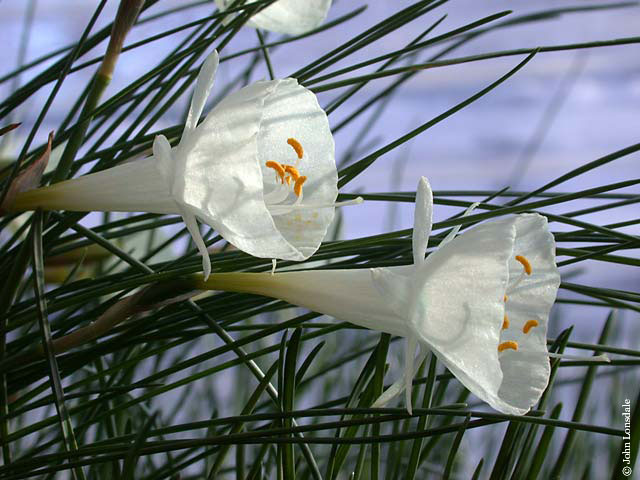
Narcissus cantabricus ssp. cantabricus var. kesticus (Maire & Wilczek) A.Fern. (syn. N. peroccidentalis). Two to four leaves, off-white or greenish white flowers. Morocco. Narcissus cantabricus subsp. kesticus (Maire & Wilczek) Ibn Tattou is considered by Kew in 2020 to be a synonym of Narcissus albicans (Haw.) Spreng. Narcissus cantabricus var. kesticus according to The Plant List is a synonym of Narcissus romieuxii subsp. albidus (Emb. & Maire) A.Fern.
Narcissus cantabricus ssp. cantabricus var. petunioides A.Fern. One to three leaves, widely flared flower. Algeria.
Narcissus cantabricus ssp. monophyllus (Durand) A.Fern. One leaf, pure white flowers. Southern Spain, Morocco, Algeria. Photo by John Lonsdale
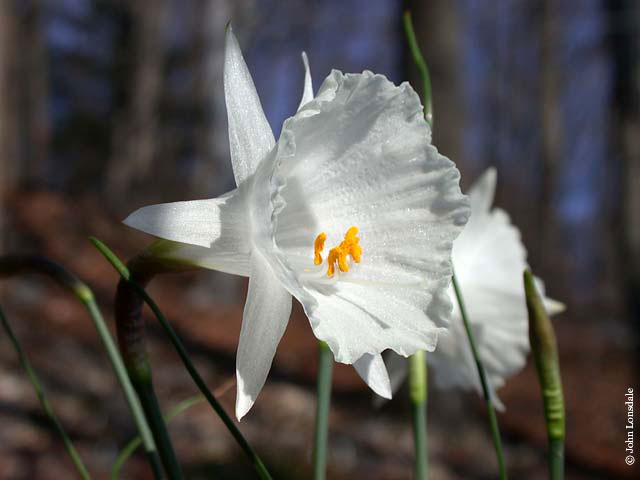
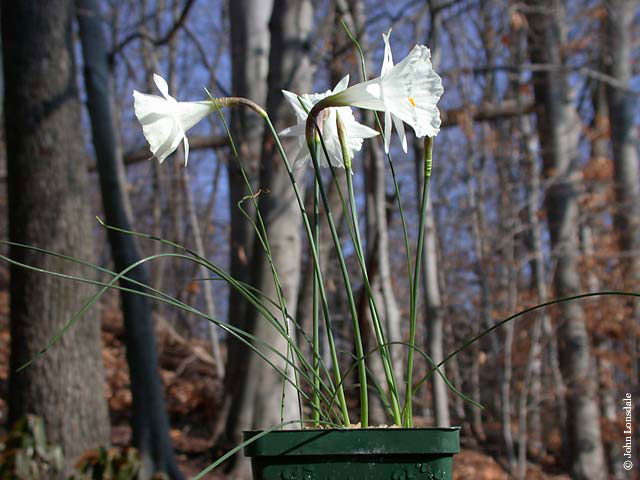
Narcissus cantabricus 'Peppermint'. Very early, opens a pale greenish-yellow and matures to a greenish white. Photograph by Arnold Trachtenberg
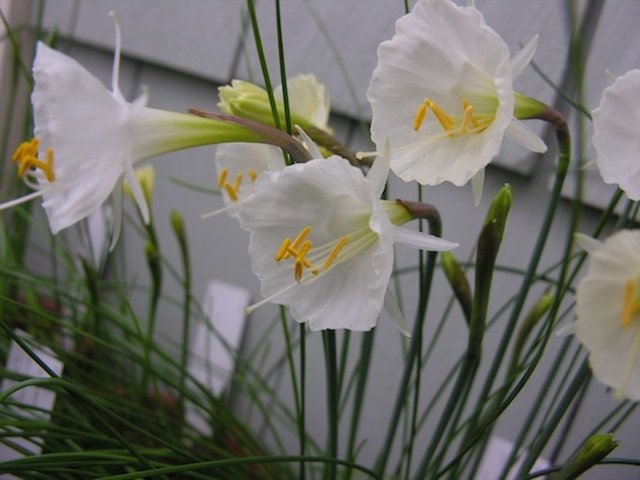
Narcissus cantabricus 'Silver Palace'. Height: about 30 cm. Photograph by Arnold Trachtenberg.
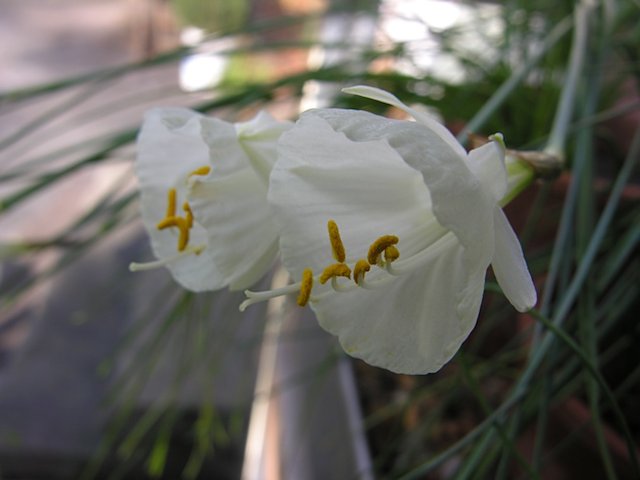
Narcissus cantabricus ssp. tananicus (Maire) A.Fern. Three to five leaves, off-white corona with light yellow petals. Morocco. This subspecies is considered by The Plant List in 2020 to be a synonym of Narcissus romieuxii subsp. albidus (Emb. & Maire) A.Fern.
Narcissus cavanillesii Barra & G.López (syn. Tapeinanthus humilis, Narcissus humilis). 1e. This is a rare Autumn flowering species which superficially more resembles a member of the genus Sternbergia with thin yellow tepals than a species of Narcissus due to the lack of a visible corona. Upon a very close inspection using a hand lens, there is a suggestive lip of what a taxonomist or a botanist could construe as a corona. Regardless of the morphology, N. cavanillesii is native to mostly the southeast Iberian Peninsula, Spain, Algeria and Morocco, with a larger-flowered form reported in the Atlas mountains. It is possibly endangered in Portugal where it is only known from two populations. N. cavanillesii grows from 5-16" tall, and has been observed to come into bloom quickly after rain at the end of the dry season. The leaves are not present during the flowering period. Photo by John Lonsdale of a plant he received as N. humilis ssp. mauretanicus.
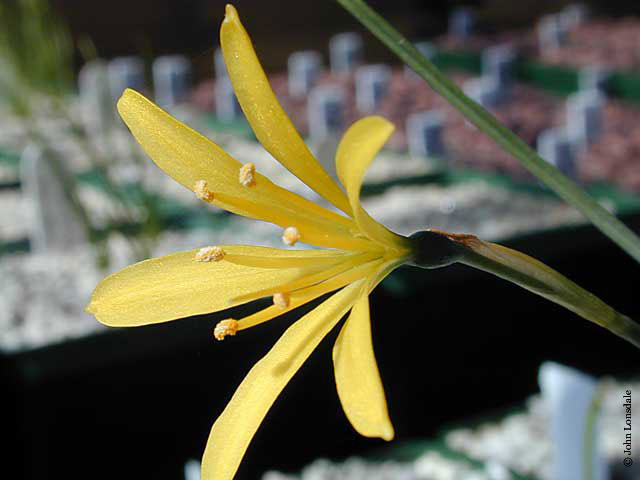
Narcissus cerrolazae Ureña 1d(i) - green-leaved jonquils. One to four flowers per umbel. Tube can be curved. Height: to about 20 cm. Spain. This species is considered by Kew in 2020 to be a synonym of Narcissus jonquilla subsp. cerrolazae (Ureña) Barra, Díez Domínguez & Ureña.
Narcissus corcyrensis. 2a(i)A - colored tazetta-like flowers. Petals pale yellow and sometimes reflexed, corona deeper yellow and lobed on the edge. From Corfu. This species is considered by Kew in 2020 to be a hybrid, Narcissus × corcyrensis (Herb.) Nyman
Narcissus cordubensis Fern.Casas 1d(i) - green-leaved jonquils. Up to three flowers per umbel, curved tube. Spain. This species is scented and very similar to Narcissus fernandesii and is included in the latter by some. It has yellow flowers with a green tinge at the base and blooms mid spring. All photos by John Lonsdale, the second and third are of the "Lemon" form (not formally recognized by Mathew).
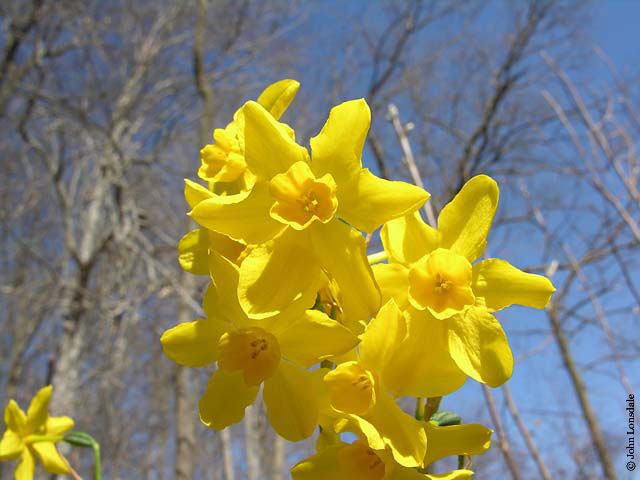
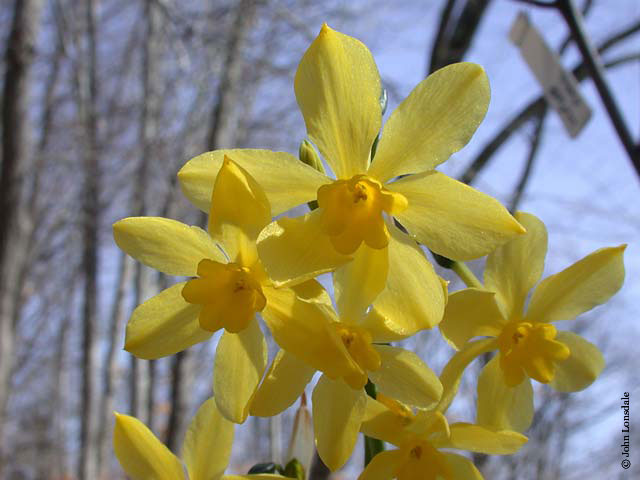
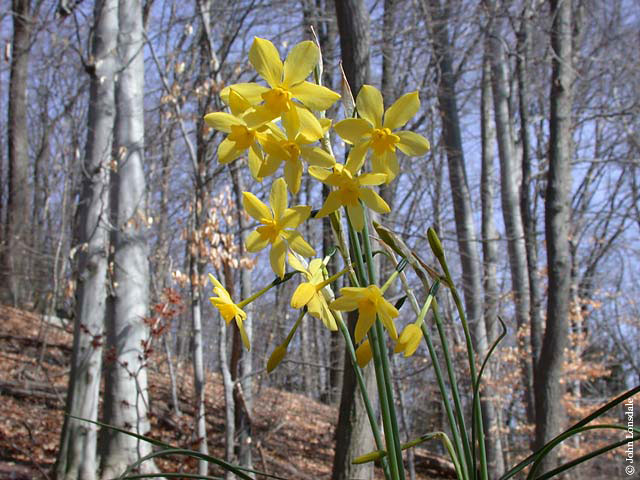
Narcissus cuatrecasasii Fern.Casas, M.Laínz & Ruíz Rejón (syn. N. rupicola ssp. pedunculatus). 1d(ii) is a somewhat variable species native to central southern Spain from Grazalema up to Montes de Toledo. Flowers are borne solitarily to a few in an umbel to six inches tall. Perianth segments appear to range in shape from apiculate to elliptic. The cup is often incurved at the margin, and variable in size compared to the segments. Overall the flowers appear to average around one inch in diameter.
Narcissus cuatrecasasii var. segimonensis (Fern.Casas) Fern.Casas Smaller flowers. From Spain, grown and photographed by Jane McGary. When this picture was added to the wiki, there was some question about whether the photo was this species or Narcissus rupicola. Harold Koopowitz who thought it looked liked the latter wrote this: "Both species are quite variable with regards, size of plant, leaves, size of flower, height and time of flowering. N. cuatrecasasii has three stamens sticking into the corona and there are three in the tube. In N. rupicola all six stamens are in the tube. In N. rupicola the opening to the tube is restricted, in N. cuatrecasasii it is wider."
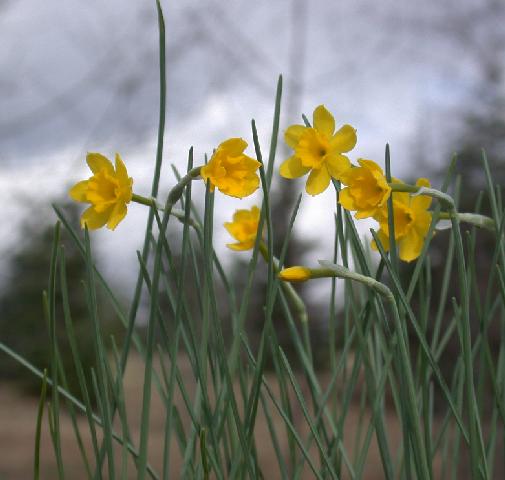
Narcissus cupularis (Salisb.) Bertol. ex Schult. & Schult.f. 2a(i)A - colored tazetta-like flowers. Another species very similar to N. aureus. This species is considered by The Plant List in 2020 to be synonym of Narcissus tazetta subsp. aureus (Jord. & Fourr.) Baker.
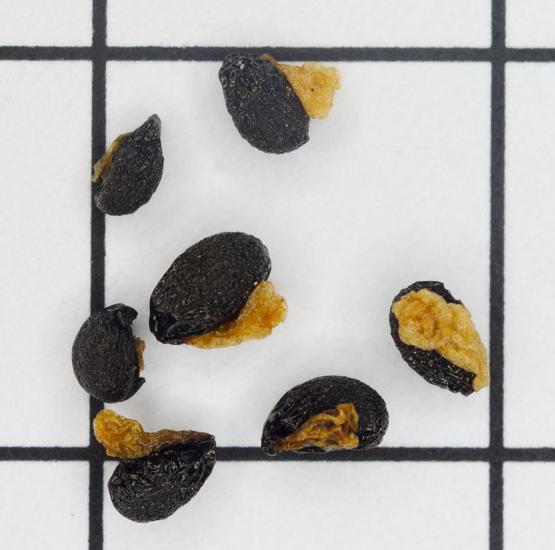
Narcissus cyclamineus DC. 1b(A) - classic daffodils with small flowers. Yellow flowers, reflexed petals. Height range: 10-20 cm. North-west Portugal and Spain. It has "a manner that has been variously compared to an angry mule, a frightened rabbit, a kicking horse. And indeed it does have a startled expression. A group of them makes one think of a bevy of gnomes in agitated conclave." --Louise Beebe Wilder. Gardening in New York, she said it grew best in damp sandy peat in partial shade. Photo by John Lonsdale. Photo of seed on a 10 mm grid by David Pilling.
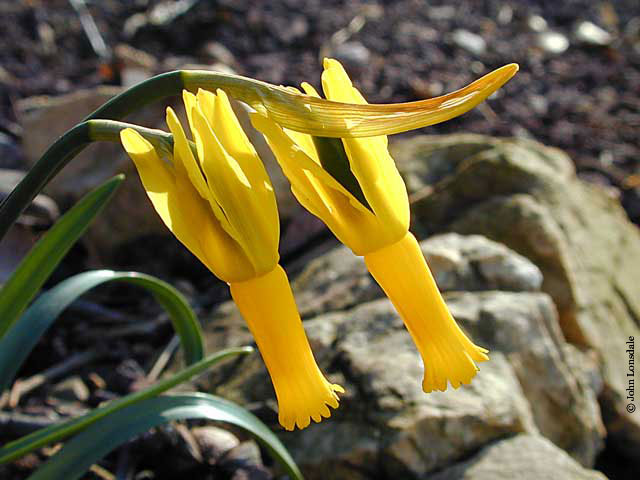
Narcissus cypri (Haw.) Haw. 2a(i)A - colored tazetta-like flowers. White petals, pale yellow flared corona. Cyprus. This species is considered by Kew in 2020 to be a synonym of Narcissus tazetta subsp. tazetta.
Narcissus index - Overview of the Narcissus species - Narcissus Species a-b - Narcissus Species c - Narcissus Species d-j - Narcissus Species k-o - Narcissus Species p - Narcissus Species q-z - Narcissus hybrids - Division 1 - Division 2 - Division 3 - Division 4 - Division 5 - Division 6 - Division 7 - Division 8 - Division 9 - Division 10 - Division 11 - Division 12 - Miniatures