The pictures below are of Romuleas that are native to South Africa, grown from seed or seen in the wild. Many of the species are very similar and difficult to tell apart. Sometimes it is necessary to examine the bracts and bracteoles and often looking at the corm is very helpful. Photos of the different corms will be added as available.
There are three good references for the southern African species, The Genus Romulea in South Africa written by Miriam de Vos in 1972, her revision written in 1982 and a later revision from John Manning and Peter Goldblatt in 2001.
Species from t to z are shown on this page.
European And Mediterranean Romuleas - South African Romulea a-d - South African Romulea e-k - South African Romulea l-n - South African Romulea o-s - Romulea index
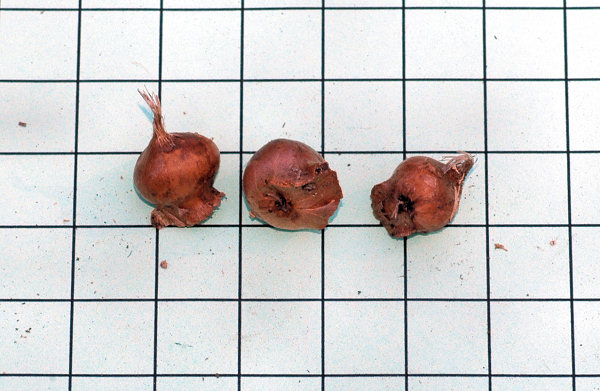
Romulea tabularis Eckl. ex Bég. is a winter rainfall species found in moist sandy or limestone flats, often in seasonal pools from Namaqualand to the southern Cape. Height: 5-10 cm. Photographed by Mark Mazer, Mary Sue Ittner, and Bob Werra. The fourth picture is of the corms on a 1 cm grid. Corms have a crescent-shaped basal ridge.
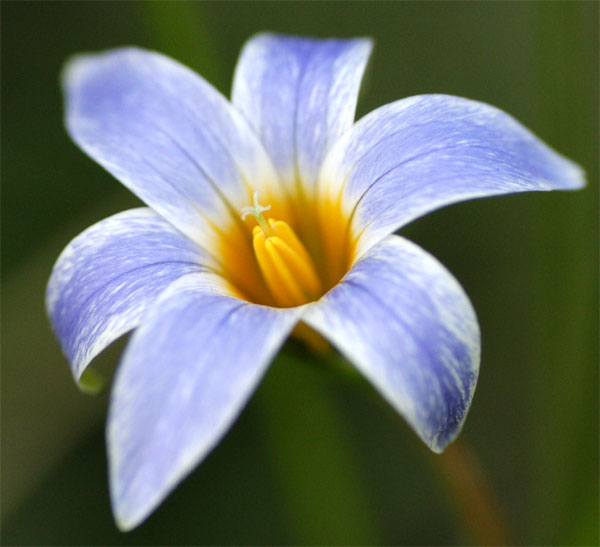
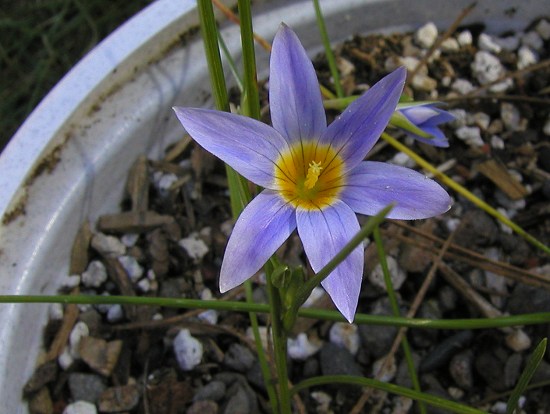
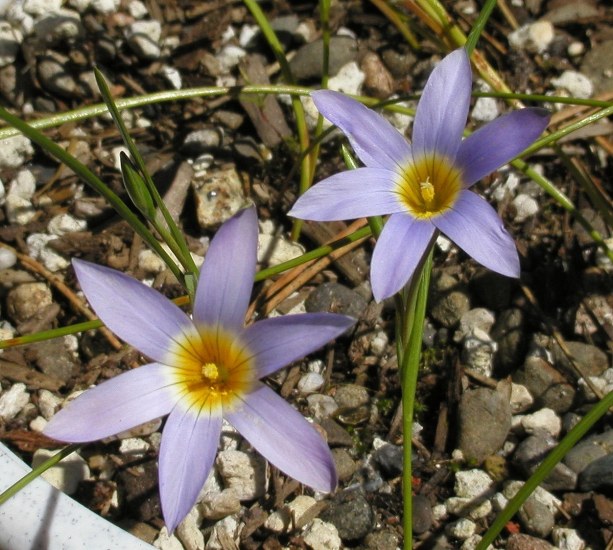
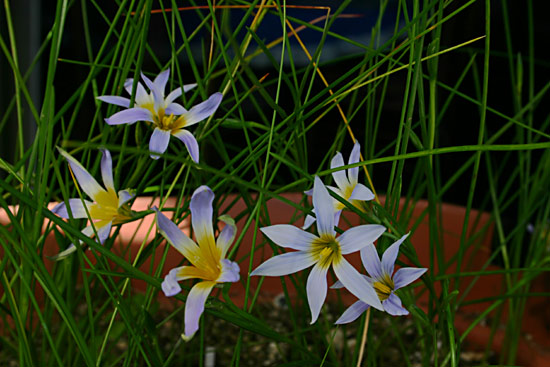
The first three photos from Bob Rutemoeller and Mary Sue Ittner were taken September 2006 on the way to Darling in the Southwestern Cape of South Africa. The last photo was taken by Cameron McMaster near Darling.

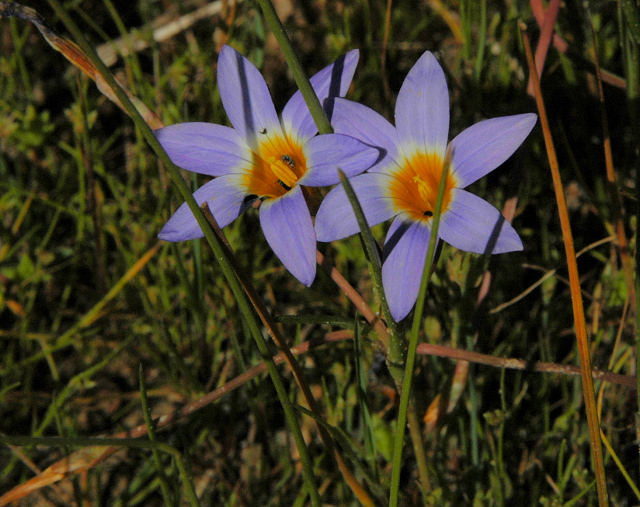
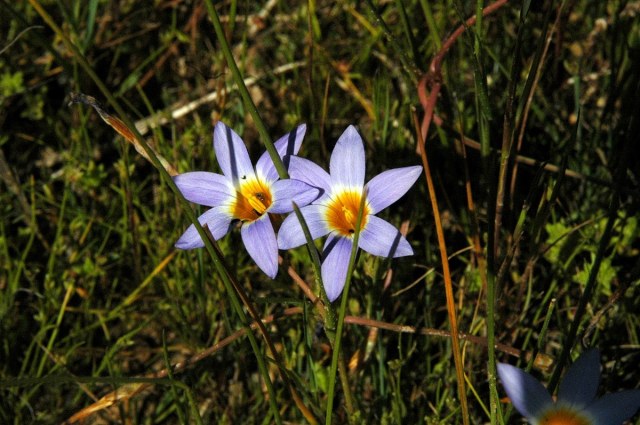
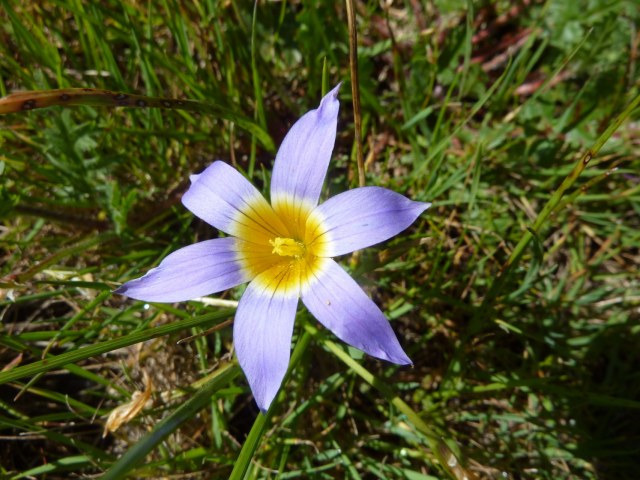
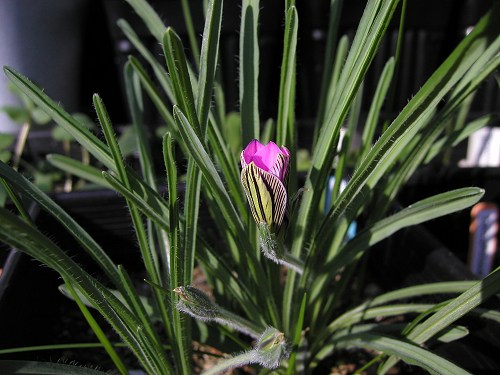
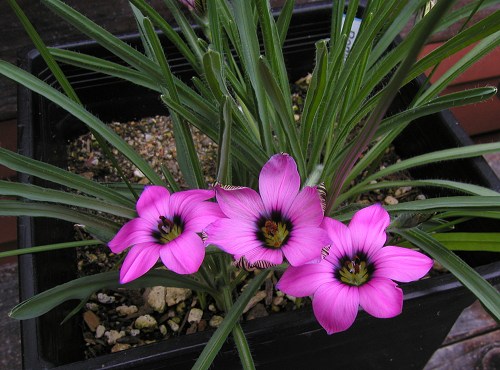
Romulea tetragona M.P.de Vos is found in clay soils in dry areas of the winter rainfall Cape and blooms in late winter. The distinctive identifying trait is the leaves which have the lateral ribs reduced and medium ribs widened to form 4 longitudinal wings (the Greek derived name means four angled). The other species showing this trait is Romulea hirta which has different colored flowers. This species is violet-rose to lilac or rarely salmon-pink with a violet or greenish yellow cup and a violet blotch or band in the throat. It is very beautiful. Height: 7-10 cm. The first two photos were taken near Middelpos in the Roggeveld September 2006 by Mary Sue Ittner. The last photo was taken by Rod Saunders.
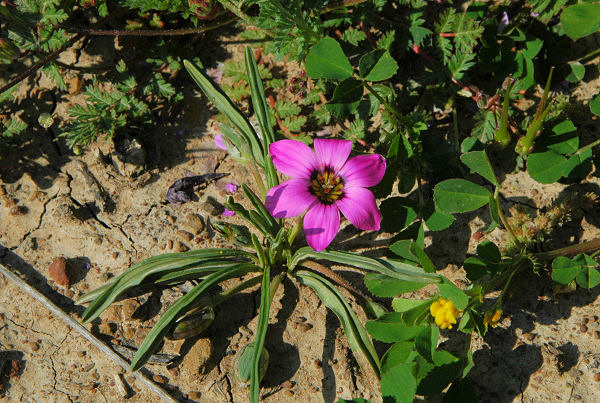
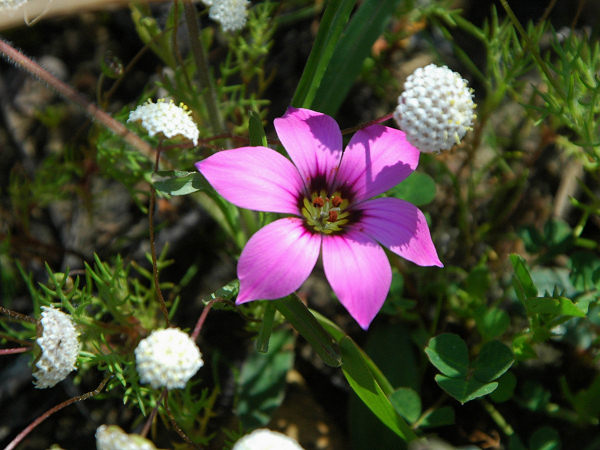
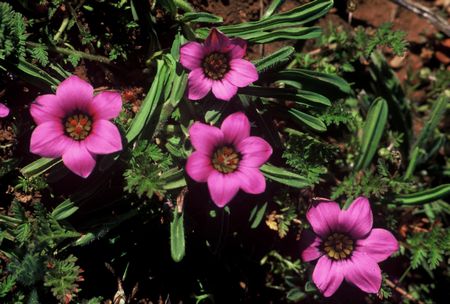
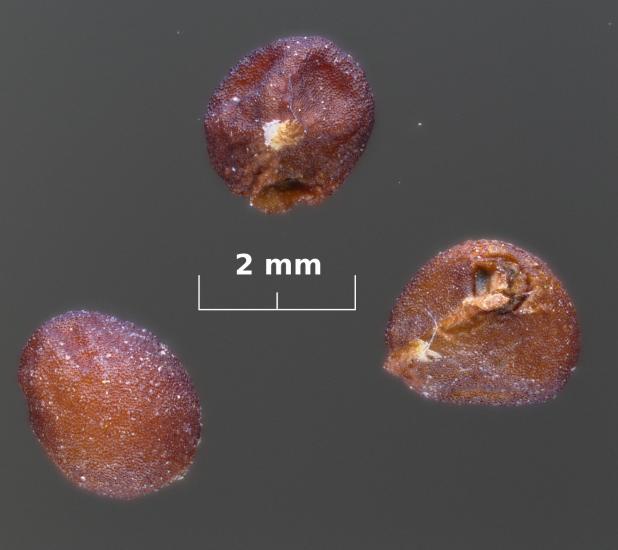
The first photo was taken by Lauw de Jager and the others by Bob Rutemoeller in January 2004. On very cool and overcast days the flowers do not open and you just see the bud. A second view shows the colorful back and the distinctive leaves. And finally there is a day warm enough for several flowers to open (bringing the pot inside to a warm bright spot works too.) Photo 5 from Mary Sue Ittner shows the corms on a 1 cm grid. Corms have a crescent-shaped basal ridge and a tunic that is split into minute parallel fibrils. Photo 6 by David Pilling of the seeds.
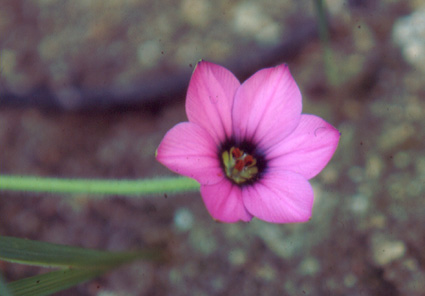


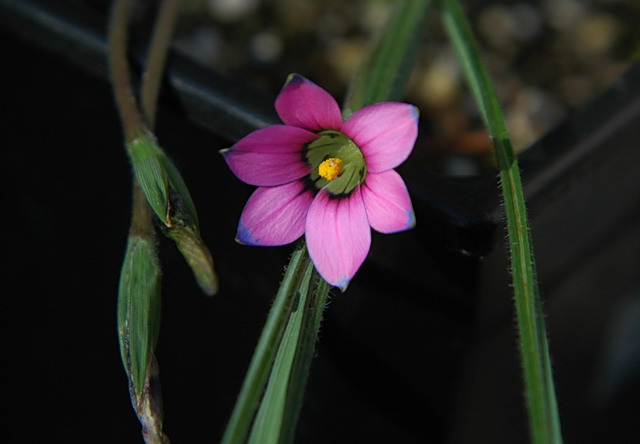
In her book Miriam de Vos recognized two varieties that in later revisions have not been accepted. One of these, var. flavandra, had erect yellow anthers and pollen and was lilac pink or salmon pink and the other, var. tetragona had purple incurved or circinal anthers with reddish-brown or orange pollen and was violet-rose to lilac pink. Photos below taken by Mary Sue Ittner are of plants grown from seed of the flavandra form.
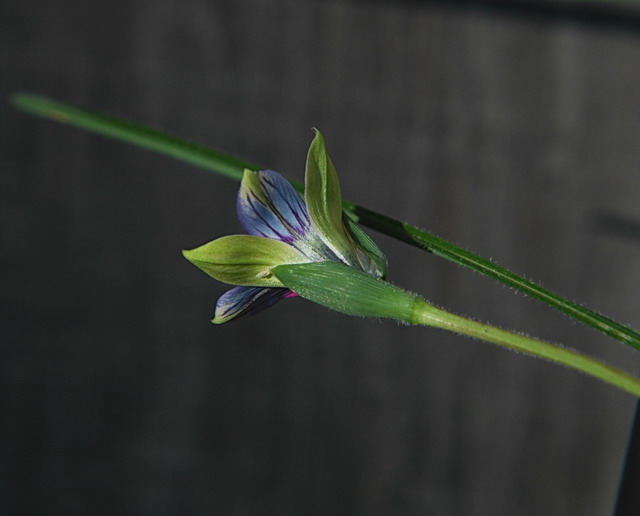
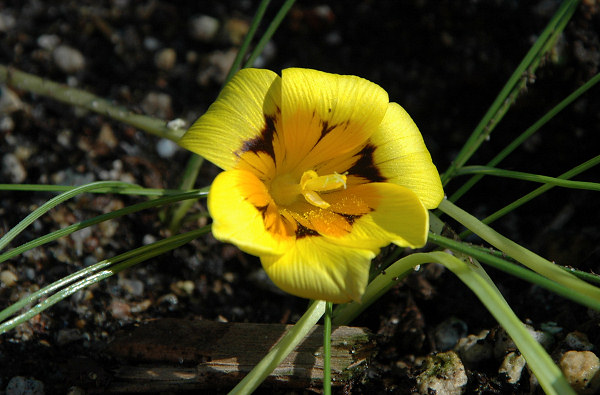
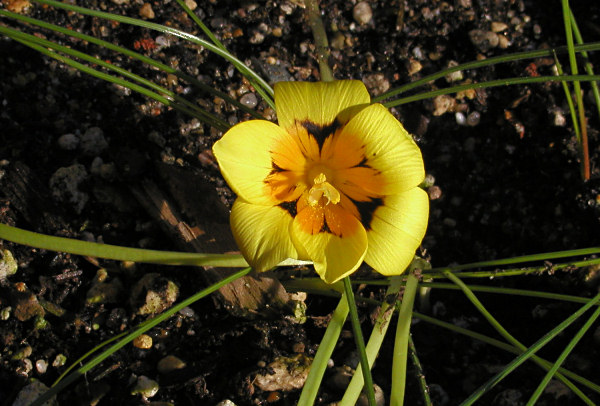
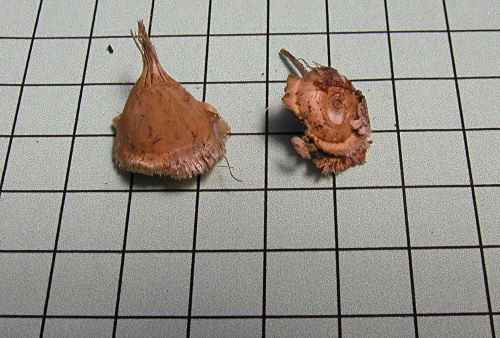
Romulea tortuosa (Licht. ex Roem. & Schult.) Baker grows in sandstone and clay soils and flowers winter into spring. It is scented and has yellow flowers with or without black marks of blotches in the throat and a distinctive corm that is flattened with a wide fan-like basal ridge. Leaves of this species in habitat are sometimes spirally twisted. Height range: 8-10 cm. The first two photographs by Mary Sue Ittner and Bob Rutemoeller were taken in the Komsberg September 2006. The third was seen near Middelpos. The fourth photo was taken by Cameron McMaster on the Sutherland Road in the Roggeveld September 2011. The last photo from the book Plants of the Klein Karoo is courtesy of Jan and Anne Lise Schutte-Vlok.
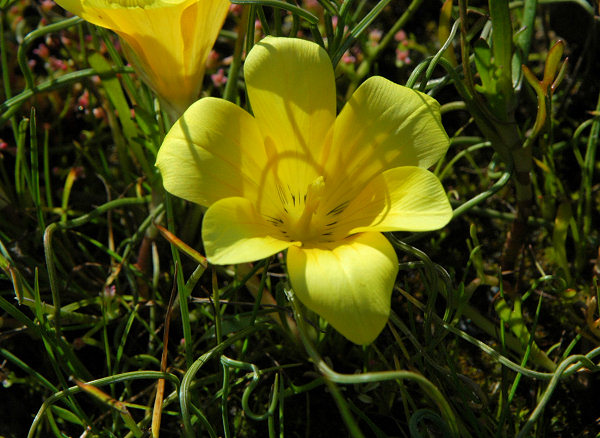
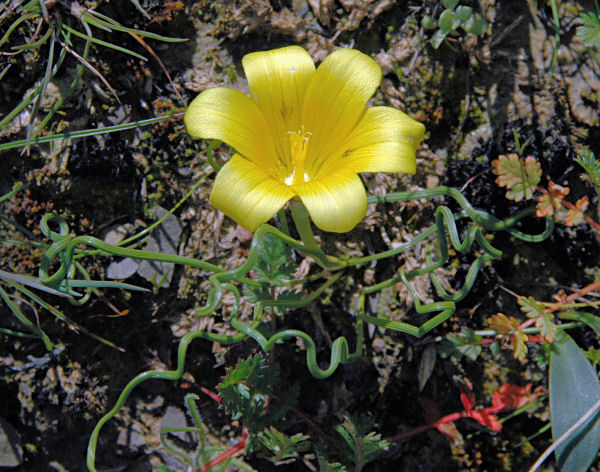
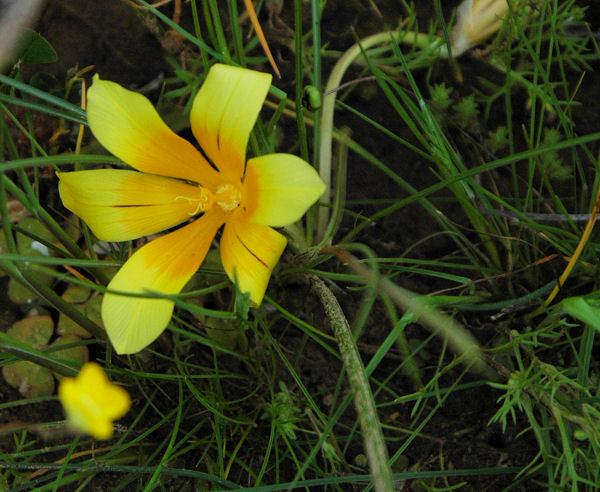
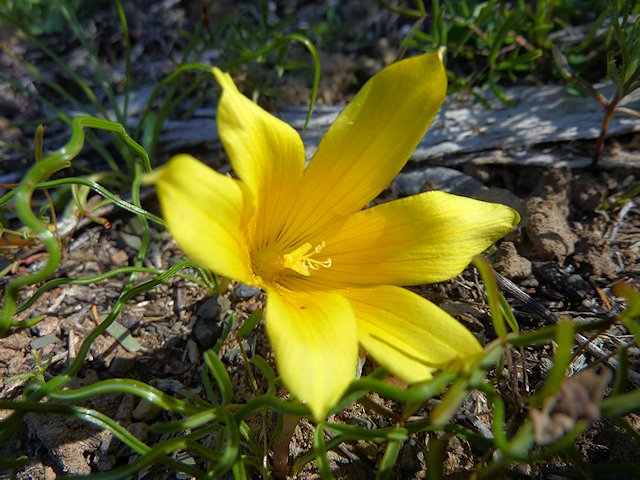
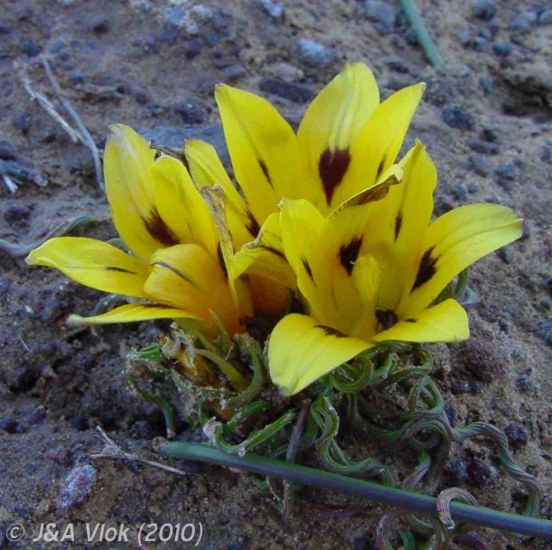
Romulea tortuosa ssp. aurea (Klatt) M.P.de Vos is buttercup-yellow to almost cadmium-orange without dark marks and with the upper part of the segments paler yellow. In northern California it flowered December to January. Photos by Mary Sue Ittner, Bob Rutemoeller, Alan Horstmann, and Carl Frederick.

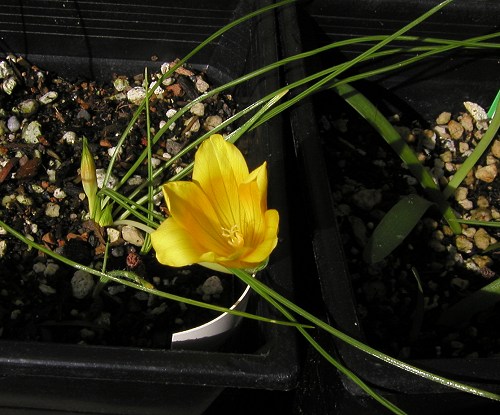
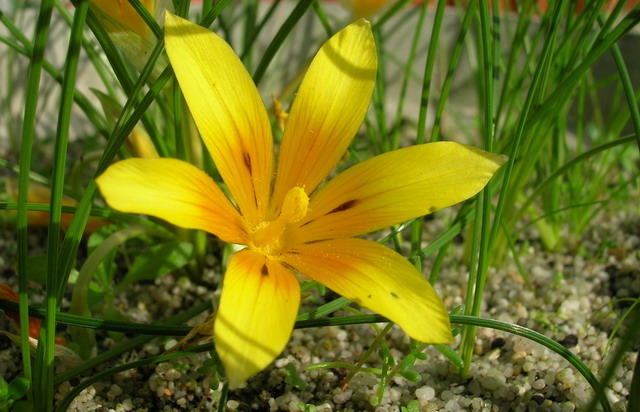
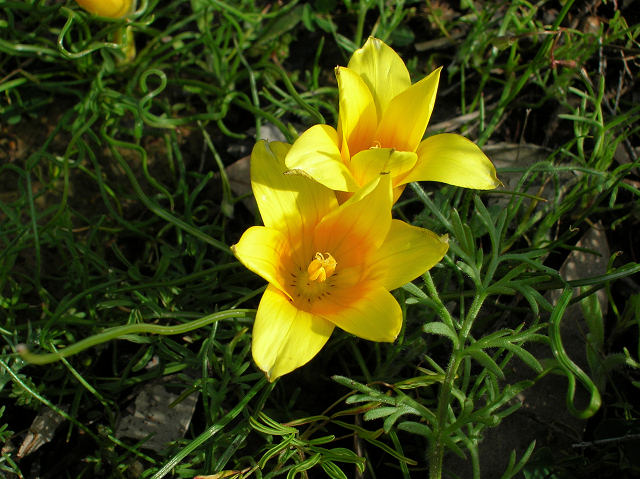

The form that used to be known as Romulea tortuosa ssp. tortuosa generally has dark blotches or veins in the throat and sometimes is a darker yellow towards the base. Photos were taken by Mary Sue Ittner of the flowers and the obliquely flattened corms with a wide fan-like basal ridge. Corms pictured (one of bottom and one of top or corm) on a 1 cm grid.
Romulea toximontana M.P.de Vos grows in sandy soils in the Northwest Cape and flowers in August. It has cream flowers with a orange-yellow base and cup. Height: 20 cm. Photos by Alan Horstmann.
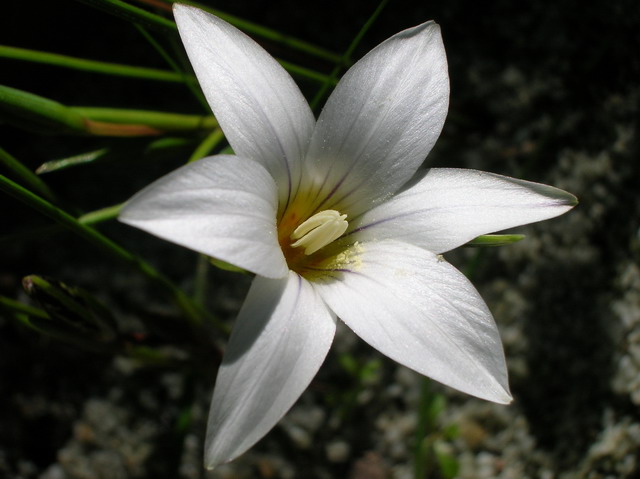
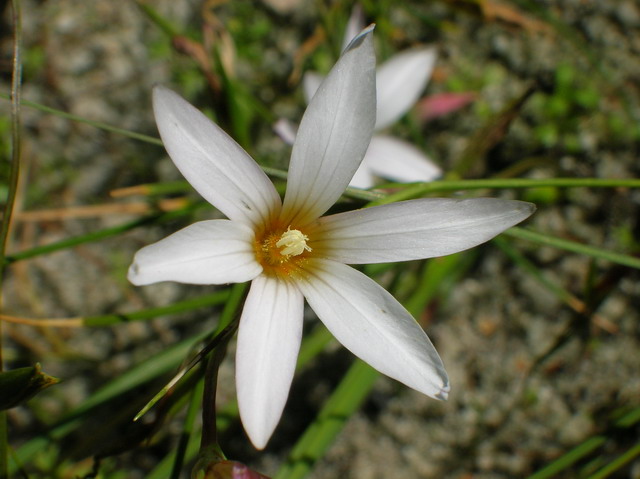
Romulea triflora (Burm.f.)N.E.Br. grows on sandstone slopes, on sandy or loamy flats in mostly seasonally moist sites and is widely distributed in the southwestern Cape. Growing from 5 to 20 cm high, it has filiform, glabrous leaves, symmetrical bell-shaped corms and golden-yellow or (occasionally) white flowers with or without darker zones or markings around the yellow cup. It flowers winter to spring (August to October). Photo from iNaturalist were taken by Nick Helme September 13, 2024 near Cape Point and shared under a CC BY-NC license. The last photo was taken by Rod Saunders.
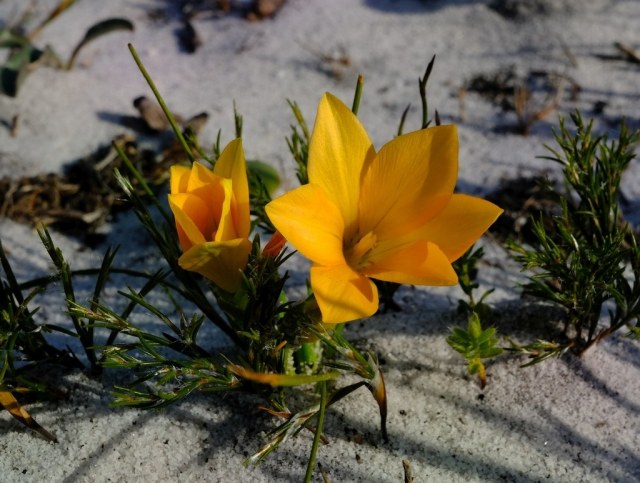
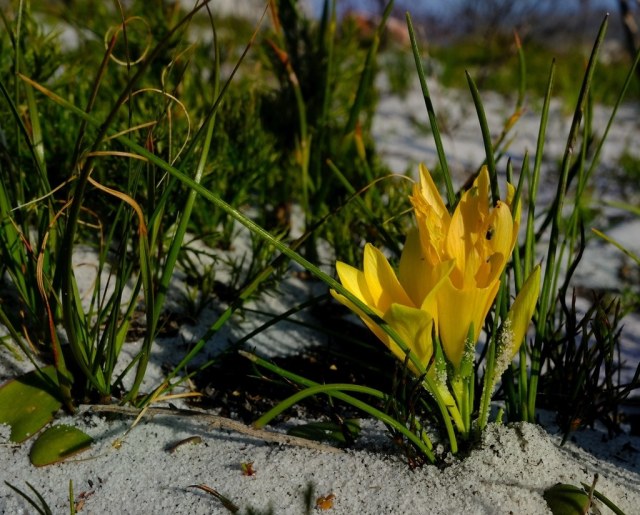
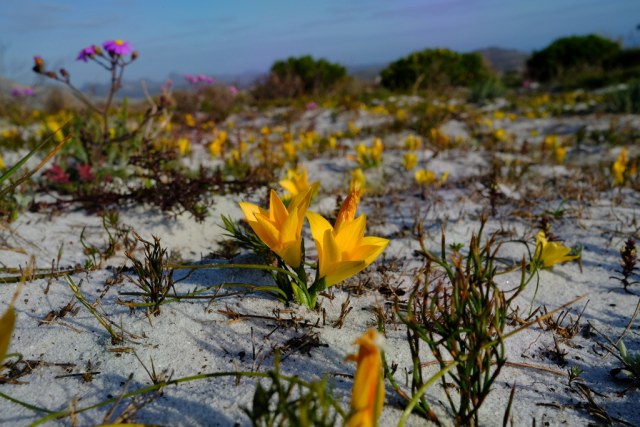

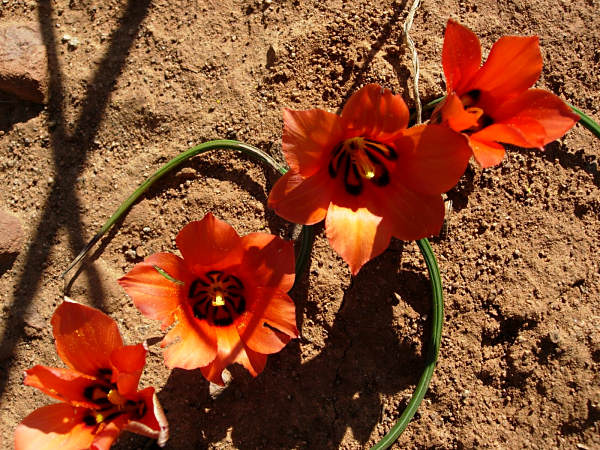
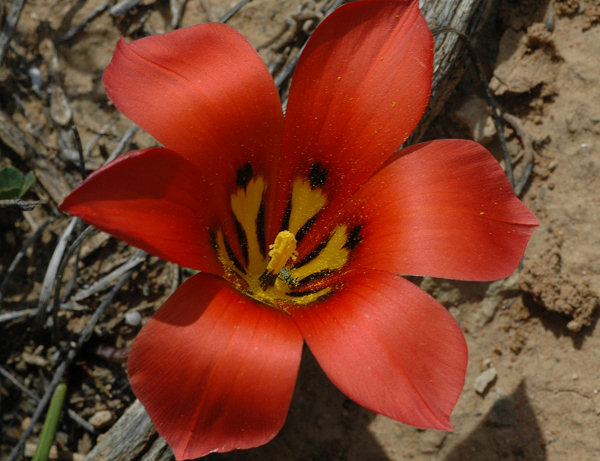
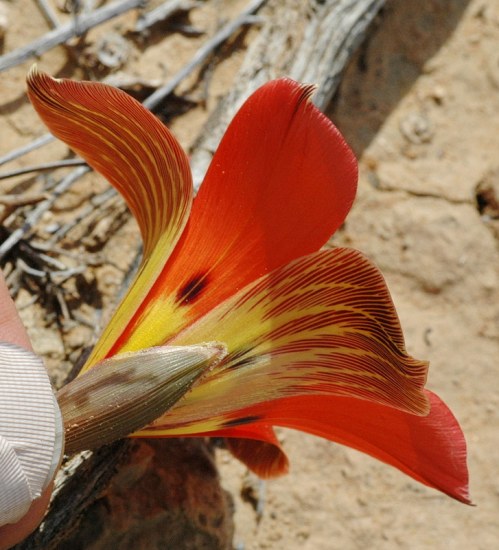
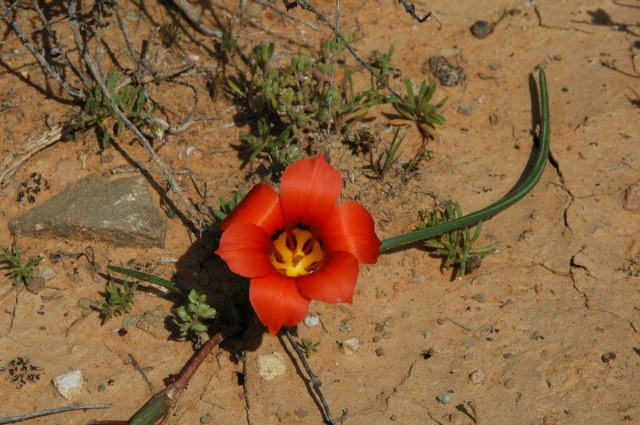
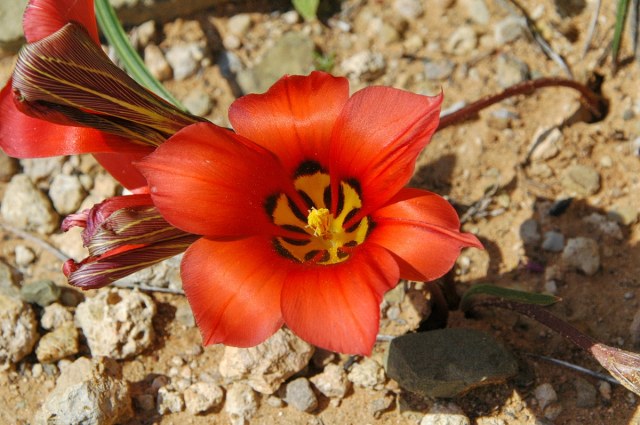
Romulea unifolia M.P.de Vos grows on dolerite flats in heavy clay open shrubland in the Roggeveld, but has also been recorded on the Bokkeveld Plateau. It is distinctive in the genus for its mostly solitary leaf (rarely with an additional one or two much reduced leaves) that is thick and broadly 4-grooved and its large, cup-shaped shiny orange to reddish flowers with black and yellow markings in the cup. Outer tepals have dark feathering on the back. Corms are rounded at the base with curved acuminate teeth. The first photo of a plant in cultivation was taken by Mary Sue Ittner. The first of the next two photos by Bob Rutemoeller show one being grown by Alan Horstmann in South Africa and the second the corms on a 1 cm grid. The small ones are two years from seed and the others blooming size.
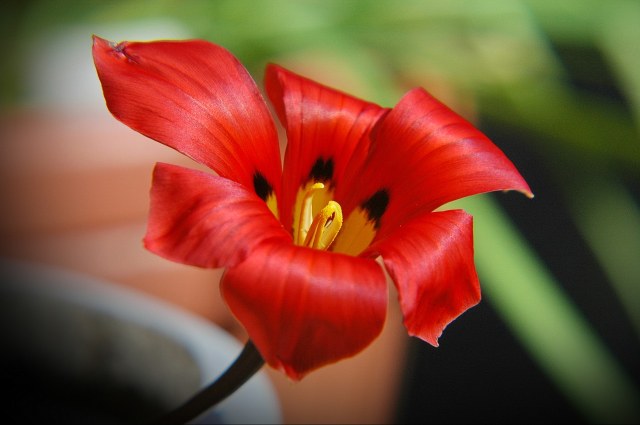
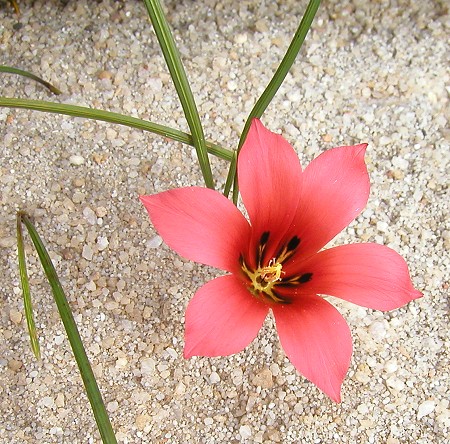
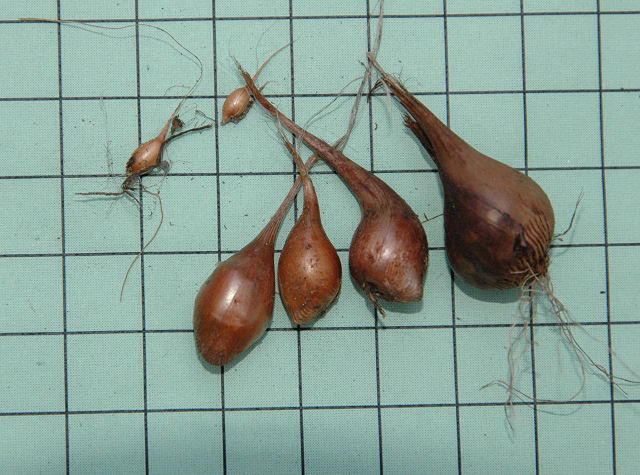
The first three photos were taken in the Roggeveld by Cameron McMaster. The fourth photo taken by Alan Horstmann shows this species blooming with Romulea subfistulosa.
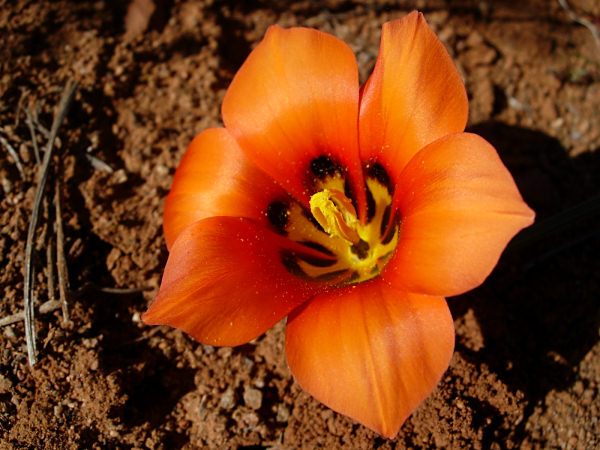
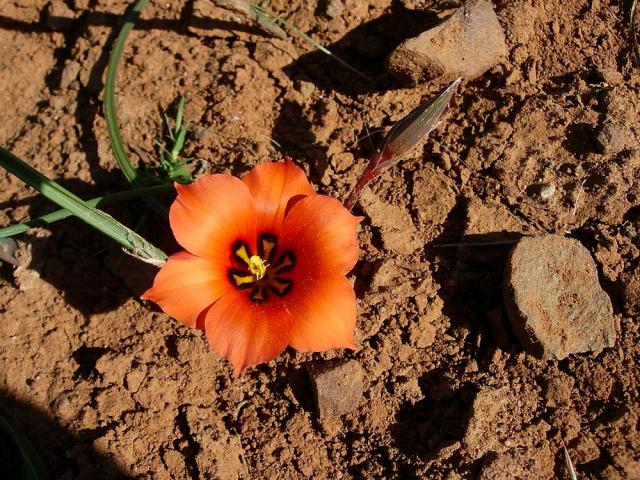
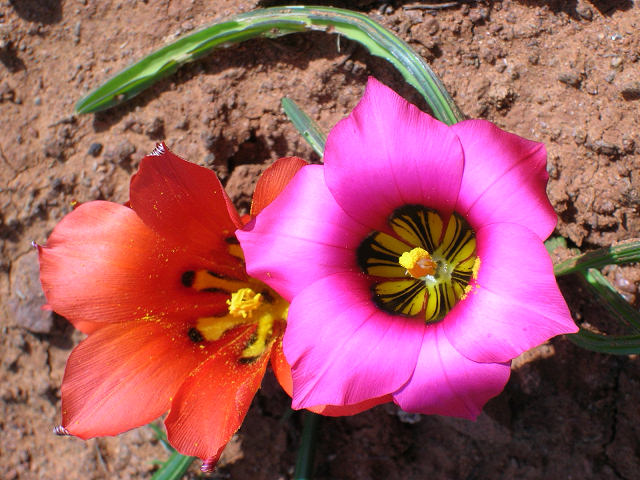
Photos from Bob Rutemoeller and Mary Sue Ittner were taken near Middelpos in the Roggeveld in September 2006. The first two by Bob Rutemoeller are a close up of a flower with a pollinator and a picture of the beautiful back markings on the petals. In the fifth photo, there is a flower of Moraea ciliata. The last one shows flowering in habitat with annual daisies.
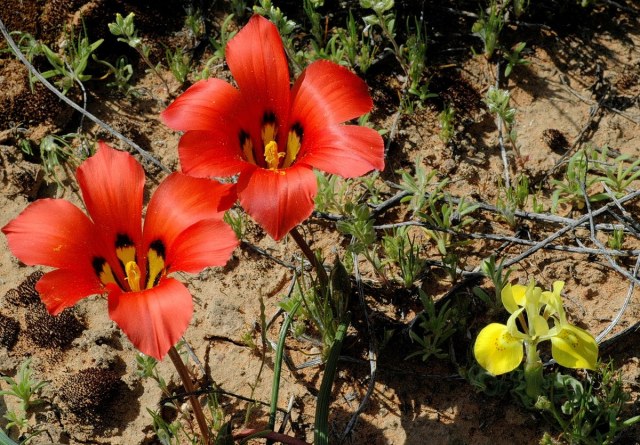
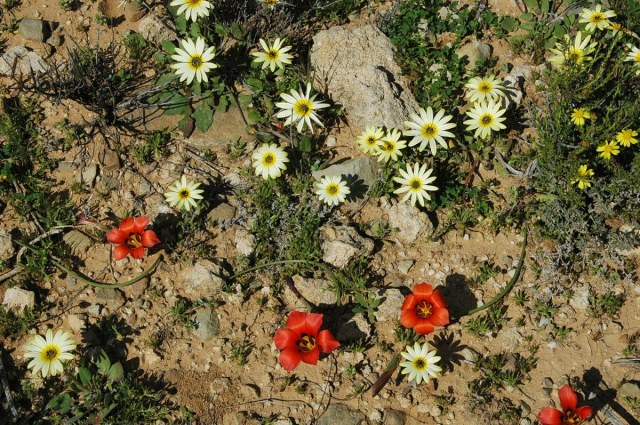
Romulea vinacea M.P.de Vos grows in sandy soils in the Northwest Cape (Pakhuis Pass) and flowers in August. It has pale blue violet flowers opening only for a few hours late in the day. The flowers are marked with violet veins and sometimes violet blotches in the throat. The outer tepals are shiny and plum or wine colored on the back. Height range: 25-35 cm. Photos by Alan Horstmann.

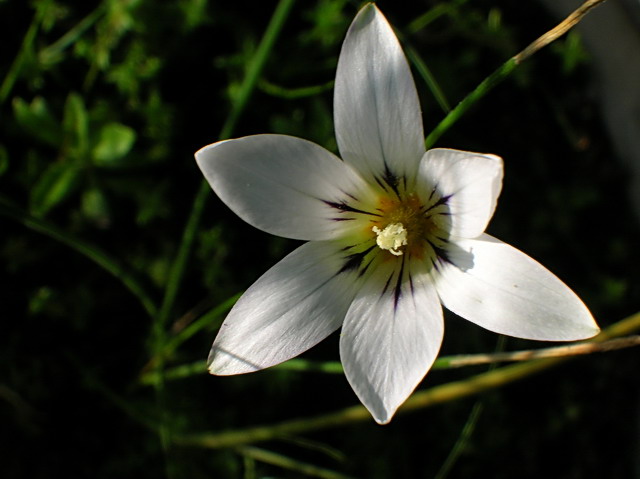
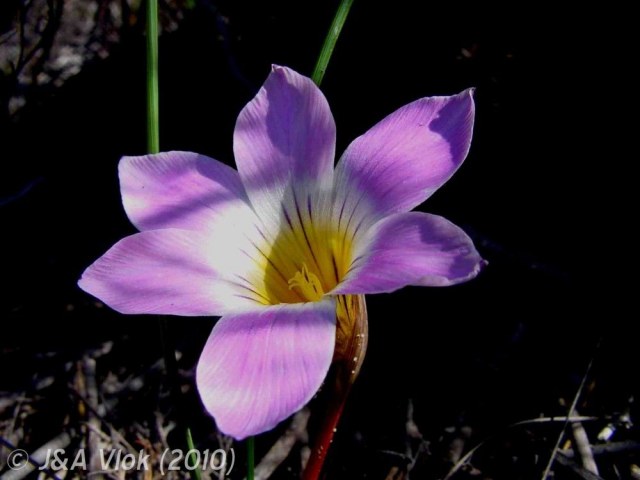
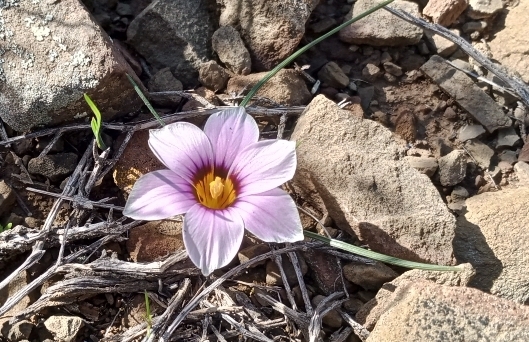
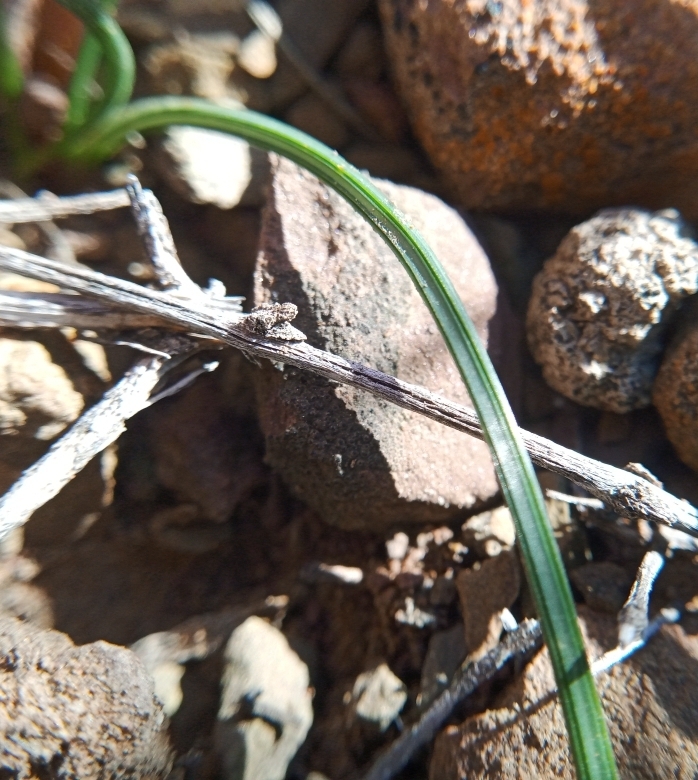
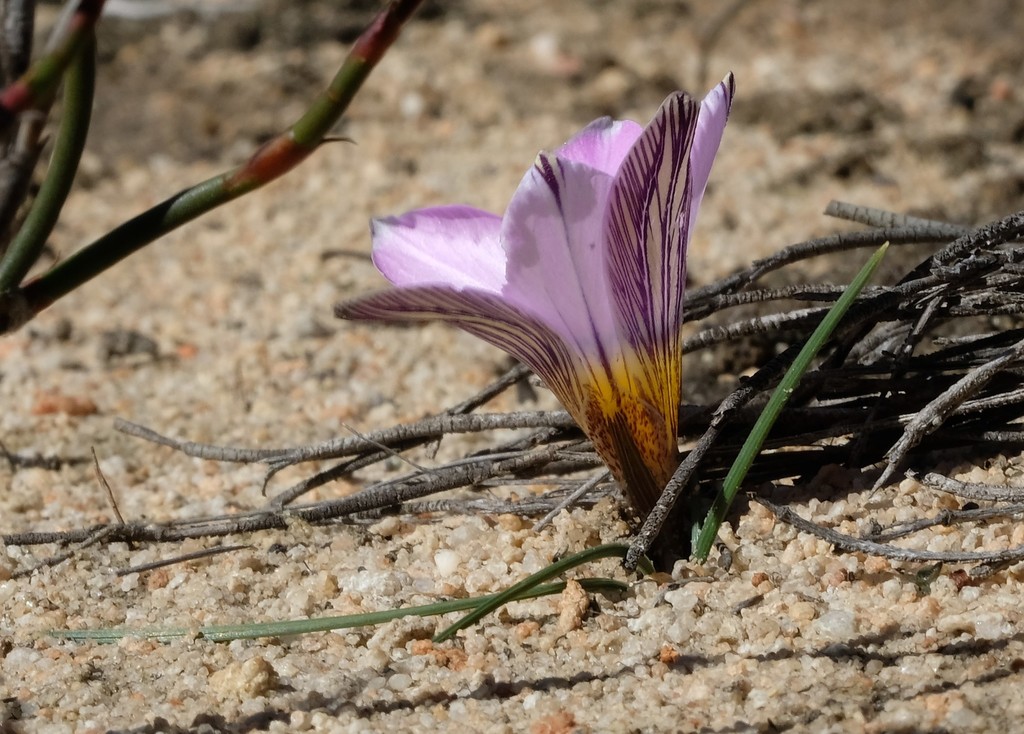
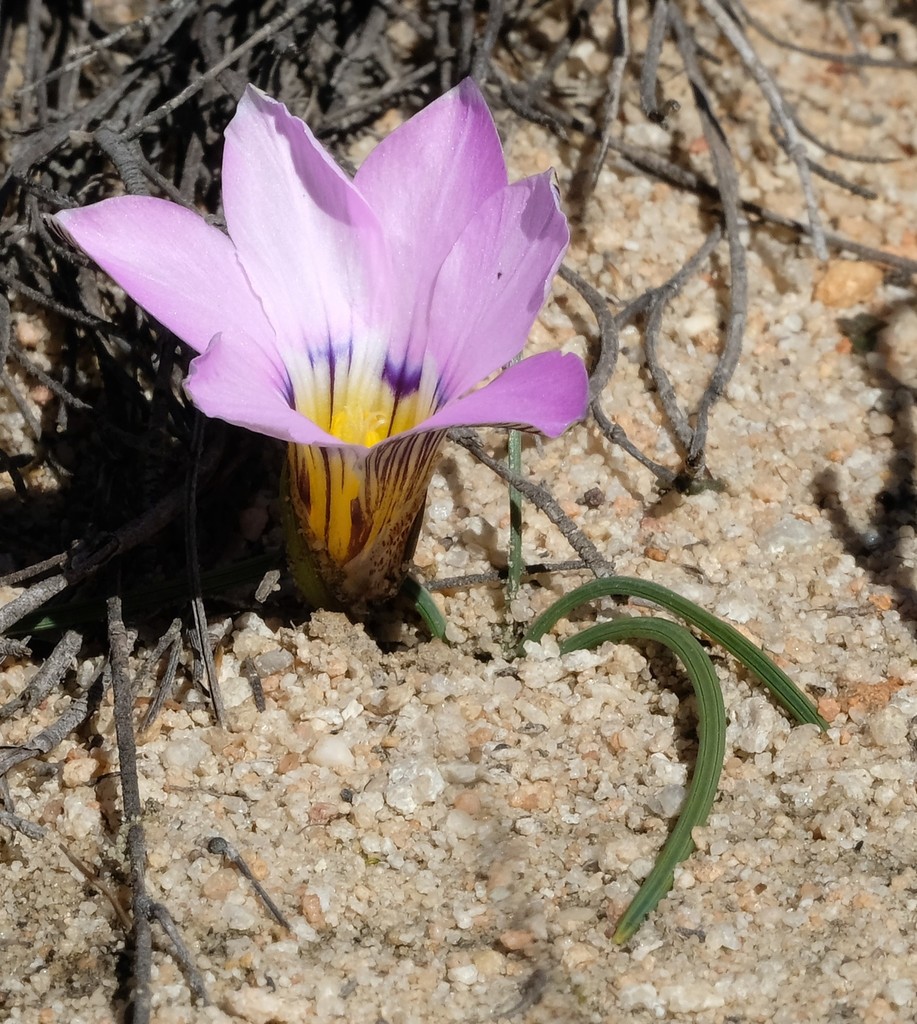
Romulea vlokii M.P.de Vos grows in wet sands, renosterveld and fynbos on the coastal and inland mountains from Montagu to the Swartberg and Kammanassie Mountains. Plants are 5 to 15 cm high with 3 to 5 narrowly four grooved narrow leaves, a subterranean stem, and pink flowers with or without blue to purple lines around the yellow to orange cup. The outer tepals are blotched or feathered with purple on the reverse. Corms are obovoid, the tunics with straight acuminate teeth converging to a pointed base. Bracts are firm, green, with prominent closely spaced veins, the outer with narrow, inner with wide, papery, brown-streaked margins and tips. It flowers in late winter to spring. This species may be confused with Romulea atrandra in the Little Karoo and examination of the corms is necessary. The first photo from the book Plants of the Klein Karoo courtesy of Jan Vlok and Anne Lise Schutte-Vlok. The remaining photos from iNaturalist were taken by Vandepitte Bart July 17, 2024 in the Drie Kuilen Nature Reserve and by Nick Helme August 2018 in the same place and shared under a CC BY-NC license.
European And Mediterranean Romuleas - South African Romulea a-d - South African Romulea e-k - South African Romulea l-n - South African Romulea o-s - Romulea index