Watsonia is a genus in the Iridaceae family of over 50 species in southern Africa where it is distributed from the mountains and coastal belt of the Western Cape to the Drakensberg escarpment of Swaziland and the eastern Transvaal. It therefore grows in both the winter and summer rainfall areas. Growing from a corm, species are both evergreen and perennial. Many are quite tall with fans of sword-shaped leaves and spikes of showy (often many) flowers that are usually pink, bright red or orange. Watsonia species a-f are found on this page.
Watsonia species g-m - Watsonia species n-z - Watsonia index
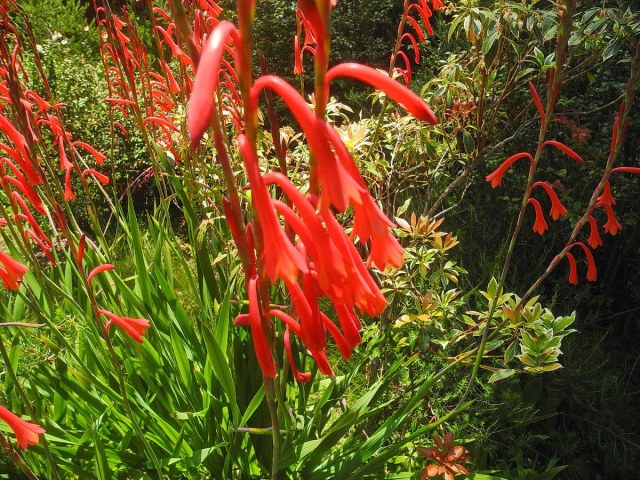
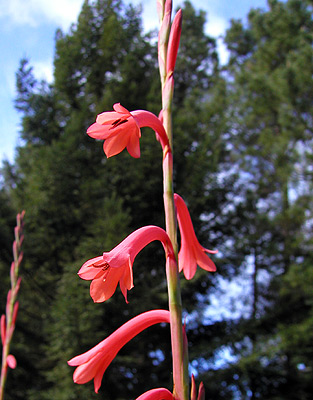
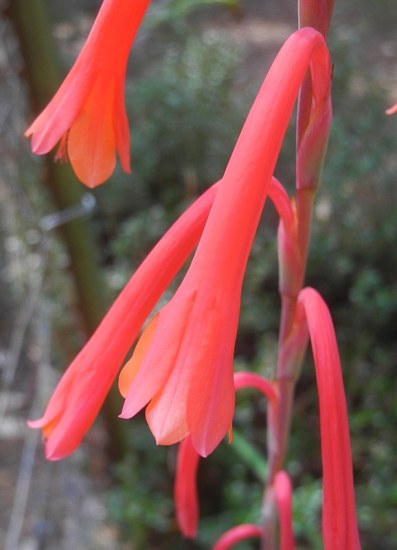
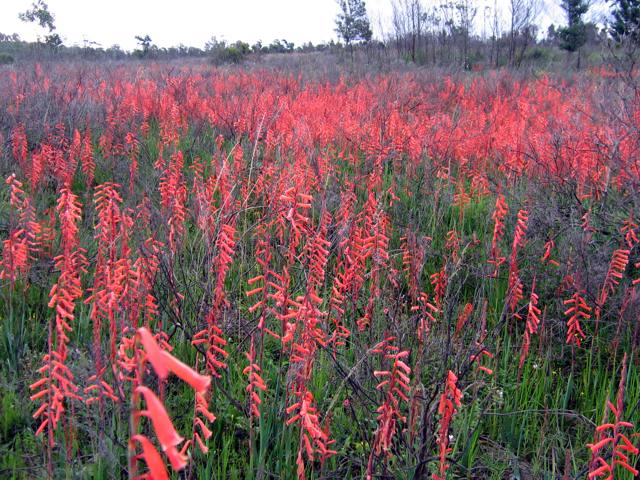
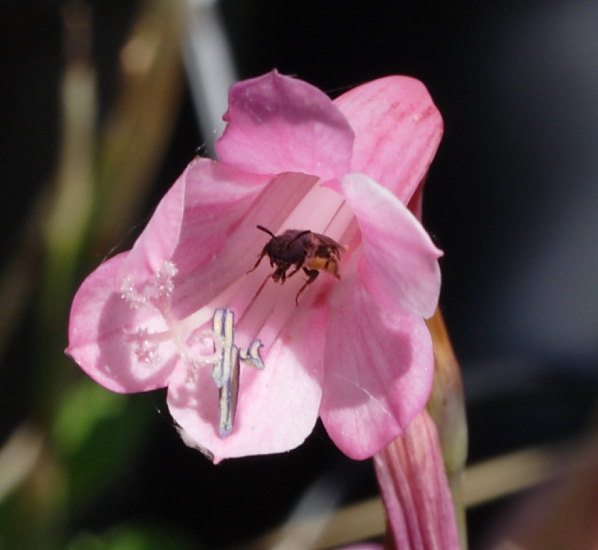
Watsonia aletroides (Burman fil.) Ker Gawler is a Cape species found on clay slopes in renosterveld and flowering in spring. It grows to 50 cm high with sword-shaped leaves and red, occasionally pink or mauve (rarely white) nodding tubular flowers in an unbranched spike. It flowers in spring and abundantly after fires. The first three photos taken by Mary Sue Ittner are of garden plants in Northern California, where they are planted in the ground. The fourth and fifth pictures are by Rogan Roth of plants flowering abundantly in a seasonally wet and burnt area near the town of Swellendam, Western Cape. The sixth picture is of a very small pink form (under two feet / 0.7 m) grown in California by Michael Mace. There is a small bee hiding in the flower. This form blooms in late spring (mid-May) in California.
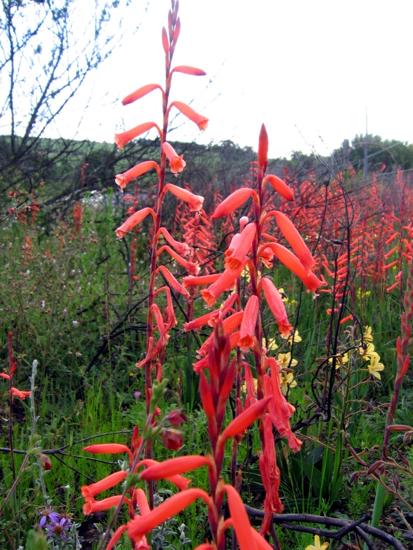
The photos below from Cameron McMaster show different color forms.
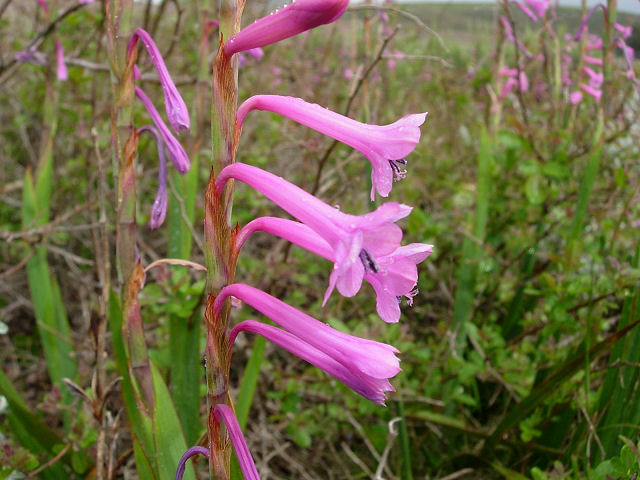
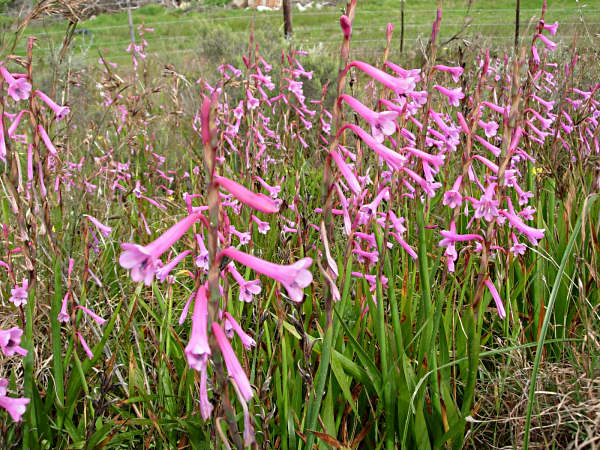
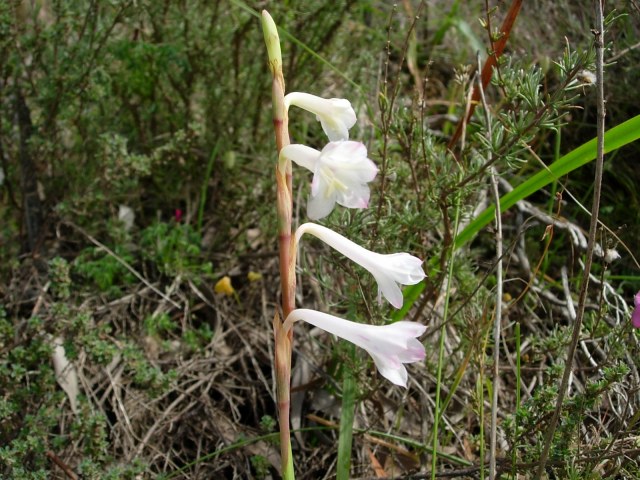
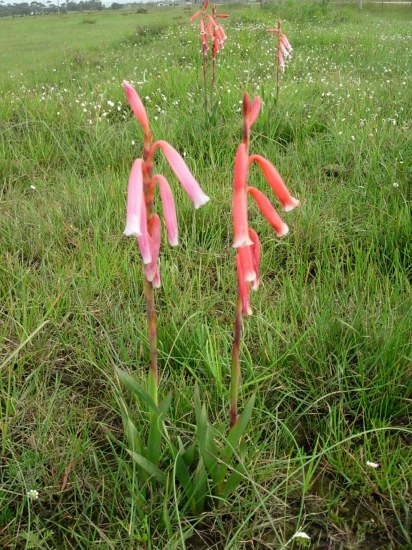
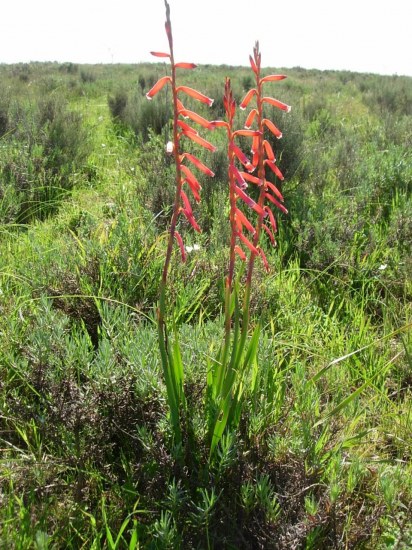
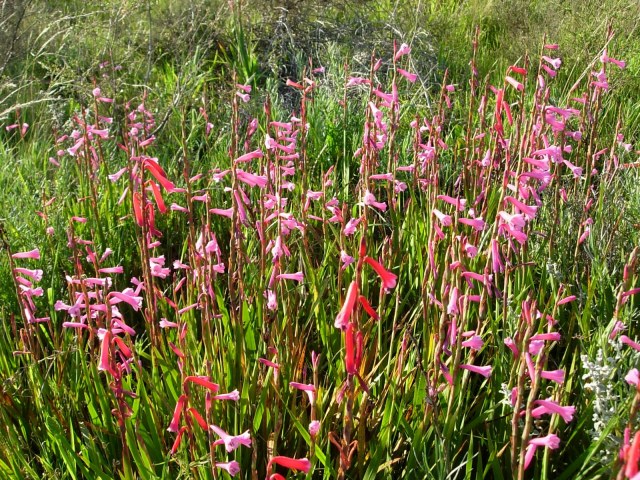
Watsonia amatolae Goldblatt occurs in the Eastern Cape in the Amatola Mountains. The purple pink flowers appear in summer. Height range: 0.4-0.6 m. Photos by Cameron McMaster.
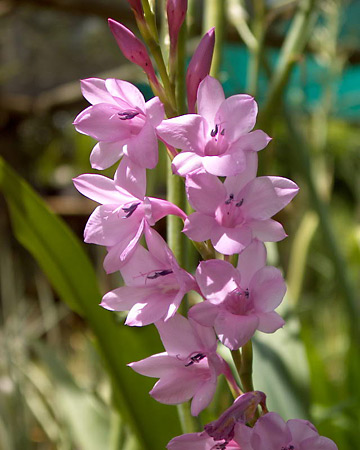
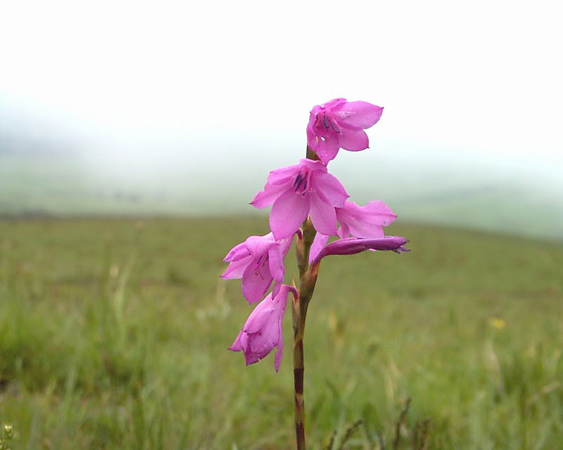
Watsonia angusta Ker Gawler is evergreen, growing to 1.2 m and is found in montane marshes and streambanks in fynbos in many areas in the Cape Province to southern KwaZulu-Natal. It has scarlet flowers in a usually branched spike and multiplies rapidly. It flowers in summer and is suitable for a wet part of a garden. The first photo was taken by Cameron McMaster. The second photo is from the book Plants of the Klein Karoo courtesy of Jan and Anne Lise Schutte-Vlok.
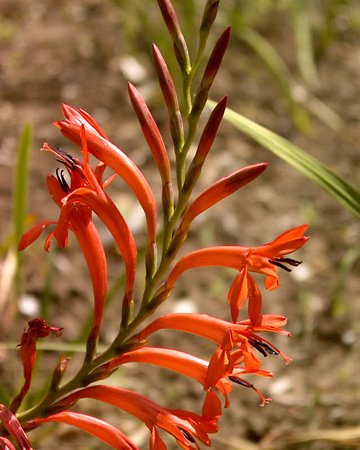
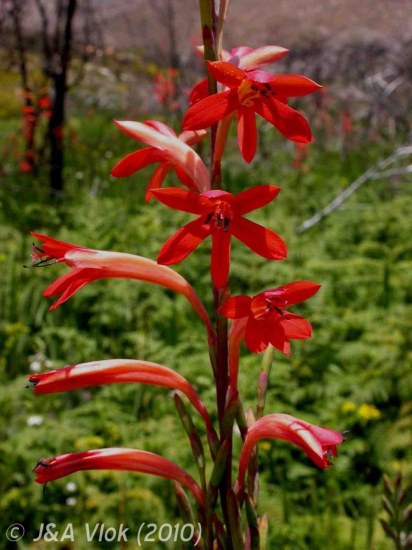
Watsonia borbonica (Pourret) Goldblatt is a species from the Southwestern Cape where it is found on rocky sandstone slopes, on granite and clay from 100-1500 m. It is deciduous, growing during autumn-winter-spring and dying back after flowering in spring to early summer and remaining dormant during summer. It has 5 to 8 apple-green sword-shaped leaves with hyaline, moderately thickened margins. It grows from 120 to 200 cm and blooms best in the wild after a fire. The bilateraly symmetrical funnel-shaped flowers are large and showy, pale to deep pink to light purple, and faintly fragrant. The tepals have a darker midline, and a white streak at the base and occasionally a plant is found where the whole tepal is white. This species flowers in spring to summer (October to January) depending on the elevation. It is pollinated by bees. Detailed information about this species can be found on the South African National Biodiversity Institute's website.The three photos below were taken by Cameron McMaster. The first two were taken after a fire and the last photo was taken at Drayton.
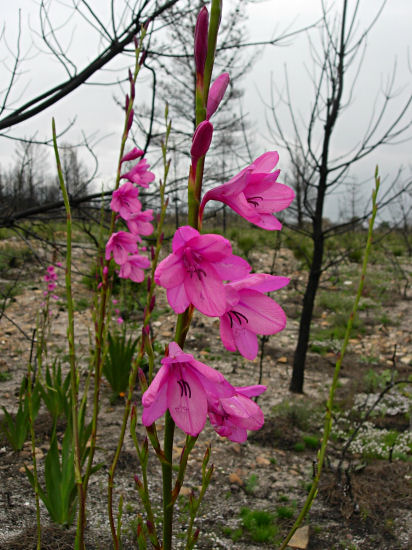
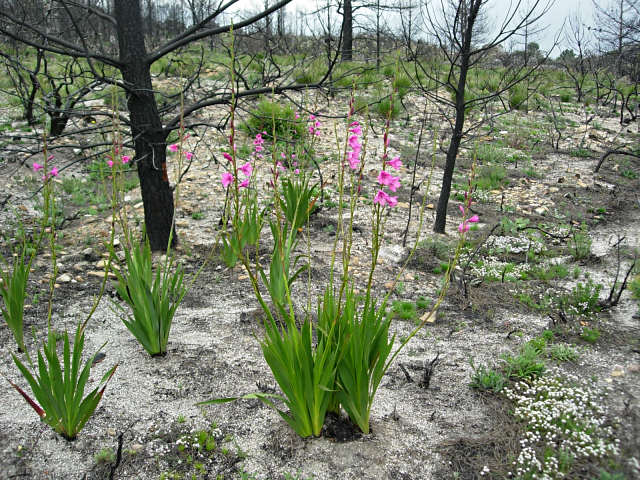
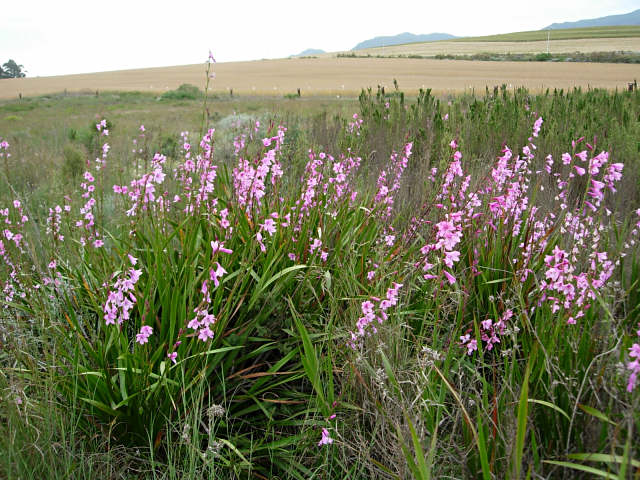
Watsonia borbonica ssp. ardernei (Sander) Goldblatt has stamens that are bent downwards and anthers that lie flat but rise towards the tip. The style is arched above the stamens. In contrast to the other subspecies, it has a slightly longer upper perianth tube. It is endemic to the extreme southwestern part of the Western Cape. It is known as the Bugle Lily. A white species is commonly grown, but is rare in the wild. There is a tall form in cultivation that has white flowers known as 'Ardern's White' that has been growing in Southern California gardens for over 50 years. The first photo was taken in Alan Horstmann's yard in 2006. The second photo was taken by Alan Horstmann.
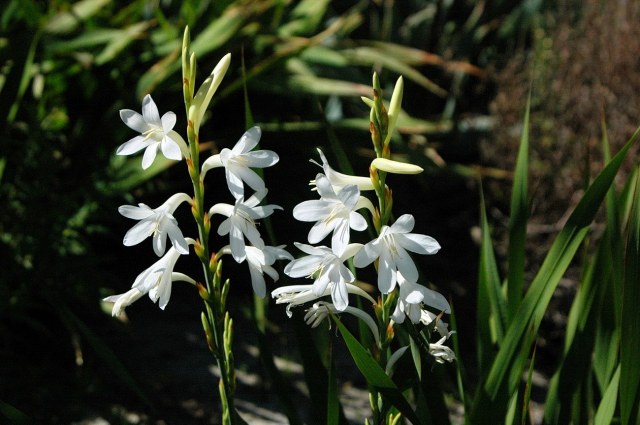
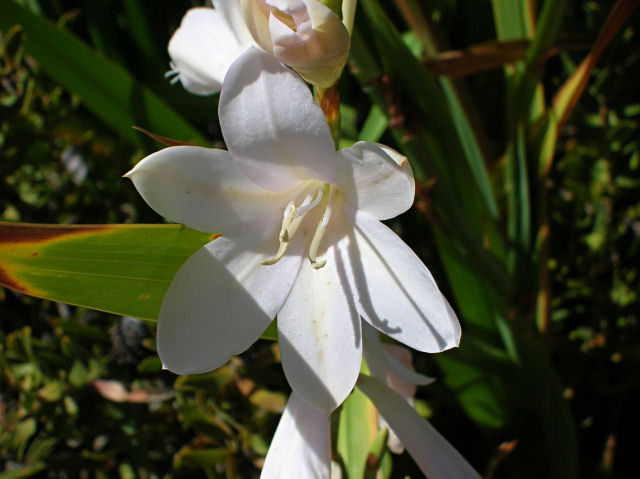
Watsonia borbonica ssp. borbonica has stamens that are bow-shaped to horizontal and horizontal anthers. The style curves below the stamens. Known as the Pyramid Watsonia, it is restricted to the southern part of the range of the species. The first photo was taken by Alan Horstmann. The last four photos were taken by Mary Sue Ittner.
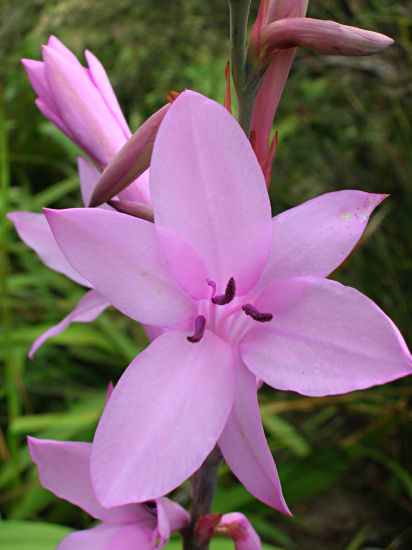
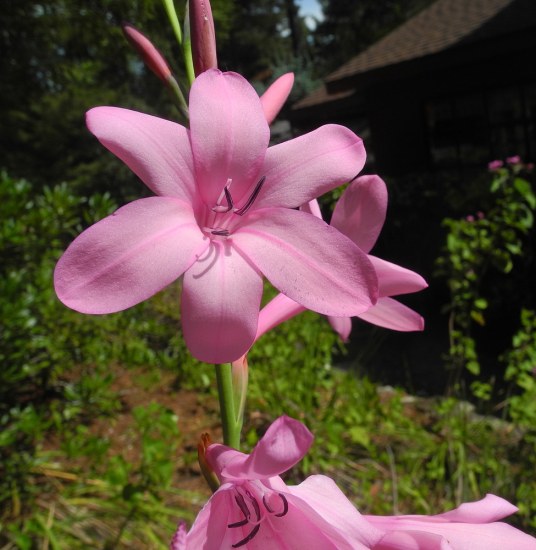
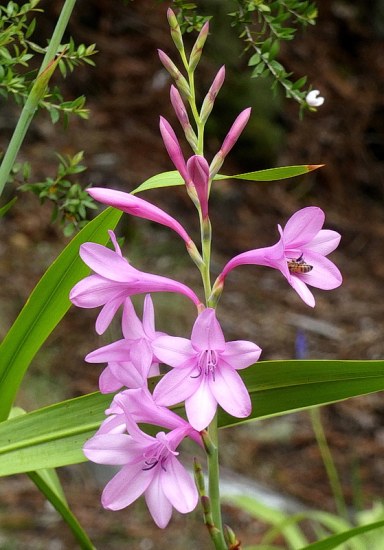
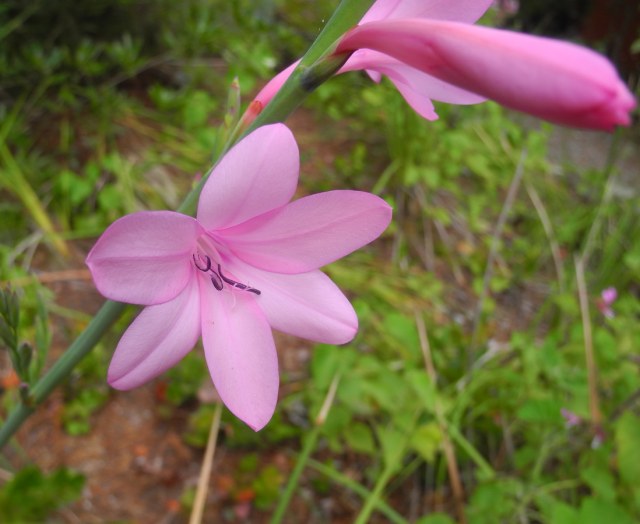
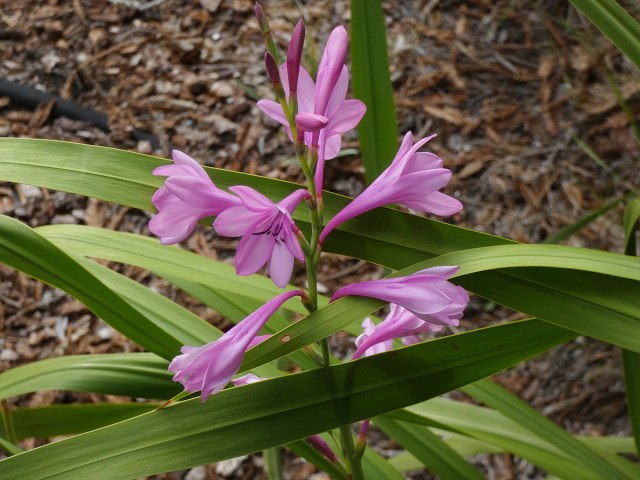
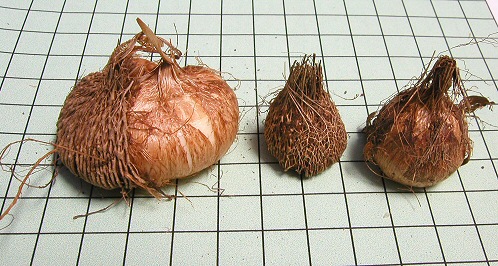
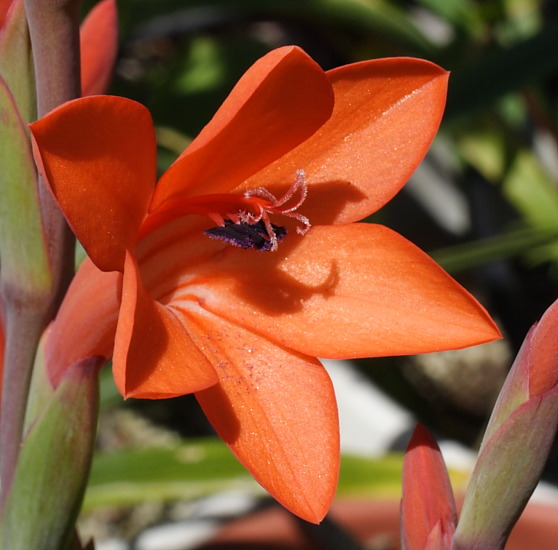
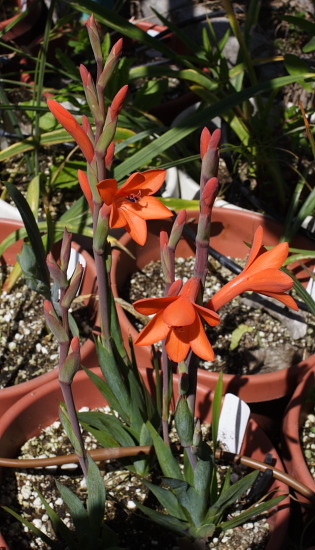
Watsonia coccinea (Herbert. ex Baker) Baker grows on moist sandstone flats or plateaus, often in seeps, in the southwestern part of the Western Cape. Growing from 14 to 40 cm tall, it has sword-shaped leaves and bilateral, symmetrical, dull to bright scarlet, purple or translucent pink flowers. It flowers best after a fire, August to November, late winter to spring. It can be grown in a pot or in the ground. It doesn't flower every year and does not increase as quickly as many species. Photos were taken by Mary Sue Ittner in different years, including one where it was flowering at the same time as a Moraea. The last photo shows the corms on a grid of 1 cm squares.
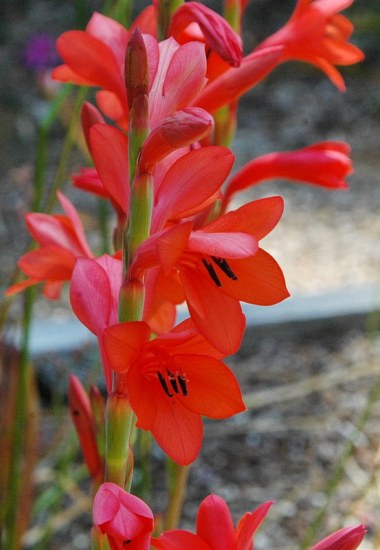
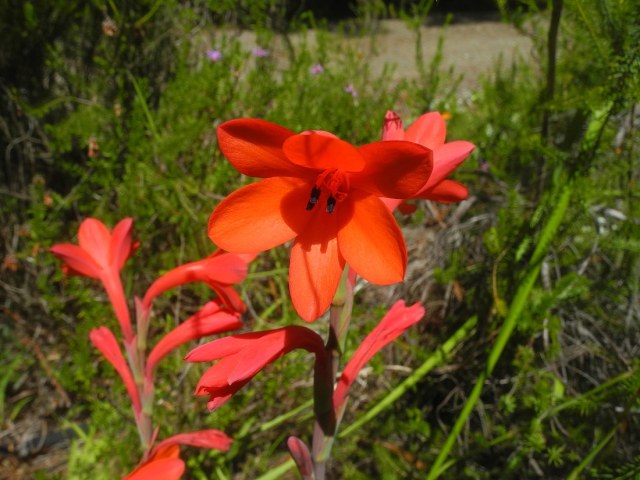

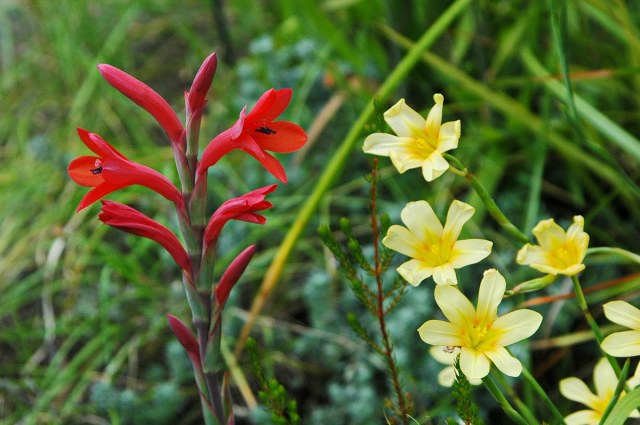
The first and second photos are by Michael Mace of a form received as seed from Kirstenbosch Garden, back in the happy days when it still sent seed to foreign members. The last photo is from Rachel Saunders.
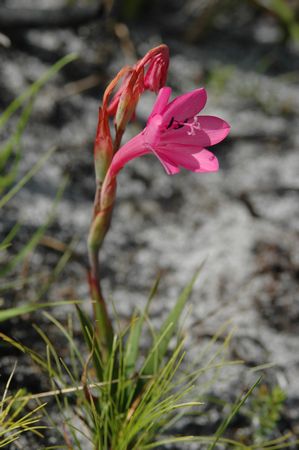
Watsonia confusa Goldblatt grows in damp sites or grassland along the coast and inland in the Eastern Cape Province to KwaZulu-Natal. It is large, up to 1.5 meters, and has more or less 30 pink to purple flowers on an unbranched stem. The first photo was taken by Cameron McMaster January 2008 at Elands Heights, Maclear. The second photo was taken by Rod Saunders. The last three were taken January 2010 at Maclear by Mary Sue Ittner.
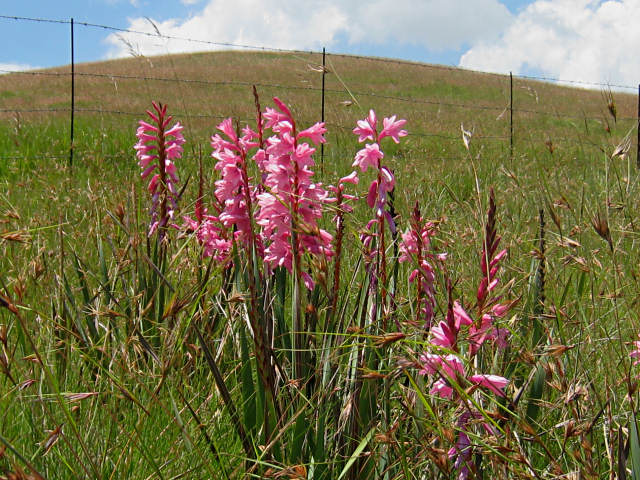
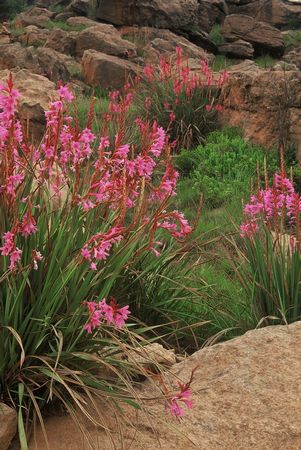
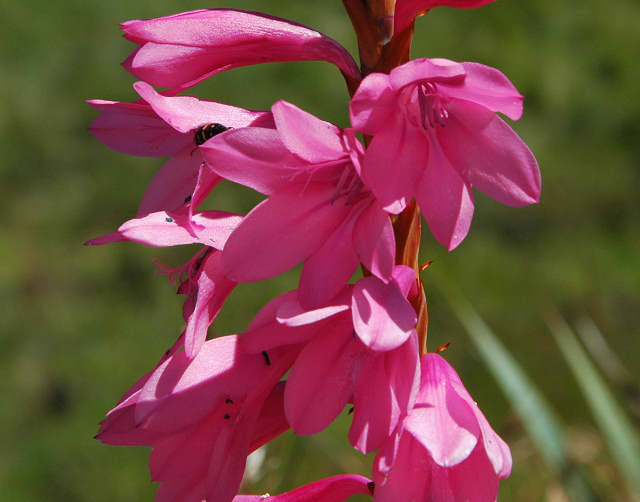
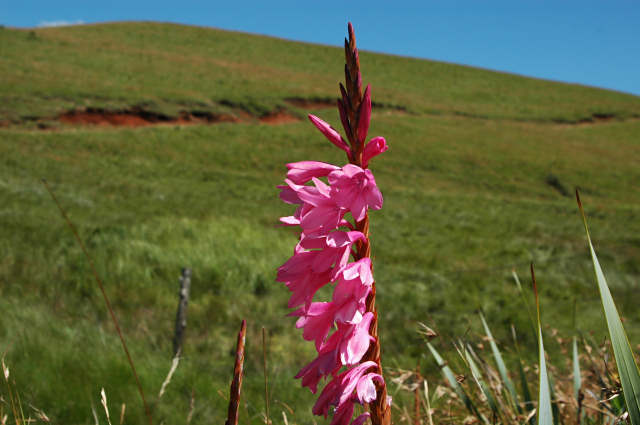
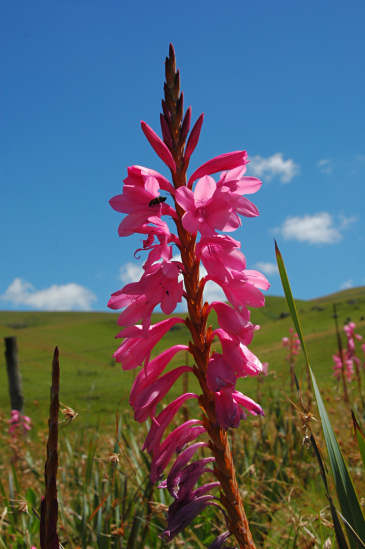
Watsonia densiflora Baker is a common summer-growing species found in the midlands and uplands of KwaZulu-Natal. Two color forms of this species are illustrated here. Height: to about 1 m. Photos 1 to 2 by Rogan Roth. The last photo was taken by Rod Saunders.
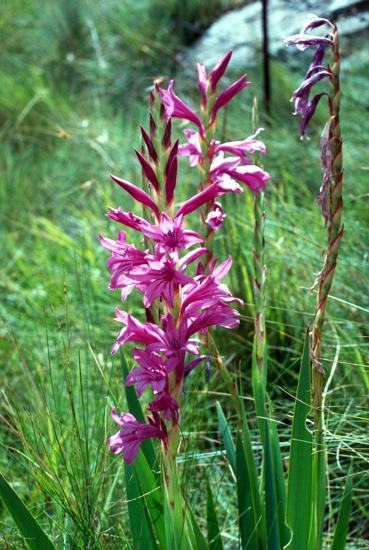
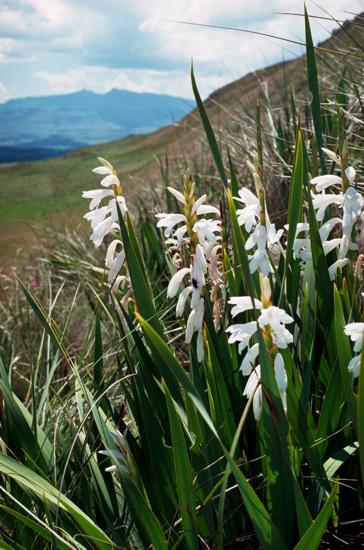
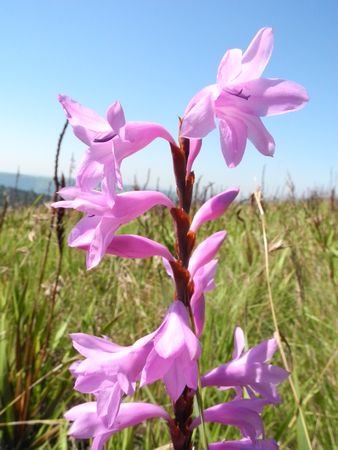
Watsonia distans L.Bolus is a rare plant found in only one remaining site in the Southwestern Cape where it grows in mountain marshes, flowering in late summer (November to December). Growing from 15 to 35 cm or taller, it has sword-shaped leaves and deep pink short-tubed flowers. Photo from Rod Saunders.
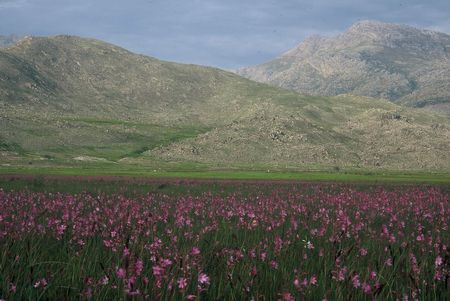
Watsonia emiliae L.Bolus is found on rocky outcrops in fynbos in the Langeberg and Swartberg Mountains. It grows to 60 cm, has narrow leaves and short tubed pink flowers, and flowers in summer. The photo below is from the book Plants of the Klein Karoo courtesy of Jan and Anne Lise Schutte-Vlok.
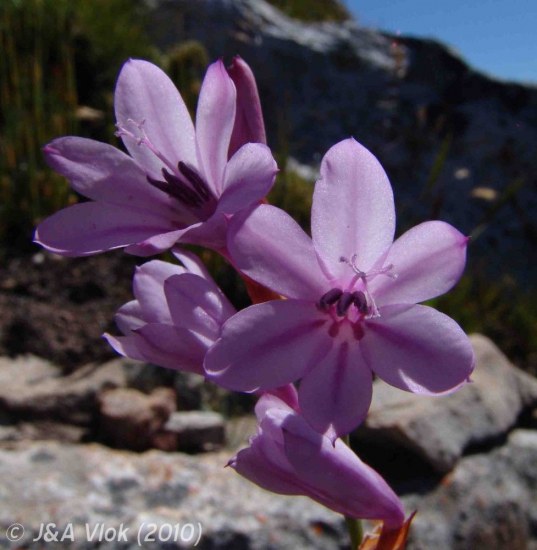
Watsonia fourcadei J.W.Mathews & L.Bolus grows on rocky sandstone slopes from the Western Cape to the Eastern Cape to Swaziland. It flowers November to January. This species grows to 2 meters and has sword-shaped broad blue grey leaves and mostly orange to red, rarely pink or purple, large flowers in elongate spikes. The first four photos by Cameron McMaster were taken at Caledon and Napier Mountain in the Overberg. The last photo is from the book Plants of the Klein Karoo courtesy of Jan and Anne Lise Schutte-Vlok.

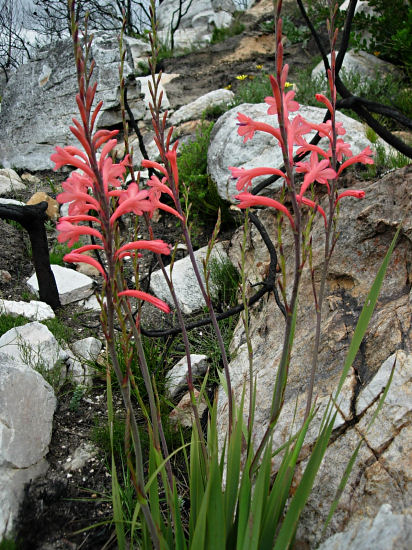
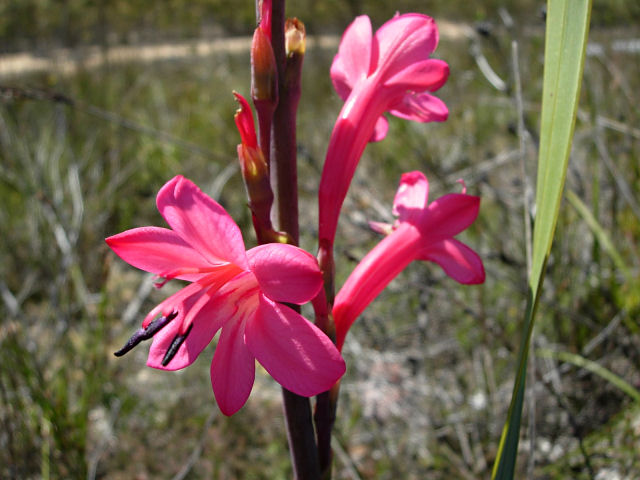
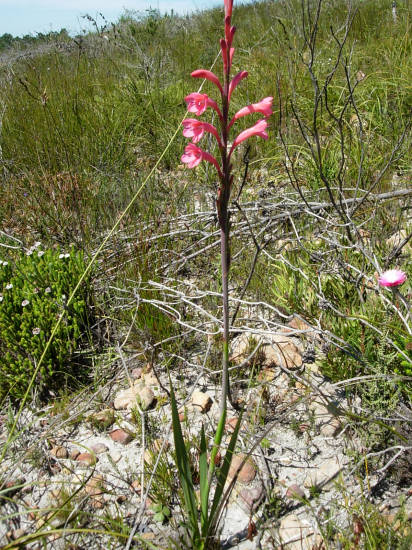
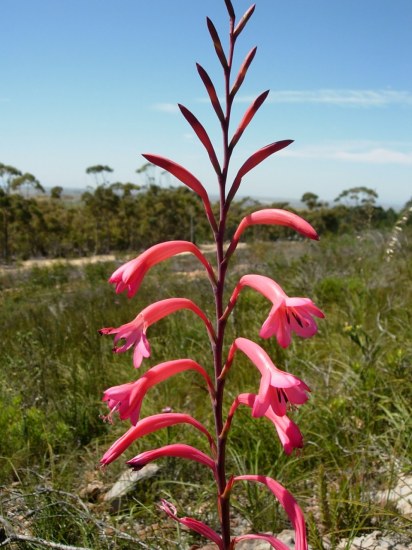
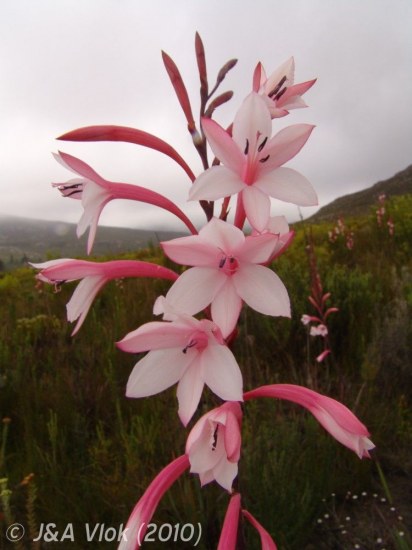
The photos below show the pink form, grown in California by Michael Mace from seeds supplied by Kirstenbosch. In California it blooms in early June.
Watsonia species g-m - Watsonia species n-z - Watsonia index