Crinum species a-b are found on this wiki page.
Crinum Species c-j - Crinum Species l-n - Crinum Species o-z - Crinum Species Index - Crinum hybrids Index
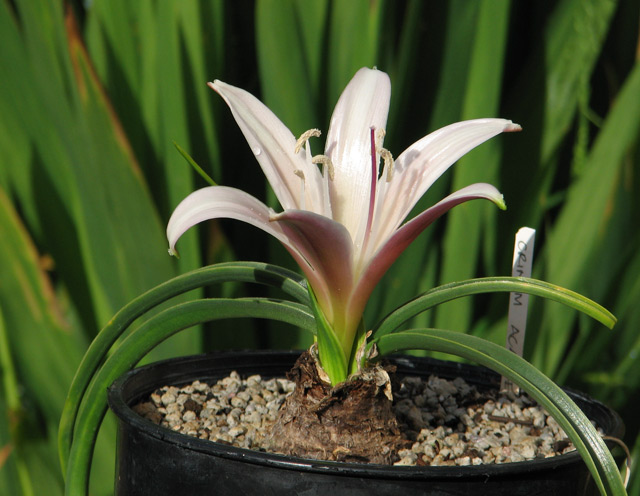
Crinum acaule Baker produces a large bulb from which emerge strappy, deeply channeled leaves with ciliate margins. Most of its emergent leaves also have truncate tips. Unusual for Crinum species, it's acaulescent which in this case means that the peduncle (flowering stem) stays within the bulb giving them an odd and beautiful appearance when in bloom. The flowers are extremely fragrant, especially upon opening at dusk. Best during the first 18 hours or so, each flower fades completely within 36 hours of opening. The fragrance can be compared to that of Brugmansia species. They bloom at the beginning of the growing season, usually in October in KwaZulu-Natal, South Africa where they are endemic. Growth continues on throughout the summer rains and then goes dormant for the dry cooler winter. Crinum acaule does not form pseudostems and its leaves lay relatively flat along the surface of the soil or arch over the edge of the container in which they are grown. Height range: 2-3 ft.
Most of their remaining habitat is severely degraded, overgrazed, or planted over with exotic timber. Healthy populations are now largely restricted to roadsides and fire-breaks. Charles Craib and Andrew Blackmore have found that well-timed maintenance practices of these fire-breaks employed by the South African Forestry Company Ltd. have actually improved population sizes within these fire-breaks. The mowing of the soil in autumn and winter along with infrequent rotovation allows this rare and beautiful lily to reproduce (sexually), while plants within exotic timber plantations do not increase. Craib & Blackmore 1997.
I have grown this species for a few years with excellent results on O'ahu, Hawai'i, planted in deep terracotta pots in pure horticultural pumice for good drainage and gas exchange. During active growth the plants thrived with daily hand watering in arid Kaimukī (500 mm precipitation pa) and later performed just as well in humid mesic Upper Mānoa Valley with its copious rain (3550 mm precipitation pa). I provide my plants with strong sun when in growth followed by a completely dry winter rest. It is closely related to Crinum minimum. Photos by Nhu Nguyen and Uluwehi Knecht.
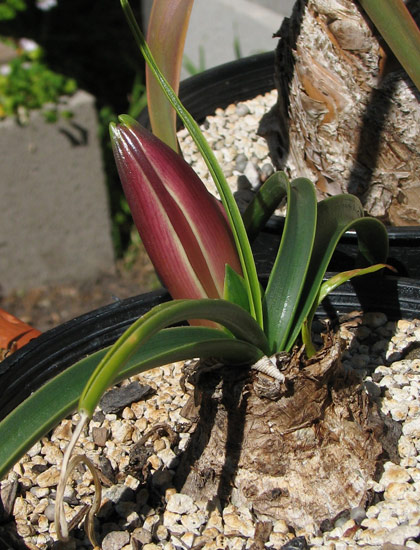
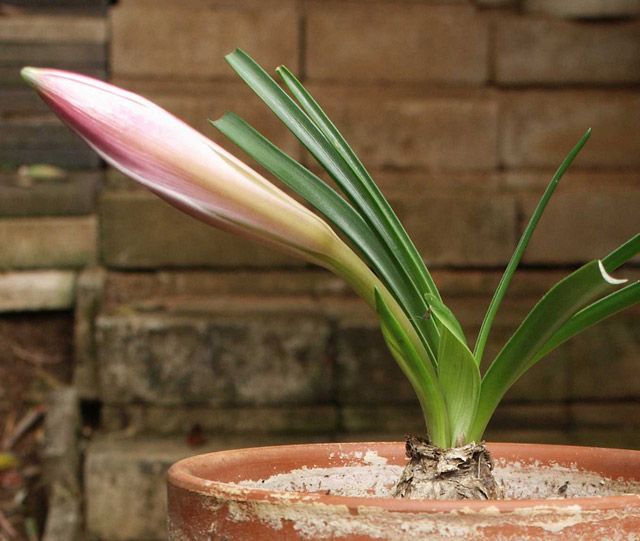

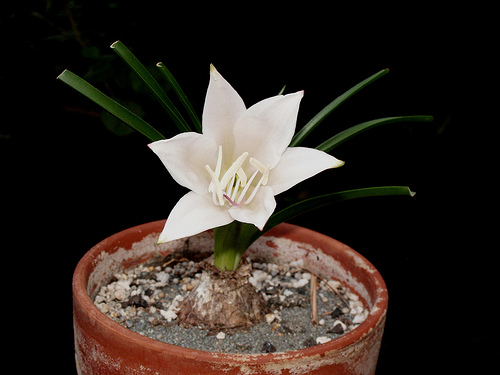
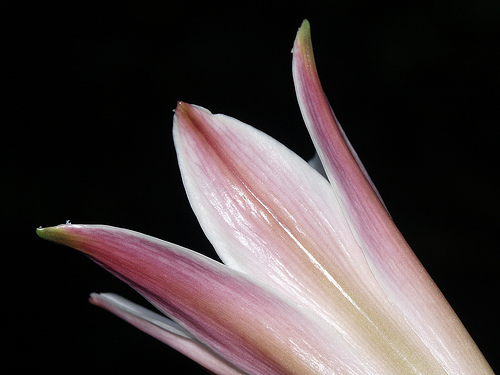
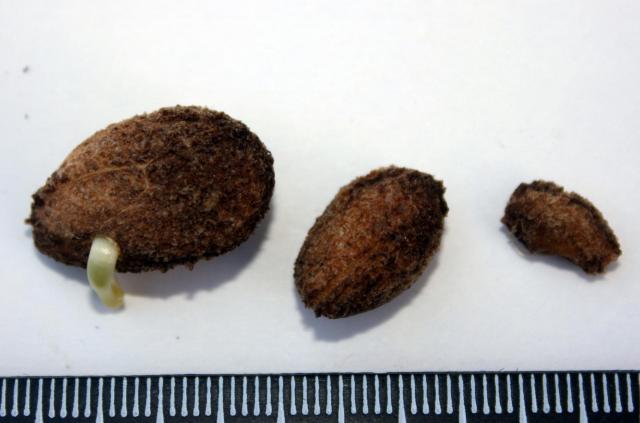
The photo below is of some seeds from this species. The seeds have a fuzzy and heavy coating of material that emanates a strong proteinaceous odor, like parmesan cheese, but much less pleasant. This odor must have something to do with its dispersal mechanism, perhaps taking advantage of a large sized mammal.
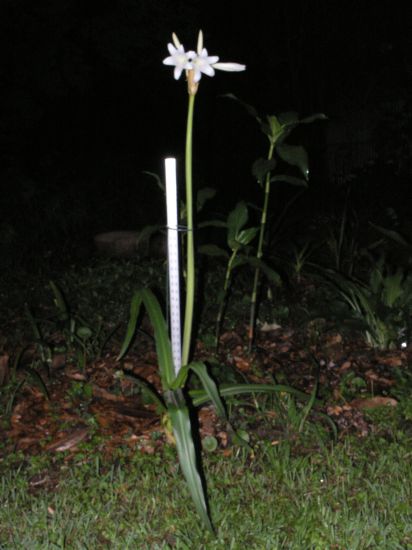
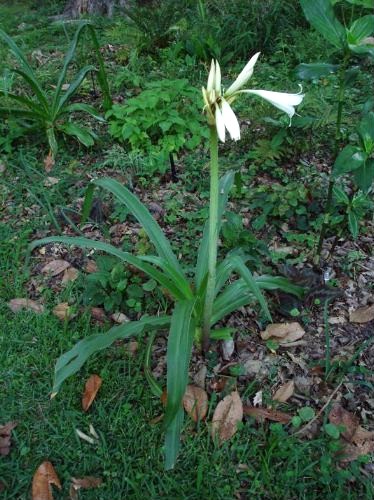
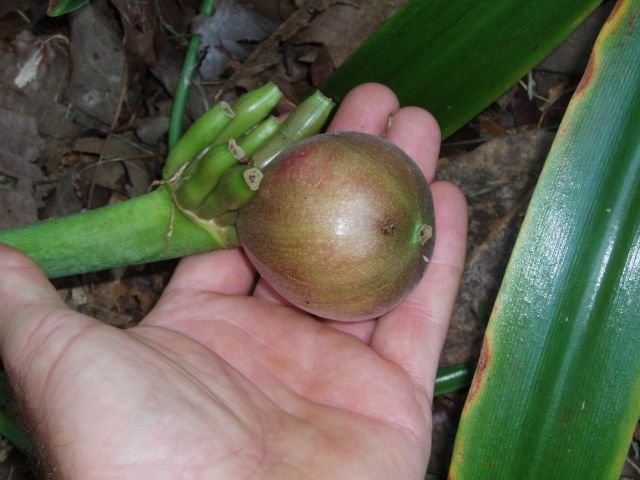
Crinum album (Forssk.) Herb. (syn. C. yemense Deflers) is a species native to Yemen and portions of the Middle East and northeastern Africa. Though these areas are associated with arid climates, this plant seems to be adapted to climates which are seasonally wet at least and I expect that this is not a desert species. This particular plant is a descendant of material distributed by L.S.Hannibal as Crinum yemense. L.S. Hannibal also apparently distributed other similar plant material as Crinum abyssinicum. Though I am growing material from both groups of stock, I cannot comment on their similarity or differences as yet. Care also must be taken to not confuse these with plants in the trade distributed by L.S. Hannibal as abyssinicum hybrid or pink abyssinicum hybrid, which seem to be hybrids involving Crinum moorei. I got this plant as Crinum yemense which is now considered Crinum album. This plant seems to match the descriptions of this species and it is inter as well as intraspecifically fertile producing large seeds nearly as large as as a tennis ball but as small as .75" in diameter as well. Height range: 3-4 ft. Photos by Alani Davis.
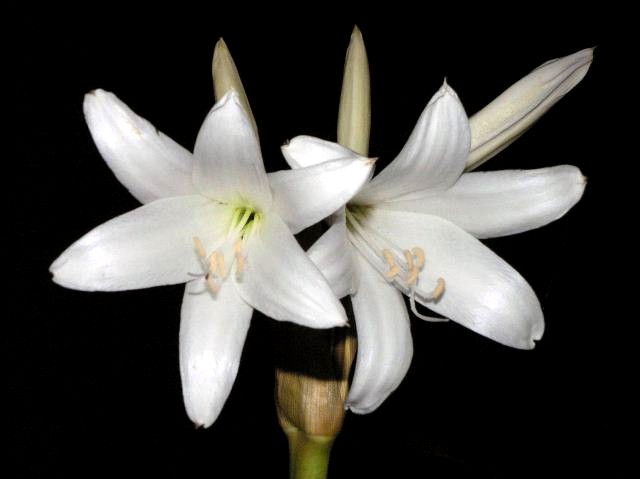
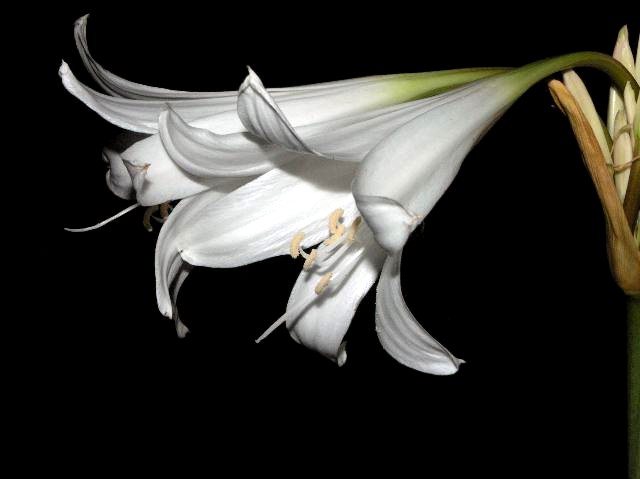
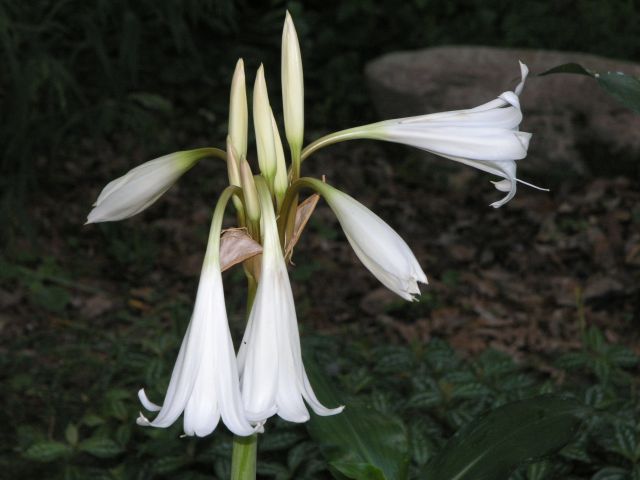
This plant will occasionally produce a double flower as the first or rather first two flowers of a scape. Sometimes these will be fully unified and at other times it will be like conjoined twins as is shown in these photos. I have never been able to get seed from these flowers whether with one or two pistils present. Photos by Alani Davis.
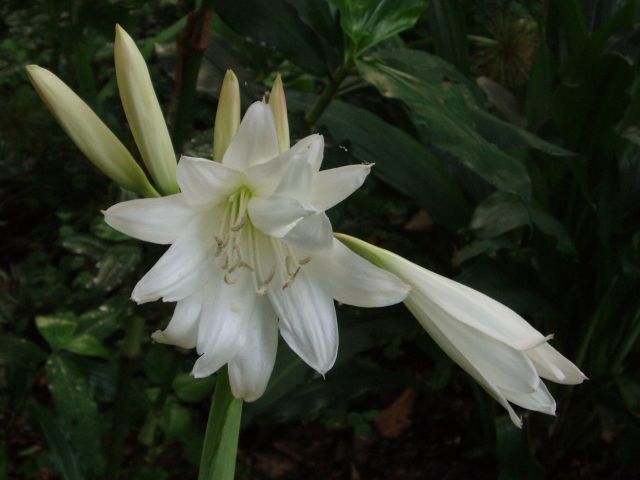
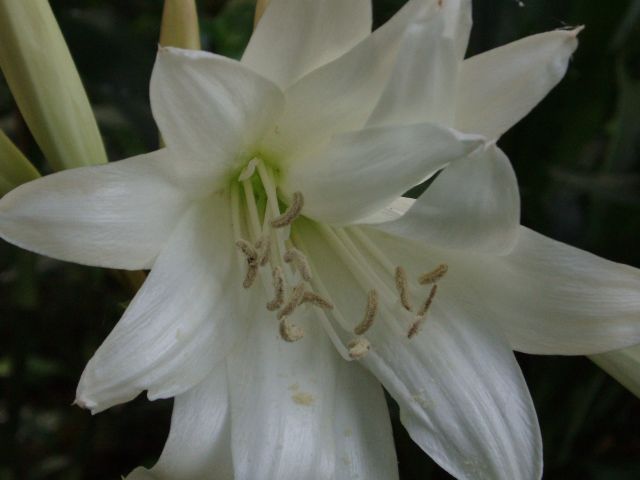
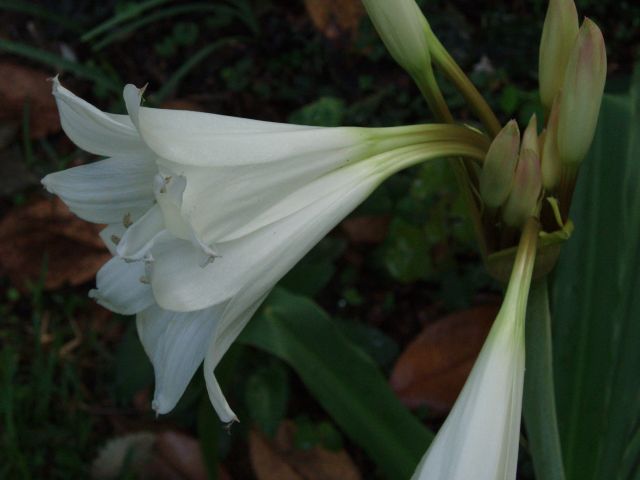
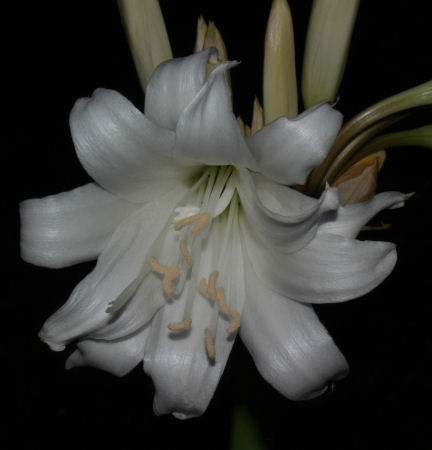
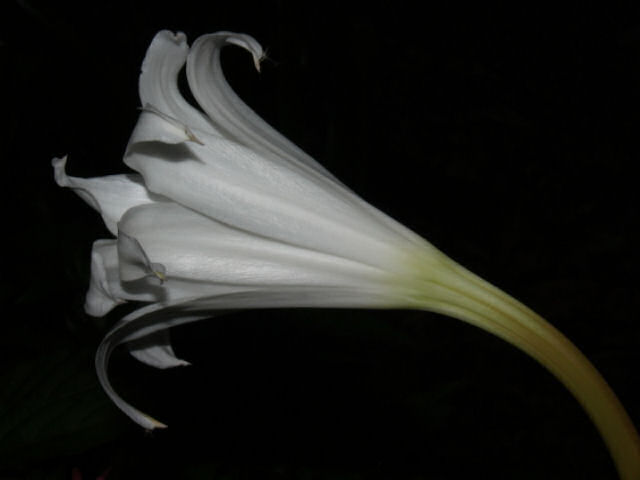
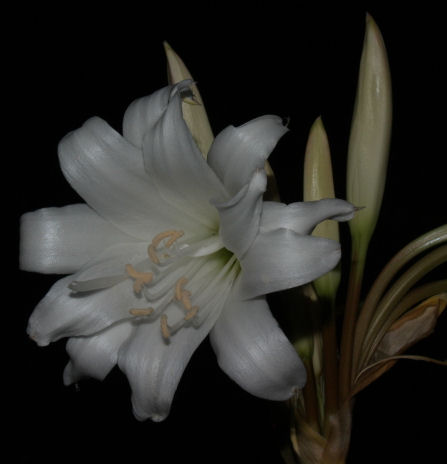
Crinum americanum L. is native to wetlands in the southeastern United States. It can spread by large rhizomes, so give it space or keep it in a container. Height range: 2-4 ft. Grown and photographed in the gardens of Jim McKenney & Alani Davis.
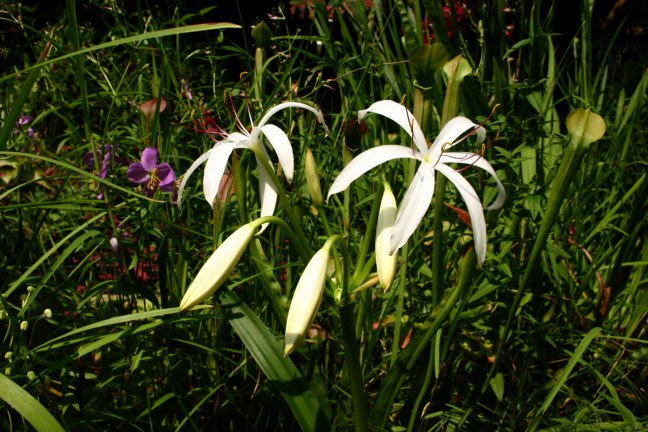


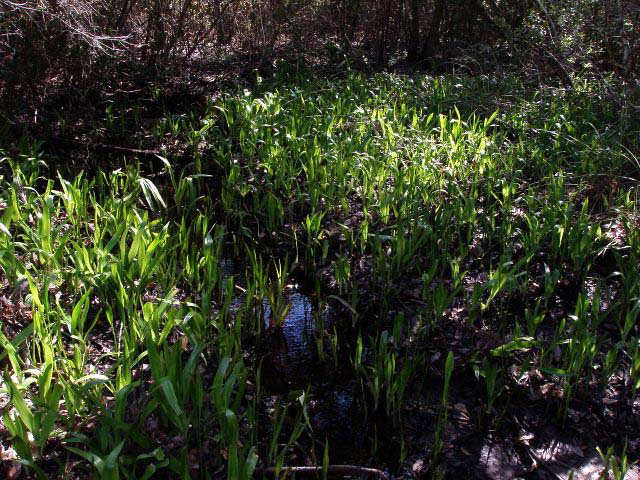
Crinum americanum in natural population in Bay County, Florida. Photos by Alani Davis.
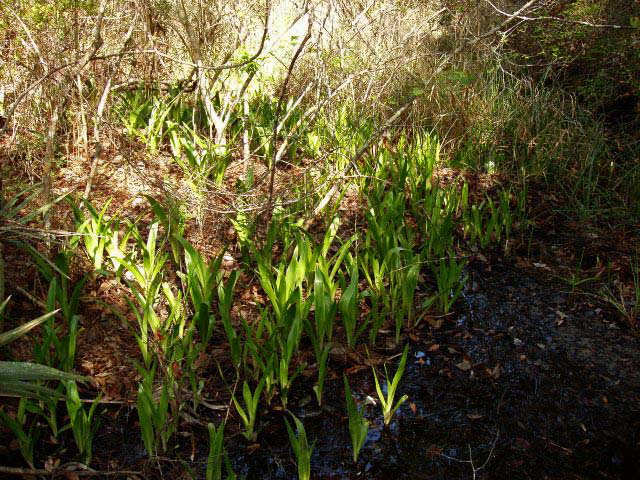
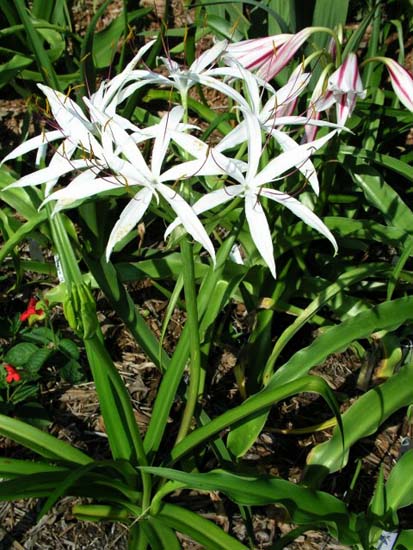
Crinum amoenum Ker Gawl. ex Roxb. is native to India, where it grows along rivers. The flowers look much like C. americanum and allies, but it does not spread by rhizomes. The flowers tend to open all at once, so an individual scape is glorious but short lived. Height range: 2-3 ft. Photos by Nestor White and Alani Davis.
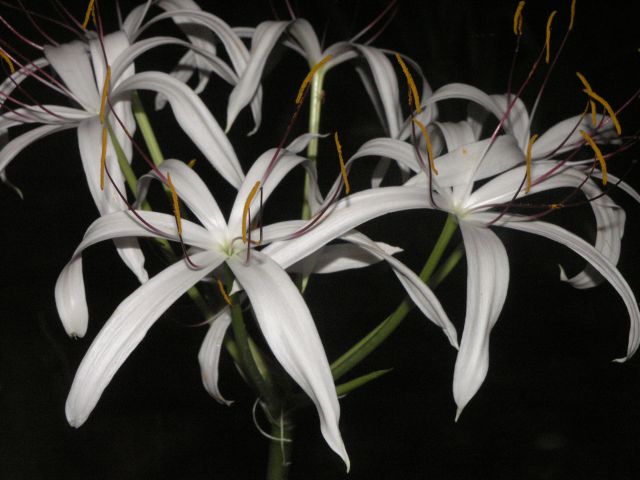
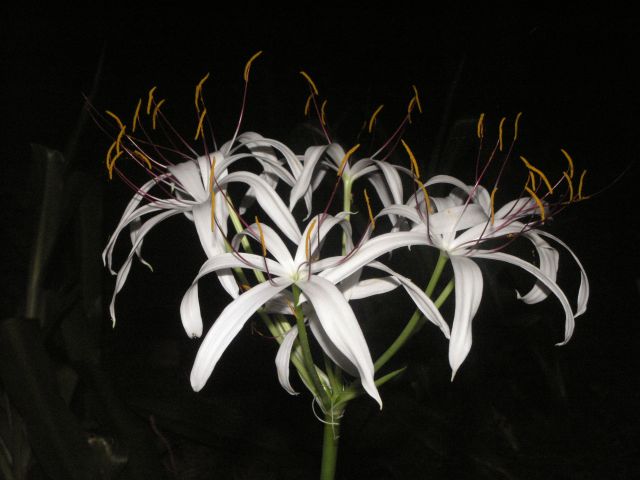
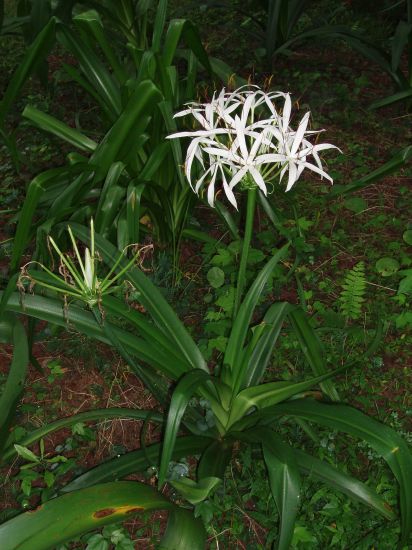
Another form or possibly another species that is being distributed as Crinum amoenum though the tepals are differently poised. The plants of the two forms are very similar, and for now I am calling it droopy Crinum amoenum. Photos by Alani Davis.
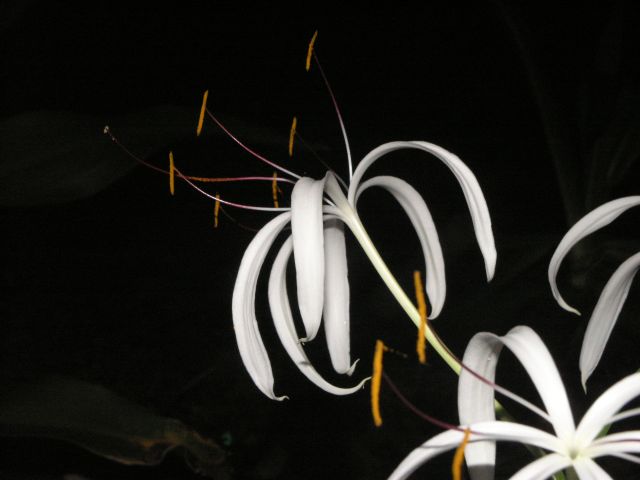
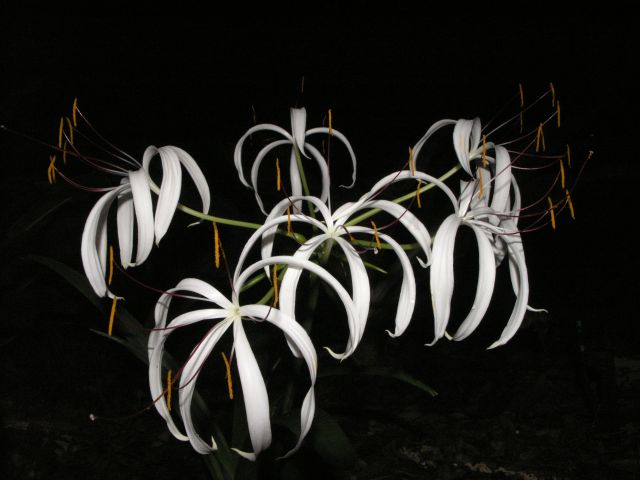
Crinum asiaticum L. is a large, variable species occurring from western India throughout southeastern Asia to southern Japan, south through the Indo-Pacific Islands to northern Australia. There are a number of forms/species associated within this complex and in addition, this species has become widespread as a landscaping plant in the tropics and subtropics. This plant is flowering for the first time from a seed grown plant and is four years old. Height range: 4-6 ft. Photos by Alani Davis.
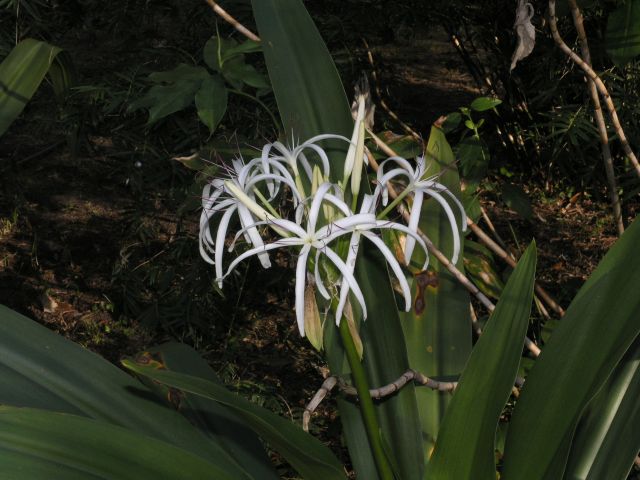
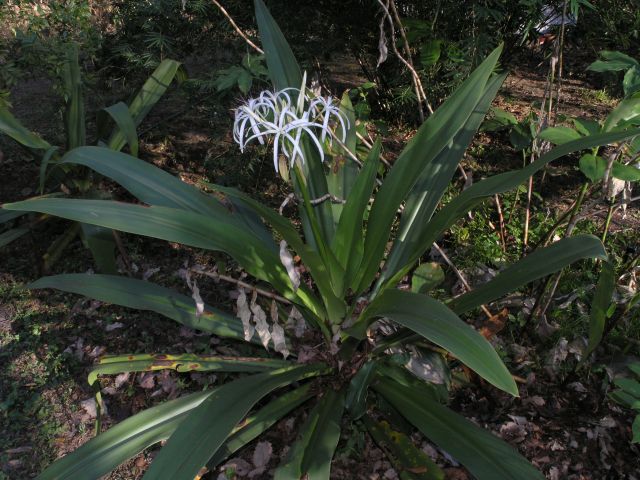
Crinum procerum Herb. is now considered to be a synonym for Crinum asiaticum var. asiaticum. The first four photos by Alani Davis are of one of the deepest burgundy pigmented forms. The outsides of the tepals are wine colored and the insides are pale pink while the scape is burgundy. The last photo from Alberto Grossi.
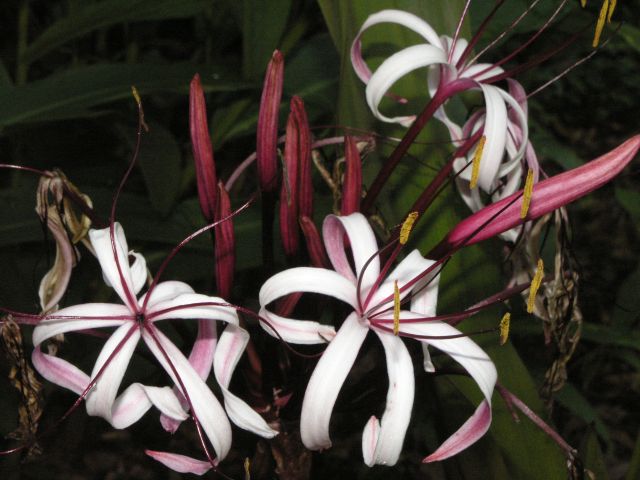


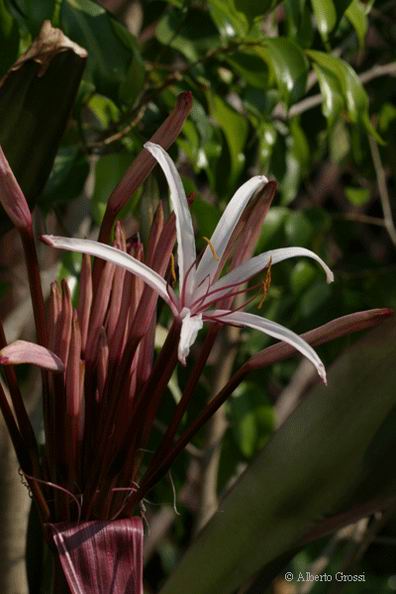
Crinum asiaticum var. pedunculatum (R.Br.) Fosberg & Sachet, syn. Crinum pedunculatum R.Br., is native to New South Wales, Australia, where it is grows in coastal wetlands, but it has also been collected in Lord Howe Island, New Guinea, Timor and the Cocos Islands. It is a robust evergreen species with fragrant white starry flowers with six erect stamens arranged in an erect circle around the throat of the flower and each with a slightly curved anther. Photos by Jay Yourch and Alessandro Marinello.

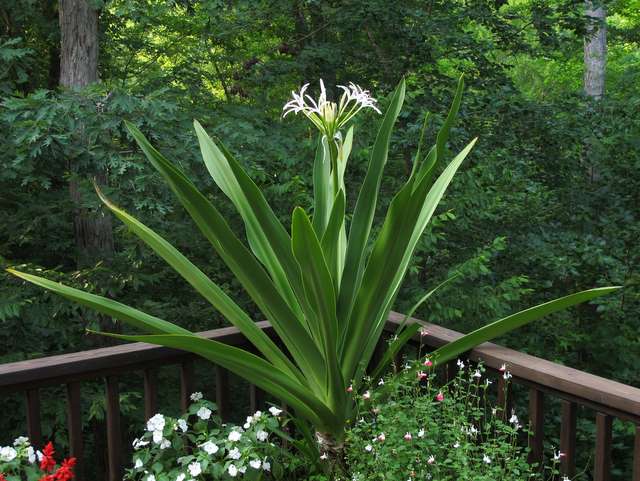
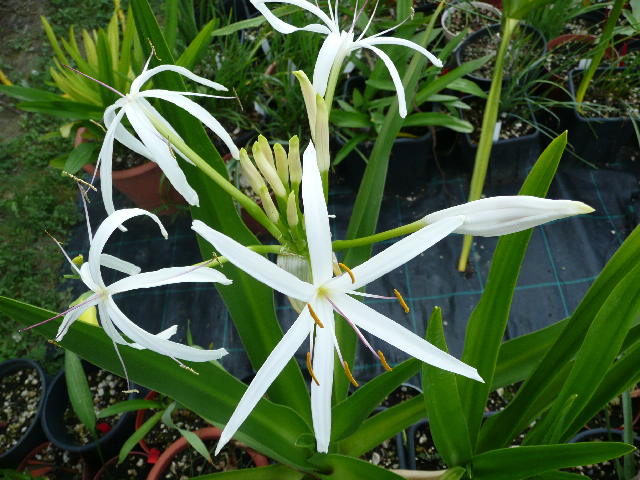
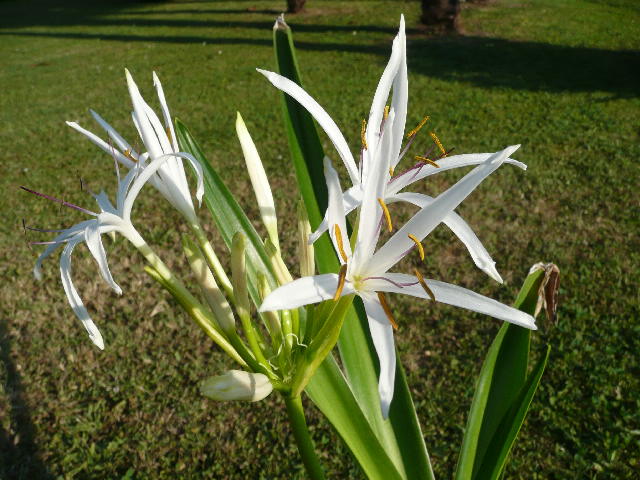
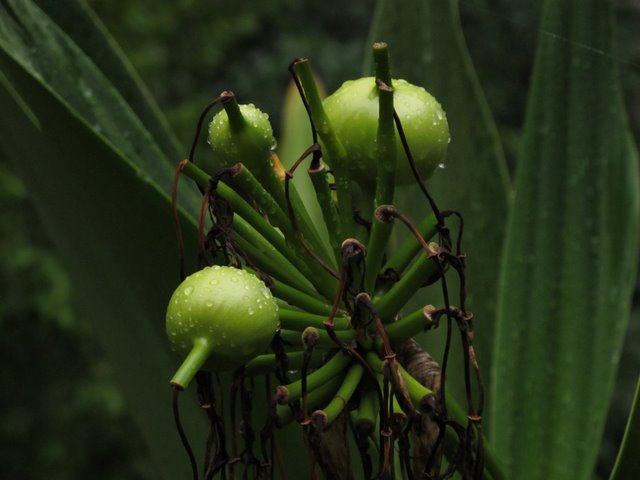
Crinum brachynema Herb. is a striking bulbous geophyte that typically reaches 30–60 cm in height and produces an umbel of white-flowered blooms along a robust scape. Endemic to parts of western India (notably Maharashtra) where it graces lateritic plateaus and rocky hill slopes, it is listed as Critically Endangered because of its narrow distribution and declining populations. Photograph by Saket Shrotri.

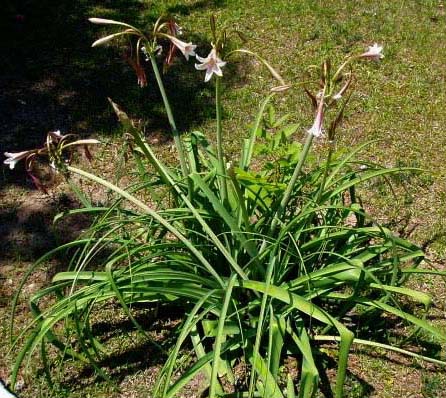
Crinum bulbispermum (Burm.f.) Milne-Redh. & Schweick. is native to South Africa. It has distinctive long, tapered glaucous foliage and blooms early in the season, but often repeats later. The flowers are typically white with reddish keels, but there is much variation in the coverage and intensity of anthocyanins pigmentation. Variations from white forms, free of anthocyanins & with green keels, to nearly red heavily pigmented forms exist. It is also common for there to be forms which open quite pale & get progressively more pigmented over a period of days with the darkening rose-red pigment spreading typically from the keels outward across the tepal and varying in a range of expression from individual to individual with some getting quite dark rose red all over to others which only darken near the keels. This characteristic also seems to be affected by the temperature with flowers on the same plant deepening in tone & pigmentation more rapidly & intensely with blooms occurring during hot temperatures compared to those that occur during cool parts of the season. This characteristic is expressed in several hybrids as well. This Crinum species is among the most tolerant of cold winter temperatures and may be the most cold tolerant Crinum species. There are naturalized colonies and scattered populations of this species across the southeastern United States and though it may be locally common in some areas, its occurrences are variable in many parts of the region. Within these populations, sometimes unique forms can be found, though usually they are less than distinct. Height range: 2-3 ft. Photos by Alani Davis. Photos 1-2 of a "typical" form growing in a cemetery and 3-4 of a full flowered white selection.
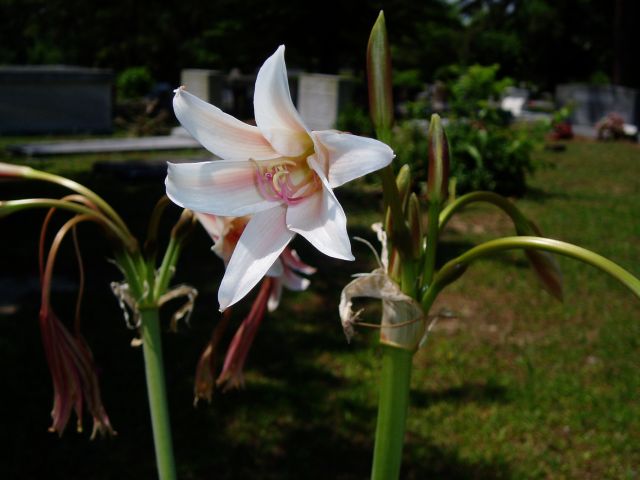
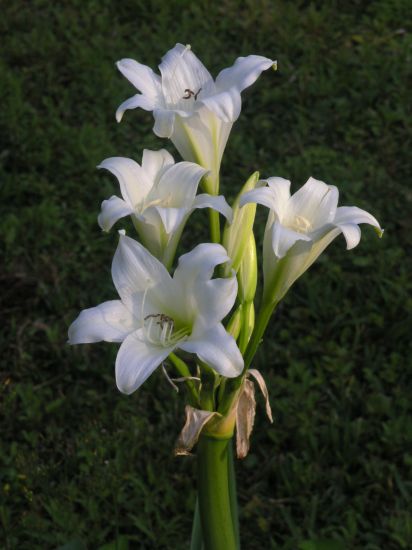
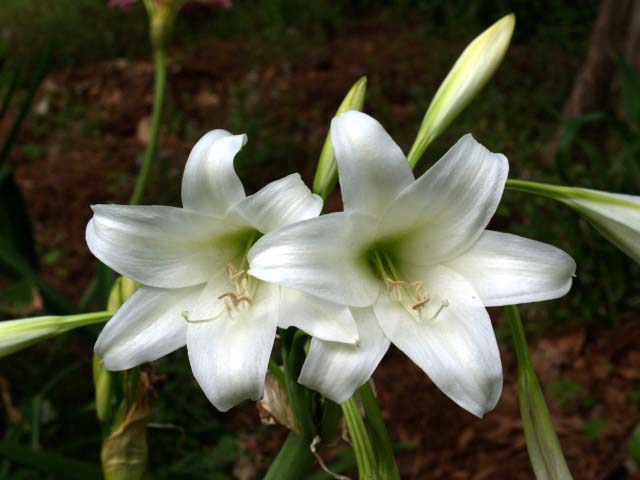
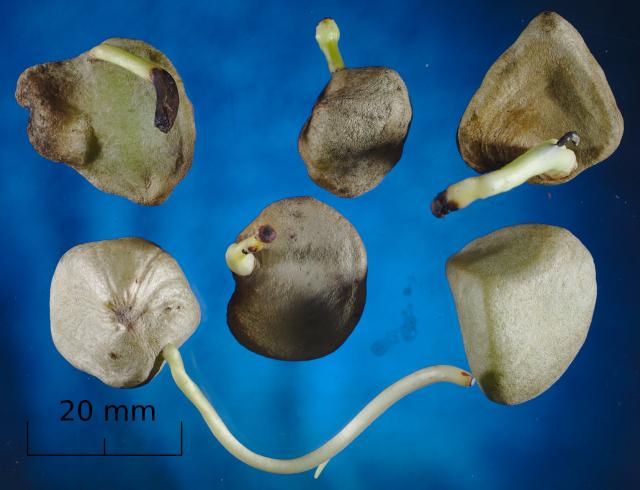
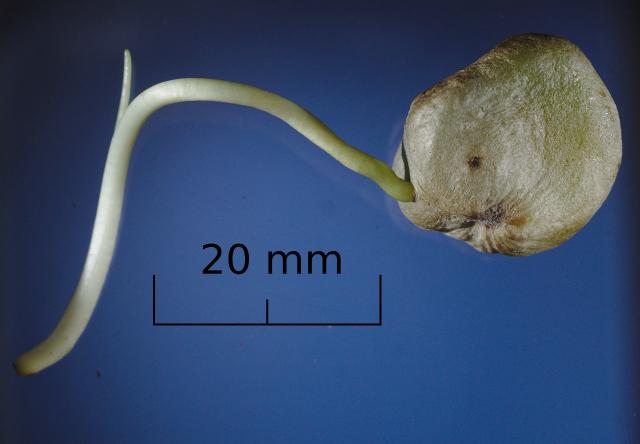
Photographs by David Pilling of seed from BX 341. Typical for this genus, seed is fleshy, ephemeral and germinates in spite of the conditions it is stored in.
'Chessboard' is a Nestor White named cultivar. It produces fertile seed. Flowers open white and turn to pink as they age. Photographs by Randy Rick.
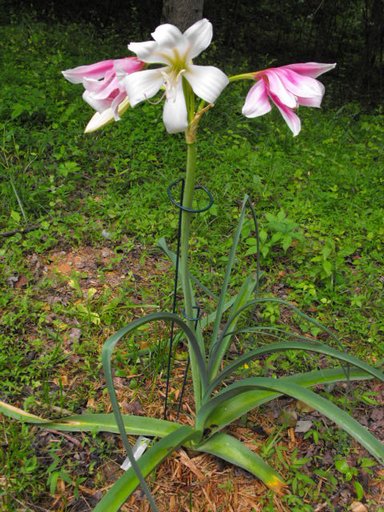
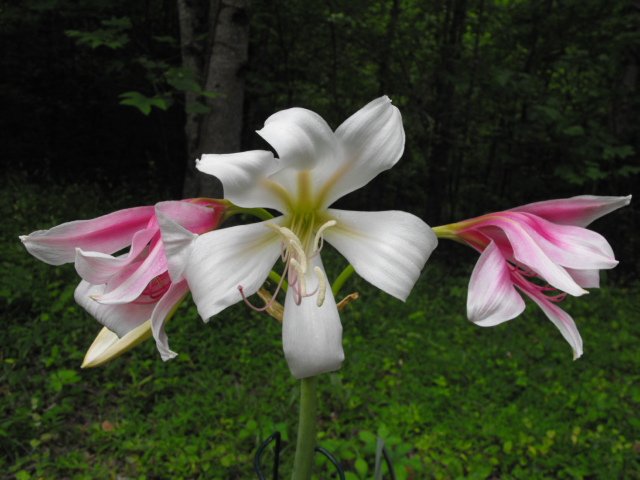
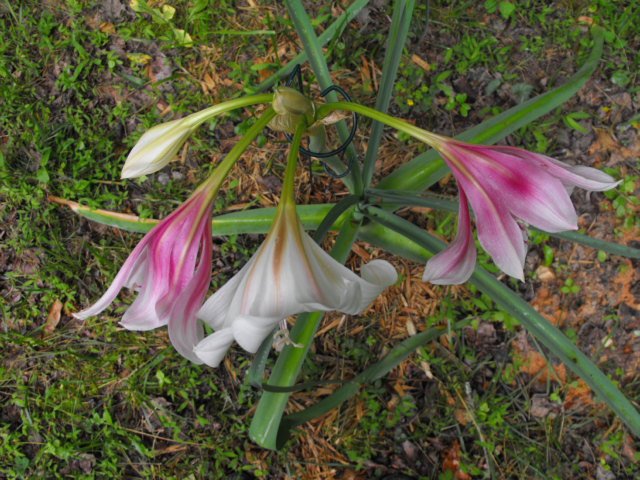
'Jumbo' seed strain began as selections of intraspecific hybrids of C. bulbispermum done by L. S. Hannibal to get larger fuller flowers, better coloration, and sturdier scapes that remain upright until flowers finish. Generally these characteristics are improved in this strain but vary with some selections being quite outstanding. Many others have continued to cross selections from this strain with great results. Also classic hybrid crosses involving Crinum bulbispermum repeated with this form have produced improved and larger hybrids. These pictures from Alani Davis are of a form that opens pale colored and darkens with age.
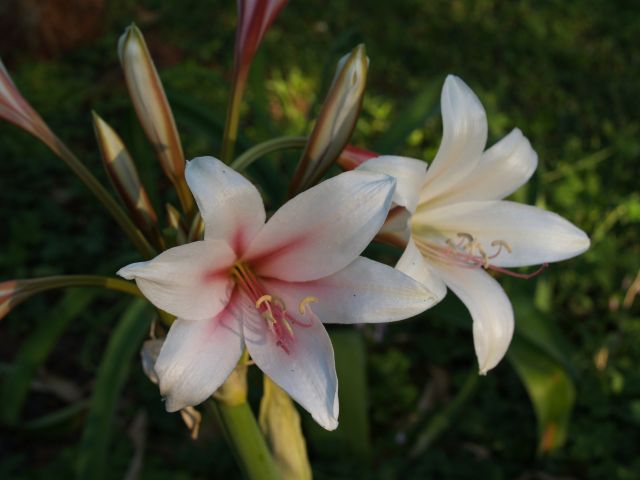
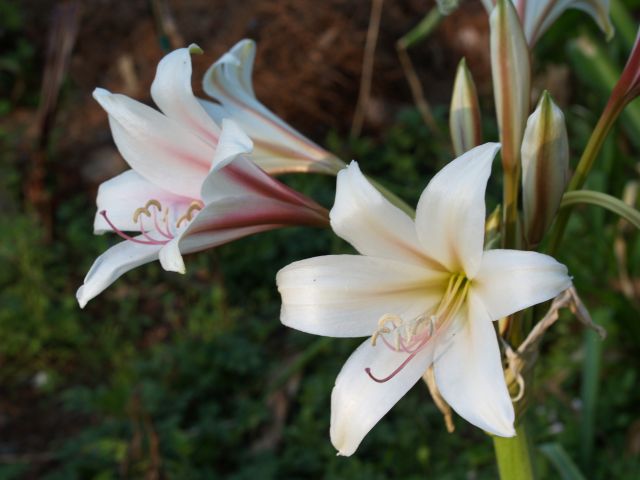
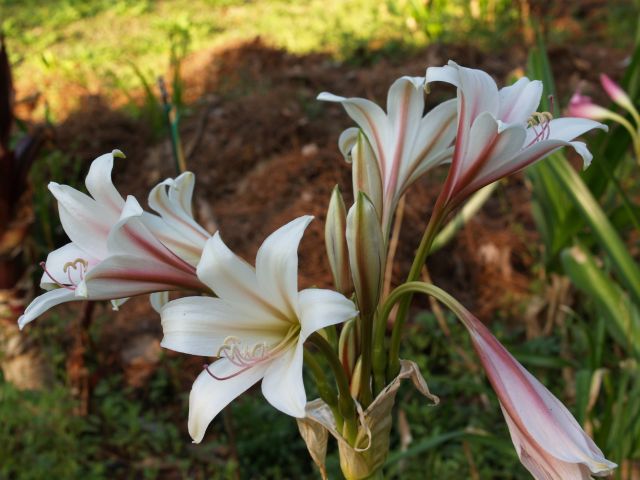
'Jumbo' seed strain is a a red selection. Photos from Alani Davis.
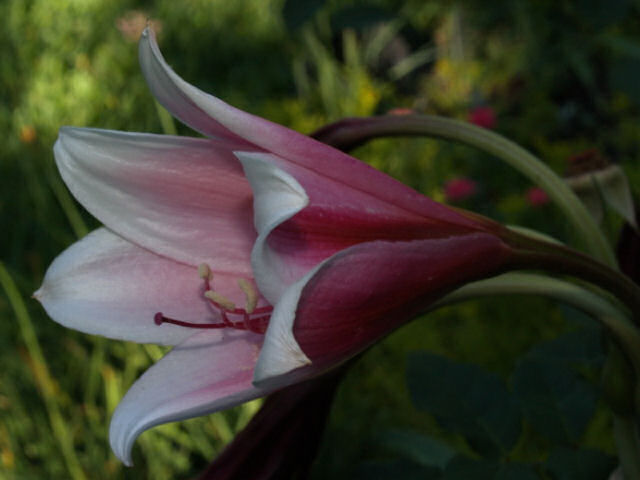
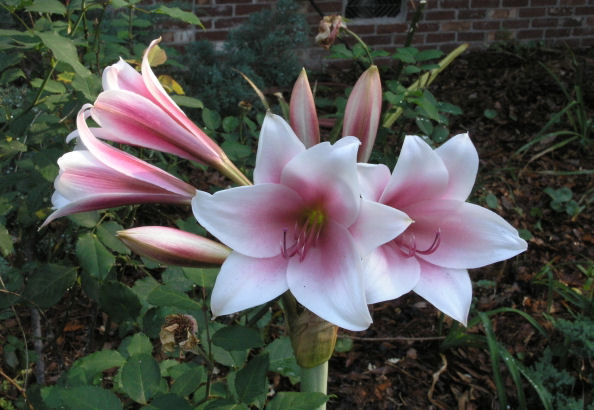
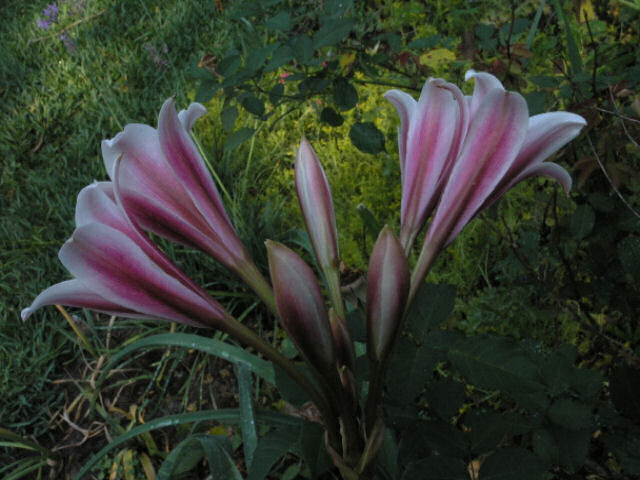
'Sacramento' seed strain is a selection with a dark red stripe outside. Inside the flowers are pure white on the first day, but they turn pink on the second day. Photos by Angelo Porcelli.
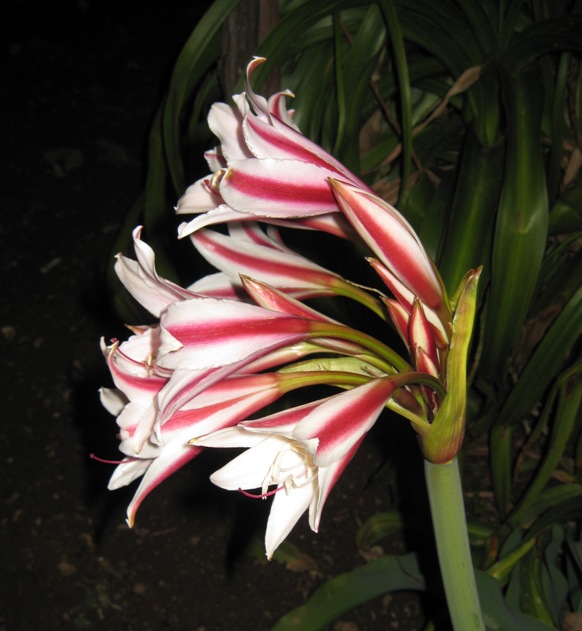
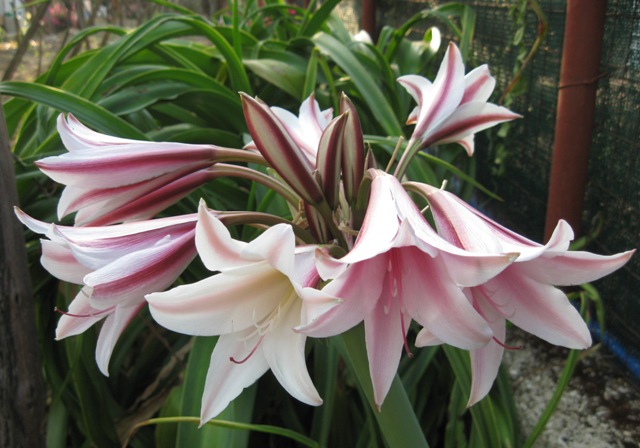
'Wide Open White' is a found selection of C. bulbispermum with white flowers that open nearly flat initially though they partially close as they age. The scapes are especially tall and prone to falling over once the buds open and are best enjoyed if staked. Otherwise this form is typical of the species and quite fertile. Photos from Jay Yourch and Alani Davis.
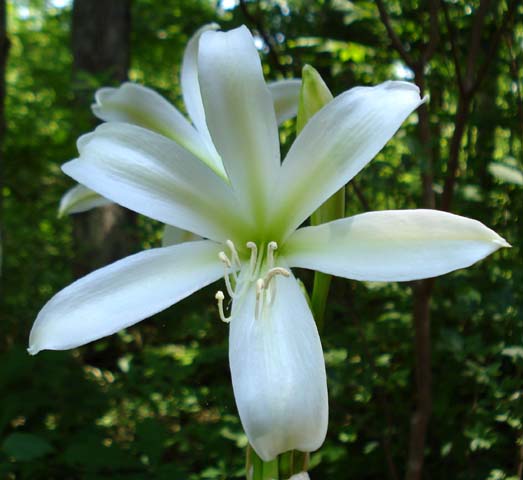
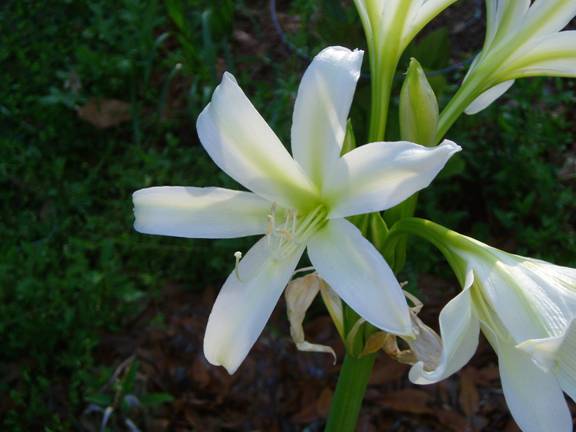
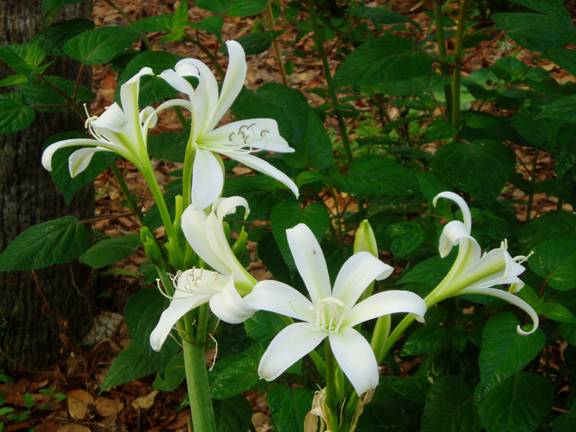
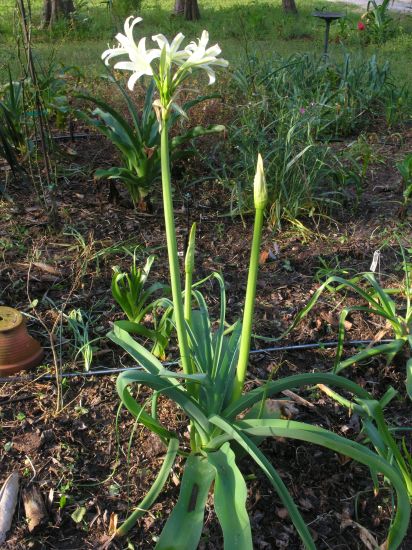
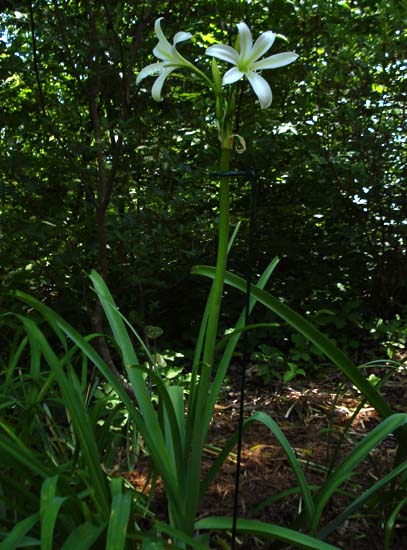
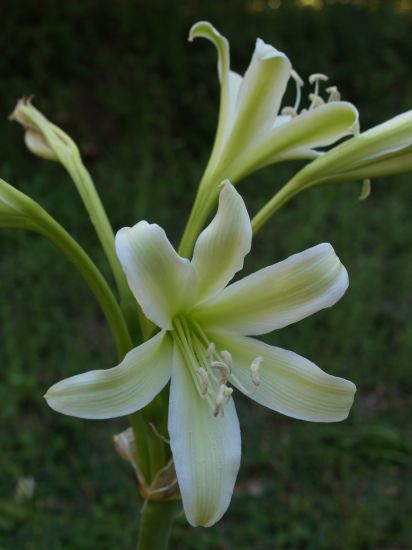
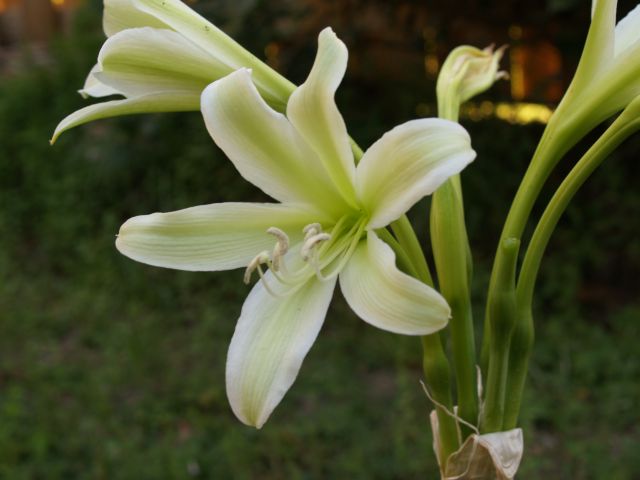
'Wide Open Green' ?? is another selection from the population that produced the 'Wide Open White' selection. It is also a white form without pigment, but rather than the narrow pigmented band on the keel that 'Wide Open White' has, this selection has a wide diffuse one which without the pigments is green to yellowish. Flowers are flared as well though not as sharply as with 'Wide Open White'. Fittingly it bloomed for the first time in my garden on St. Patrick's Day! Photos from Alani Davis.
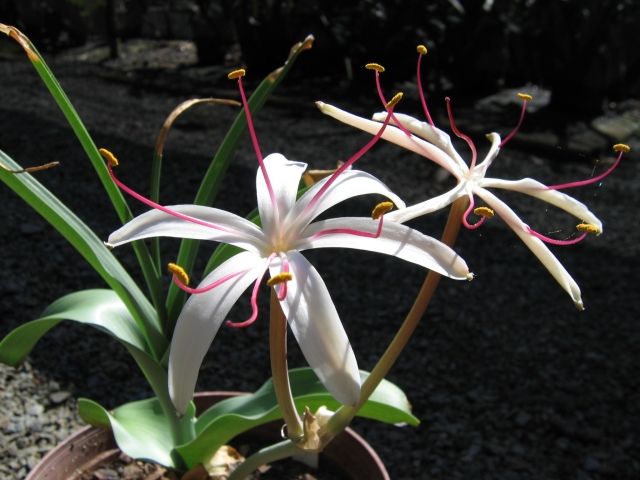
Crinum buphanoides Welw. ex Baker is a species of tropical Africa and South Africa. This is a young, seed-grown plant flowering for the first time. Information on this species can be found in L.S. Hannibal's "A Systematic Revision of the Genus Crinum". Height: to about 1 m. Photo by Rogan Roth.
Crinum Species c-j - Crinum Species l-n - Crinum Species o-z - Crinum Species Index - Crinum hybrids Index