Lycoris is an endemic genus in the Amaryllidaceae family from eastern Asia, mainly China, Japan and Korea. They are leafless in late spring and summer, bloom in summer and fall, and then grow through autumn, winter or spring. Most grow best in the ground and they need summer warmth and some summer moisture to bloom well. Seeds are hard, black, and round. Seeds should be planted as fresh as possible (best planted immediately after harvest). Push the seeds down half-way into a moist planting medium. The seeds usually sprout quickly, but Sue Madison found that peeling off the black seed coat helps the seeds germinate. In colder areas with freezing temperatures, keep the seed pots in a cold frost-free greenhouse. Lycoris chinensis should germinate in spring. It is best to keep the seedlings in growth for as long as possible until they are large enough to be in their own pots. This can be accomplished by growing them indoors under lights. It takes a long time from seed to bloom, often as long as 5 years, so they are often propagated by division of the bulbs. Jim Waddick has provided a very complete guide to this genus called Garden Lycoris and More.
Lycoris Hybrids includes information and photos of some of the hybrids.
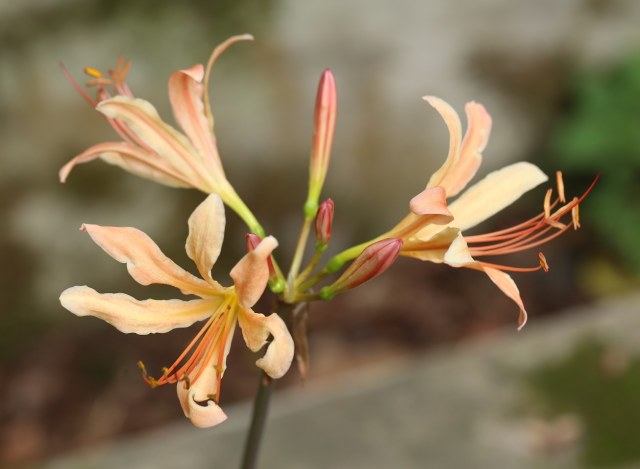
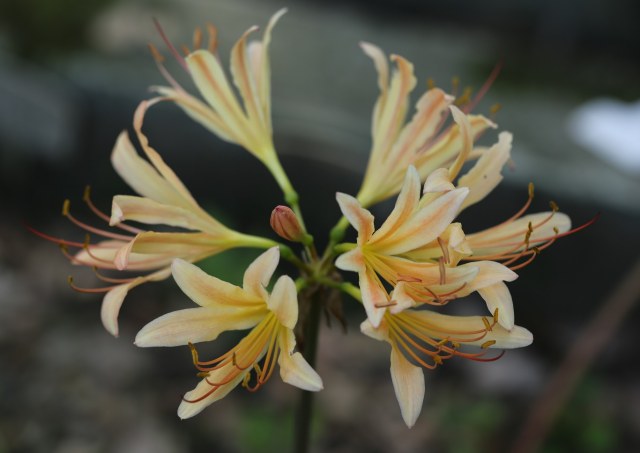
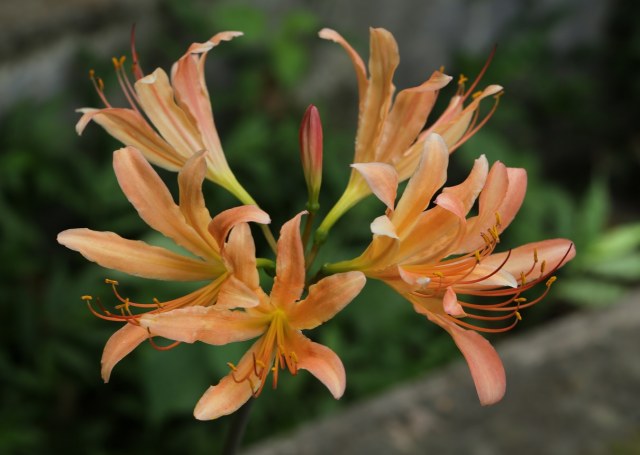
Lycoris × albiflora Koidz. was established in Botanical Magazine 1924 as a natural hybrid between L. radiata var. pumila and L. traubii, maybe spontaneously generated on the island Amamiohshima in Japan. Chromosome number is 2n=17,18. The original literature describes Lycoris × albiflora with white flowers, but being a hybrid species, there are some changes in color and shape. Height: 45-60 cm. Japanese gardeners have selected some individuals for varieties according to their color and shape. Photos below taken by Zhang Pengchong show some varieties of Lycoris albiflora from Japan.

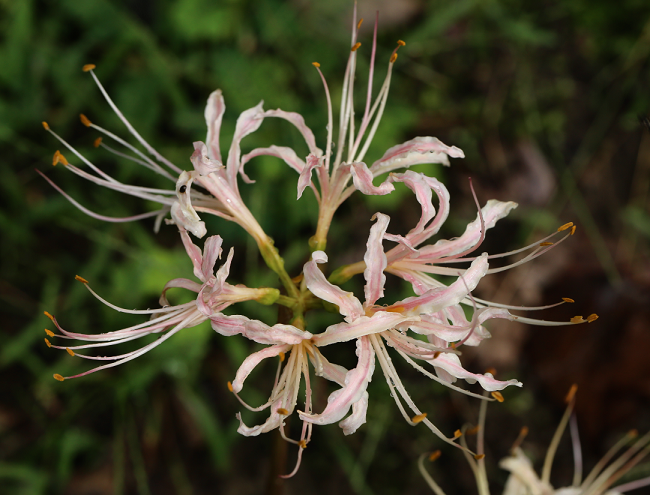

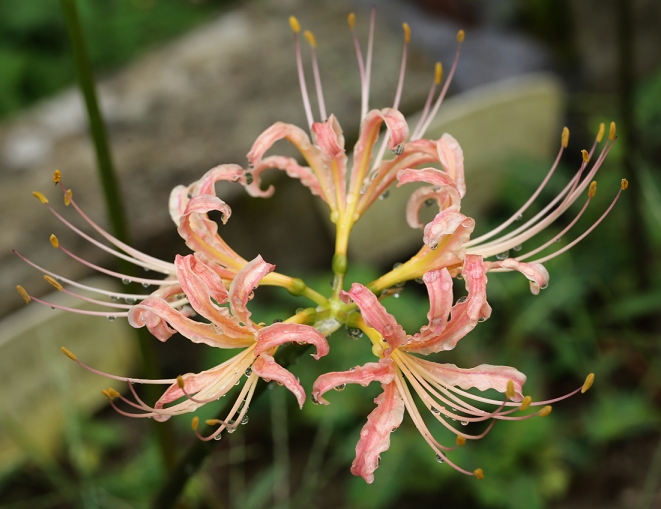
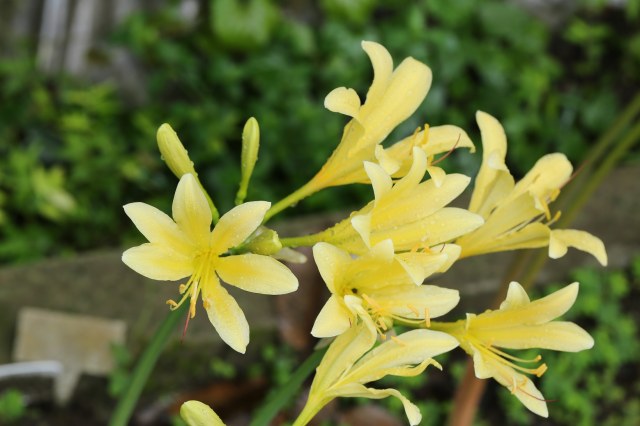
Lycoris anhuiensis Y. Hsu & G. J. Fan was published by Xu Yin in the Vol.20, 2nd issue of ACTA PHYTOTAXONOMICA SINCA in 1982. The specific epithet is derived from its origin, Anhui Province which coincides with the distribution area of Lycoris longituba. The main differences are that the flower of Lycoris anhuiensis is yellow, smaller, and the perianth segments have a greater degree of expansion, with slightly wrinkled bases. Lycoris guangxiensis, Lycoris shaanxiensis and Lycoris longituba var. flava were published simultaneously. Shi (2006) conducted a cluster analysis based on ITS sequence data, which grouped Lycoris longituba, Lycoris longituba var. flava, and Lycoris anhuiensis together indicating Lycoris anhuiensis could potentially be a variety of Lycoris longituba and not be recognized as a separate species. According to my own field surveys, Lycoris longituba, Lycoris chinensis and Lycoris anhuiensis coexist in the same areas, and have similar flowering periods at the same location as well. A series of continuous variations exist in the morphological characteristics of Lycoris anhuiensis. Based on chromosomal and molecular evidence, it is inferred that Lycoris anhuiensis is a hybrid of Lycoris longituba and Lycoris chinensis, forming a hybrid population with continuous variations in floral tube length, color, symmetry form of perianth and segments width. Height: to about 50 cm. Photos below taken by Zhang Pengchong show some varieties of Lycoris anhuiensis.
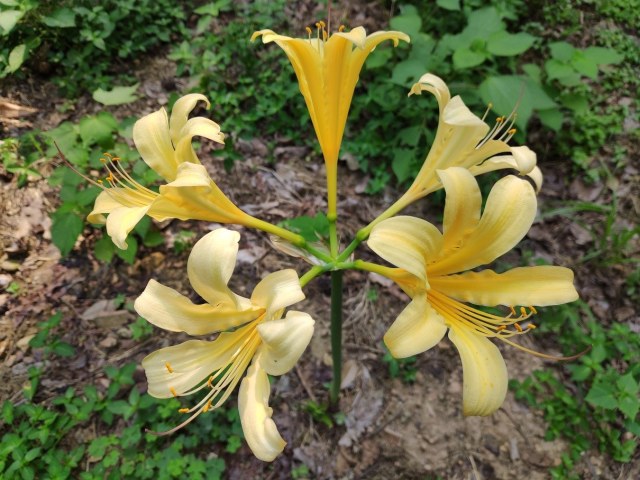
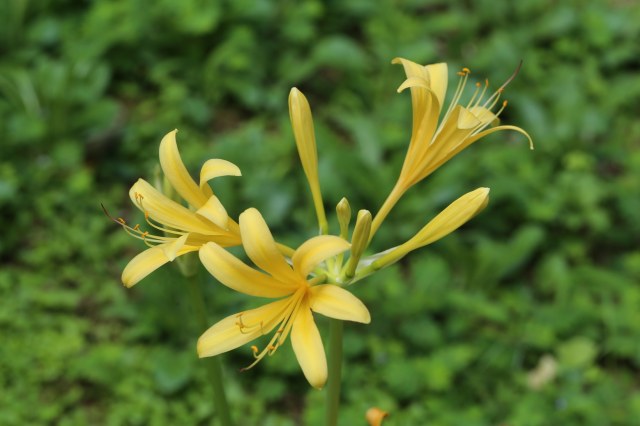
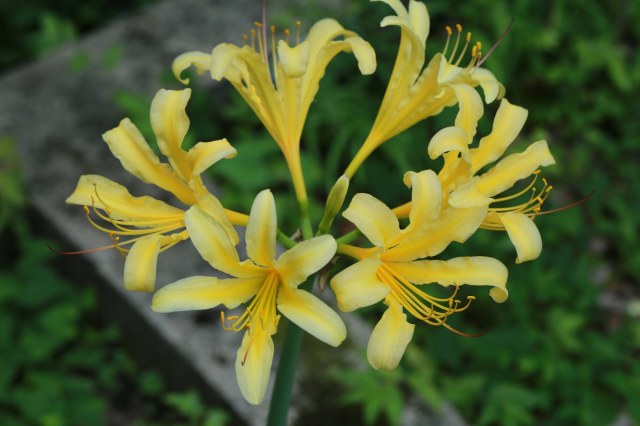
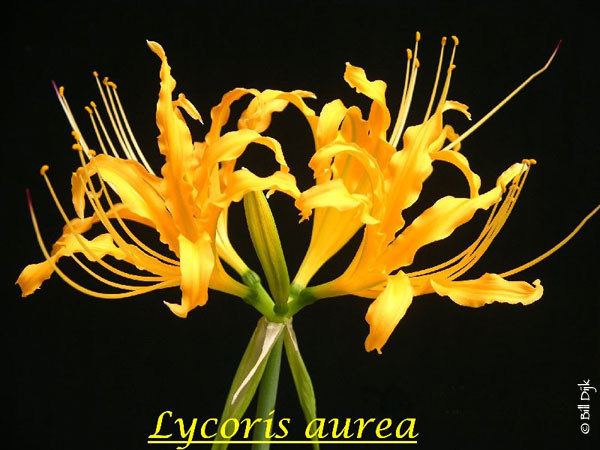
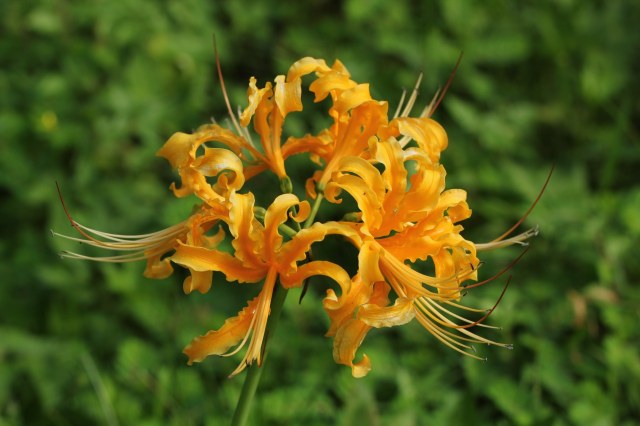
Lycoris aurea (L'Hér.) Herb. is the golden spider lily and originates from limestone areas of China. The spidery flowers face upwards and are a orange-cadmium yellow. It can often be a difficult species to get into flower. It requires a hot dry resting period during summer to promote flowering. Dressings of potash and lime are also helpful. Lycoris are splendid autumn-flowering bulbs when their requirements are met, and make excellent garden subjects and provide a good supply of cut flowers. Height range: 30-60 cm. The first photo by Bill Dijk. The second photo by Zhang Pengchong illustrates the form that is widespread in the southwest of China. Flowers are more horizontal and the color is a darker yellow.
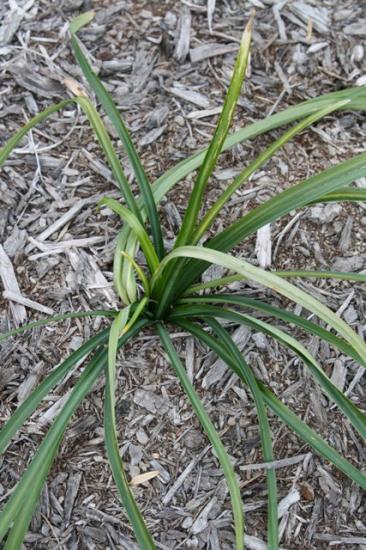
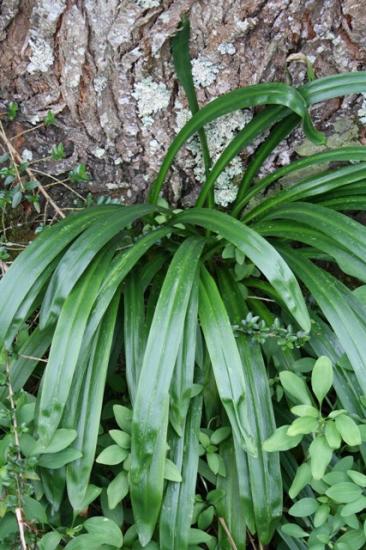
Photographs by Tony Avent who comments photo 1 is of our L. traubii foliage which is much narrower and emerges later than L. aurea shown in photo 2. The foliage of our L. aurea can be up to 2" wide and is the first to emerge and a very glossy green. Our L. aurea is also the only species that emerges with remnants of last year's leaves on the sides of the flower stalk, a trait that reportedly distinguishes L. aurea from all other species.
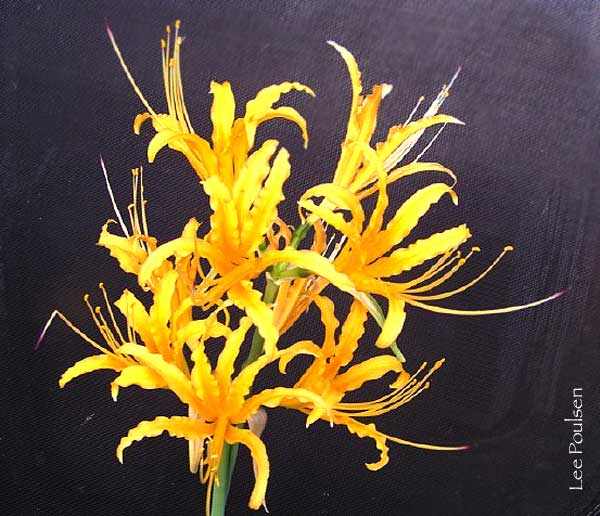
Lycoris aurea var. surgens Worsley ex Traub. & Moldenke, now included in the species, skipped blooming for a couple of years, then sent up two, much larger, scapes this year. It bloomed after all my other Lycoris bloomed. Photo taken October 2006 by Lee Poulsen.
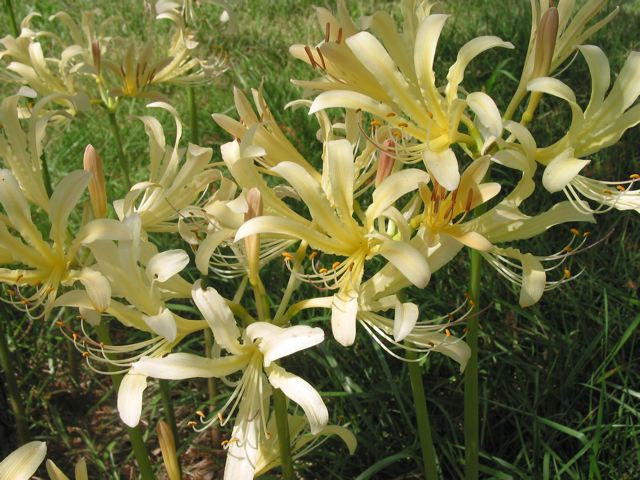
Lycoris caldwellii Traub known as Pale Yellow Surprise Lily has pastel yellow flowers that fade to near white. Although not common, this species is easy and hardy to Zone 5. This is a sterile triploid and probably originated as a natural hybrid in China. It is valuable for its pastel color, later bloom season, abundant flowers and impressive size. Height range: 30-45 cm. Photos by Jim Murrain and Jim Waddick showing flowers in various stages of bloom.
Lycoris chejuensis K.H.Tae & S. C. Ko was established by Kyoung Hwan Tae in Vol.23, No.4 of Kor. J. Plant Tax. 1993 which mainly distributes in Cheju Prov. of South Korea. Leaves emerge in early spring and blooms in late August to early September. Its flora color is yewllowish white with red tinge along the midrib of perianths, the overall color is orange or yellow-orange. Individuals growing in the sun have more red than those in the shade. Its chromosomal number is 2n=30 and karyotype is 3V+27R indicating presumably a hybrid between Lycoris sanguinea var. koreana and Lycoris chinensis. Height range: 60-75 cm. Photos below taken by Zhang Pengchong in China and the bulbs were give by Siro Kurita.
Lycoris chinensis Traub known as the Golden Surprise Lily has medium yellow to golden-orange spidery flowers with curved and ruffled petal edges. It is native to China and is a fully fertile seed producing diploid that readily hybridizes with Lycoris longituba. It is hardy to Zone 5 and vigorous. Height: about 70 cm. Photos by Arnold Trachtenberg, Jim Murrain, and Jim Waddick. The last two show the variation in color, with one a rich yellow spidery form with twisted petals and the second near orange color with the color extending to the stamens.
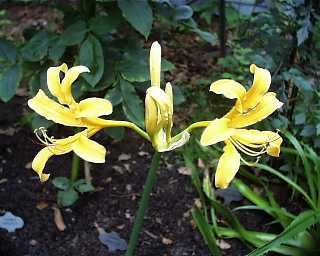
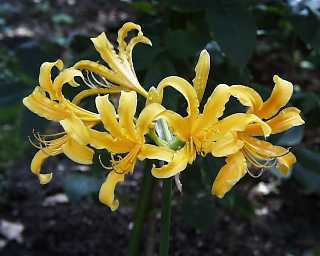
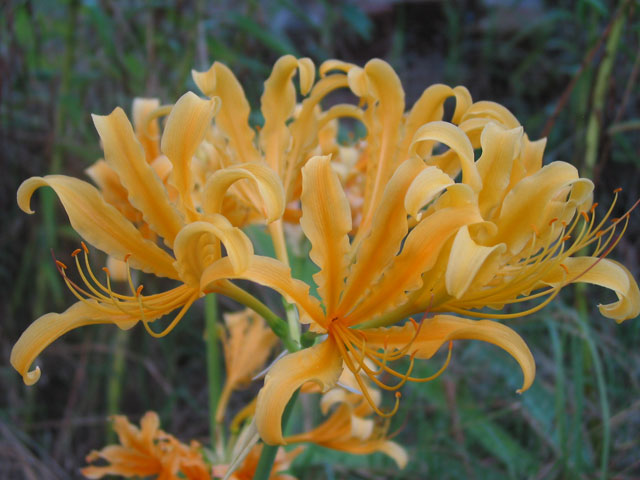
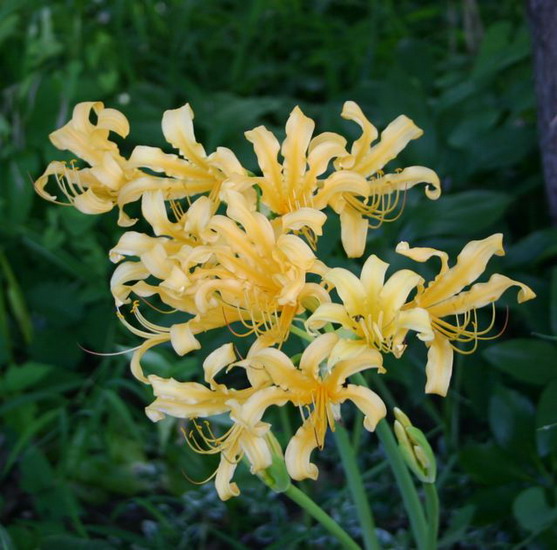
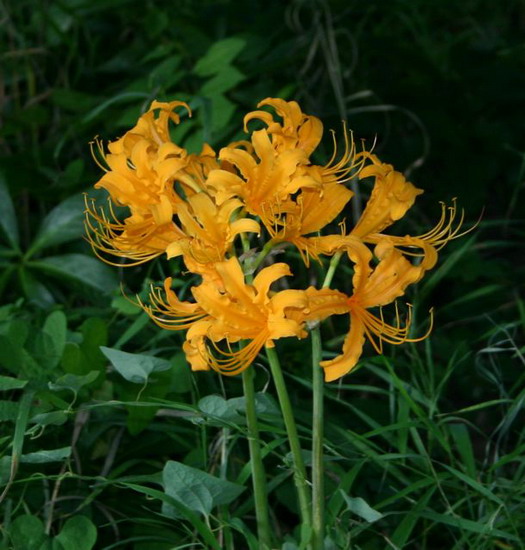
Lycoris × elsiae Traub was published in Plant Life in 1958. The original bulbs were likely imported to the US from Japan during 1940-1948. Lycoris × elsiae was treated as a synonym of Lycoris × albiflora in Flora of Japan, 2016 and in 2024 this is accepted by the major databases.
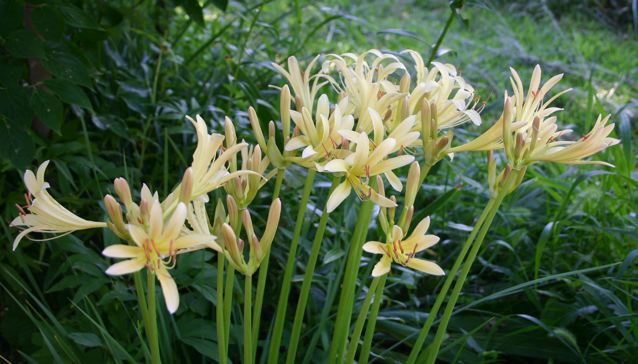
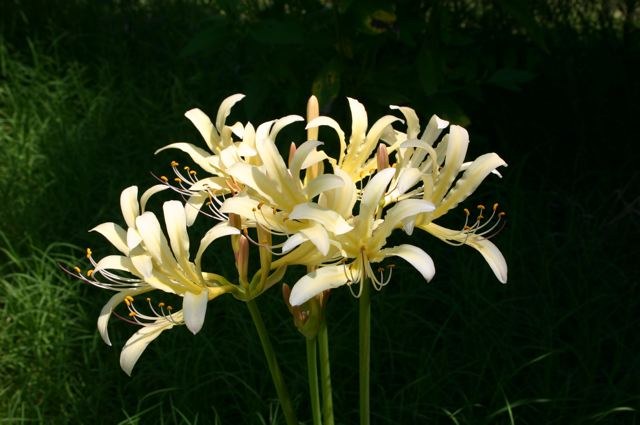
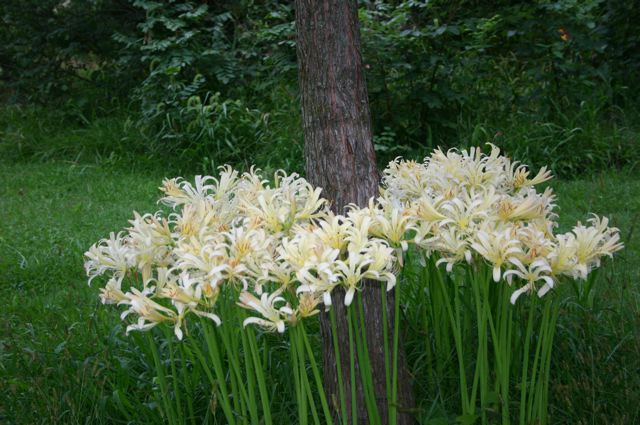
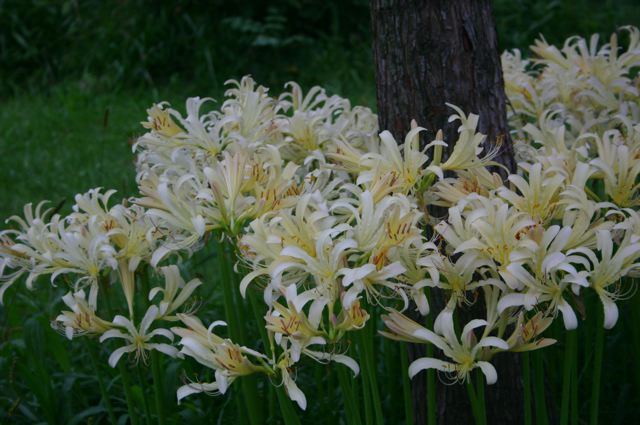
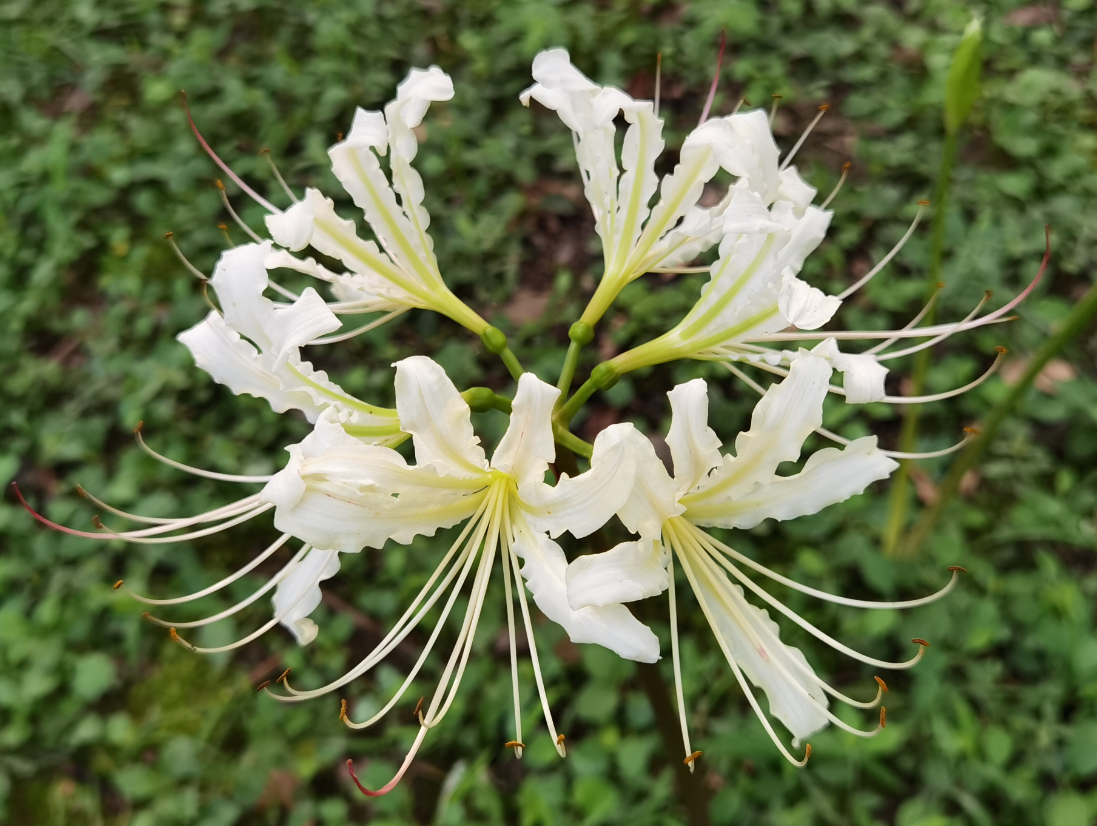
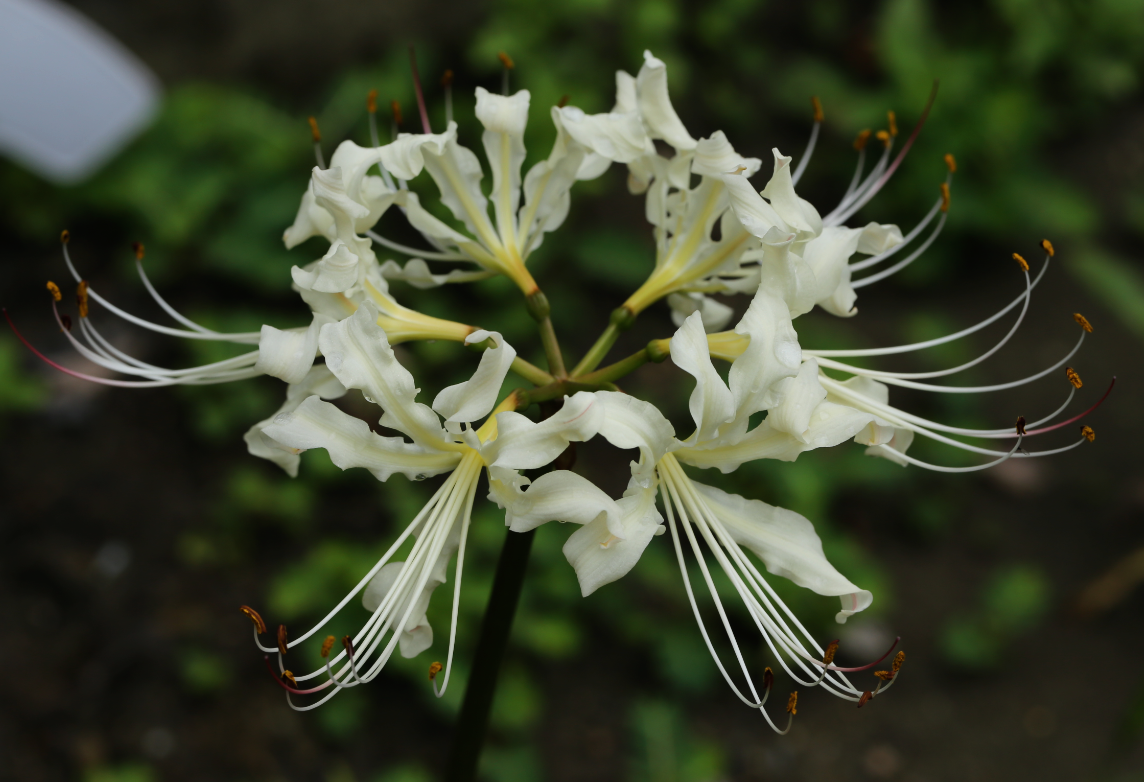
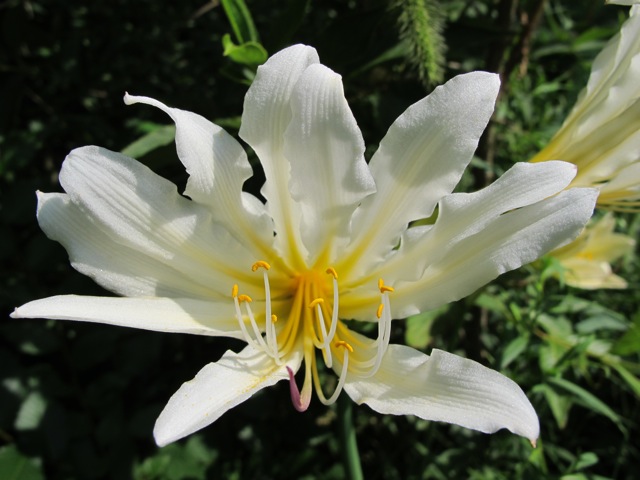
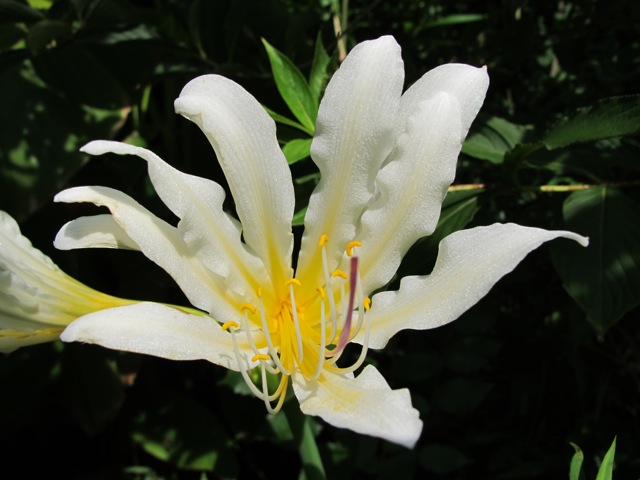
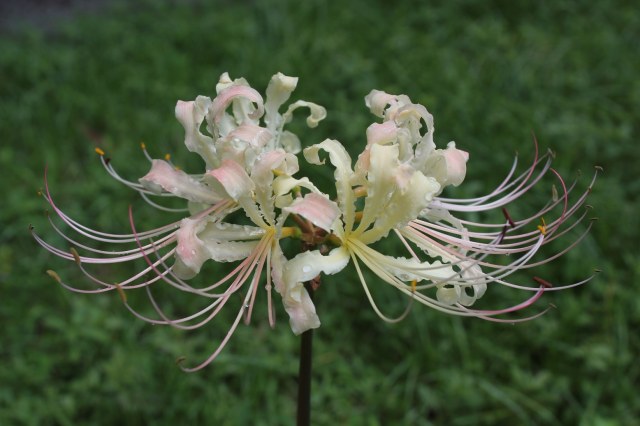
Lycoris houdyshelii Traub is another controversial species published in Plant Life 1957. The bulbs were imported from a Chinese nurseryman in Shanghai in 1948 labeled 'Lycoris alba'and flowered in late June-July 1953. Its chromosome karyotype is 2n=30 (Bose, 1957). It is clear milky white, almost an oyster white, and abaxially with green mid-vein, but sometimes slightly penciled pinkish. According to Plants Delight nursery website it is a naturally-occurring hybrid (L. straminea × L. radiata var. pumila) found in the Chinese provinces of Jiangsu and Zhejiang. It was named by Dr. Traub in honor of bulb collector Cecil Houdyshel. However, in 2024 both World Flora Online and Plants of the World Online accept it as a species, not a hybrid. The frilly, light-yellow flowers top the 20" tall stalks that seemingly appear from nowhere in mid- to late-August. Emerging from the center of the petals are long stamens, often tinged in light pink, like eyelashes on a lady of the evening. After flowering, the deer-resistant winter rosettes of 15" long basal leaves emerge in late September and persist all winter. Pot size: 24 fl. oz (709.77 ml) implying a relationship with the real Lycoris straminea. The photos below taken by Zhang Pengchong show the same bulb flowering in two consecutive years, which vary from white to pale yellow. Lycoris houdyshelii should be the triploid form of Lycoris straminea.
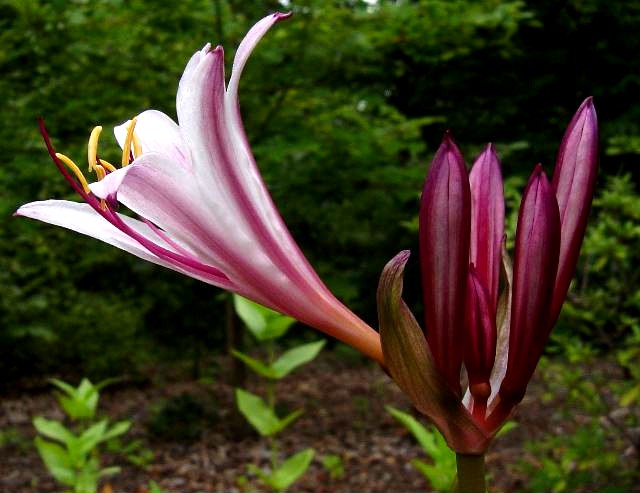
Lycoris incarnata Comes ex Sprenger is sometimes called Peppermint Lycoris because it has red and white striped buds and flowers. Unlike many Lycoris, this one is reported to require a hot, dry resting period to flower well. It clumps up rapidly and produces dense displays of flowers. It is a good selection for northern gardens as it is hardy to Zone 5. Height range: 30-60 cm.Photos by Rob Hamilton, Jay Yourch, and Jim Murrain, and Jim Waddick. Notice the striped buds and pink midline on the inside and outside of the petals.

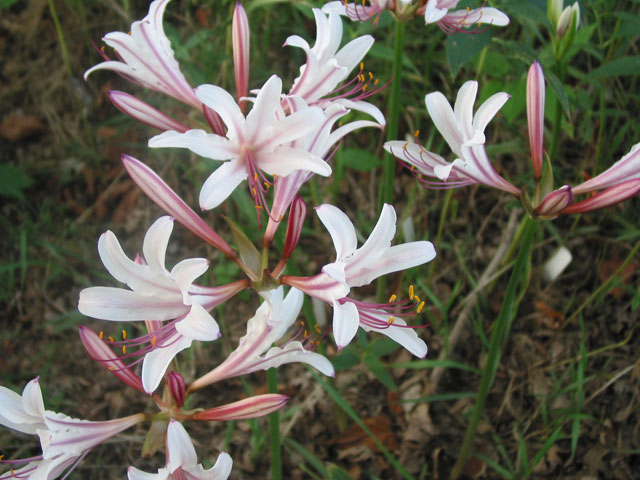
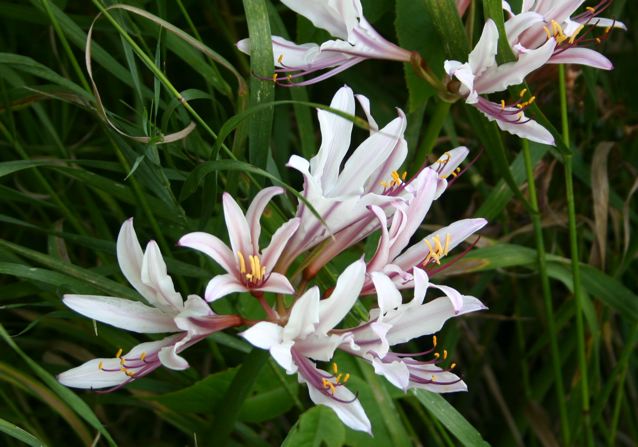
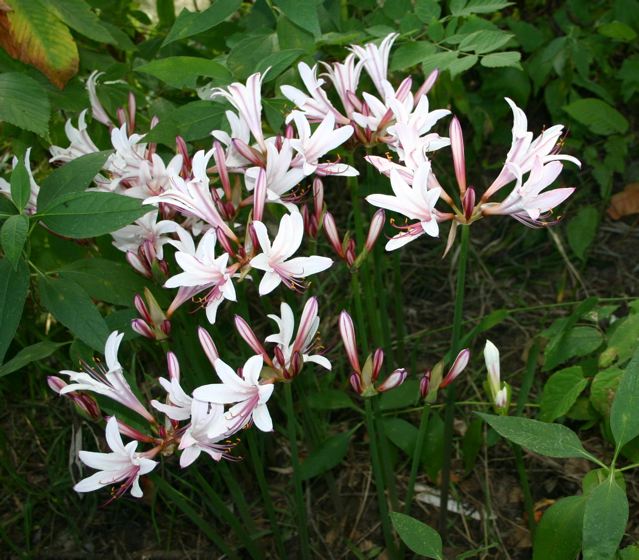
Lycoris longituba Y.C.Hsu & G.J.Fan known as the White Spider Lily is a large handsome plant from China with the flower stems reaching to nearly 3 ft. The large regular lily-shaped flowers are variable in color and a pale yellow form (Lycoris longituba var. flava) has been named. Up to 15 different colors and forms from white to yellow to pink and median shades have been recognized in China. It is hardy to Zone 5, vigorous, and a fertile diploid readily producing seed and hybridizing with other fertile species. It is believed to be one of the parents of Lycoris squamigera. Photos by Arnold Trachtenberg and Jim Murrain.
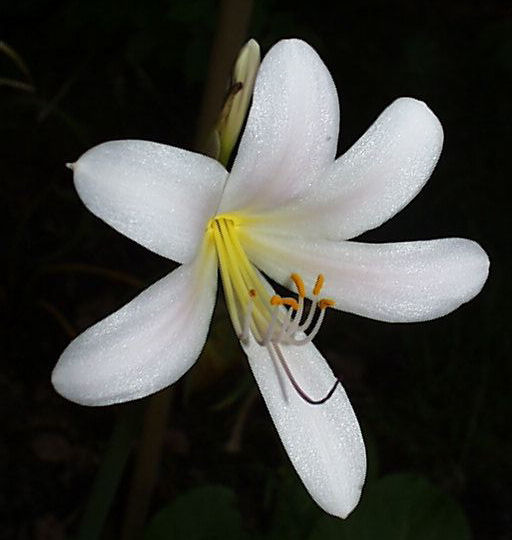
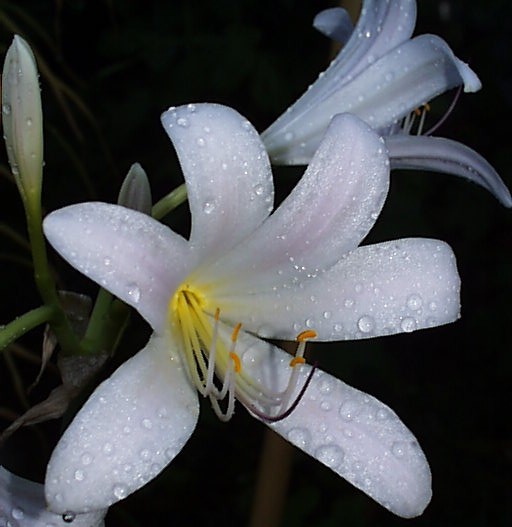
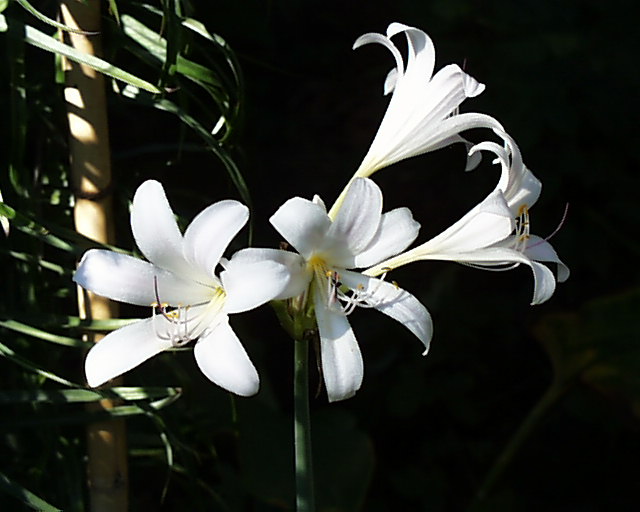
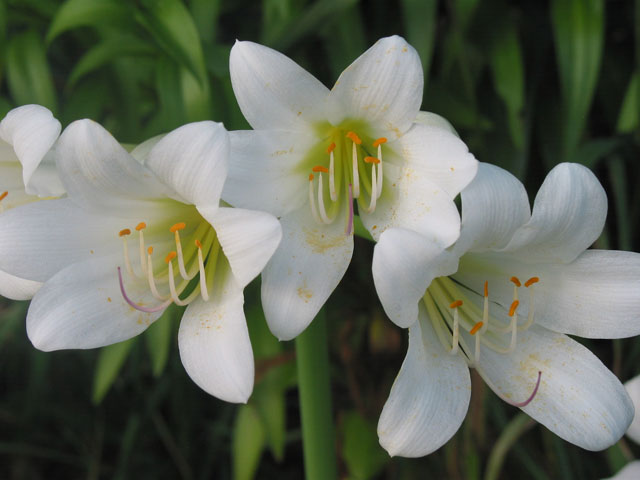
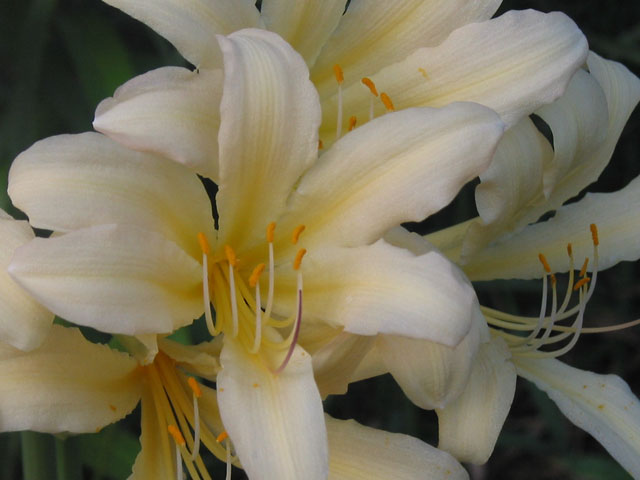
These photos by Jim Waddick, show two different flowers from a single scape of Lycoris longituba. Normal flowers have 6 tepals, 6 stamens and a single stigma. This stem has flowers with 10 or 11 tepals and 9 or 10 stamens each. The single stigma seems unchanged. Normally Lycoris longituba is a fertile diploid species so these have been self pollinated in hopes of developing a multi-petal strain.
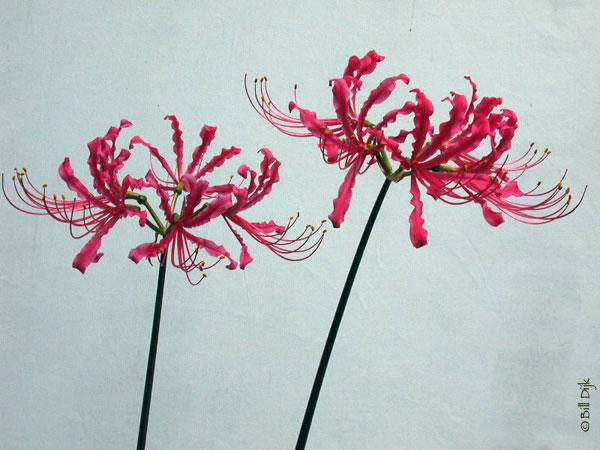
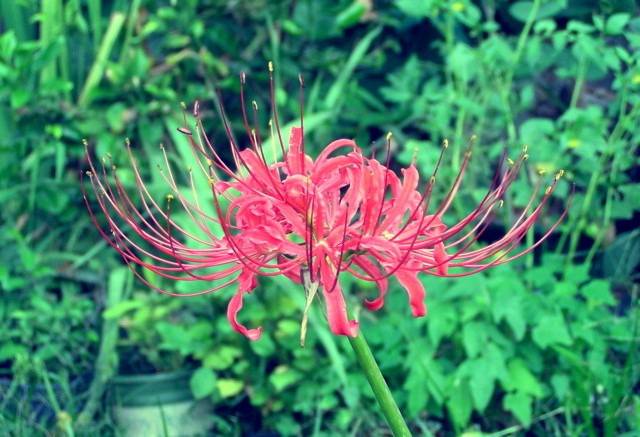
Lycoris radiata (L'Hér.) Herb. is native to China, Korea, Nepal, and Japan. Var. pumila Grey, now included in the species, is the red spider lily, and has much reflexed, recurved red flowers, wavy on the margins, with long, exerted filaments on tall, naked stems in late summer. Long-lasting and popular with the ladies in their floral art arrangements. This is the fertile diploid form having an earlier flowering time. Height range: 30-60 cm. Photo by Bill Dijk.
Lycoris radiata var. radiata is the sterile triploid form, received from Jim Waddick, and common throughout much of the southern USA. Photo taken August 2004 by Lee Poulsen and September 2007 by Jay Yourch.
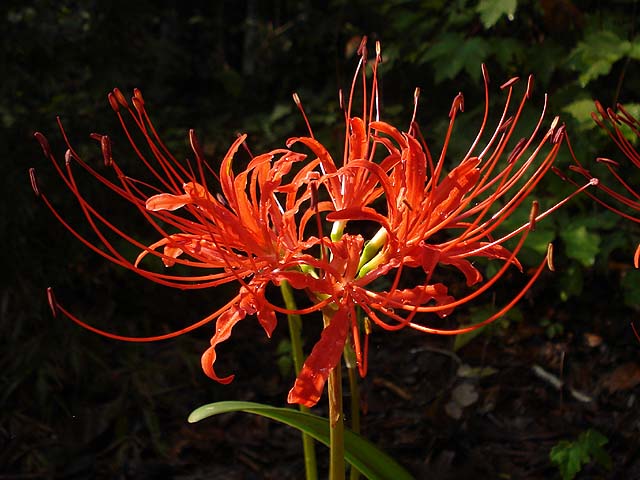
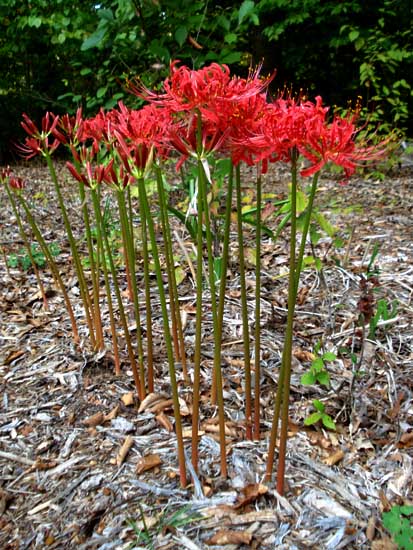
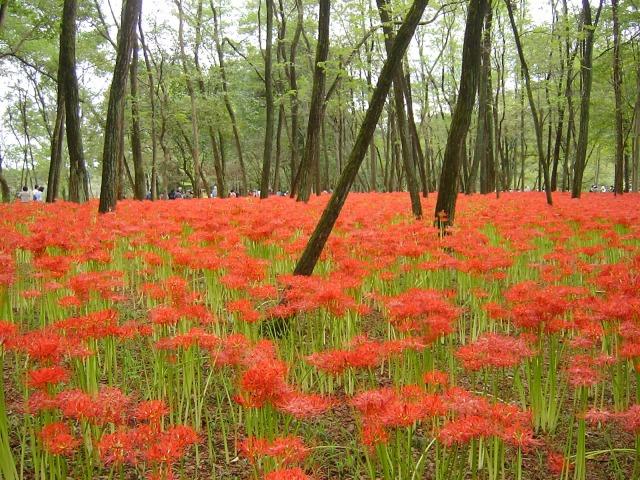
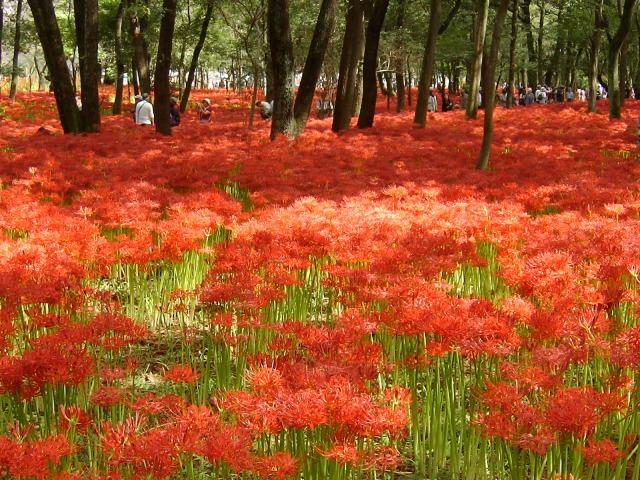
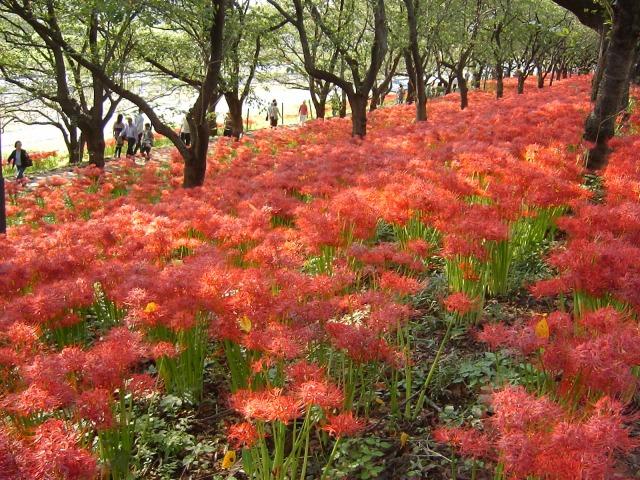
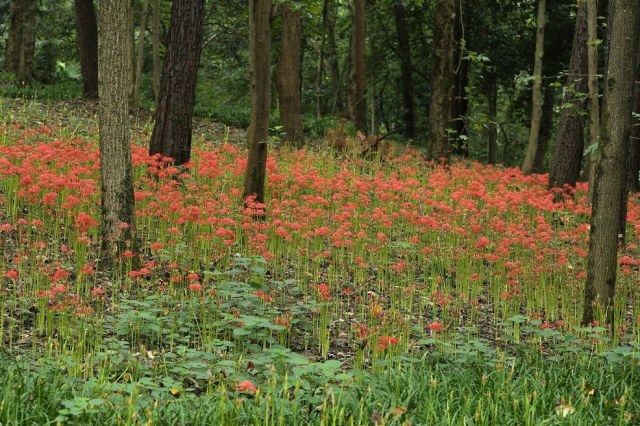
The first three photos of Lycoris radiata var. radiata were taken by Mari Kitama in the Kinchakuda and Gongendo parks in Japan in September 2010. Kinchakuda, a flat field surrounded by the Koma River was originally a natural habitat for this species. Many years ago people removed other plants so it would just display Lycoris radiata. It is estimated that there are now more than one million bulbs in this location. Gongendo was made into a bank to prevent a flood of the Gongen river about 430 years ago. It was not a natural habitat for this species; they were planted starting about the year 2000. The last The photo of L. radiata var. radiata was taken by Zhang Pengchong in Hangzhou Botancial Garden where it is planted on a gentle slope under a deciduous broadleaf forest.
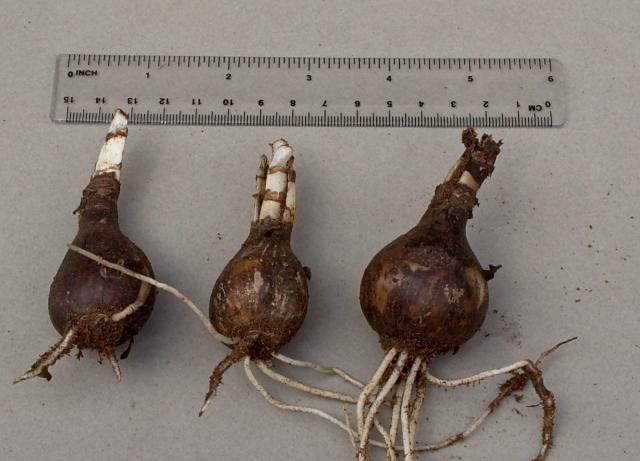
Commercial Lycoris radiata bulbs, photographed by David Pilling.
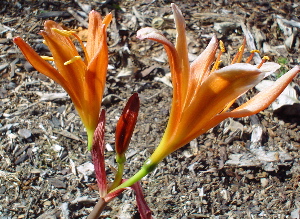
Lycoris sanguinea Maxim. is known as the Orange Surprise Lily. This is one of the smaller species and one of the most common of Japanese origin. Flowers are apricot to orange and it is one of the first to bloom. The var. kiusiana Makino ex T.Koyama has larger flowers, but is otherwise similar to type. It is hardy to Zone 5. Height: about 18 cm. Photographed and grown by Rob Hamilton.
Lycoris sanguinea var. sanguinea, photographs from Japan by Mari Kitama.
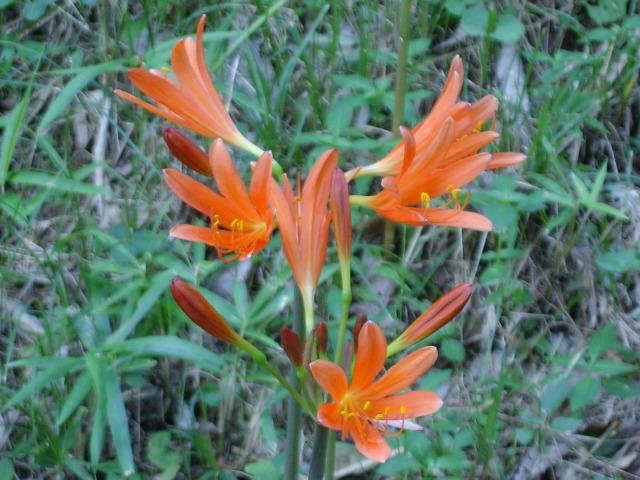
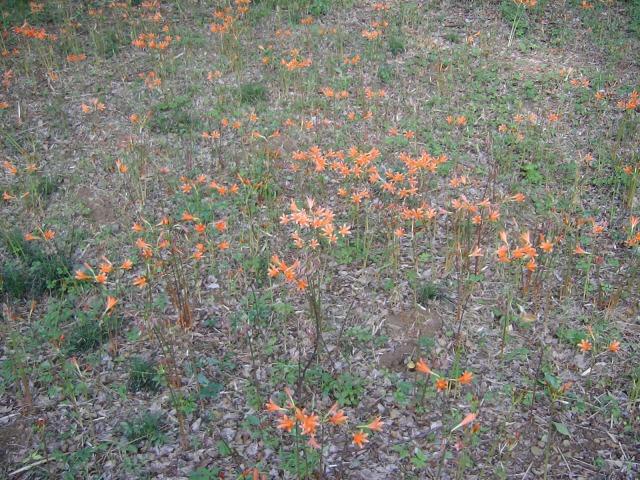
Lycoris sanguinea var. kiushiana Makino ex T. Koyama and Lycoris sanguinea var. koreana (Nakai) T. Koyama were published by Tessuo Koyama in Vol.7 of BAILEYA in 1959. They differ from the typical Lycoris sanguinea by the larger size of flowers and the longer stamens distinctly exserted from the the perianth, in addition to having earlier anthesis. In addition, Lycoris sanguinea var. koreana can be distinguished from Lycoris sanguinea var. kiushiana in smaller size of perianth. Photos below taken by Zhang Pengchong in China and the bulbs were give by Siro Kurita who thought there were two other varieties of Lycoris sanguinea (Lycoris sanguinea var. kirishimense and Lycoris sanguinea var. autumnalis) but not published. The first two are Lycoris sanguinea var. kiushiana, the last two are Lycoris sanguinea var. koreana.
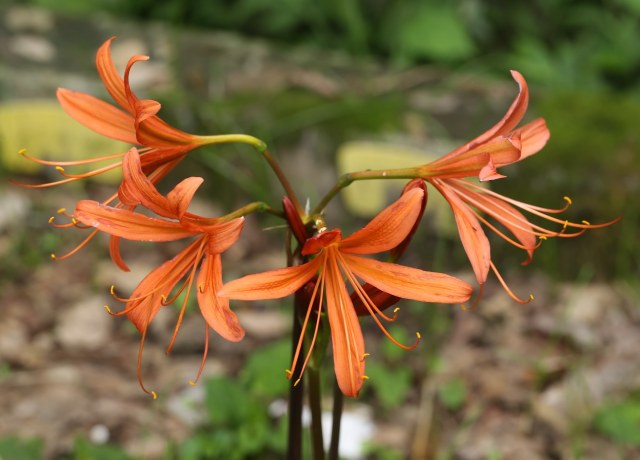
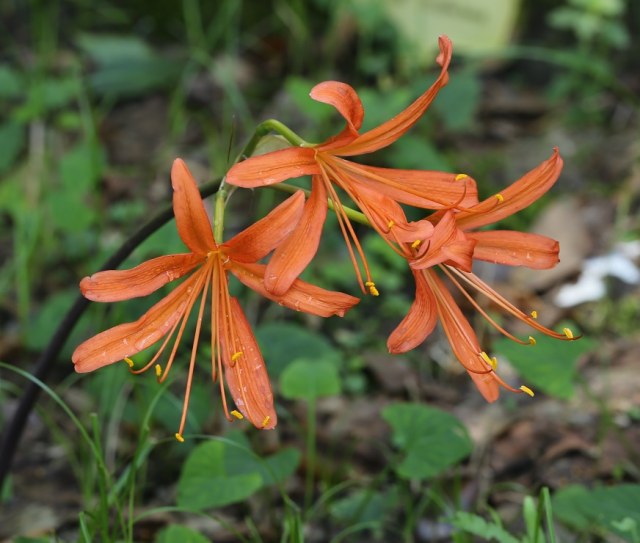

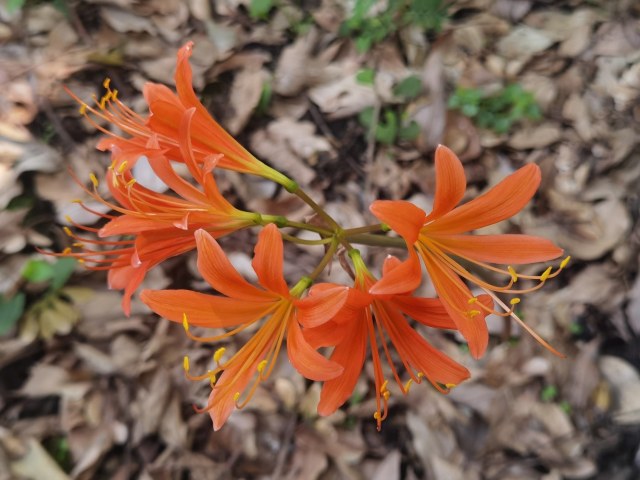
Lycoris sprengeri Comes ex Baker known as the Small Pink or Electric Blue Surprise Lily is overall smaller in leaf and stem than many of the other species with stalks rarely exceeding 15 inches. Flowers are essentially pink, with pale blue tips, but variable with some a deeper pink and others almost entirely rich ‘electric’ blue. Height: about 45 cm. This is a fertile diploid that readily produces seed and is well suited to many garden locations as well due to more modest size. It is hardy to Zone 5. Photos by Arnold Trachtenberg, Bill Dijk, and Jim Murrain.

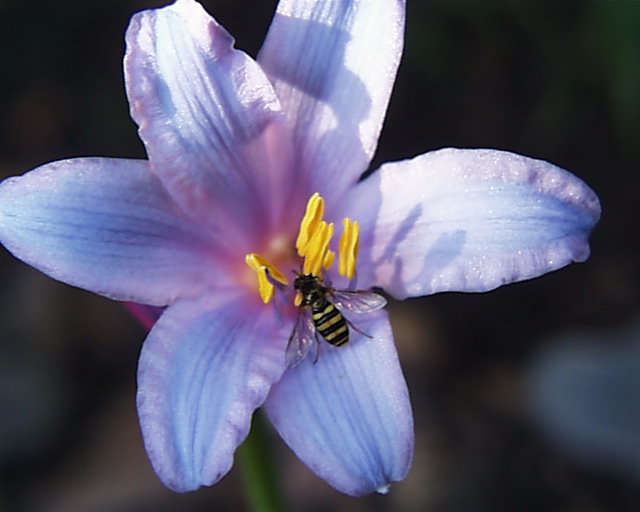
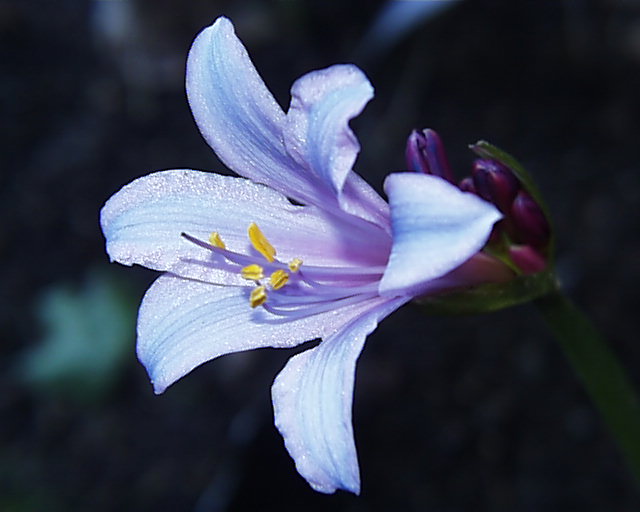
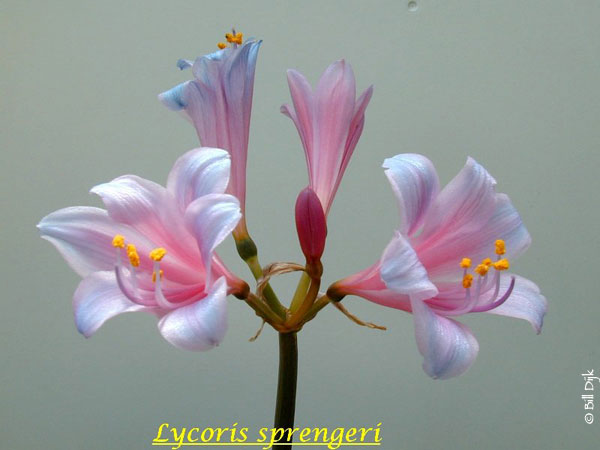
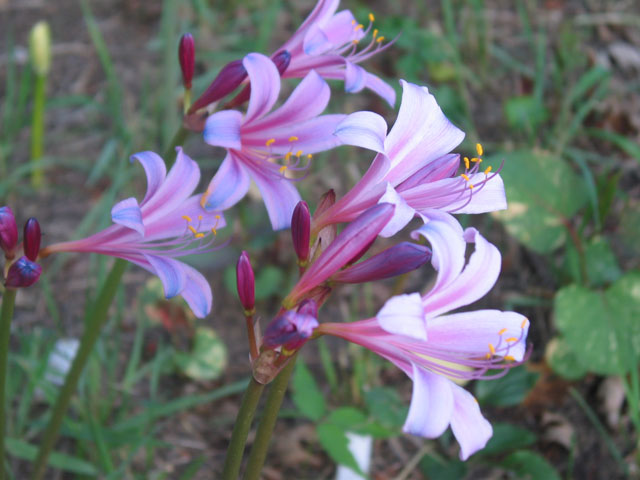
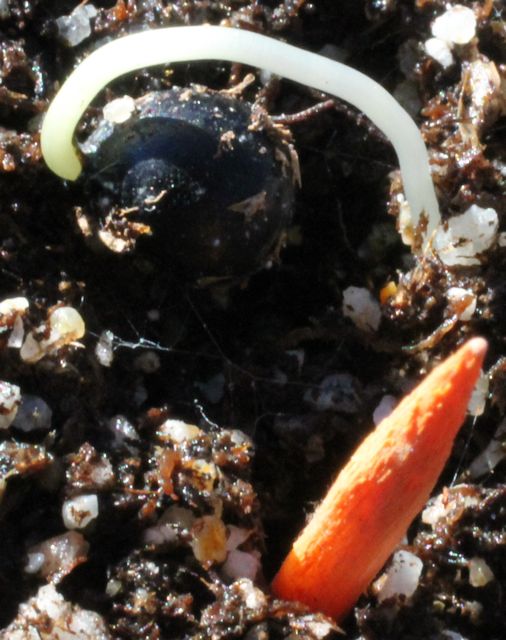
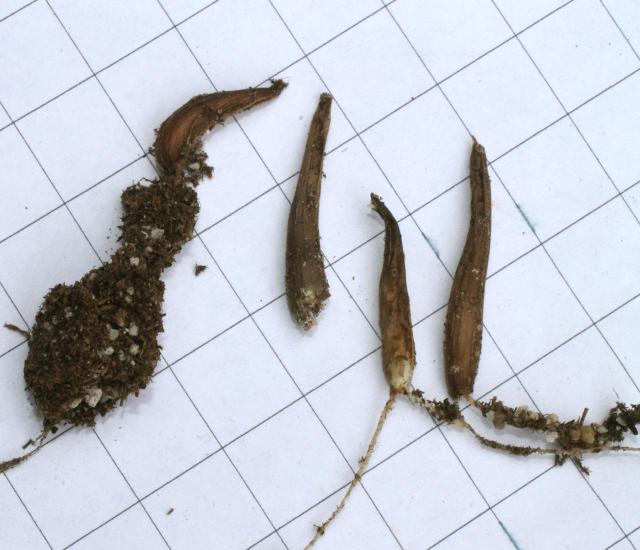
Here are photos of two separate scapes from the same bulb (from Jim Waddick) blooming once again in southern California, showing how the amount of blue can change from scape to scape. The first scape (first photo) bloomed when the temperatures were very hot, mid-to-high 90s F. (high 30s C.), and are more pink. The second scape (second and third photos), which bloomed when the temperatures were unusually low for August, upper 70s F. (mid 20s C.) are much more blue. The electric-blue buds are particularly spectacular. The last flower photo is of Lycoris sprengeri and Lycoris radiata blooming together, showing contrast between Lycoris flower form and color. Photos taken August 2004 by Lee Poulsen. In photo 5 a Lycoris sprengeri seed from Jim Waddick via PBS BX 297-4 is germinated by M. Gastil-Buhl, with toothpick in foreground included for scale. Photo 6 shows bulblets 2 cm long by 0.5 cm wide 7 months later in July.
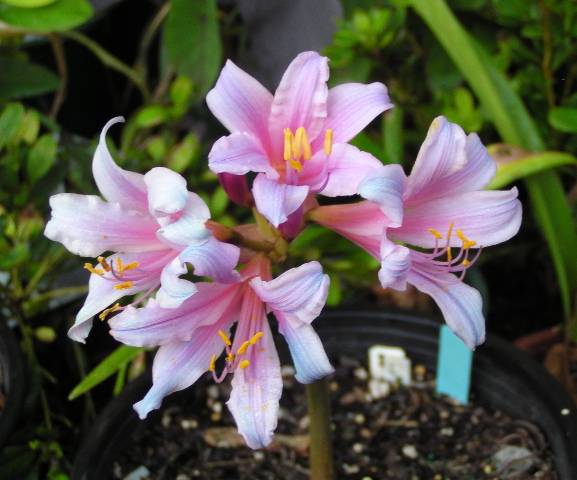
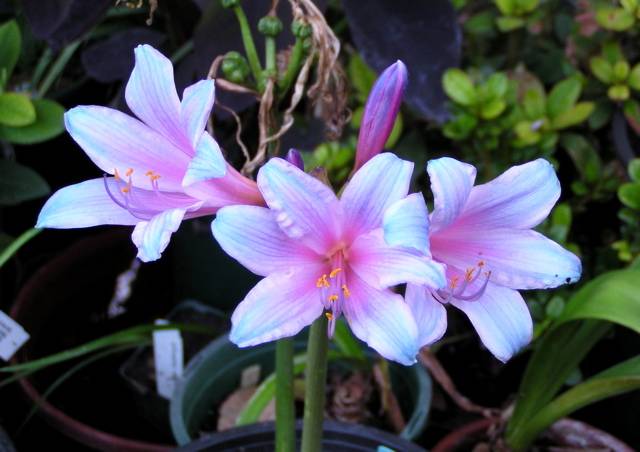
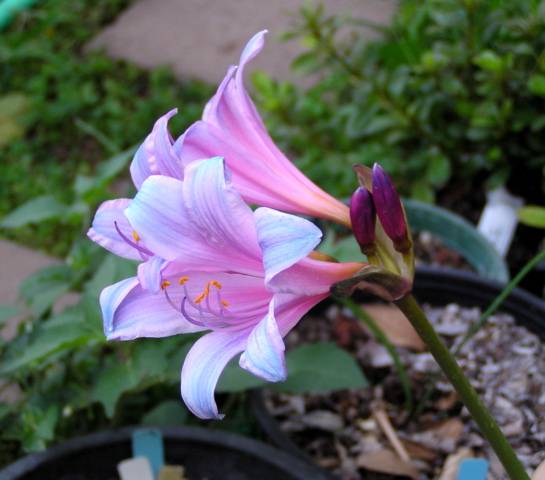
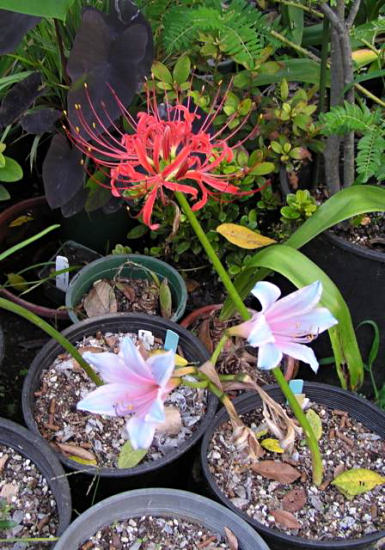
Jim Waddick, Kelly Irvin, and Lee Poulsen contributed advice how to grow this cold-winter species L. sprengeri in zone 5-6, zone 6a/b, and zone 10a. All agree if grown in a container the depth must be that of a 2-gallon tree pot, 15 inches tall. Contrary to he normal growth pattern of winter dormancy and spring foliage expected for this species, Lee Poulsen has grown it successfully in a mild climate where it has altered its seasonal growth pattern, leafing out in mid-autumn and growing throughout the winter and spring and then going dormant in late spring. Even his grown from seeds follow this pattern. Then they bloom in August while dormant.
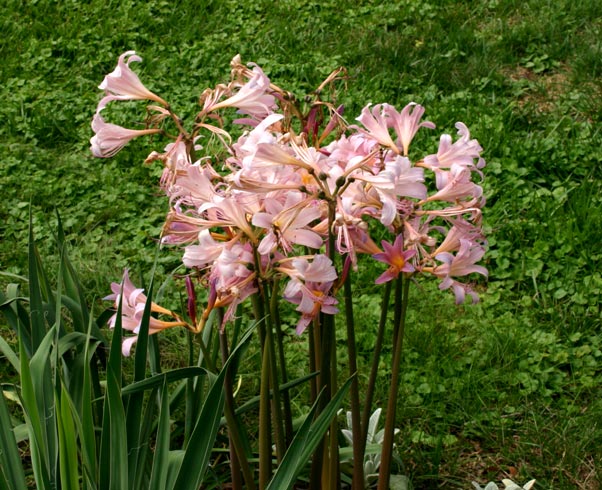
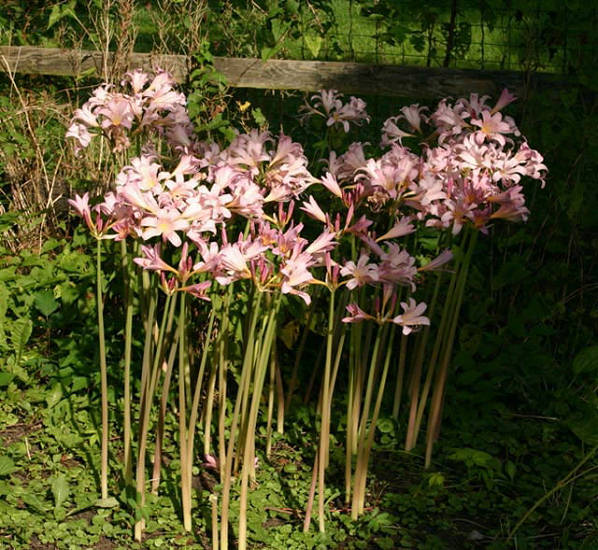
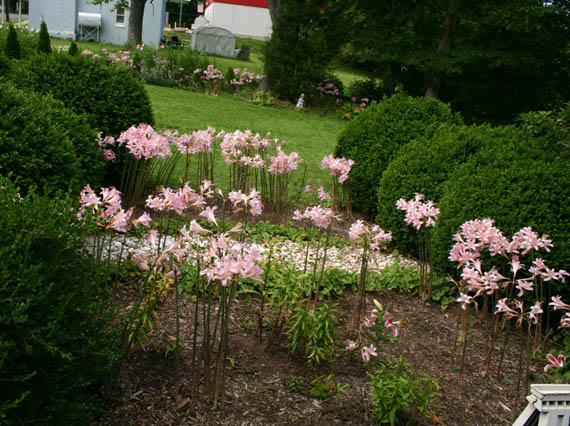
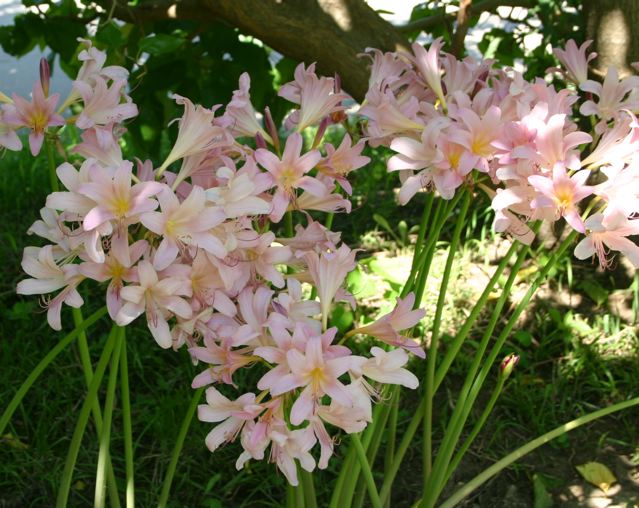
Lycoris squamigera Maxim. is one of the most cold hardy. The flowers are pink with blue tips. Height: to about 60 cm. The identity of this sterile hybrid (listed as a species) is controversial. Earlier works suggest that one of the parents is "L. straminea". What was known as L. straminea then is now called L. longituba. It may be a natural hybrid of L. sprengeri × L. chinensis. Experimental crosses between these two species also resulted in a hybrid that look to be L. squamigera. However, morphological characteristics point to a possible cross between L. longituba (2N) and L. sprengeri (N) to form a triploid hybrid.
Many people confuse Lycoris squamigera and Amaryllis belladonna because both bloom in the fall on bare stalks with no leaves, and both can have large pink flowers. You can see the differences on the Amaryllis belladonna versus Lycoris squamigera page.
Photos 1-2 taken July 2004 and August 2005 by Jay Yourch. Photos 3-5 were taken by Jim McKenney in a country garden he visited.

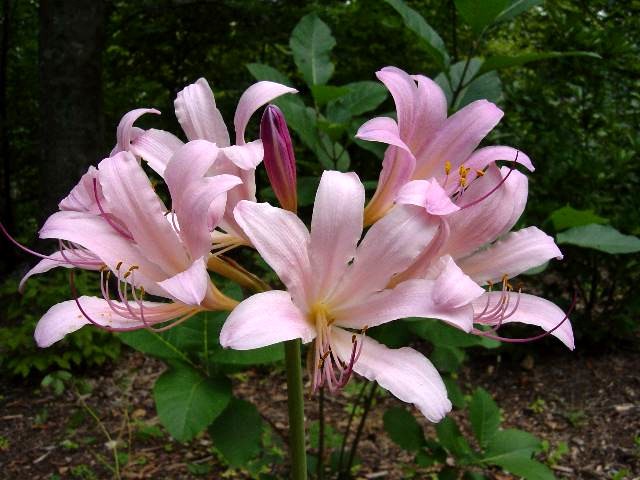
Photos below from Jim Waddick. The first shows it surrounding a sweet gum tree. The second is a close-up showing the hint of blue on petal tips. The last two show it blooming in sun and shade.
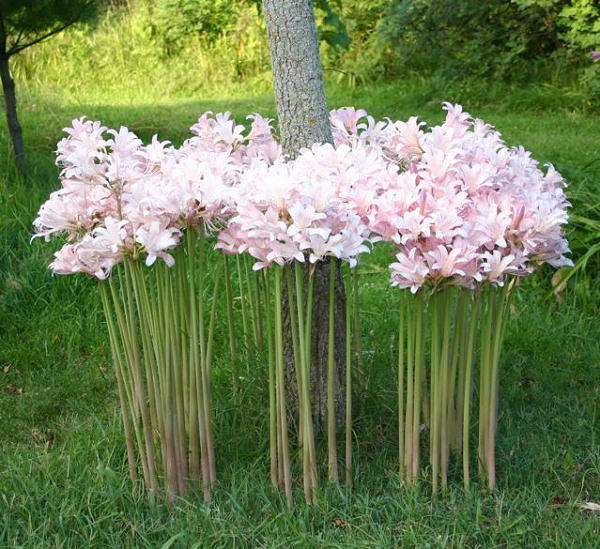


These photos by Jim Waddick show two different flowers that very closely resemble the common sterile triploid Lycoris squamigera, but there is no sign of blue tints in any part of the flower. All flowers on this stalk show this. It may be a similar hybrid. First seen in 2010, I have tried selfing it and crossing with typical Lycoris squamigera to see if it may produce seed one way or another.
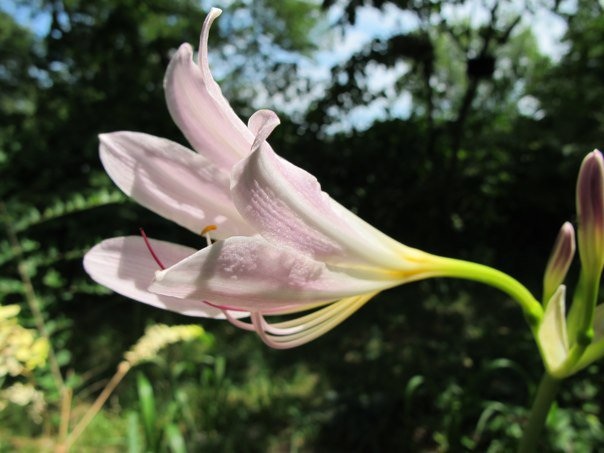
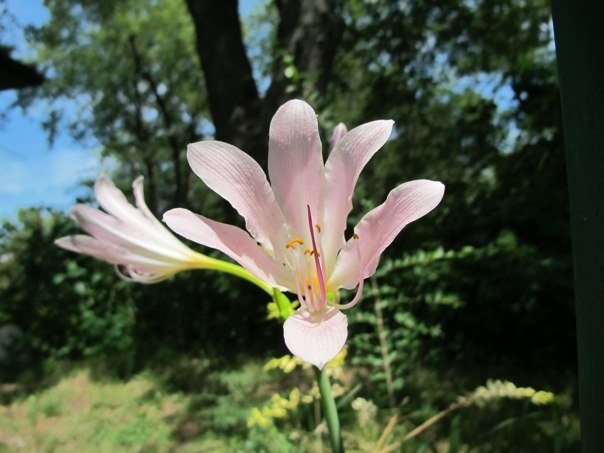
Lycoris straminea Lindl. was named by John Lindley in the Journal of the Hort. Soc., London, 3:76.1848. The name was in fact a nomen subnudum for an inadequate description. The bulbs were collected by Fortune from China and sent to Kew Gardens, England in 1845. Until 1954 Hamilton P. Traub found the type specimen of Lycoris straminea in the Cambridge University Botany School Herbarium (CGE), and designated the left hand side specimen of the sheet as the lectoype according to Lindley's description and made an emended description making it a legal name. Now Lycoris straminea is distributed in East China having pale straw-colored flowers with a pink line along the middle of the segments, and a few scattered dots. It produces leaves in autumn so is not quite hardy. It is inferred to be a hybrid of Lycoris chinensis and Lycoris radiata in East China, therefore there are some forms in the wild. Height range: 50-66 cm. Photos below taken by Zhang Pengchong show some varieties of Lycoris straminea.
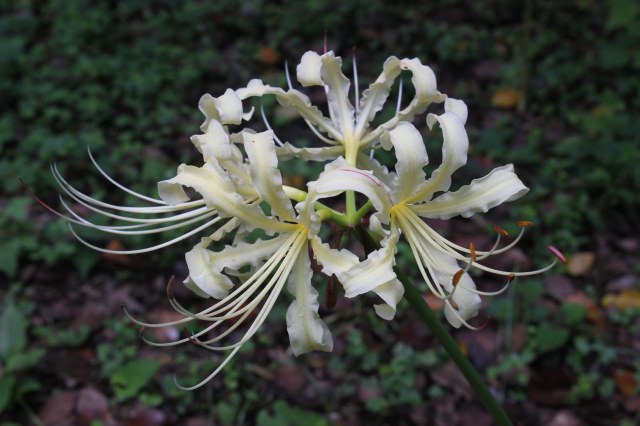
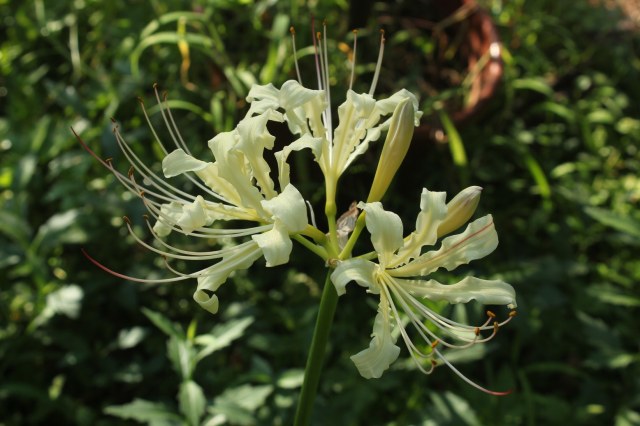
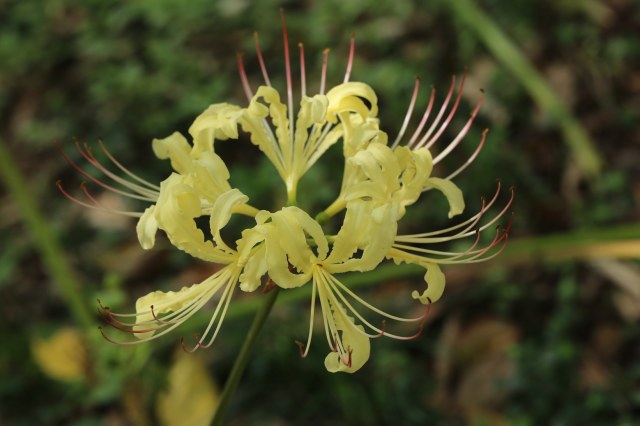
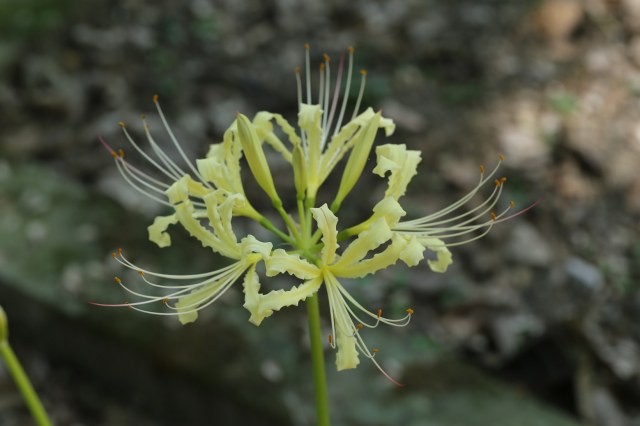
Lycoris traubii W. Hayw. was established by Wyndham Hayward in Vol.13 of Plant Life 1957 which was named for Dr. Hamilton P. Traub of La Jolla, California. At first it was believed a variety of Lycoris aurea. The more important differences between Lycoris traubii and Lycoris aurea are that Lycoris traubii has fall appearing leaves about a month later than Lycoris aurea, relatively short spathe-valves (4 vs 8 cm), shorter pedicels (up to 9 vs 15-22 mm), more or less horizontal flowers, longer (19 vs 12 mm) and curved downward tepaltube, saffron-yellow color and relatively cold resistant. Lycoris traubii was imported from Japan as early as 1936. Lycoris × woodii (Lycoris traubii × Lycoris radiata) made by Wm. T. Wood in 1941 and bloomed in 1951 is the first artificial hybrid in literature. Height range: 45-50 cm. Photos below taken by Zhang Pengchong and the bulbs are from Taiwan.
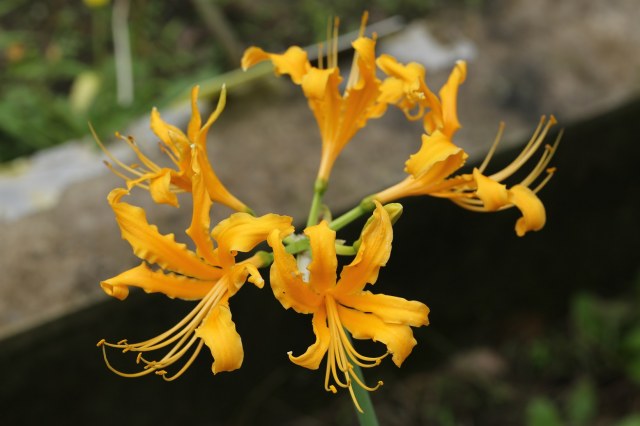
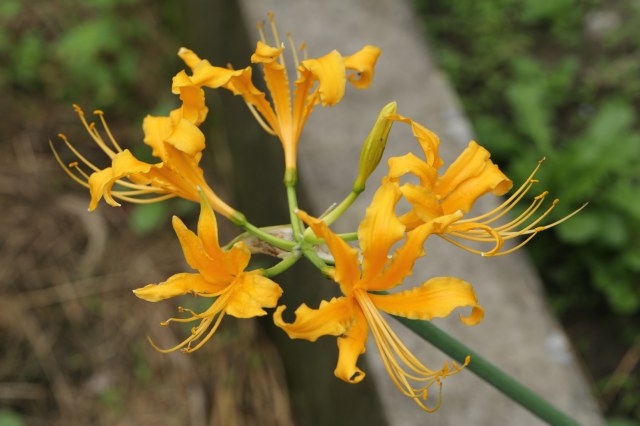
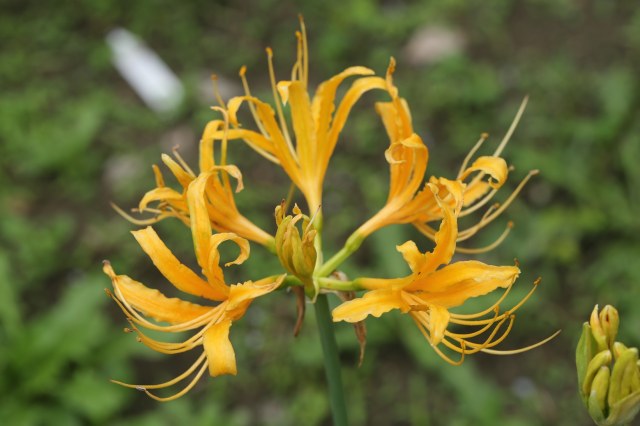

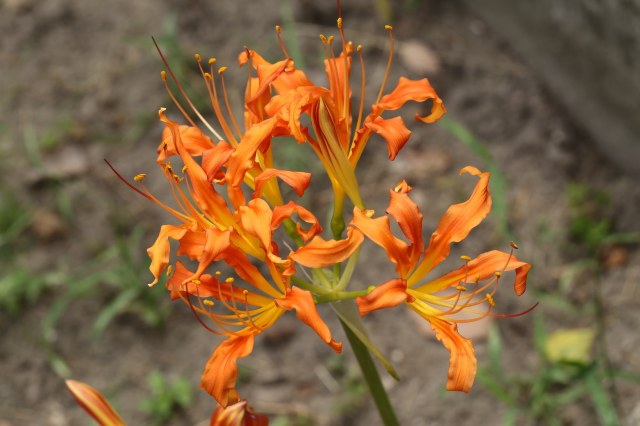
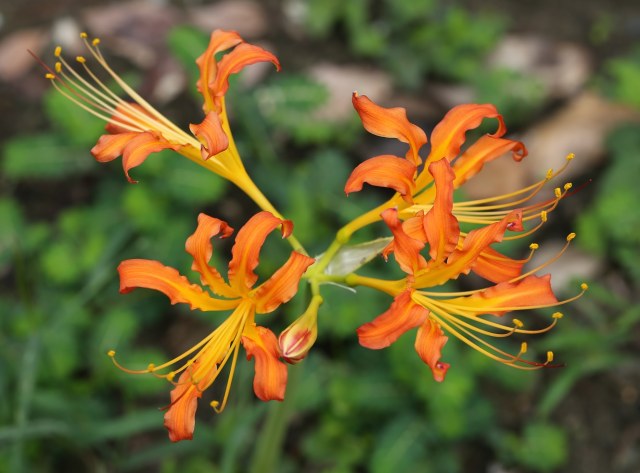
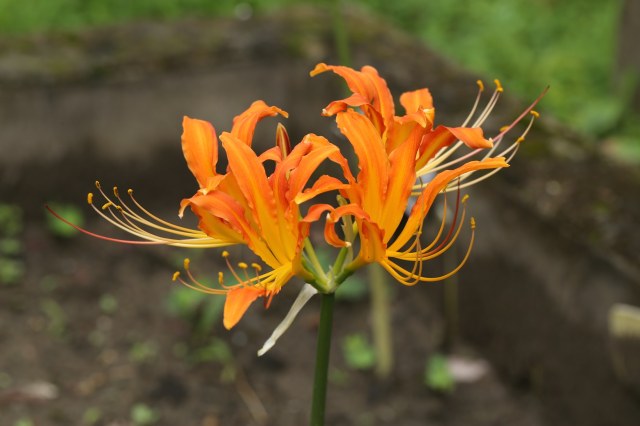
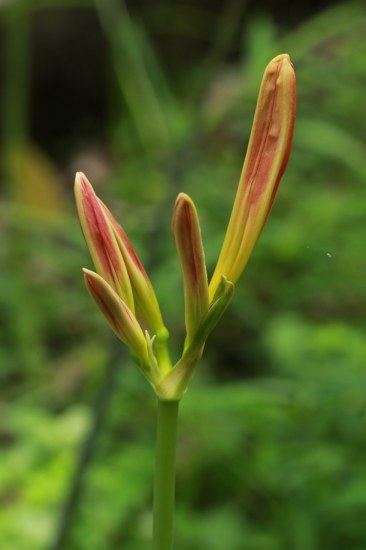
Lycoris tsinlingensis P. C. Zhang, Yi Jun Lu & Ting Wang was published by Zhang Pengchong in the Vol.57 of Annales Botanici Fennici in 2020. The specific epithet is derived from Tsinling, the name of the type locality of the collection. It closely resembles Lycoris chinensis in having leaves appearing in spring and stamens nearly as long as or slightly longer than perianth, but can be distinguished by the larger spathe bracts, buds yellow with red stripes, tepals orange-red, and margins undulate and recurved. Although some people believe Lycoris tsinlingensis to be a variety or form of Lycoris chinensis, the results of hybridization and molecular data indicate that they are different. Height range: 50-60 cm. Photos by Zhang Pengchong.