The genus Moraea can be divided into five groups: Galaxia, Gynandriris, Hexaglottis and Homeria, and Moraea.
Moraea group species c-e are found on this wiki page. More information can be learned from Peter Goldblatt's book on Moraeas.
Moraea index lists all the species in all five groups alphabetically.
The other species in the Moraea group are listed alphabetically on these wiki pages: Moraea group a - Moraea group b - Moraea group f - Moraea group g-i - Moraea group j-m - Moraea group n-r - Moraea group s - Moraea group t - Moraea group u-v
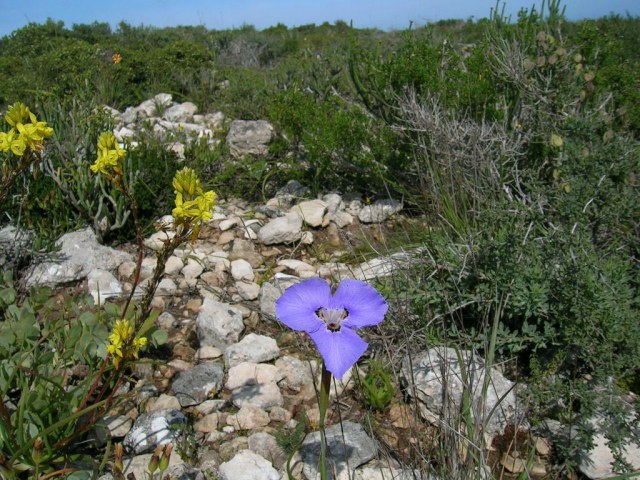
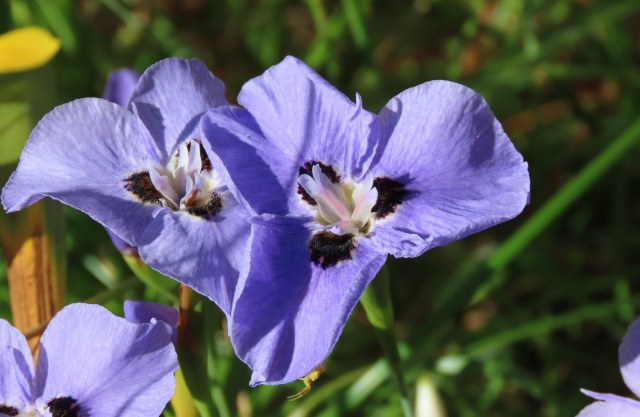
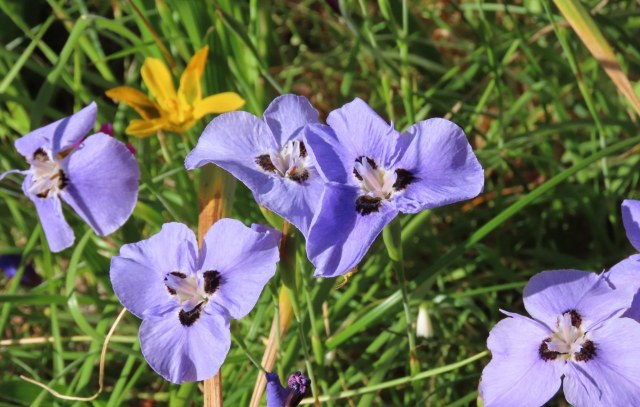
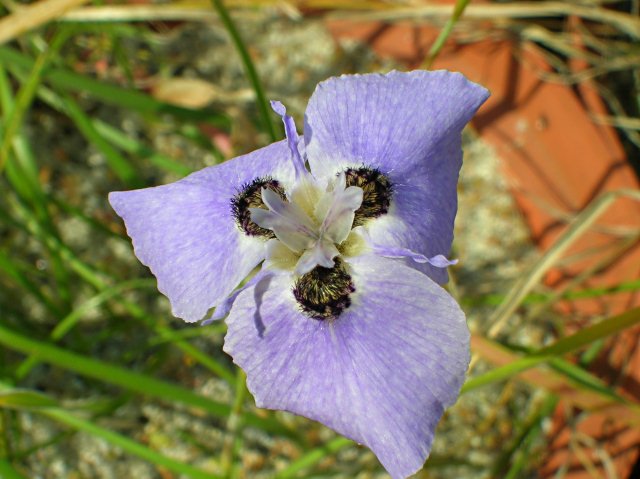
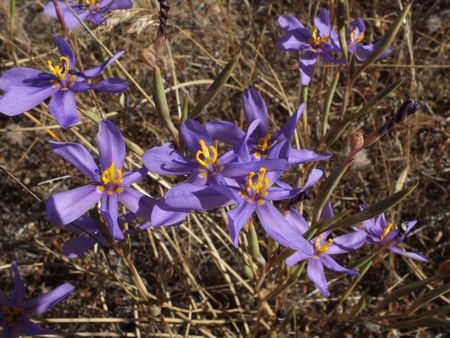
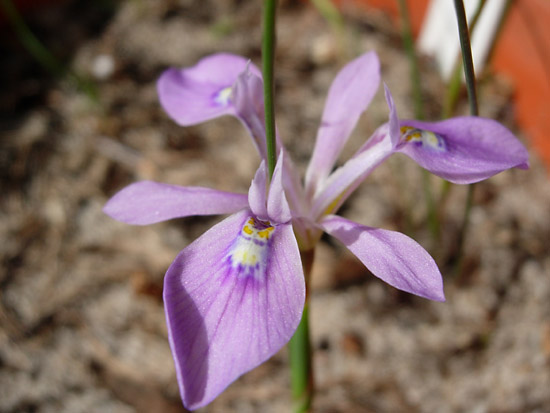
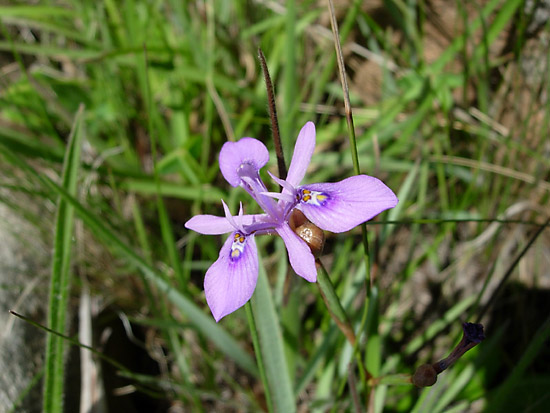
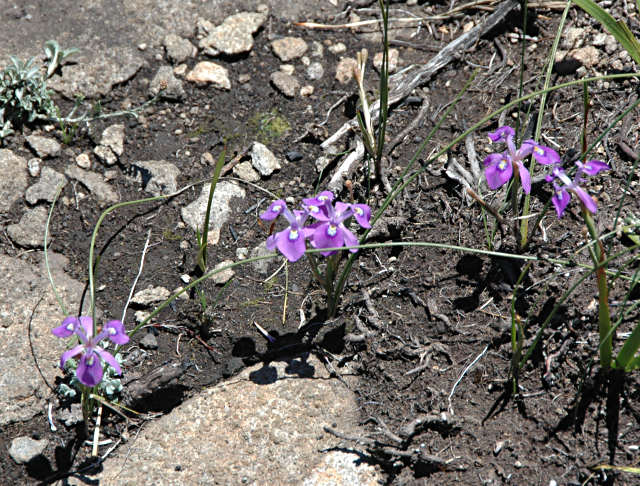
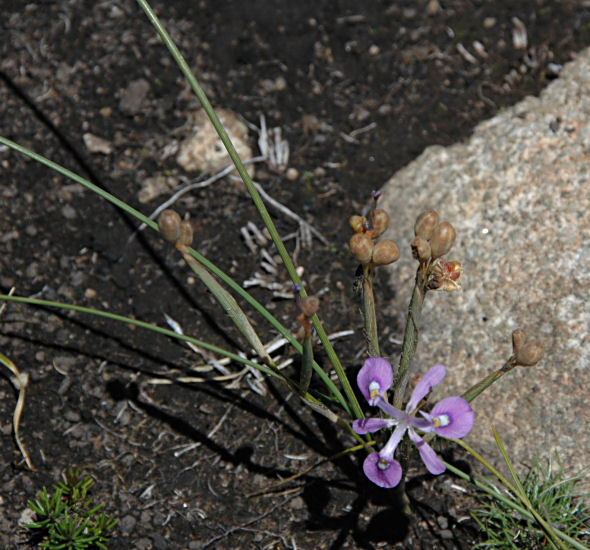
Moraea caeca Barnard ex Goldblatt grows on rocky sandstone slopes in fynbos in the Northwest Cape. It has a single linear trailing leaf and mauve flowers. The tepals are unequal; the outer tepals have a small dark or yellow nectar guide. It flowers in spring. Although not endangered in the wild, this one is very rare in commerce and is reputed to be difficult to grow. Height: about 20 cm tall. The first photo by Alan Horstmann. The next four photos from iNaturalist were taken by gerhardmalan, Brian du Preez, and Riaan van der Walt on the West Coast from August to October and shared under CC BY-NC and CC BY-SA licenses.
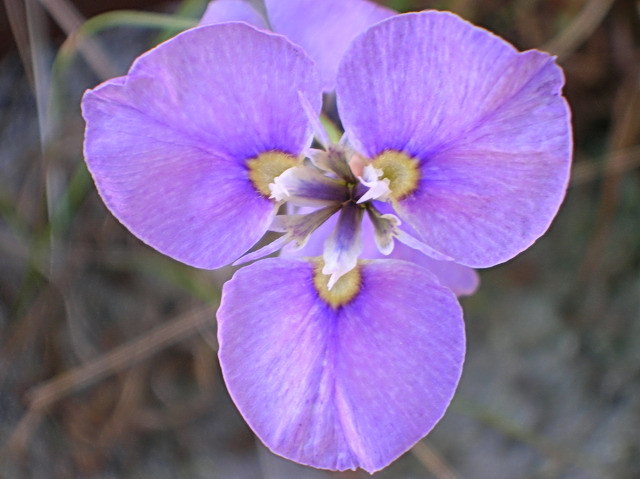
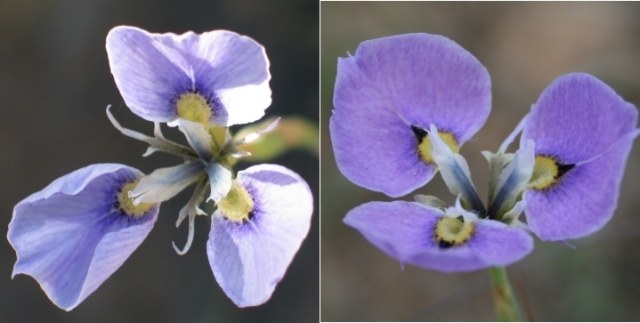
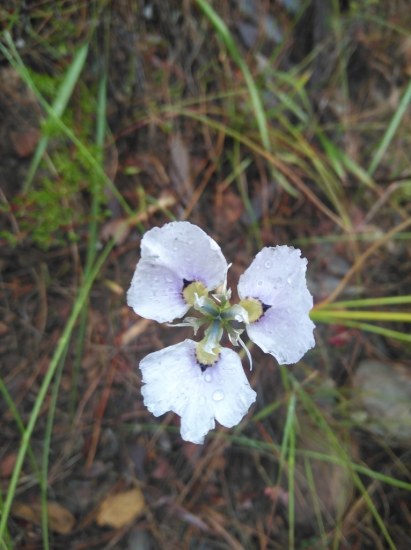
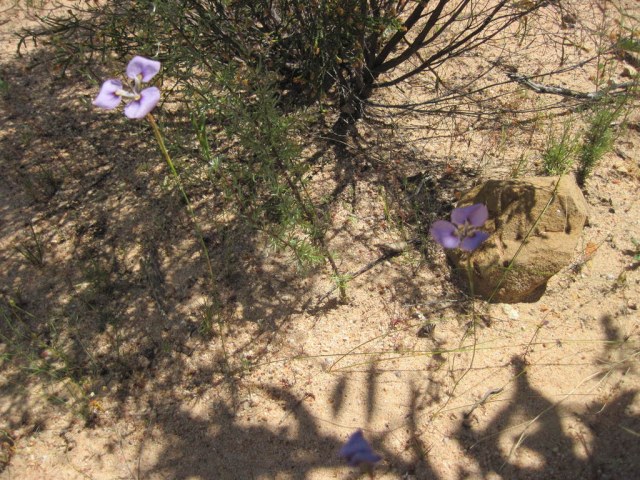
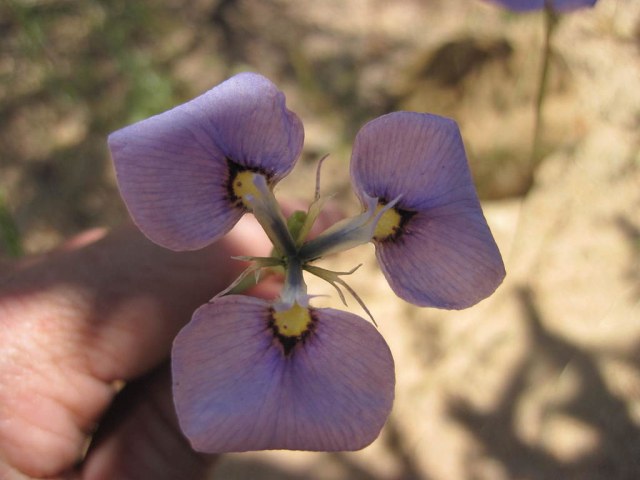
Moraea calcicola Goldblatt grows on limestone hills in the southwest Cape and blooms in late winter early spring, growing about 10 cm high. In the wild it is reportedly found in only three locations with fewer than 200 mature plants. It is occasionally offered in commerce and is relatively easy to grow. M. calcicola has mauve to purple flowers with dark blue nectar guides. The first three photos were taken by Bob Werra, the fourth by Jana Ulmer of the first bloom from Bob Werra seed in March 2005, and the fifth by Michael Mace.
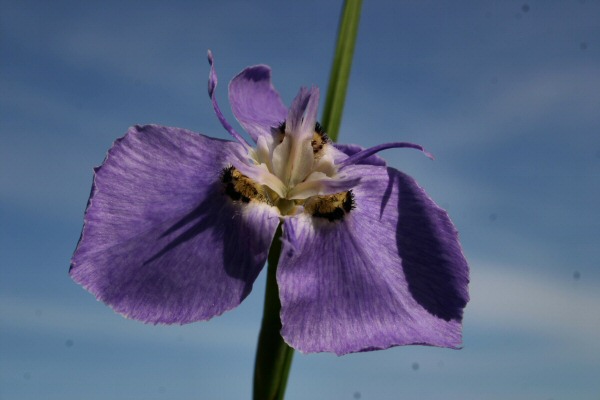
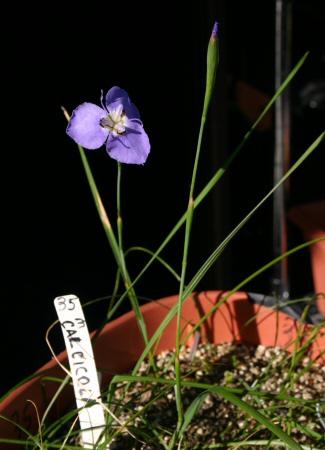
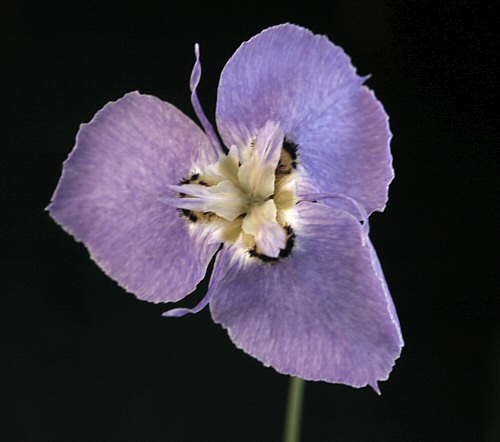
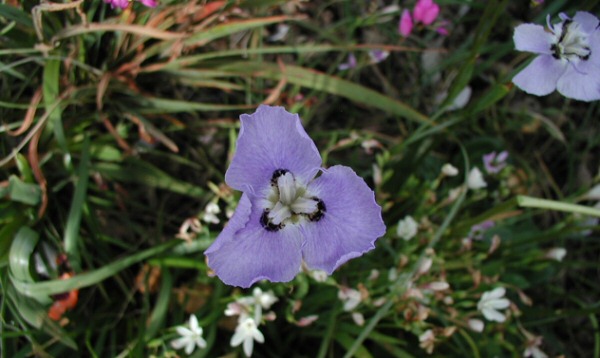
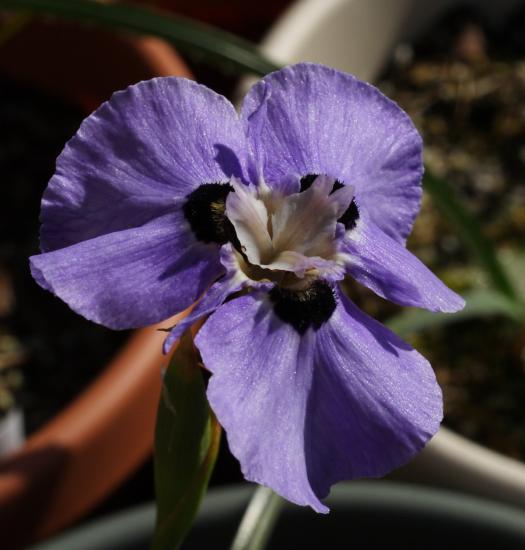
The first photo from Cameron McMaster was taken in the Southwestern Cape in September 2011. The next two photos from iNaturalist were taken by Nick Helme on the West Coast in August and shared under a CC BY-SA license. The last three photos were taken by Alan Horstmann.
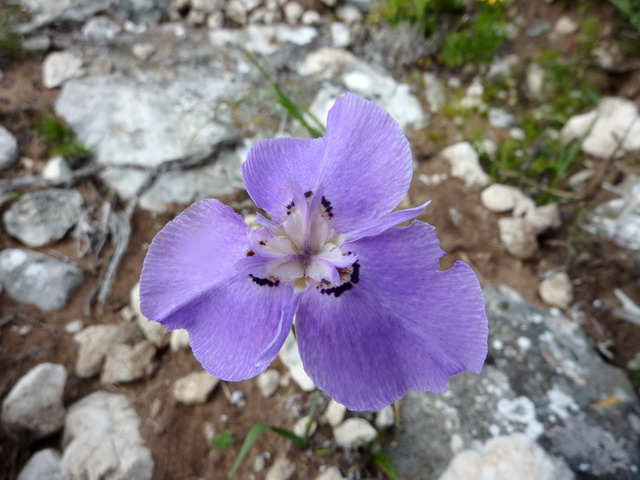
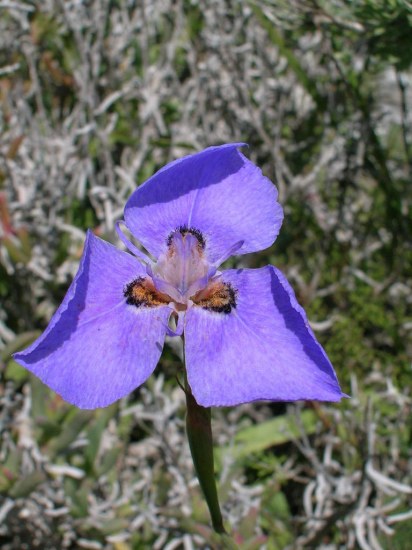
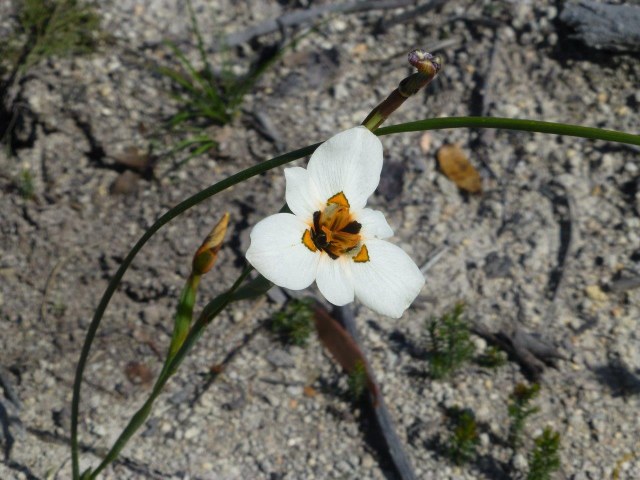
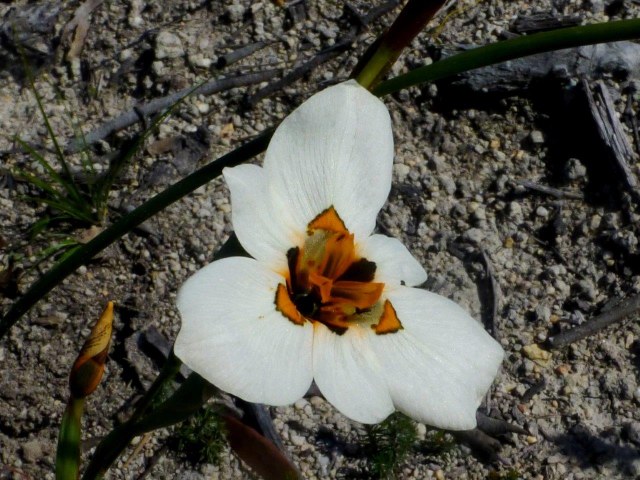
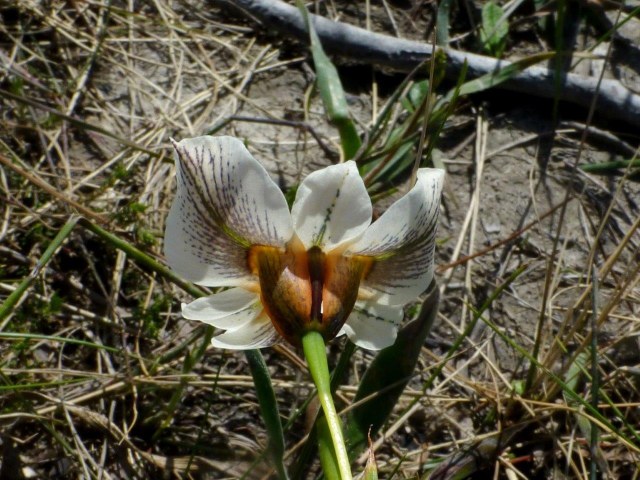
Moraea cantharophila Goldblatt & J.C.Manning is found in well drained rocky granitic, sandstone and shale slopes in fynbos in the Southwestern Cape winter rainfall area from Sir Lowry's Pass to Sandy's Glen. Part of the subgenus Vieusseuxia, this species flowers best after a fire. It is unusual with relatively large inner tepals with a brown median streak at the claw. The flowers are white or cream with outer tepals darkly veined with yellow at the base, style branches brownish with salmon edges, crests salmon. This species is most closely related to Moraea lurida and it differs by a shallower floral cup and unscented nectarless flowers. Photos were taken September 2016 near Sandy's Glen by Cameron McMaster.
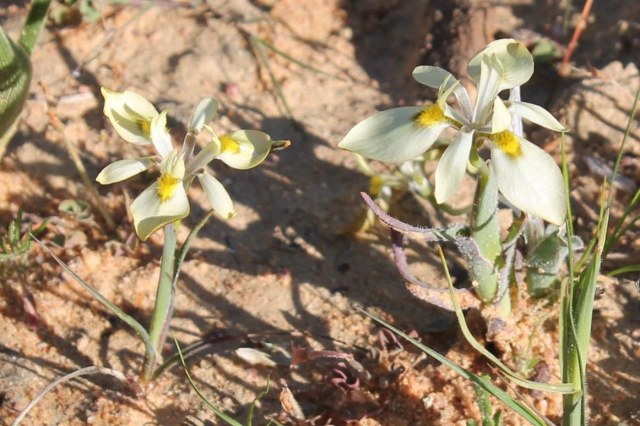
Moraea ciliata (L.f.) Ker Gawl. grows on sandy and clay slopes in the winter rainfall areas. The stemless plants are rarely more than 10 cm tall with furrowed hairy leaves or at least some hairs on the leaf margins. Flowers are enclosed in large, lightly hairy spathes and can be blue, yellow or white with a yellow nectar guide. Height: to about 10 cm. Flowering is from late winter to spring (July to September) with each flower lasting a single day, opening soon after dawn and closing in the evening. There are three recognized subspecies: Moraea ciliata ssp. ciliata with blue and occasionally white flowers, Moraea ciliata ssp. cuprina Goldblatt & J.C.Manning (found along coastal Namaqualand, and Moraea ciliata ssp. lutescens Goldblatt & J.C.Manning. The latter subspecies ranges from the Gifberg, (possibly also the Knersvlakte) through to the Cederberg, and down to the Olifants River Valley and as far south as near Goudini. It occurs in both stony sandstone and clay soils. The photo of it was taken by Margaret Fox in the Western Cape.
The first three photos below were taken by Mary Sue Ittner who has found this species rarely blooms for her. The second photo shows a year when several flowers were open at once and the third the back of a blue flower. The fourth was taken by Michael Mace. The last two by Bob Werra, illustrate how hairy the foliage on this one can be.
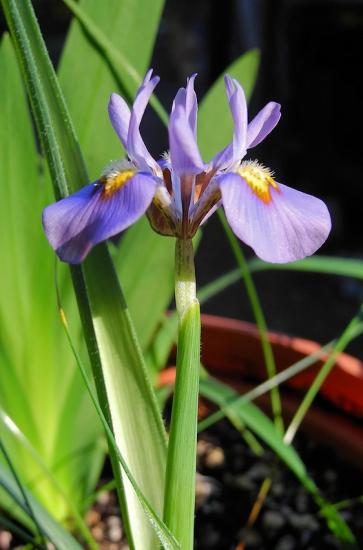
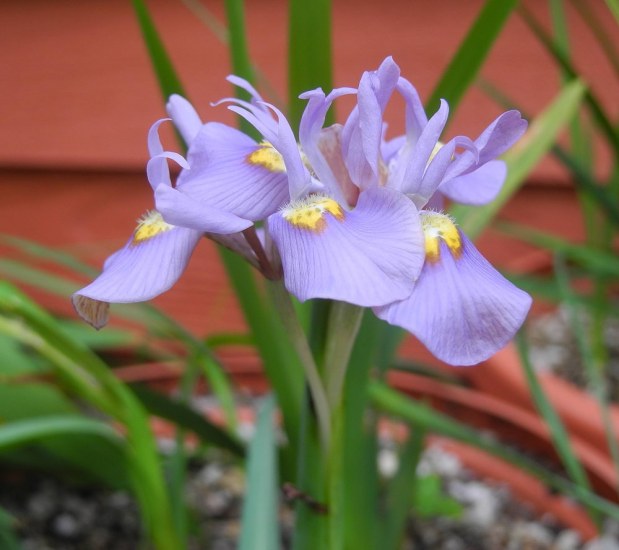
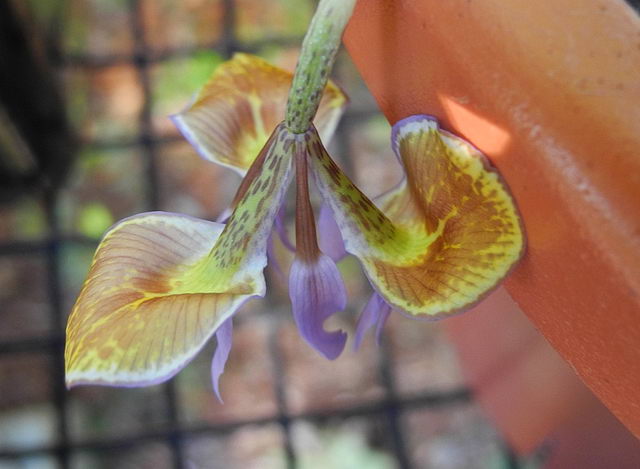
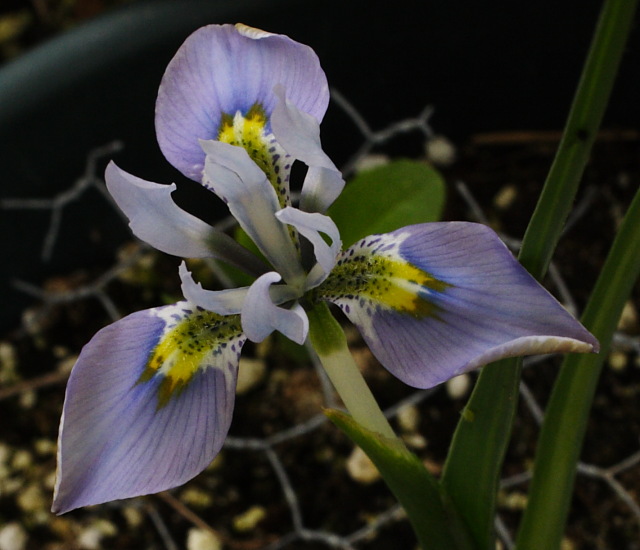
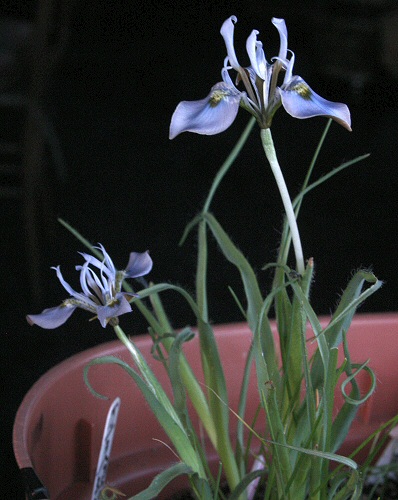
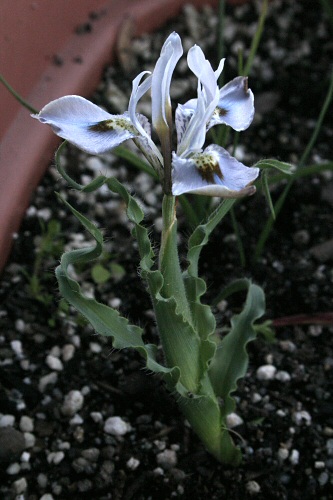
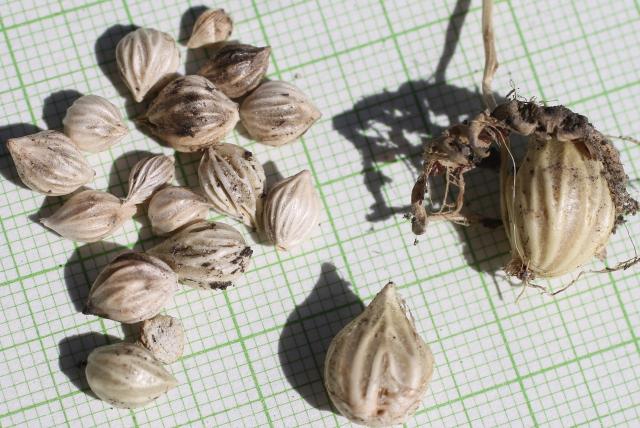
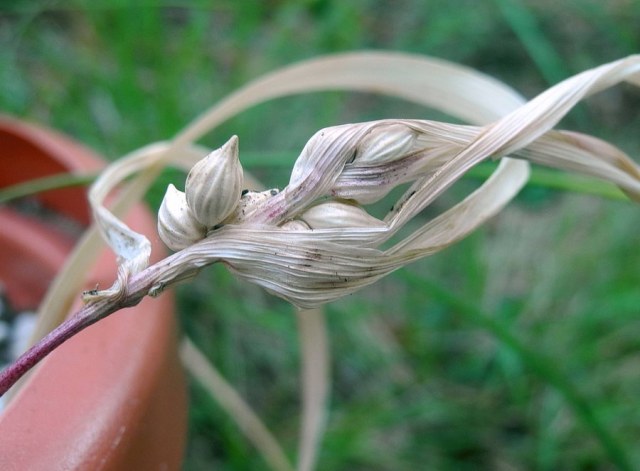
The first photo by Bob Rutemoeller is of a white flowered form in Alan Horstmann's collection. The next two by M. Gastil-Buhl show the first of at least four flowers to emerge from the single 4.5 cm tall spathe and the two corms and 15 cormlets in the second photo on a 1 mm grid, all from that one plant. The last photo from Mary Sue Ittner shows the cormlets in the drying leaves.
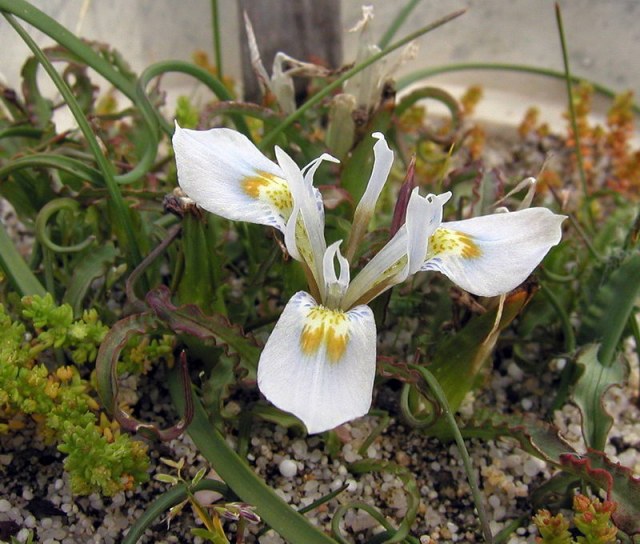
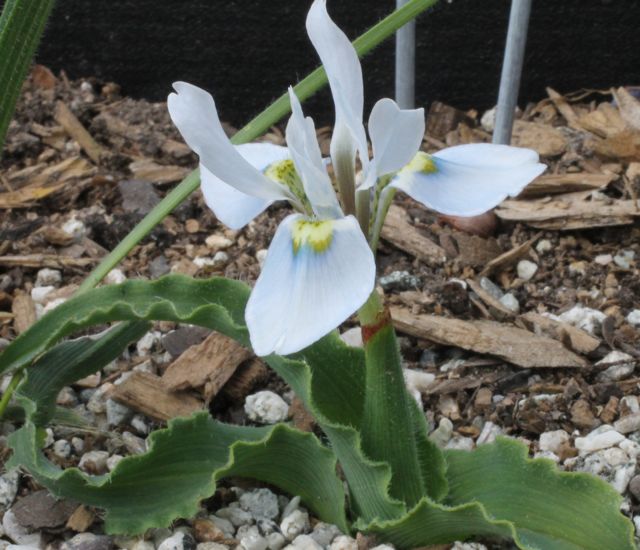
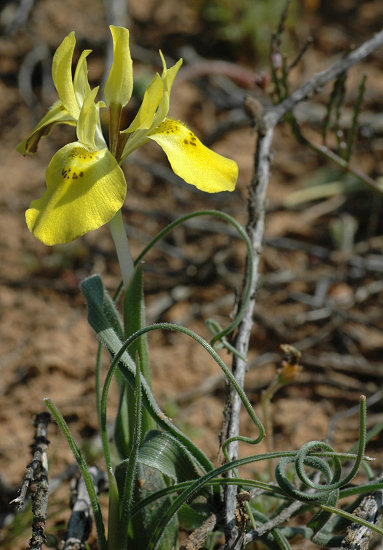
Three photos taken by Bob Rutemoeller near Middelpos in the Roggeveld September 2006 show variations in color and leaves. A fourth by Mary Sue Ittner is of a yellow form photographed at the same time and place. A fifth and sixth were taken in Sutherland and Middelpos also in the Roggeveld by Cameron McMaster.

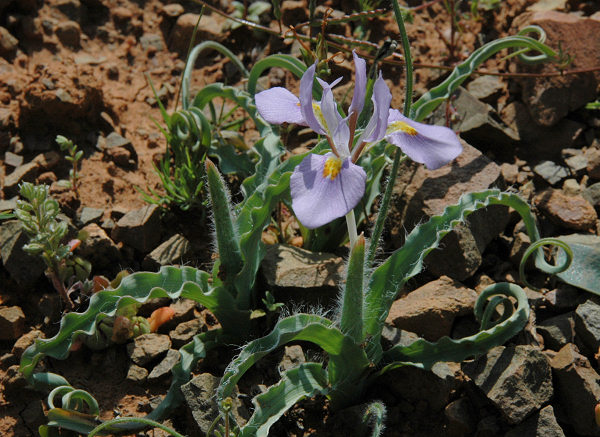
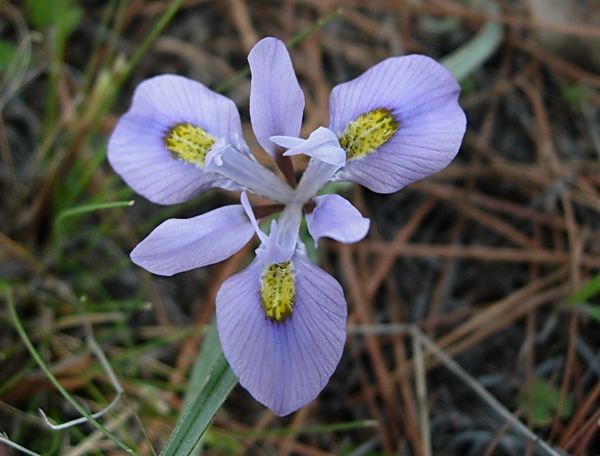
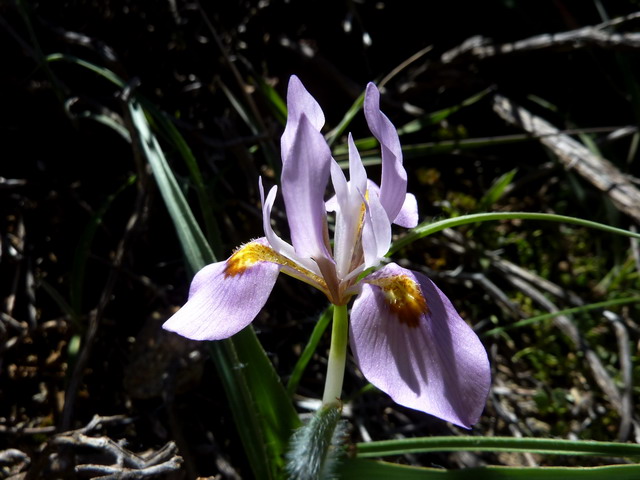
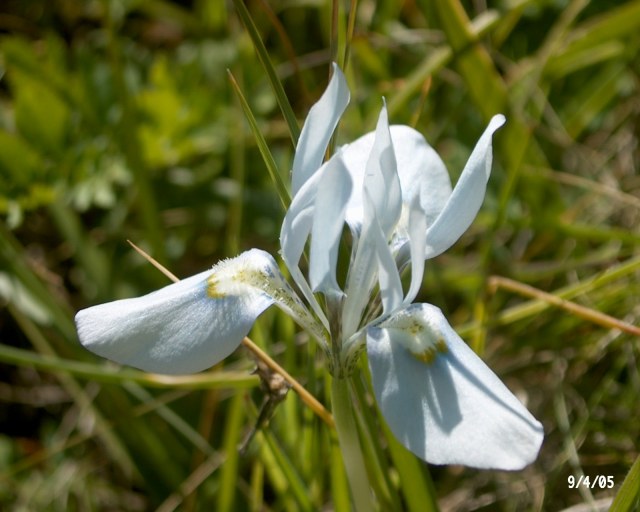
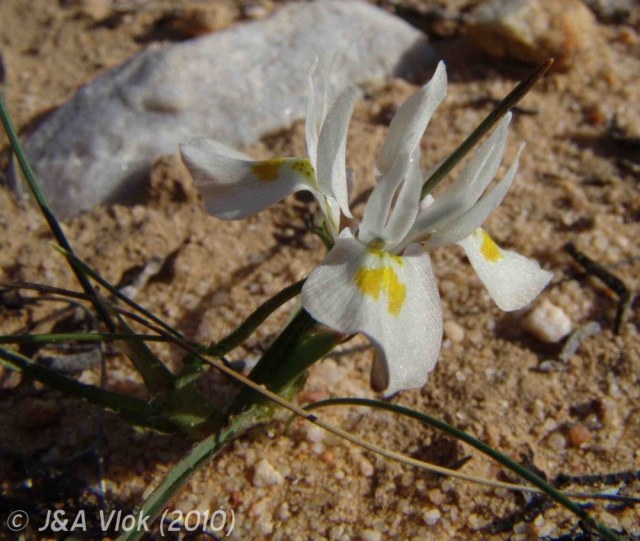
Photos below are of white flowers. The first was taken near Napier by Cameron McMaster in the Overberg. The second is from the book Plants of the Klein Karoo courtesy of Jan and Anne Lise Schutte-Vlok.
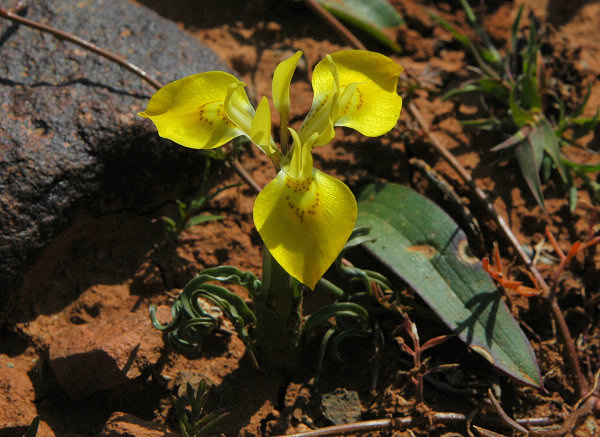
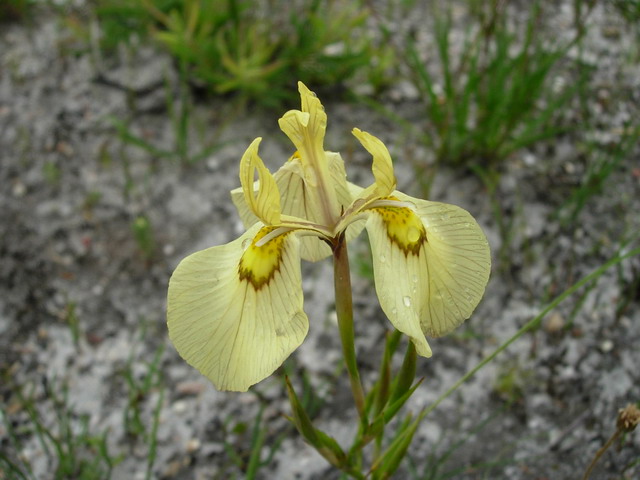
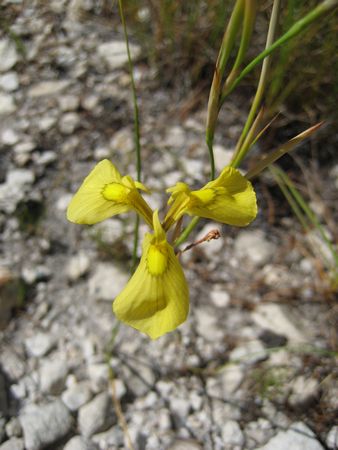
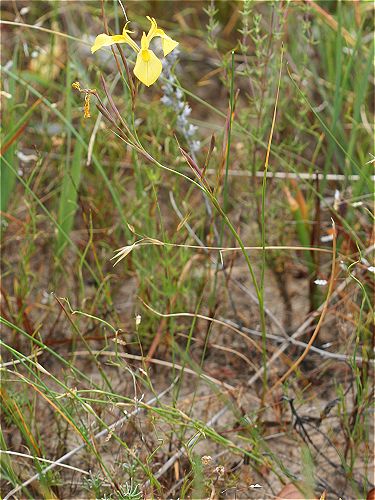
Moraea cooperi Baker is a rare plant found on rocky sandstone slopes and flats, often near water, in the Southwestern and Northwestern Cape. It has large yellow flowers delicately purple-veined with only three tepals united in a well developed tube. It flowers in spring. Height: to about 25 cm. The first photo was taken by Cameron McMaster in the Overberg and the second by Rod Saunders. Photos three and four were taken between Bainskloof and Breerivier in the Western Cape by Andrew Harvie.
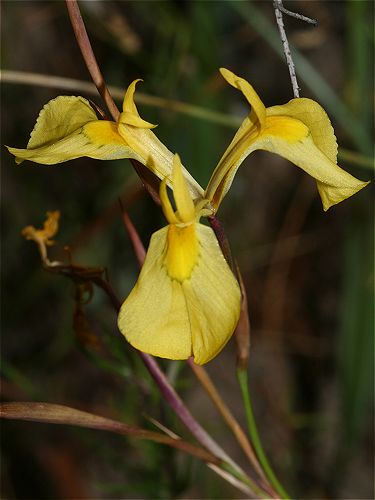
Moraea crispa Ker is found in the Karoo and interior Cape mountains on clay or sandy flats and slopes. The first photo is from Bob Werra who wrote: "It has a single leaf and blue-mauve flowers a little larger than a US quarter with yellow to orange nectar guides. The flowers are unusual, looking like a pinwheel. They lack the paired erect crests found in many moraeas. The flowers open late afternoon and only last a day, but the plant continues to send up new blooms for two weeks. Height: about 20 cm. I started with three 15 yrs. ago and have only one left. However, it has bloomed alone for the past 10 yrs. neglected, without fertilizer. It hasn't produced additional corms as so many other species do." The next two photos were taken in the Roggeveld by Andrew Harvie. The fourth photo is from Rod Saunders. The corm photo was taken by Michael Mace.
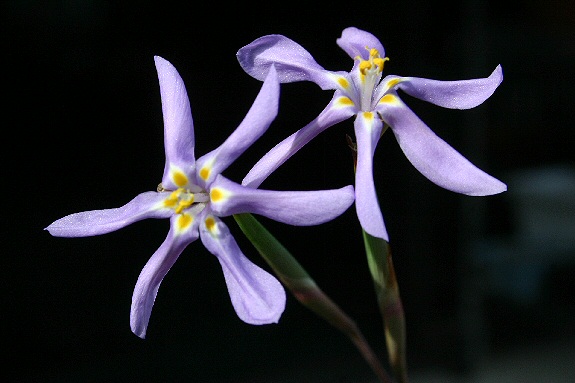
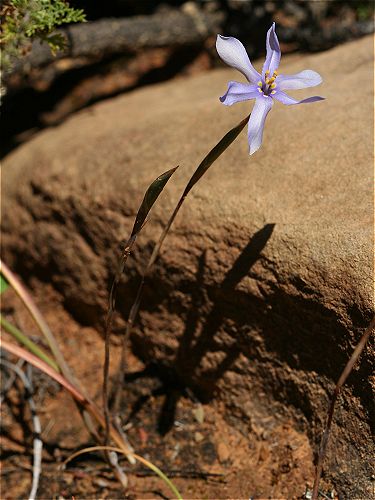
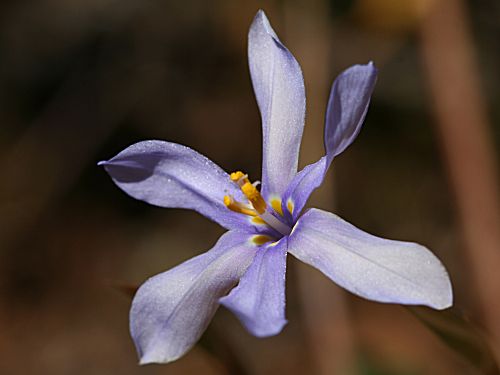
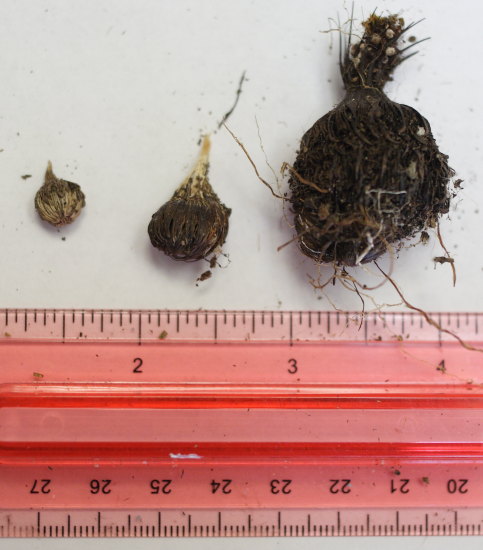
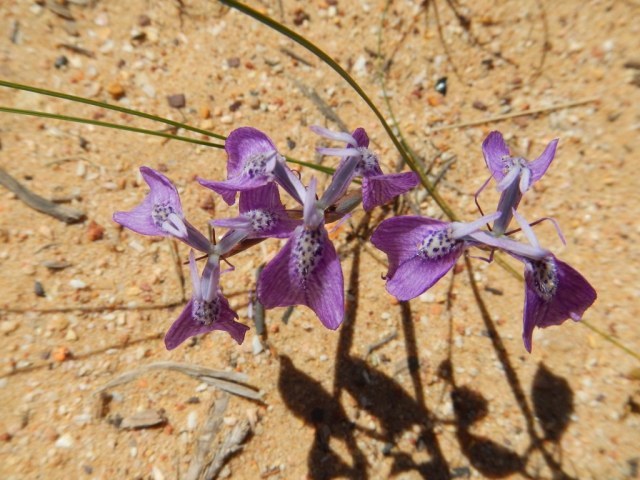
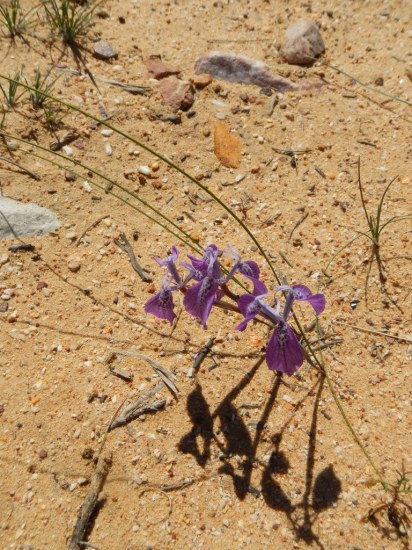
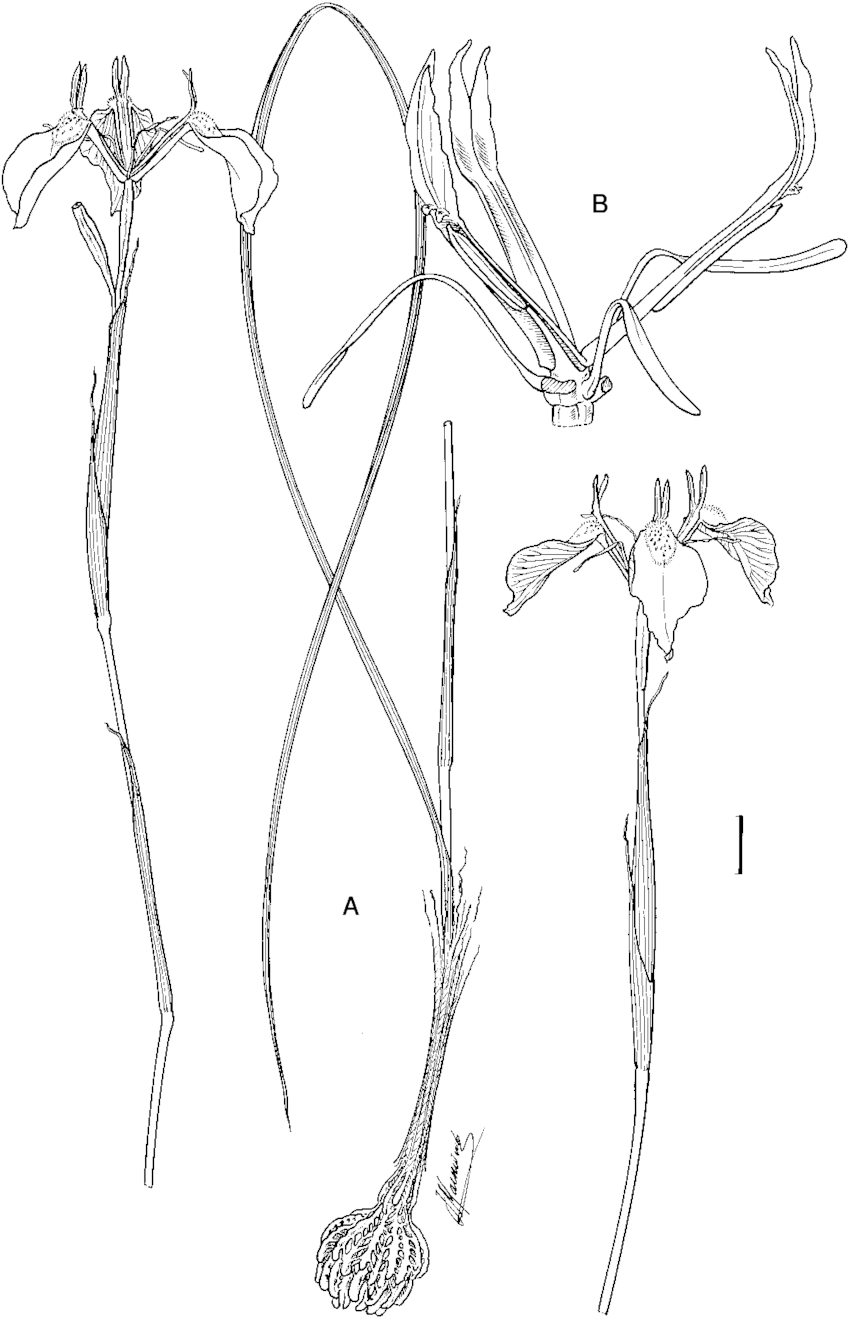
Moraea cuspidata Goldblatt & J.C.Manning is part of the Moraea tripetela complex. Information about it has been taken from the Goldblatt, Manning article describing the complex. It is named for its long, cusp-like inner tepals. It is an inland species from semi-arid mountain areas where it grows in sandy soils in both mountain renosterveld and dry marginal fynbos. It has a narrow foliage leaf and dark corms and pale blue, mauve, or violet flowers with large white fuzzy nectar guides spotted with dark blue on a white background. The inner tepals are linear (thicker than a thread, but straight-sided) and usually over 10 mm long. The dark purple anthers bear red pollen. Height range: 18-30 cm. It flowers mid-September to late October. Photos from iNaturalist taken by Dave U in the Central Karoo in September and kevinjolliffe in the Cape Winelands in September and shared under a CC BY-NC license. Drawing by John Manning shared with his permission from the paper referenced above. Figure notes: A, flowering stems and corm; B, inner perianth whorl plus filaments and style. Scale bar: A, 10 mm; B, 2 mm
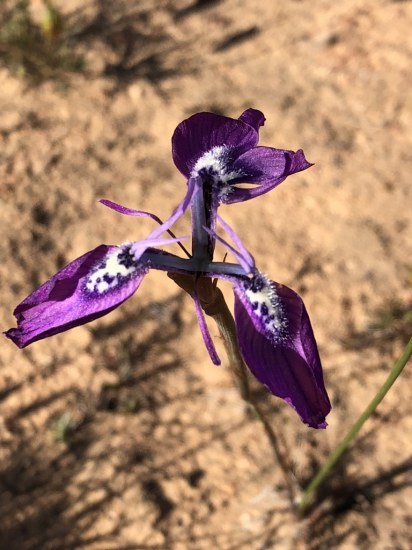
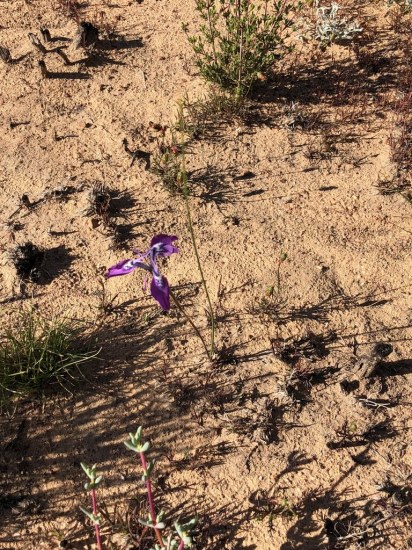
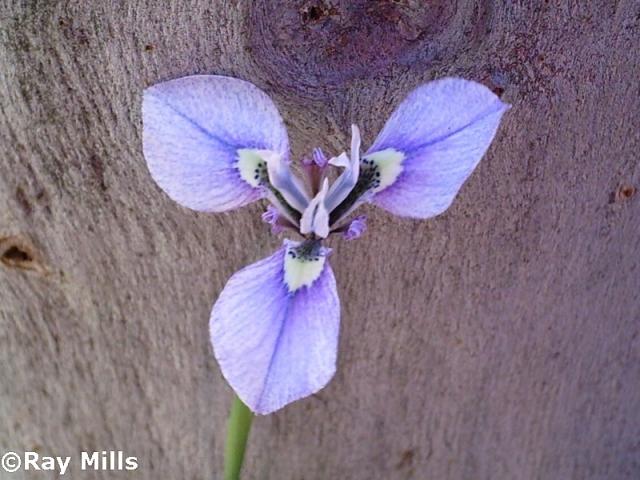
Moraea debilis Goldblatt is a winter-growing species with small purple flowers marked with a white nectar guide. It grows in the Caledon area and blooms in late spring (September to October in South Africa). It is probably related to M. tripetala. The first photo by Ray Mills, courtesy of the Species Iris Group of North America. The next two photos from iNaturalist were taken by Tony Rebelo in the Western Cape in December and shared under a CC BY-SA license.
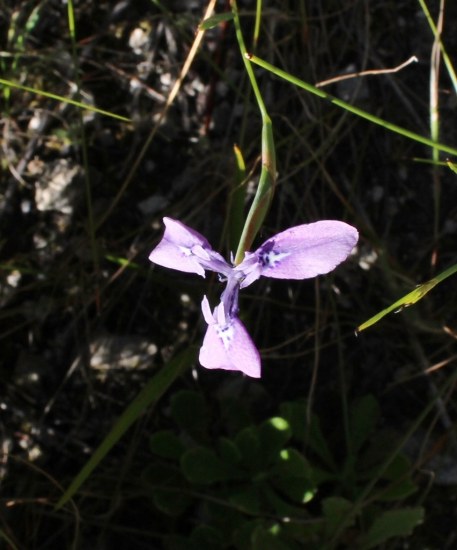
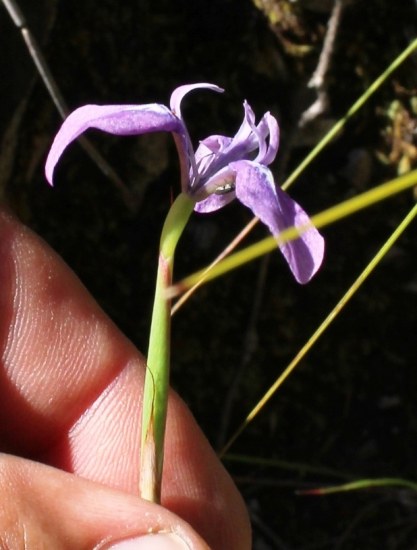
Moraea decipiens Goldblatt & J.C.Manning is part of the Moraea tripetela complex. Information about it has been taken from the Goldblatt, Manning article. It is from the western half of the Piketberg in the Western Cape where it occurs on stony sandstone slopes. It occurs at lower elevations than Moraea tripetala and flowers earlier, late October to November. Growing from 30 to 45 cm, it has pale to deep purple flowers with a white wedge-shaped nectar guide and a dark violet stripe above it. It differs in having the inner tepal claws 7–9 mm long and widening in the middle so it almost divides into three points, often with a twisted central lobe. Pollen is orange-red.
Moraea deltoidea Goldblatt & J.C.Manning grows in the winter near Hermanus on south-facing sandstone slopes, flowering after fires. It is probably related to Moraea unguiculata. Flowers are pale cream with dark speckles on the outer tepal. Photos from iNaturalist were taken by Liz Hutton at Fernkloof Nature Reserve and in the Overberg in November and early December and shared under a CC BY-NC license.
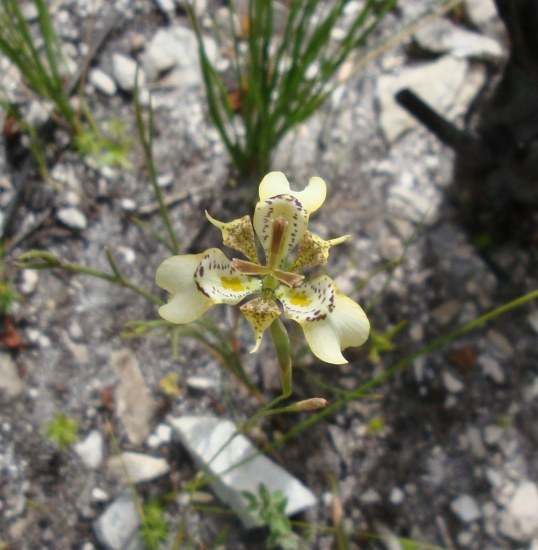
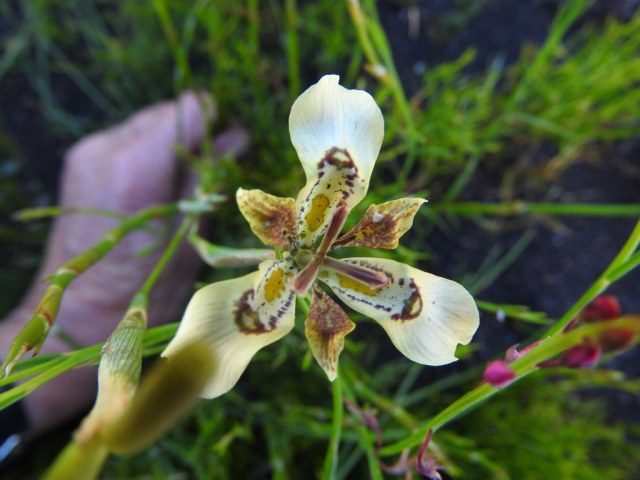
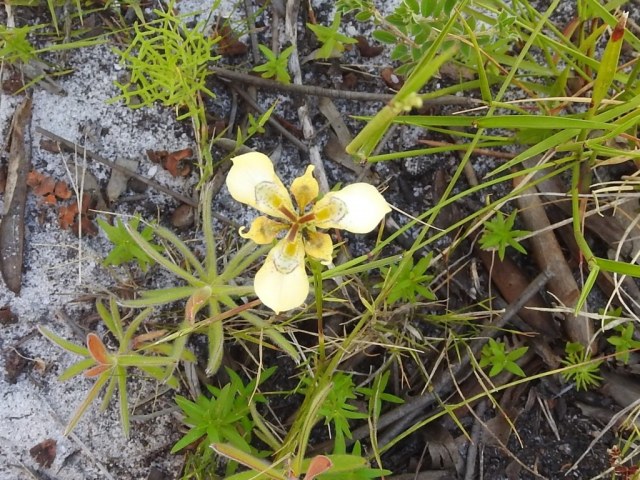
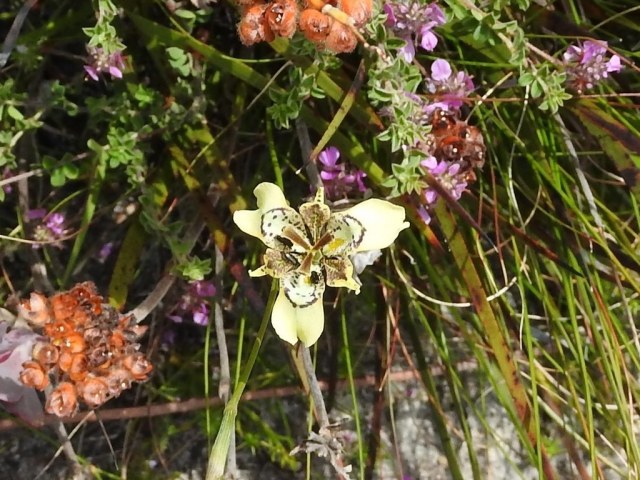
Moraea deserticola Goldblatt grows in stony, quartz covered slopes and flats in succulent karoo shrubland in the Western Cape. Photographs were taken north of Vanrhynsdorp in August by Alan Horstmann.
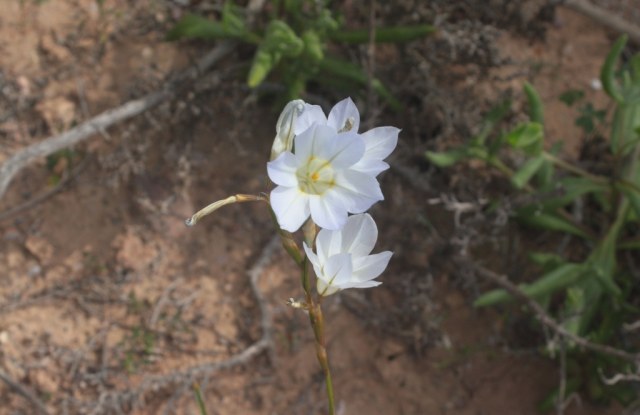
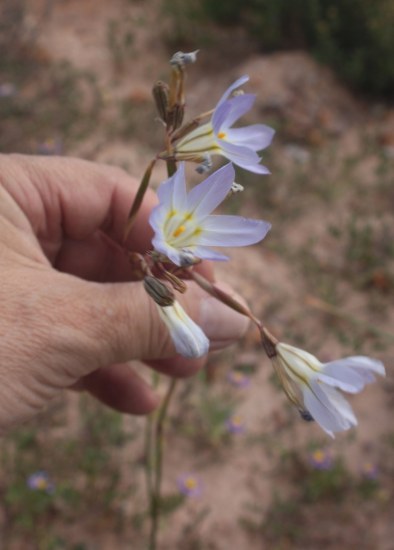
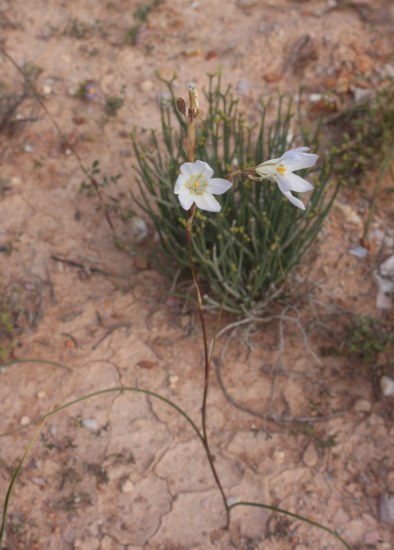
Moraea dracomontana Goldblatt is a summer-growing species native to the Drakensberg Mountains near Witsieshoek. It has bluish-purple flowers with yellow nectar guides. This species is related to Moraea modesta, but grows in damper sites. Photos from iNaturalist were taken by Brendan Cole in November and December in the Drakensberg and shared under a CC BY-NC-ND license.
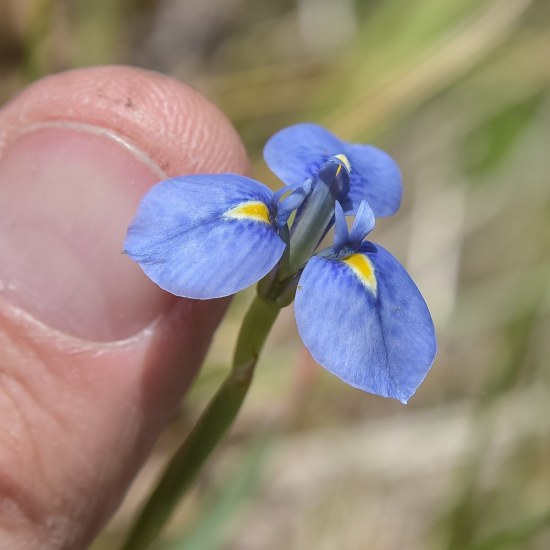
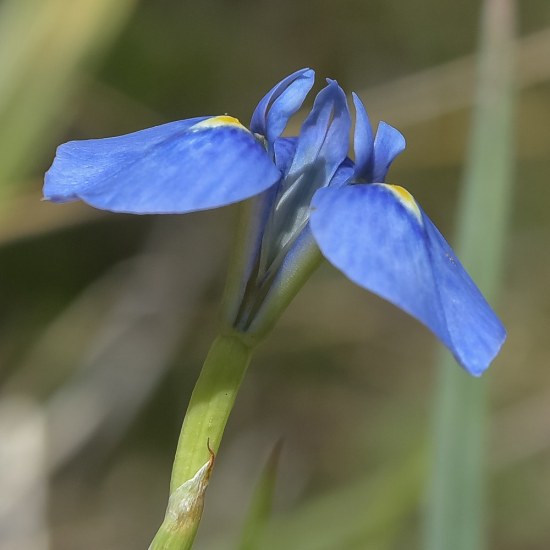
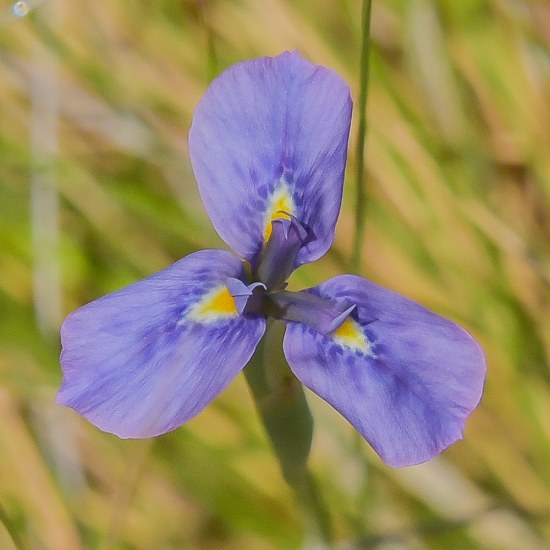
Moraea elliotii Baker is found on grassy sandstone slopes from Mossel Bay to Malawi. It has a single leaf and blue-violet flowers with yellow nectar guides. It flowers in spring. It sometimes has been confused in cultivation with Moraea setifolia. The first two photos were taken by Cameron McMaster. The next four photos were taken by Bob Rutemoeller and Cameron McMaster at Gaika's Kop, January 2010. This area had burned previously.
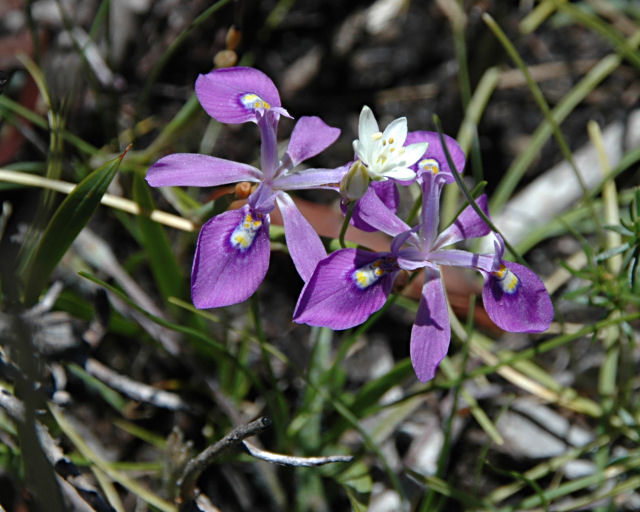
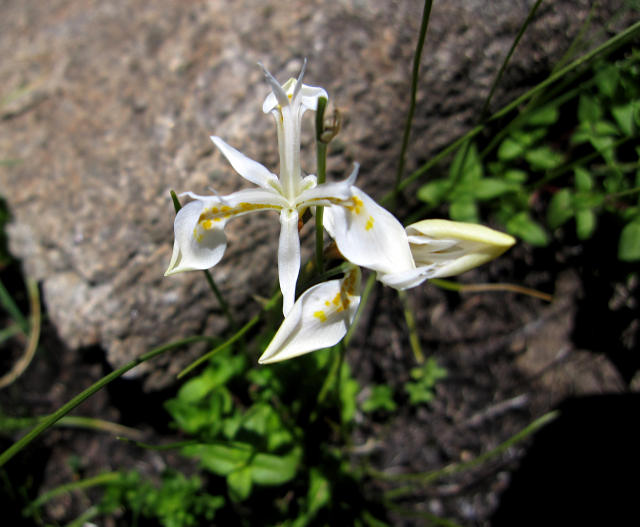
Moraea elsiae Goldblatt is a small plant native to the Cape area, where it grows on sandy lowland flats. Although it was collected from numerous sites in the past, most of the locations have now been built on or converted to farmland. There is speculation that M. elsiae probably grows today in fewer than 10 locations, and it has been classified as a vulnerable species. The plant has a distinctive branching pattern, sticky stems, brown tips to its spathes, and the flowers lack the style crests found in most Moraea species. Flowers open at midday and close at dusk. When grown in California, this species does most of its growing in spring, and blooms in early to mid-summer (June to July). This makes it one of the latest bloomers of the winter-growing Moraeas. If you grow it in pots, you should probably plan to water it longer into summer than most other Mediterranean-climate bulbs. The first four photos from iNaturalist were taken by Nick Helme in November and December on the Cape Peninsula and shared under a CC BY-SA license. The last two were taken by Michael Mace.
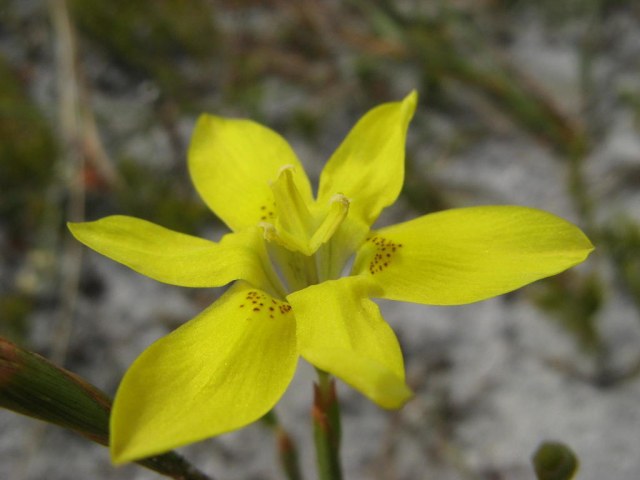
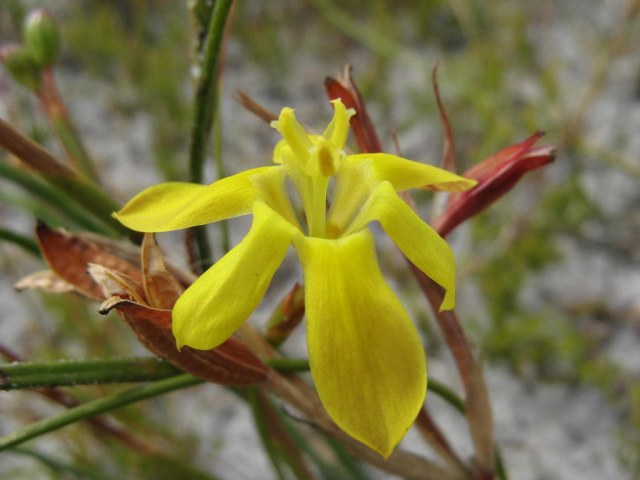
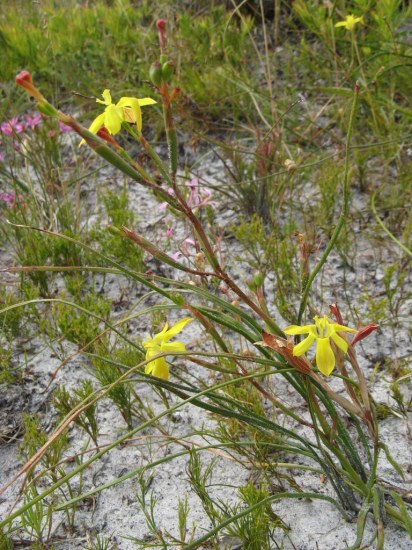
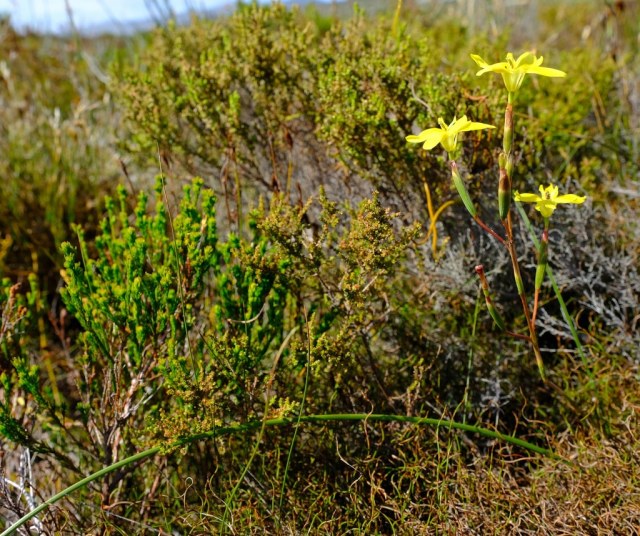
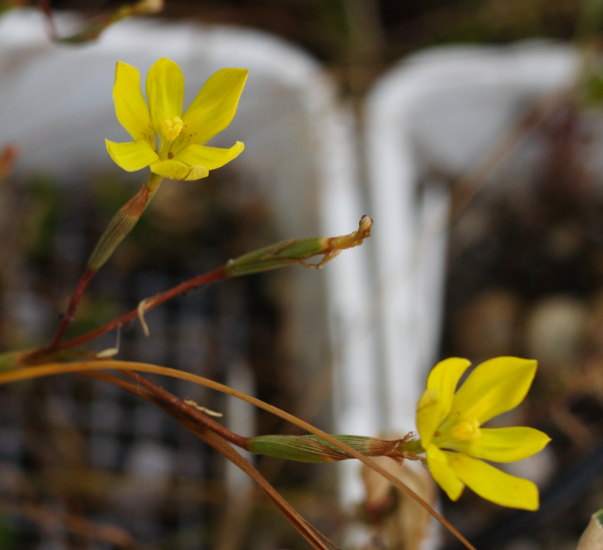
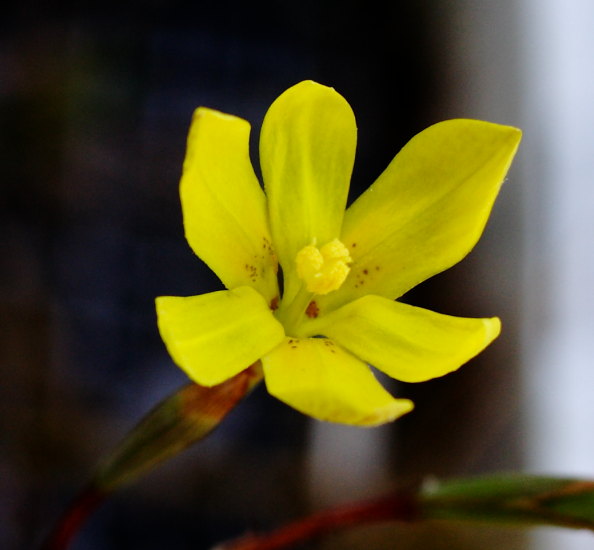
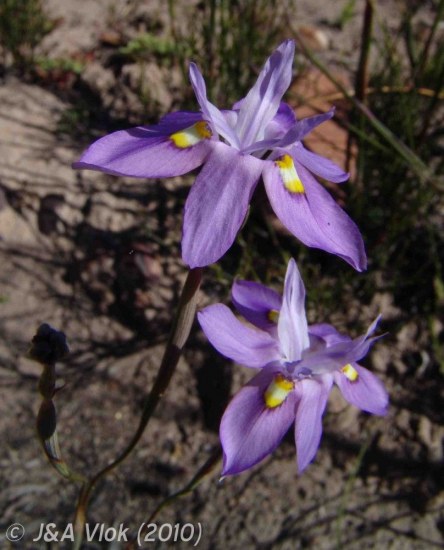
Moraea exiliflora Goldblatt is rare and endemic to the Little Karoo. It flowers in spring and occurs sporadically in fynbos and renosterveld. From 15 to 25 cm high, this species has a single linear channeled leaf and blue mauve flowers with yellow and white nectar guides. The photo below from the book Plants of the Klein Karoo courtesy of J and A Vlok.
Galaxia - Gynandriris - Hexaglottis - Homeria a-j - Homeria k-z - The other species in the Moraea group are listed alphabetically on these wiki pages: Moraea group a - Moraea group b - Moraea group f - Moraea group g-i - Moraea group j-m - Moraea group n-r - Moraea group s - Moraea group t - Moraea group u-v - Moraea hybrids - Moraea index