There are more than 200 species of Oxalis in South Africa and 270 varieties and probably many new species as well. The only handbook on the Southern African species, by Salter, is almost sixty years old and out of print so there are many challenges in identifying them. Cape Plants, a conspectus of the Cape flora of South Africa by Peter Goldblatt and John Manning lists 118 in the Cape Floral Kingdom but there is only a brief botanical description, location sometimes with habitat information, and time of bloom in this book.
South African species f-g are found on this wiki page.
[Oxalis | Oxalis index]] - Miscellaneous Oxalis - Oxalis flava - Oxalis hirta - Oxalis obtusa - Oxalis pes-caprae - Oxalis purpurea - oxalis storage organs - South African oxalis a-b - South African oxalis c -South African oxalis d-e - South African oxalis h-k - South African oxalis L-M - South African oxalis n-o - South African oxalis p - South African oxalis r-s - South African oxalis t-z - South American oxalis
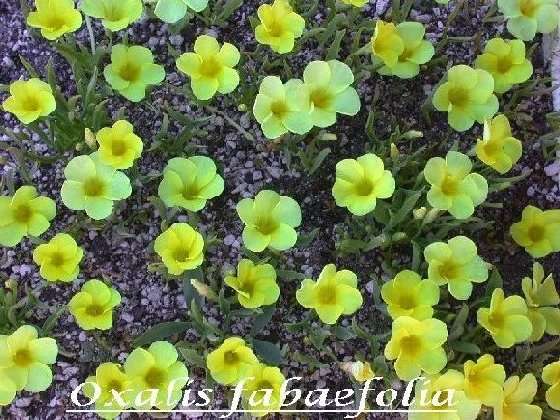
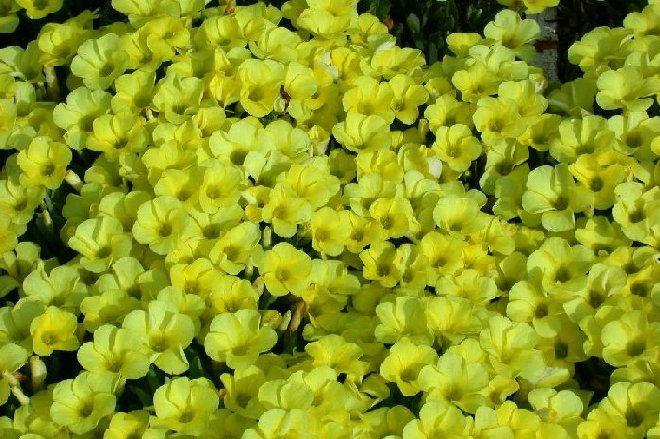
Oxalis fabifolia Jacq. is a species with a number of synonyms, O. asinina Jacq., and O. crispa Jacq. It has previously been spelled Oxalis fabaefolia. Height: about 8 cm. In his doctorate K.C. Oberlander (2009, pages 174-202) (also to be published in South African Journal of Botany) showed that morphological and molecular data place what was then spelled O. fabaefolia strongly within the Oxalis flava species group, and thus proposed that Oxalis fabaefolia should be considered as a variety of O. flava as Oxalis flava var. fabaefolia (Jacq.) Dreyer & Oberl. Kew is now agreeing with this designation, but the spelling has changed in 2026 to Oxalis flava var. fabifolia (Jacq.) Dreyer & Oberl.
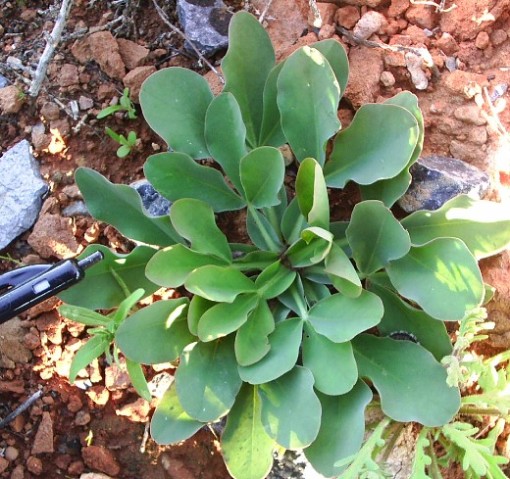
Plants sometimes called O. namaquana are really O. fabifolia. The leaflets of O. fabifolia can be rather broad and have "wings", whereas the leaflets of O. namaquana tend to be narrow. Photos 1-2 were taken by Bill Dijk. Photo 3 taken by Christiaan van Schalkwyk shows this species in habitat from a colony outside Vanrhynsdorp. This is a three leaflet form with broad petiolate wings. In this colony the flowers' colour included all the possibilities for this species: yellow, white and mauve. The photo was taken after flowering and after a very good rainfall season, both adding to the large size of this plant.
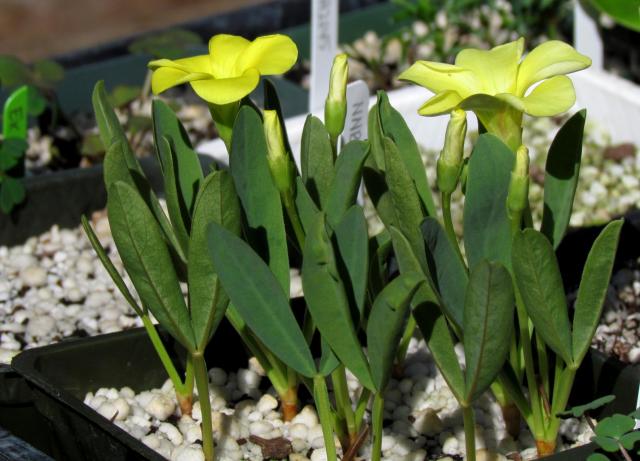
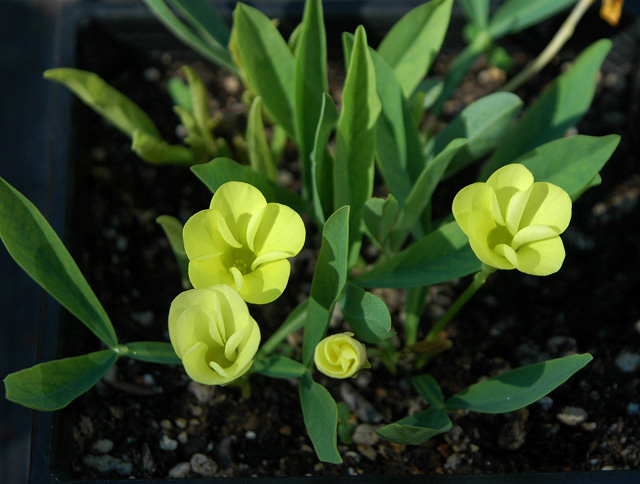
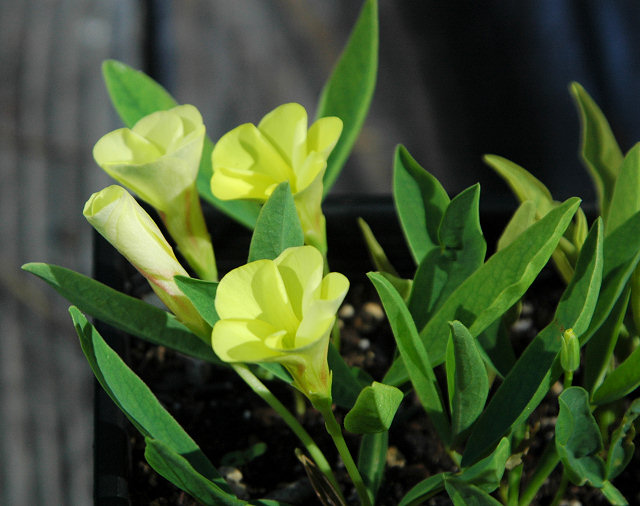
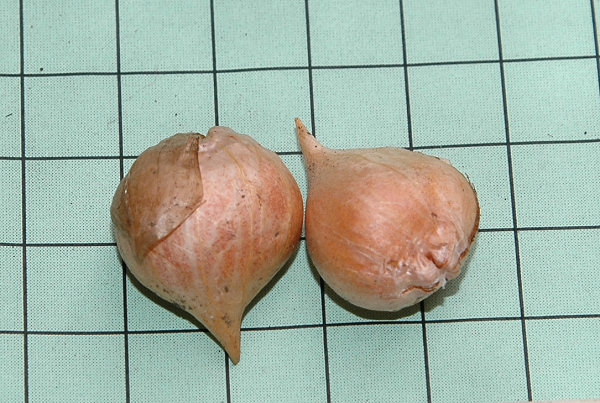
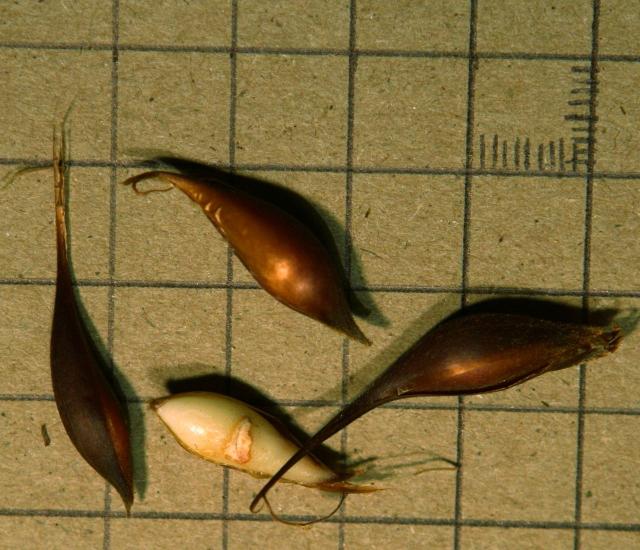
The photos below shows a form with narrow 2-leaflets leaves. Photos 1-2 were taken by Nhu Nguyen. Photos 3-5 were taken by Mary Sue Ittner. Photo 5 shows the bulbs on a 1 cm grid.
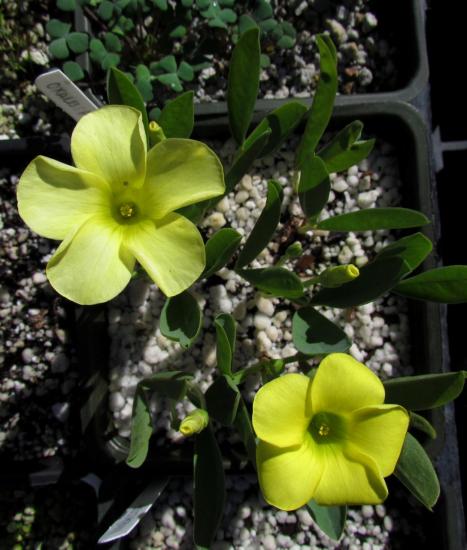
Oxalis flava L. is a fall blooming South African species-complex with solitary yellow, white or pink flowers found on sandy flats from Namaqualand southwards to the Cape Peninsula and eastwards to Riverdale. For more information and photos see the Oxalis flava page.
Representative photos from Mary Sue Ittner, Bob Rutemoeller, and Christiaan van Schalkwyk are shown below.

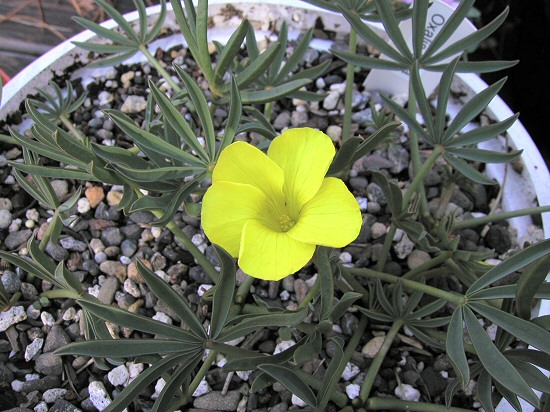
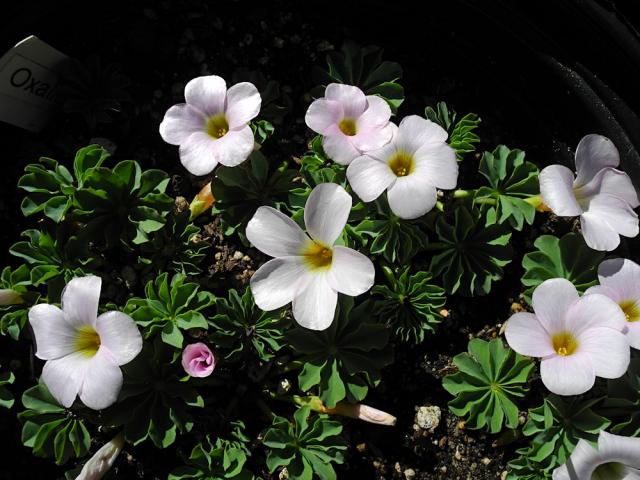

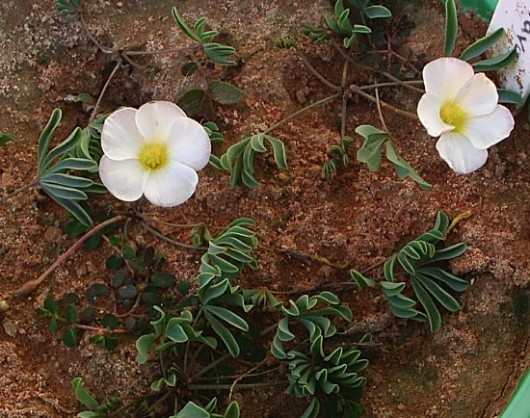
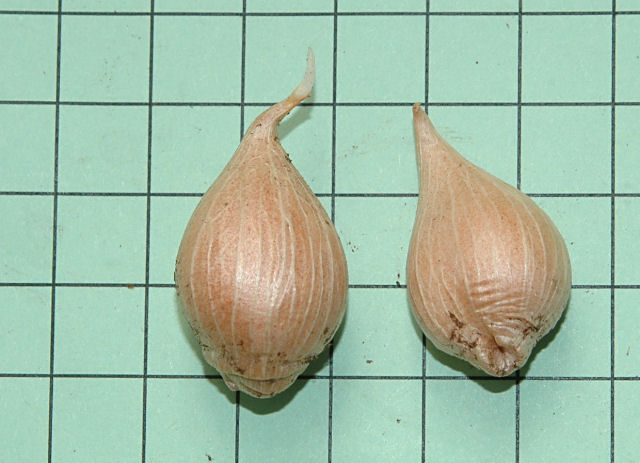
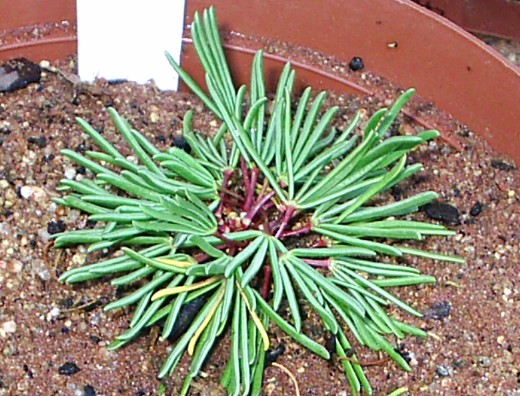
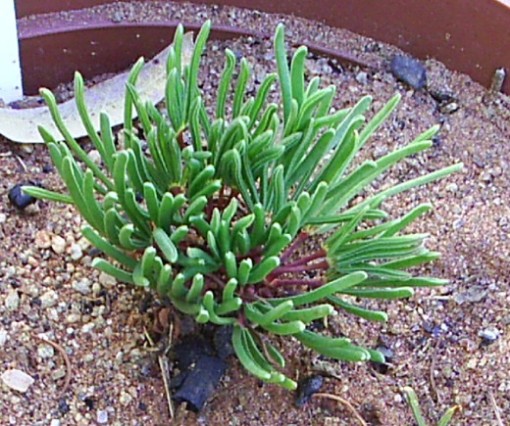
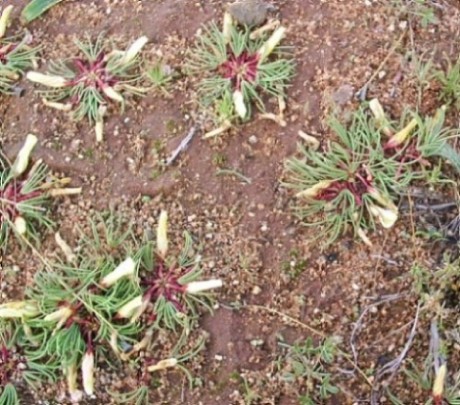
Oxalis flaviuscula T.M.Salter is a species found in the Northern Cape. The description below from a knowledgeable oxalis grower from the area lists a variety that is not recognized by Kew and is not found in IPNI. He wrote: "var. longifolia and the type variety are found in and around Steinkopf, Springbok and Kamieskroon in very hard clay soil. Var. flaviuscula occurs more in the north and west, while the south and eastern areas harbour the var. longifolia. The difference between the two varieties are the size (larger in var. longifolia) and the red colour of the petioles in var. longifolia. The flowers are yellow and typical of the section Crassulae (which includes species like O. flava, O. fabaefolia and O. namaquana). The first two pictures are from the same plant, the first taken in the morning, the second taken at noon, showing the folding of the leaves to conserve water during the day, and opening up at night to collect moisture. Similar leaf folding takes place in many other species. Photos by Christiaan van Schalkwyk.
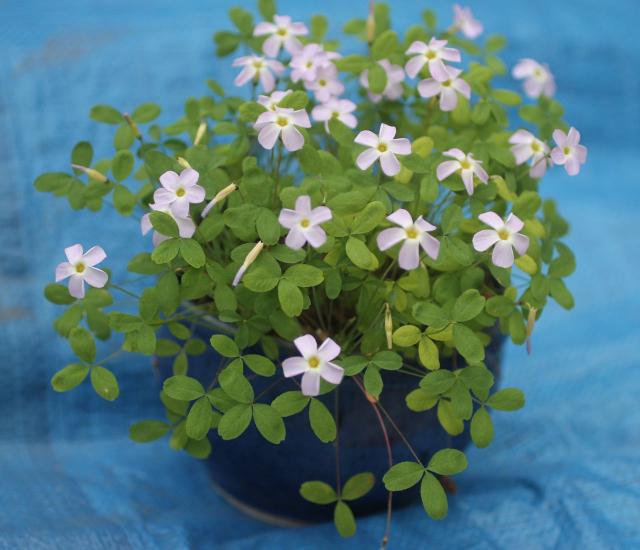
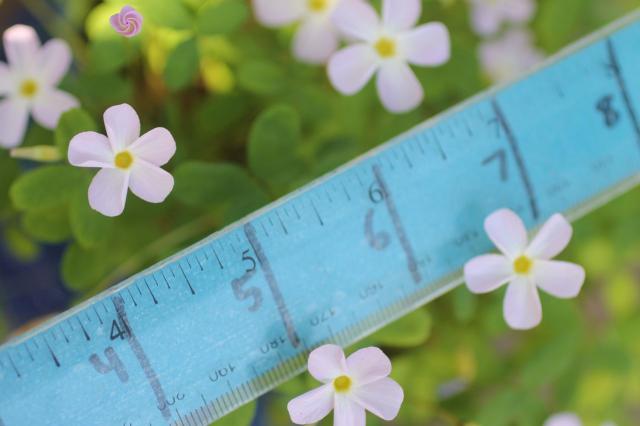
Oxalis fragrans Tod. This is what the Latin would translate as "a naked name". It is a manuscript name used by Dr. L. Dreyer in her thesis, and has not been validly described. It was attributed to a species collected in the Karoo, fragrant and night blooming. It is supposed to belong to the section Pardales. Plants seen and grown by me as Oxalis fragrans do not belong to this section, and are therefore not this species, even though it is fragrant and night blooming. Unfortunately at this stage I can offer no definite identification. If anyone has info. as to where it originated, I’ll appreciate it. Apparently Michael Vassar received it from B.M., but thus far I'm unable to trace it. It might be an undescribed species, but without the locality data it is worthless. The first photo of this misnamed plant is by Christiaan van Schalkwyk. Photos 2-4 by M. Gastil-Buhl show bulbs on a 1 cm grid from Telos Rare Bulbs and the first year's flowers blooming in a 6 inch pot, late afternoon and early evening. These grow well crowded and doubled in number the second year. The fragrance is subtle and sweet.
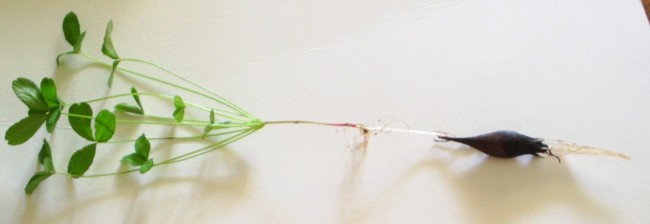
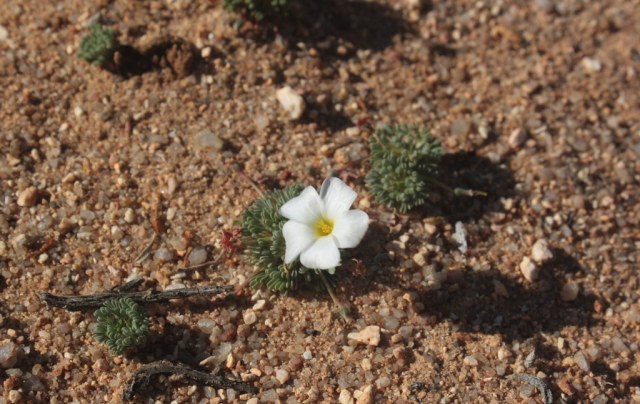
Oxalis furcillata T.M.Salter is a short species found in Namaqualand. Leaves are hairy and the 1 flower per stem is white with a yellow throat. Height: about 8 cm. Flowering is June to July. Photos from Alan Horstmann taken near Concordia, photographed in July.

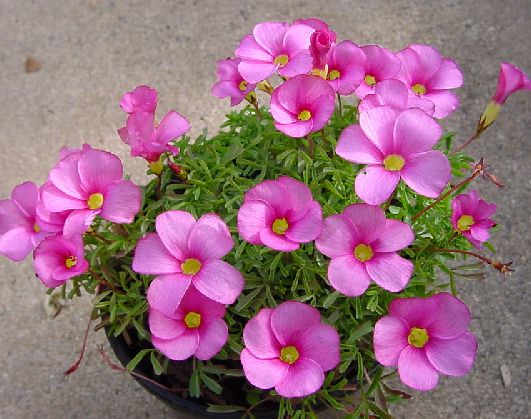
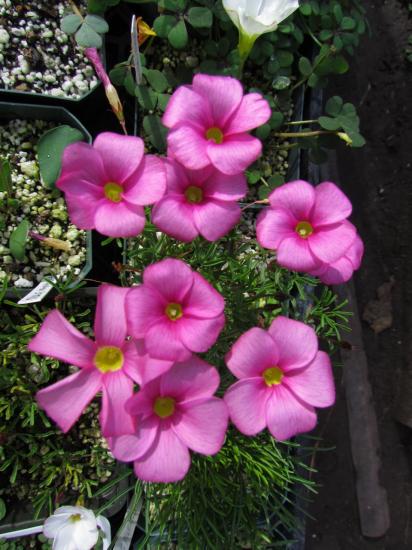
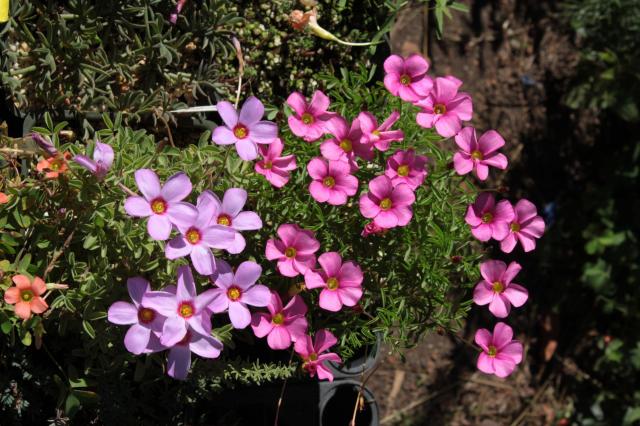
Oxalis glabra Meisn. ex Sond. produces tiny bulbs, but a great number of them very quickly. According to Kew the name is a synonym of Oxalis versicolor L.. These small bulbs sprout into large plants that produce wonderfully large and showy flowers. Height range: 5-20 cm. Caution may be required when growing this plant as it has the potential to escape. It flowers in autumn. Photos below from Mary Sue Ittner. The first one shows what most of us have been growing as Oxali glabra (the pink flower) coming up in a pot of Oxalis versicolor. The latter was never as invasive as the former has been.

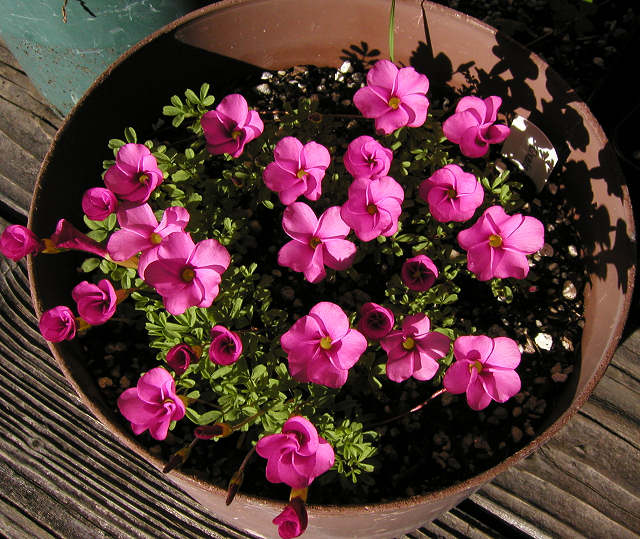
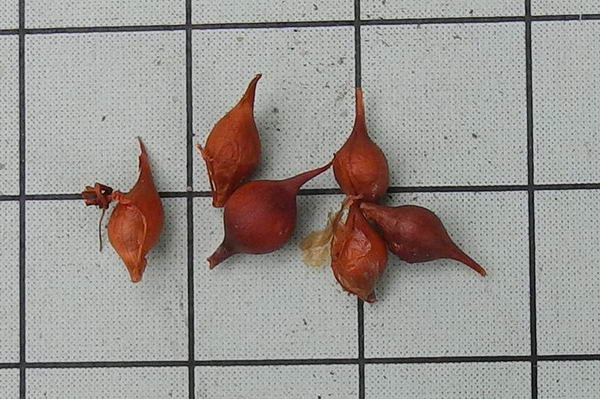
Photo 1 by Lyn Edwards, photo 2 by Bill Dijk, and photos 3-4 by Nhu Nguyen. Photo 4 shows this plant next to Oxalis callosa.
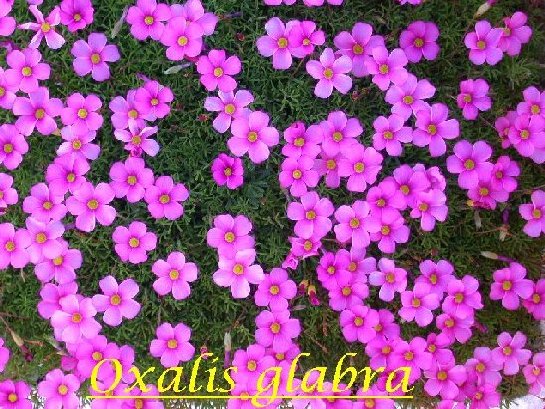
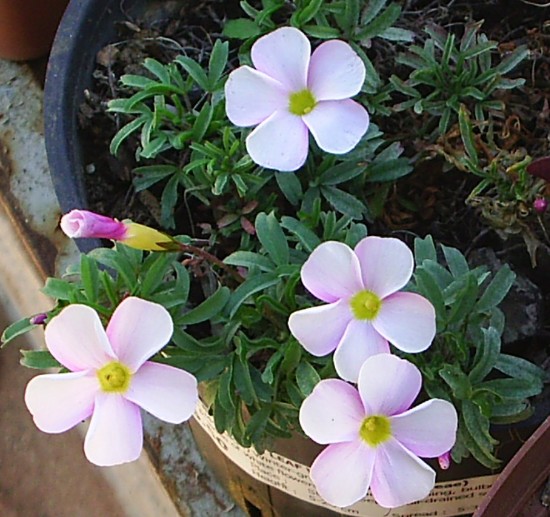
Oxalis glabra white. These plants were obtained from Kirstenbosch National Botanical Garden, sometimes showing a tinge of pink. Photo by Christiaan van Schalkwyk.
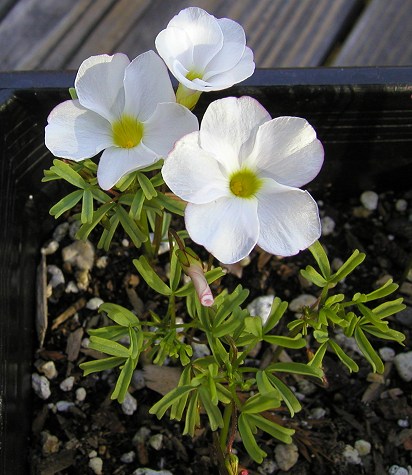
Oxalis goniorhiza Eckl. & Zeyh. is a winter blooming species usually found in damp marshy places. It has white flowers with reddish-purple margins. Height: 20 cm. These photos taken by Mary Sue Ittner are of bulbs purchased from Telos Rare Bulbs blooming January 2004.
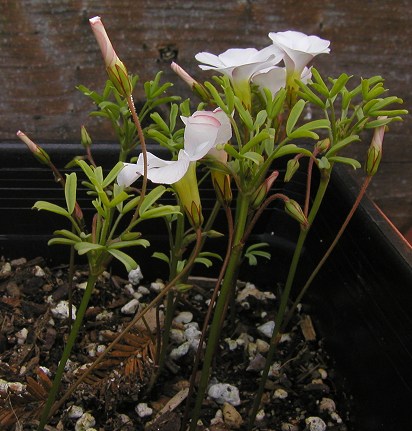
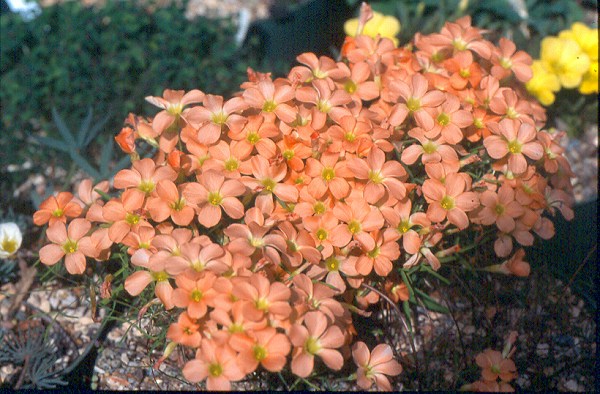
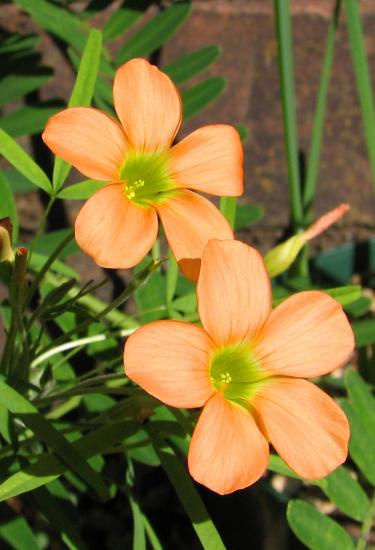
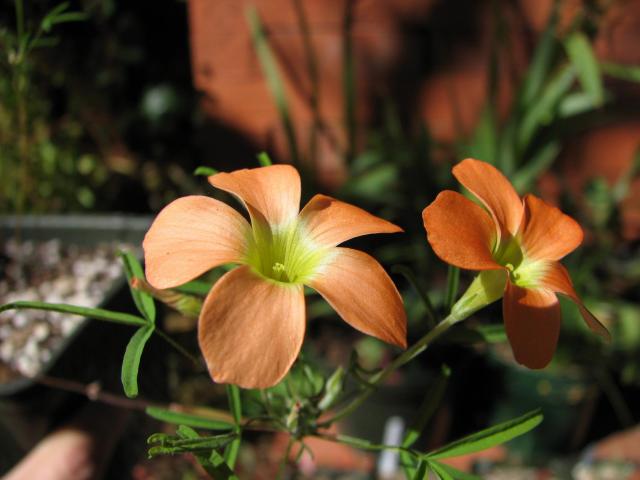
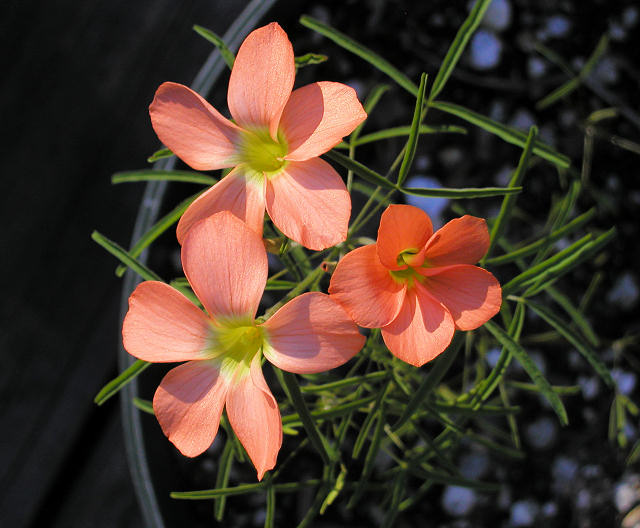
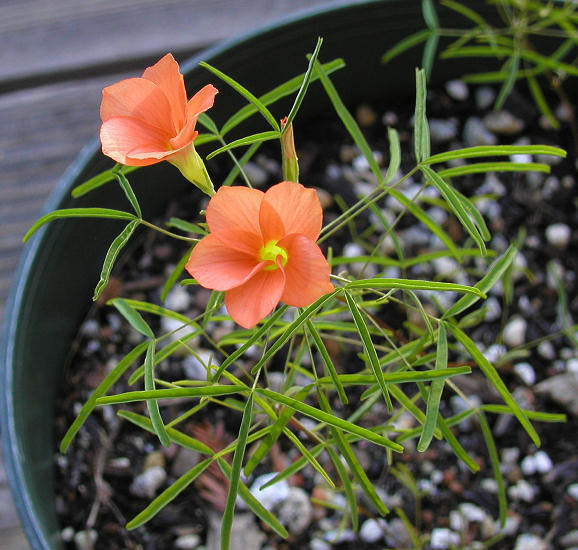
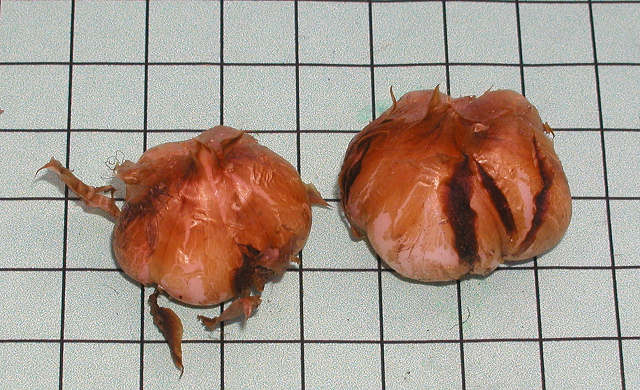
Oxalis gracilis Jacq. is a species of the northwest Cape (Namaqualand to Clanwilliam). It grows on sandy flats and slopes and has trifoliolate linear leaves and apricot-pink or white flowers with a yellow tube. Height: to 30 cm. Plants grown under the name of Oxalis karooica with red stems and finely dissected leaves appear to be this species. The bulbs can be large, but are slow to multiply. Photo 1 was taken by Andrew Wilson, photos 2-3 were taken by Nhu Nguyen. Photos 4-6 were taken by Mary Sue Ittner. Photo 6 shows the bulbs on a 1 cm grid.
Oxalis index - Miscellaneous Oxalis - Oxalis flava - Oxalis hirta - Oxalis obtusa - Oxalis pes-caprae - Oxalis purpurea - oxalis storage organs- South African oxalis a-b - South African oxalis c -South African oxalis d-e - South African oxalis h-k - South African oxalis L-M - South African oxalis n-o - South African oxalis p - South African oxalis r-s - South African oxalis t-z - South American oxalis