Tigridia Juss. is a genus of about 30 species mainly from Mexico and Guatemala in the Iridaceae family. They produce a succession of short lived flowers which are usually in bright colours. The rootstock is a tunicated bulb, found from 3 to 15 cm deep in the wild. Bulbs are never found to offset in the wild. Leaves are pleated in a broad fan. The best known species is Tigridia pavonia whose flowers are 10-15 cm (4 -6 inches) across in red, orange, yellow or white variously blotched in the centre. They commence growth in spring and generally die back during autumn. Many species are easy to grow in pots, but survive best if protected from rain in the winter. This genus was the subject of the topic of the week September 2003. An introduction was furnished by Alberto Castillo.
The most comprehensive publication on Tigridia is The genus Tigridia (Iridaceae) of Mexico and Central America, a monograph published by the University of California in 1970 (University of California publications in botany, v. 54). It was based on the thesis of Dr. Elwood Molseed, who died in 1967 at age 29. The monograph is long out of print, unfortunately, but can be found in some university research libraries. It's worth looking for, as it includes a lot of information, detailed anatomical drawings and a number of color photographs. Molseeds classification into the subgenera of Tigridia and Hydrotaenia based on the position of the nectar glands on the inner tepals was not supported by later genetic studies. In their 2008 book, The Iris Family: Natural History and Classification, Peter Goldblatt and John Manning included the four species of Rigidella that differed only in having a minute outer segment. They viewed this as merely an adaptation for hummingbird pollination. Also included were one of the species in the genus Colima and the genus Sessilanthera.
Growing Tigridia from seed is fairly easy. They usually germinate in 20 to 40 days under indoor conditions. Molseed stated that under greenhouse conditions, all species can be kept from going dormant until their first bloom. Even if allowed to go dormant, some vigorous individuals may bloom in their second year from seed, though most will wait for the third year.
Representatives of some of the species are shown below.
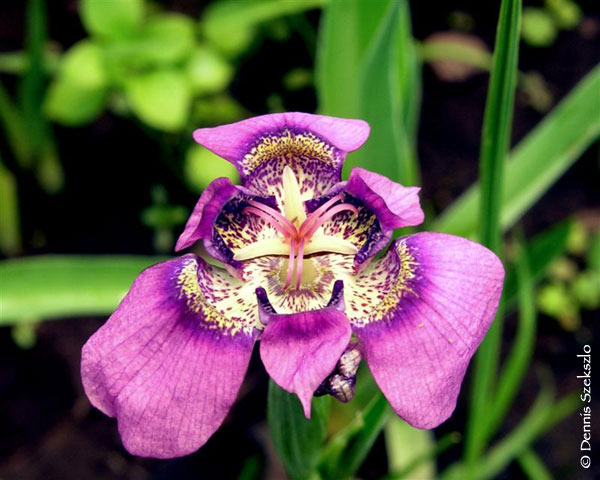
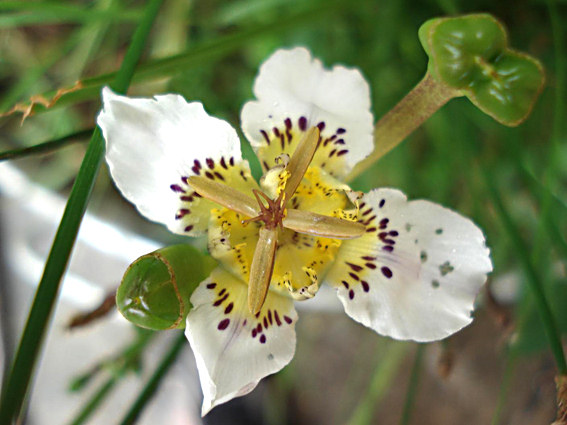
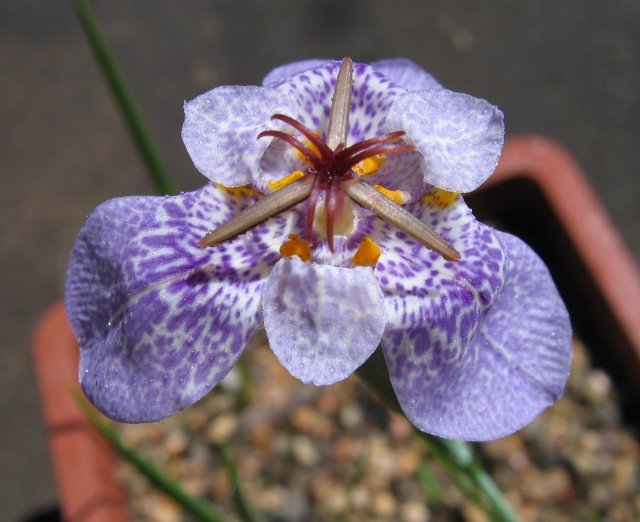
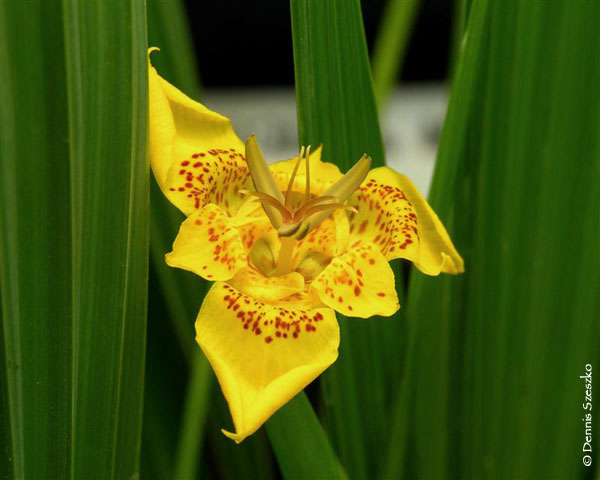


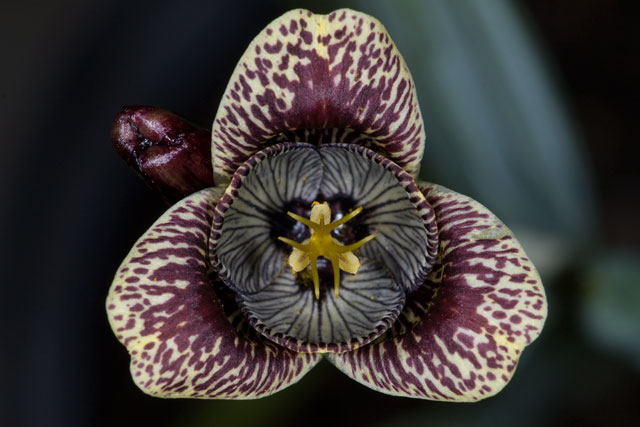
Information on named species can be found on the wiki pages below or by clicking on the name of the species in the table.
Jump to: A B C D E F H I L M O P T V
![Tigridia augusta, Dennis Szeszko [Shift+click to enlarge, Click to go to wiki entry]](https://www.pacificbulbsociety.org/pbswiki/files/Tigridia/th00---Tigridia_violacea_DS.jpg.jpg?svg=600x480 "Tigridia augusta, Dennis Szeszko [Shift+click to enlarge, Click to go to wiki entry]")
![Tigridia bicolor, Michael Hughes [Shift+click to enlarge, Click to go to wiki entry]](https://www.pacificbulbsociety.org/pbswiki/files/Tigridia/th00---Tigridia_bicolor_MH.jpg.jpg?svg=412x550x960x1280 "Tigridia bicolor, Michael Hughes [Shift+click to enlarge, Click to go to wiki entry]")
![Tigridia chiapensis, Rob Hamilton [Shift+click to enlarge, Click to go to wiki entry]](https://www.pacificbulbsociety.org/pbswiki/files/Tigridia/th00---Tigridia_chiapensis_RH.jpg.jpg?svg=600x405 "Tigridia chiapensis, Rob Hamilton [Shift+click to enlarge, Click to go to wiki entry]")
![Jennie Lovell, iNaturalist, CC BY-NC [Shift+click to enlarge, Click to go to wiki entry]](https://www.pacificbulbsociety.org/pbswiki/files/Tigridia/th00---Tigridia_convoluta_JL.jpg.jpg?svg=548x550x1022x1024 "Jennie Lovell, iNaturalist, CC BY-NC [Shift+click to enlarge, Click to go to wiki entry]")
![Tigridia dugesii, Paul Tyerman [Shift+click to enlarge, Click to go to wiki entry]](https://www.pacificbulbsociety.org/pbswiki/files/Tigridia/th00---Tigridia_dugesii2.jpg.jpg?svg=375x379 "Tigridia dugesii, Paul Tyerman [Shift+click to enlarge, Click to go to wiki entry]")
![Tigridia durangense, Rogan Roth [Shift+click to enlarge, Click to go to wiki entry]](https://www.pacificbulbsociety.org/pbswiki/files/Tigridia/th00---Tigridia_durangense.jpg.jpg?svg=640x522 "Tigridia durangense, Rogan Roth [Shift+click to enlarge, Click to go to wiki entry]")
![Tigridia ehrenbergii subsp. ehrenbergii, Verónica Chavez [Shift+click to enlarge, Click to go to wiki entry]](https://www.pacificbulbsociety.org/pbswiki/files/Tigridia/th00---Tigridia_ehrenbergii_VC2.jpg.jpg?svg=480x360 "Tigridia ehrenbergii subsp. ehrenbergii, Verónica Chavez [Shift+click to enlarge, Click to go to wiki entry]")
![Tigridia flammea, Illustration [Shift+click to enlarge, Click to go to wiki entry]](https://www.pacificbulbsociety.org/pbswiki/files/Tigridia/th00---Tigridia_flammea_scanMBT1.jpg.jpg?svg=339x550x633x1024 "Tigridia flammea, Illustration [Shift+click to enlarge, Click to go to wiki entry]")
![Tigridia hallbergii, Rafa Díez Dominguez [Shift+click to enlarge, Click to go to wiki entry]](https://www.pacificbulbsociety.org/pbswiki/files/Tigridia/th00---Tigridia_hallbergii2_AG.jpg.jpg?svg=600x450 "Tigridia hallbergii, Rafa Díez Dominguez [Shift+click to enlarge, Click to go to wiki entry]")
![Tigridia immaculata, Martin Bohnet [Shift+click to enlarge, Click to go to wiki entry]](https://www.pacificbulbsociety.org/pbswiki/files/Tigridia/th00---Tigridia_immaculata_MBt1.jpg.jpg?svg=607x550x1024x927 "Tigridia immaculata, Martin Bohnet [Shift+click to enlarge, Click to go to wiki entry]")
![Tigridia inusitata, Elsa Cabrerax, iNaturalist, CC BY-NC [Shift+click to enlarge, Click to go to wiki entry]](https://www.pacificbulbsociety.org/pbswiki/files/Tigridia/th00---Tigridia_inusitata_EC.jpg.jpg?svg=366x550x683x1024 "Tigridia inusitata, Elsa Cabrerax, iNaturalist, CC BY-NC [Shift+click to enlarge, Click to go to wiki entry]")
![Tigridia lutea, Norton Cuba Melly [Shift+click to enlarge, Click to go to wiki entry]](https://www.pacificbulbsociety.org/pbswiki/files/Tigridia/th00---Tigridia_lutea_NCM1.jpg.jpg?svg=640x480x1164x873 "Tigridia lutea, Norton Cuba Melly [Shift+click to enlarge, Click to go to wiki entry]")
![Tigridia mariaetrinitatis, isaac_js, inaturalist, CC BY-NC [Shift+click to enlarge, Click to go to wiki entry]](https://www.pacificbulbsociety.org/pbswiki/files/Tigridia/th00---Tigridia_mariaetrinitatis_ij.jpg.jpg?svg=411x550x620x828 "Tigridia mariaetrinitatis, isaac_js, inaturalist, CC BY-NC [Shift+click to enlarge, Click to go to wiki entry]")
![Tigridia matudae, Dennis Szeszko [Shift+click to enlarge, Click to go to wiki entry]](https://www.pacificbulbsociety.org/pbswiki/files/Tigridia/th00---Tigridia_matudae_DS1.jpg.jpg?svg=640x428 "Tigridia matudae, Dennis Szeszko [Shift+click to enlarge, Click to go to wiki entry]")
![Tigridia meleagris, Dennis Szeszko [Shift+click to enlarge, Click to go to wiki entry]](https://www.pacificbulbsociety.org/pbswiki/files/Tigridia/th00---Tigridia_meleagris3_DS.jpg.jpg?svg=640x480 "Tigridia meleagris, Dennis Szeszko [Shift+click to enlarge, Click to go to wiki entry]")
![Tigridia mexicana, Dennis Szeszko [Shift+click to enlarge, Click to go to wiki entry]](https://www.pacificbulbsociety.org/pbswiki/files/Tigridia/th00---Tigridia_mexicana_top-view_DS.jpg.jpg?svg=400x500 "Tigridia mexicana, Dennis Szeszko [Shift+click to enlarge, Click to go to wiki entry]")
![Tigridia multiflora, Paul Tyerman [Shift+click to enlarge, Click to go to wiki entry]](https://www.pacificbulbsociety.org/pbswiki/files/Tigridia/th00---Tigridia_multiflora.jpg.jpg?svg=513x443 "Tigridia multiflora, Paul Tyerman [Shift+click to enlarge, Click to go to wiki entry]")
![Tigridia orthantha, Rob Hamilton [Shift+click to enlarge, Click to go to wiki entry]](https://www.pacificbulbsociety.org/pbswiki/files/Rigidella/th00---Rigidella_orthantha_RH.jpg.jpg?svg=400x283 "Tigridia orthantha, Rob Hamilton [Shift+click to enlarge, Click to go to wiki entry]")
![Tigridia pavonia, orange color variant, Dennis Szeszko [Shift+click to enlarge, Click to go to wiki entry]](https://www.pacificbulbsociety.org/pbswiki/files/Tigridia/th00---Tigridia_pavonia3_DS.jpg.jpg?svg=640x429 "Tigridia pavonia, orange color variant, Dennis Szeszko [Shift+click to enlarge, Click to go to wiki entry]")
![davidfl22, iNaturalist, CC BY-NC [Shift+click to enlarge, Click to go to wiki entry]](https://www.pacificbulbsociety.org/pbswiki/files/Tigridia/th00---Tigridia_tepoxtlana_DF2.jpg.jpg?svg=412x550x768x1024 "davidfl22, iNaturalist, CC BY-NC [Shift+click to enlarge, Click to go to wiki entry]")
![Tigridia vanhouttei, Dennis Szeszko [Shift+click to enlarge, Click to go to wiki entry]](https://www.pacificbulbsociety.org/pbswiki/files/Tigridia/th00---Tigridia_vanhouttei_DS2.jpg.jpg?svg=640x427 "Tigridia vanhouttei, Dennis Szeszko [Shift+click to enlarge, Click to go to wiki entry]")