Several species settle for these clear signal colors, often associated with bird pollination. This may result in very special flower shapes with long perianth tubes.
Though magenta is considered the basic red in printing color systems, we follow the common western color perception. Magenta colored Gladiolus can be found in the Purple Gladiolus index.
Page 1: G. abbreviatus... Page 2: G. engysiphon... Page 3: G. merianellus... Page 4: G. priorii...
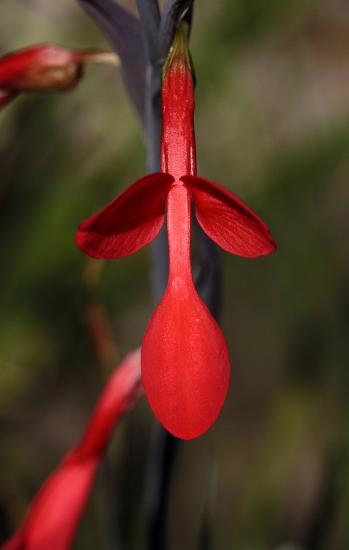
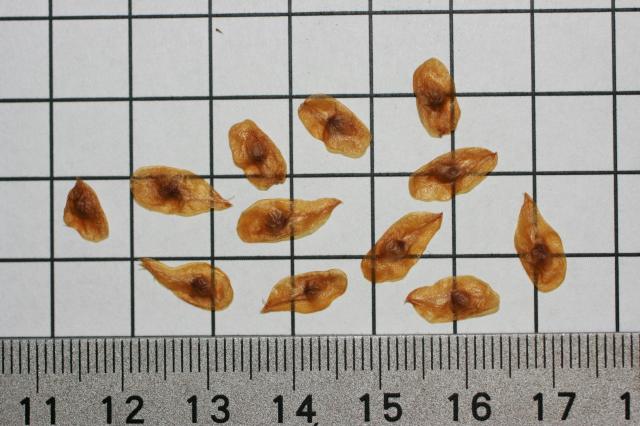
Gladiolus splendens (Sweet) Herb., formerly known as Anomalesia splendens (Sweet) N.E.Br., is found in rocky clay, mostly near streams in the Roggeveld and the Calvinia district. The bright red flowers are formed in a strongly inclined spike. Height: 50-110 cm. Photos 1 and 2 were taken by Mary Sue Ittner near Middelpos September 2006; photo 3 was taken by Bob Rutemoeller in a garden in Calvinia. Photo 4 was taken by Alan Horstmann. Photo 5 was taken by Uluwehi Knecht. Photo 6 by Nhu Nguyen shows the seeds on a 1 cm square grid.
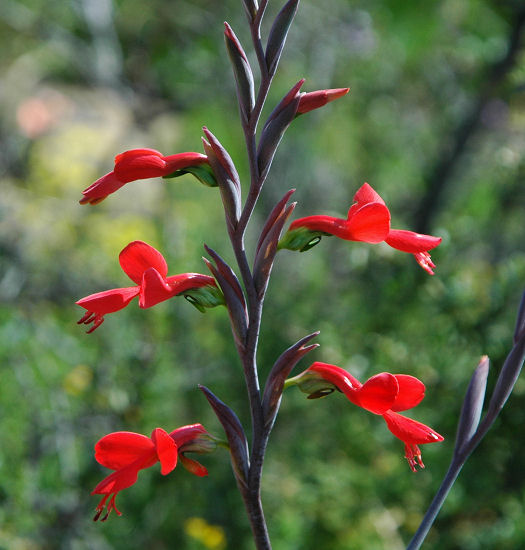
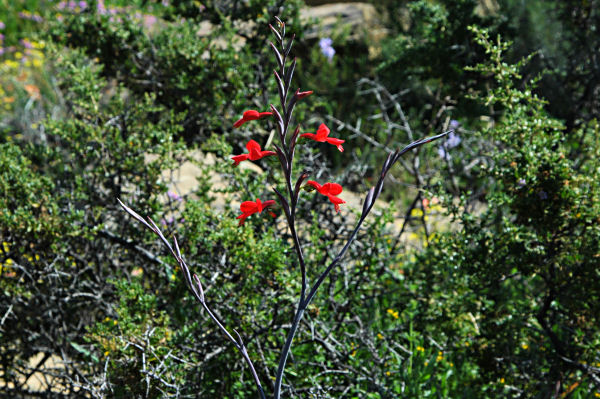
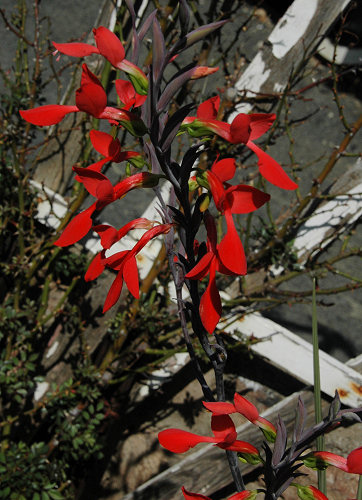
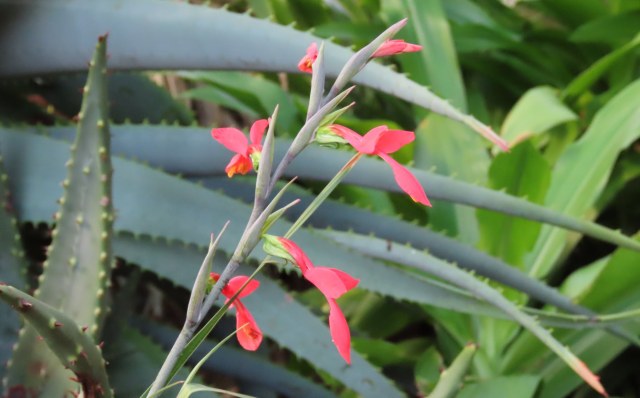
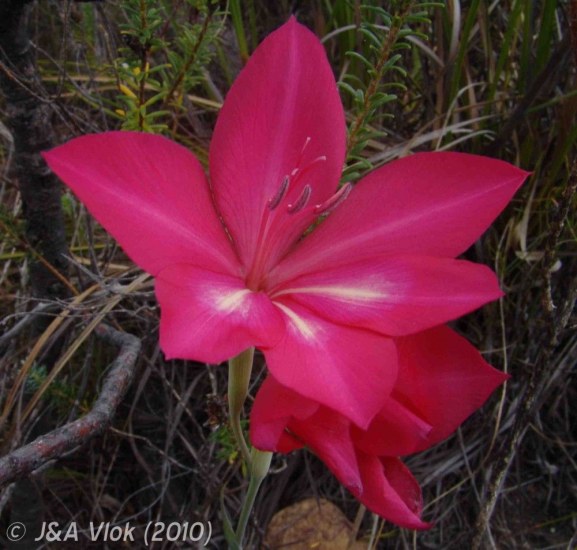
Gladiolus stefaniae Oberm. grows in the mountains of the southern Cape on rocky slopes in gullies that are wet. It grows up to 60 cm. This species flowers at the end of the dry hot summer after the weather has become cooler and it has started to rain. The flowering stem is produced before the leaf. The large flowers are red with a median white streak in the lower two-thirds of the lower three tepals and are pollinated by the mountain pride butterfly. The first photo from the book Plants of the Klein Karoo courtesy of Jan and Anne Lise Schutte-Vlok. The last two photos by Mary Sue Ittner are close-ups of the first flower (of two) blooming September-October 2008 in Northern California. It has continued to flower, but not increase. It usally flowers in California before our rainy season has started.
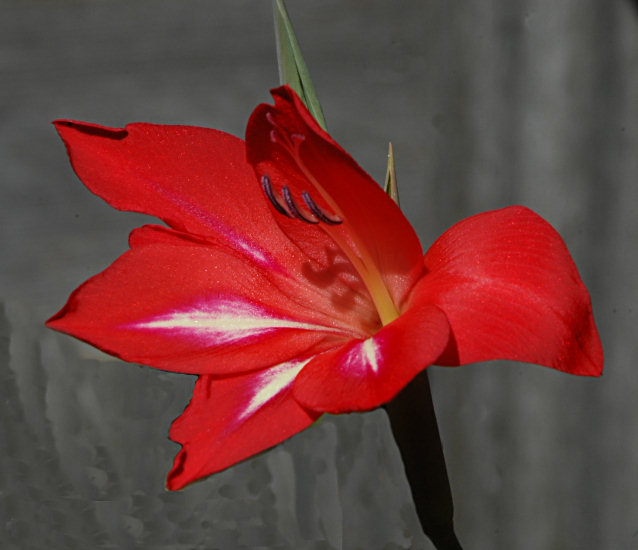
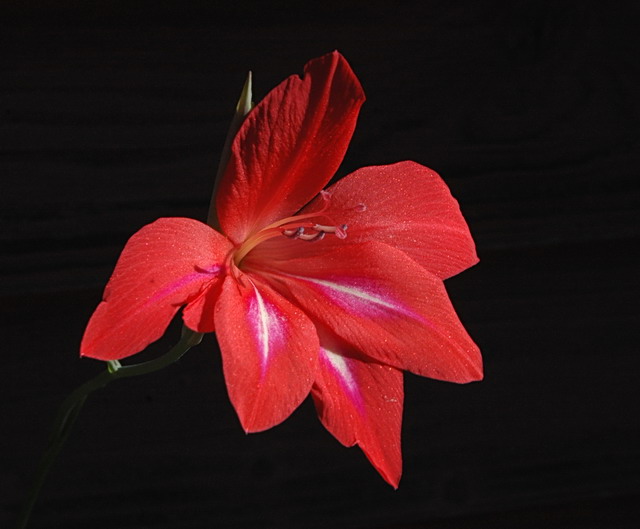
Gladiolus stokoei G.J.Lewis is found on marshy sandstone slopes from 500 to 1000 m in the Riviersonderend Mountains (Southwest Cape.) Flowering March to April, it grows from 30 to 45 cm with the scarlet tulip shaped flowers (in a one to three flowered spike) appearing before the solitary linear leaf. Photos taken March 2016 by Rachel Saunders.
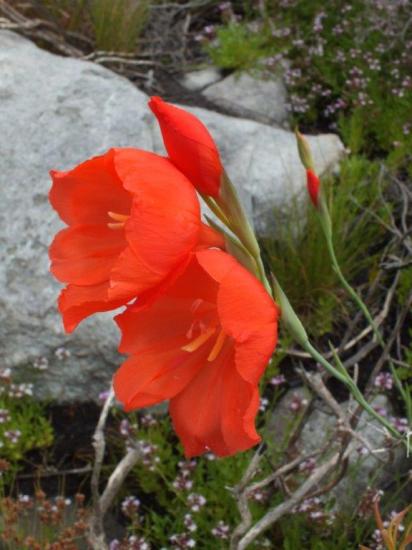
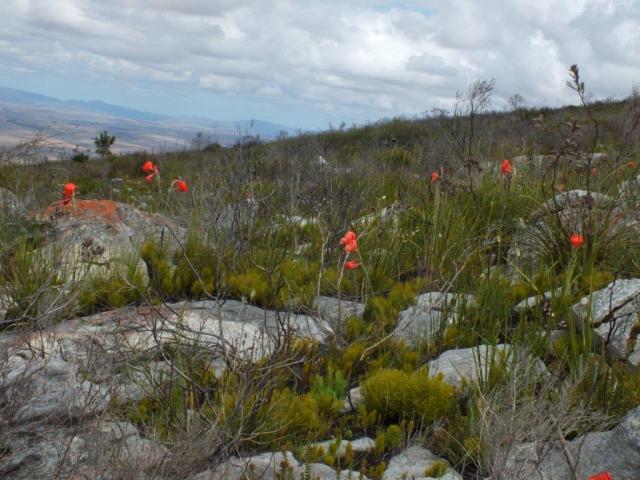
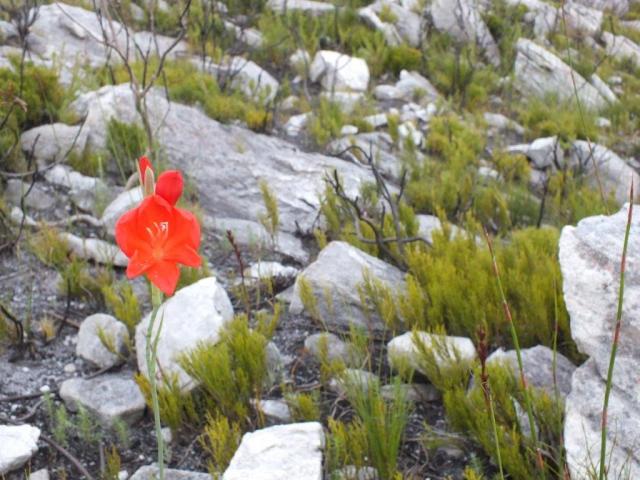
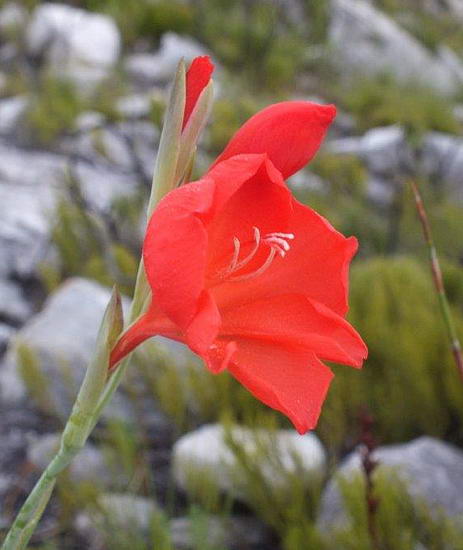
Gladiolus teretifolius Goldblatt & M.P.de Vos (syn. Homoglossum muirii) is a rare plant found in the southern Cape growing in heavy soils in renosterveld. It has scarlet flowers and blooms fall to winter. Height range: 40-70 cm. Photos taken by Cameron McMaster in the Overberg, Bredasdorp and Agulhas.

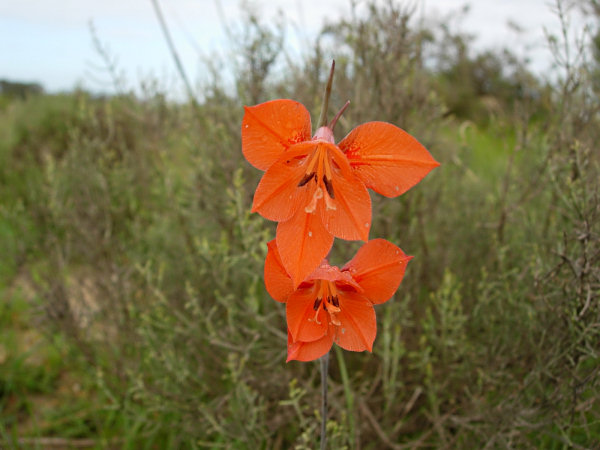
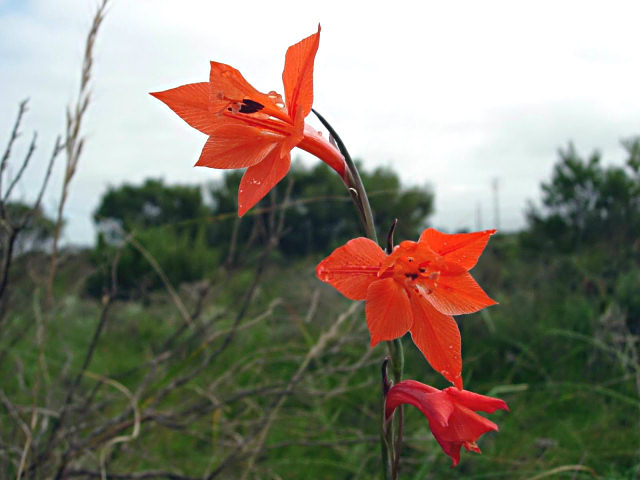
Gladiolus vandermerwei (L.Bolus) Goldblatt & M.P.de Vos, syn. Antholyza vandermerwei L.Bolus, syn. Homoglossum vandermerwei (L.Bolus) L.Bolus , has a narrow distribution in the central part of the western Cape where it is found on shale slopes in renosterveld in dry habitats. It has bright red flowers with an elongated perianth tube. The lower tepals are short and narrow, yellowish in the lower half and arch outward. Height range: 30-60 cm. Photos were taken near Bredasdorp in the Overberg by Cameron McMaster in September in different years.
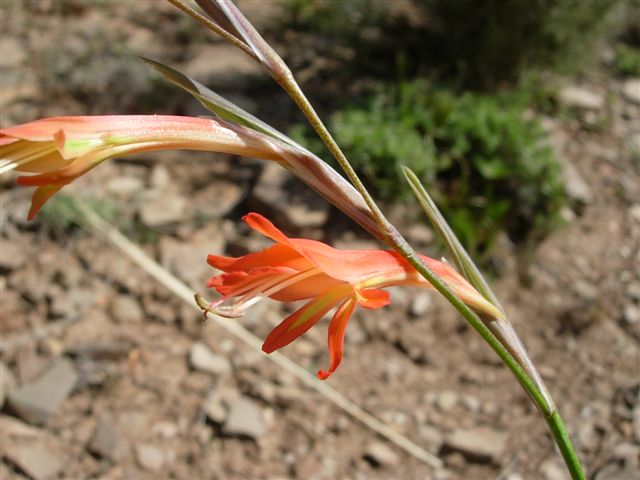
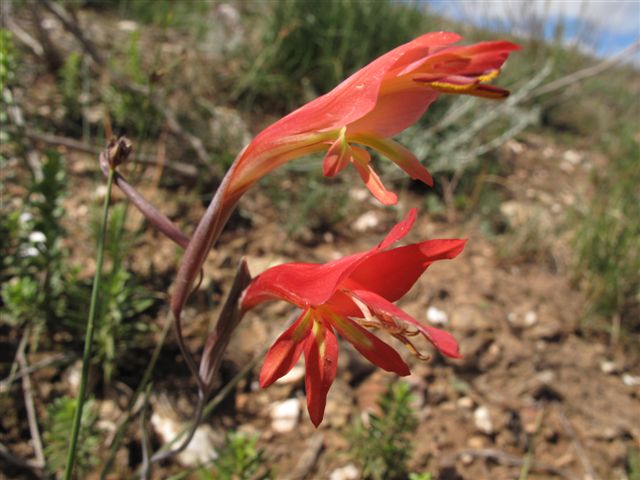
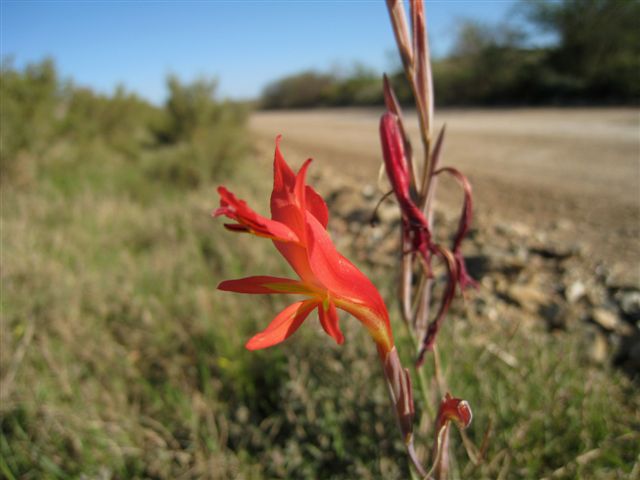
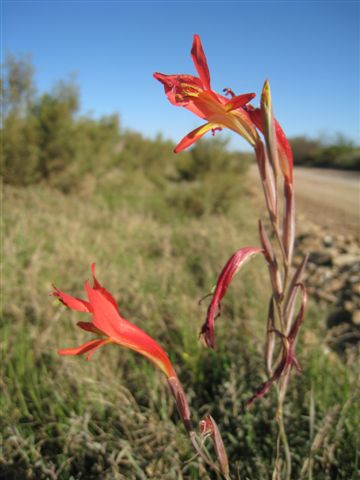
Gladiolus watsonioides Baker is found on the mountains of Kenya and northern Tanzania, growing from 2600 m to 3900 m. It is not quite a true alpine, but not far off. There is a frost almost every night and the plant copes with this well at all stages of its growth. With the almost constant daylength and general conditions through the year the plant can remain active without going dormant. This evergreen habit is maintained in cultivation & the plants remain green throughout the year if kept moist, but they can go dormant if they dry out. I have stocks from both mountains (Kilimanjaro and Mt. Kenya) and they grow equally well in a gritty, humus-rich compost in deep pots in a frost-free greenhouse, but there is no doubt that the Mt Kenya version is the one to grow. Height range: 1 to 2.3 ft. Description and photos by John Grimshaw. The last two images are of the Mt. Kenya version.
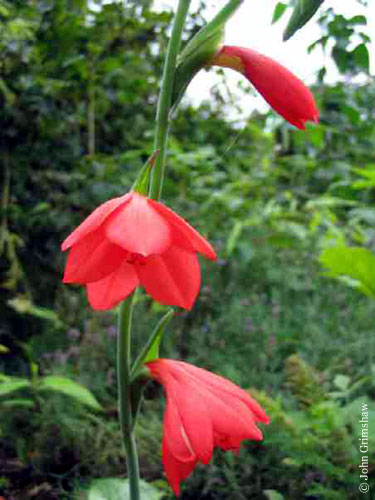
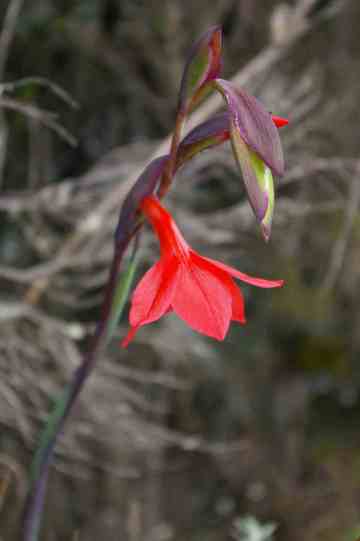

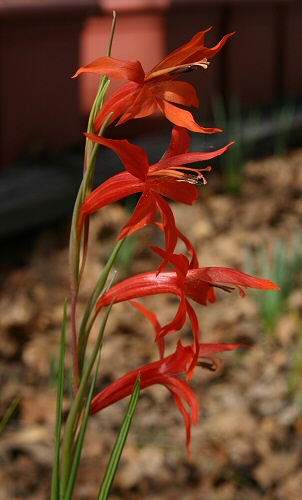
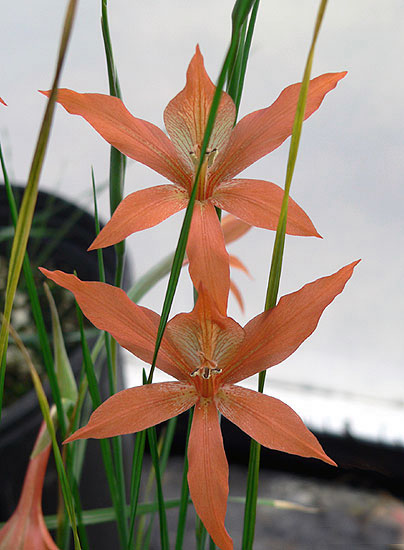
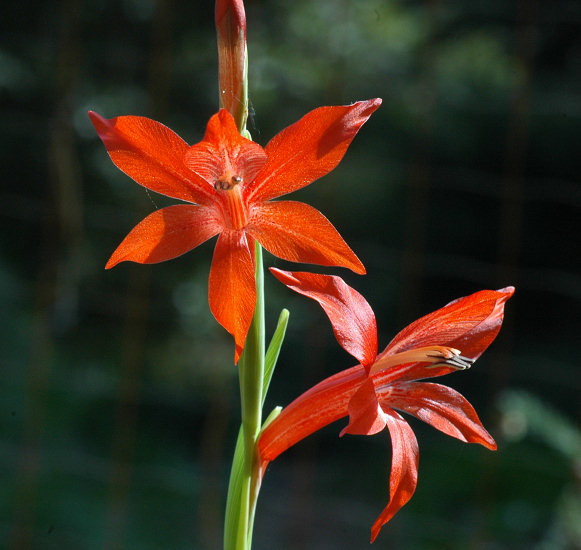
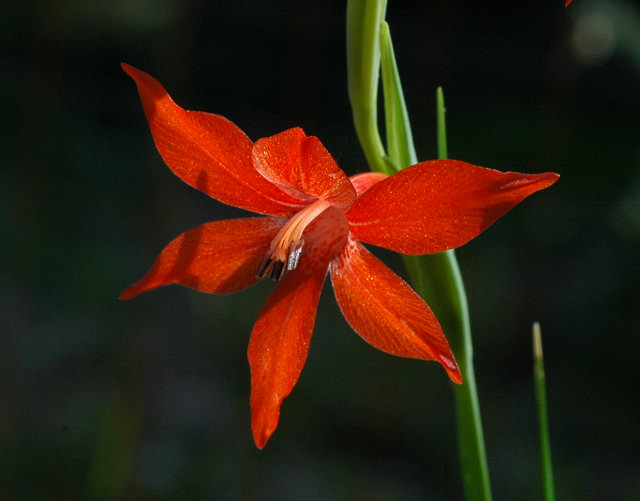
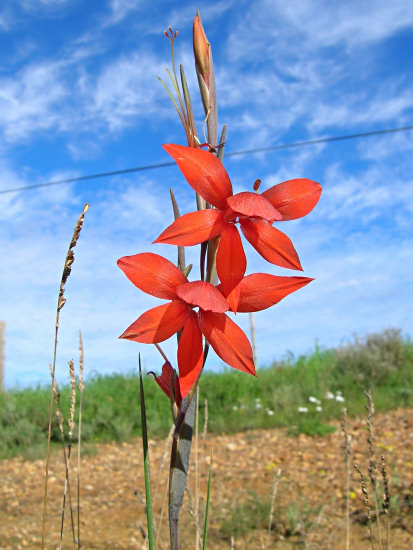
Gladiolus watsonius Thunb. has had multiple names over the years. It has been included in Watsonia, Homoglossum and Antholyza before settling in Gladiolus. It is found on clay and granite slopes in renosterveld in the northwest and southwest Cape. It blooms in late winter, early spring with an erect spike of red to orange flowers. Height range: 30-70 cm. The first photo below was taken by Bob Werra and the second by Susan Hayek in the greenhouse of Diana Chapman. Photos three to five by Mary Sue Ittner of plants at Telos and plants blooming in her garden in February 2007. The sixth photo was taken by Alan Horstmann.

The photo below shows some dormant corms. The tunics can sometimes have a papery outer layer, as shown by the larger corm on top. But the two smaller corms at center show the "teeth" at the bottom of the tunic that are typical for this species. Photo by Michael Mace.

Page 1: G. abbreviatus... Page 2: G. engysiphon... Page 3: G. merianellus... Page 4: G. priorii...