There are about 163 species of Gladiolus (with new ones being discovered) in the area south of the Tropic of Capricorn and including Botswana, Lesotho, Namibia, South Africa, Swaziland, and Mozambique. Some are found in winter rainfall areas and some in summer rainfall areas. For more information see Goldblatt and Manning, 1998. Southern African species from S-T are pictured on this page.
Gladiolus index - Southern African gladiolus A-B - Southern African gladiolus Ca - Southern African gladiolus Ce-E - Southern African gladiolus F-H - Southern African gladiolus I-Me - Southern African gladiolus Mi-Pa - Southern African gladiolus Pe-R - Southern African gladiolus U-Z - Gladiolus Hybrids - Miscellaneous gladiolus
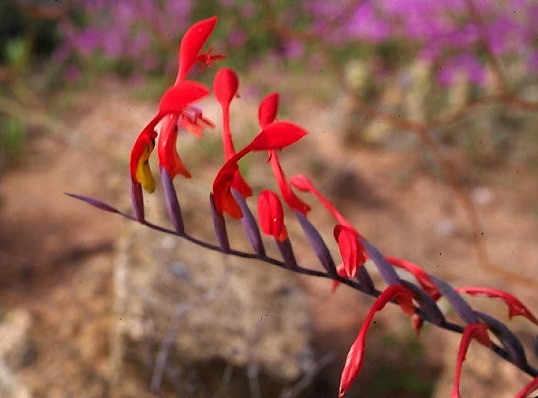
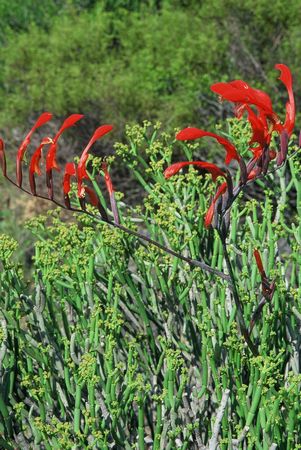
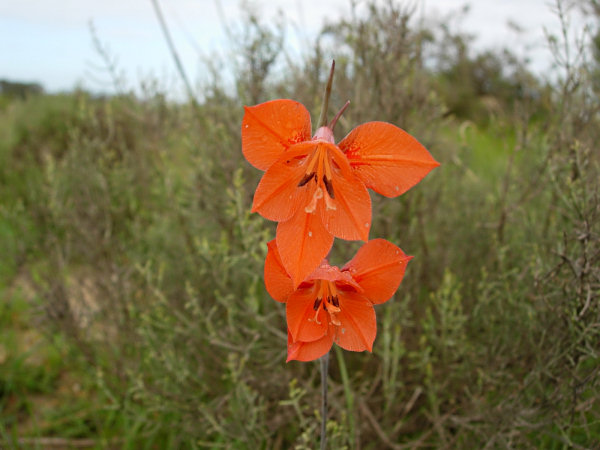
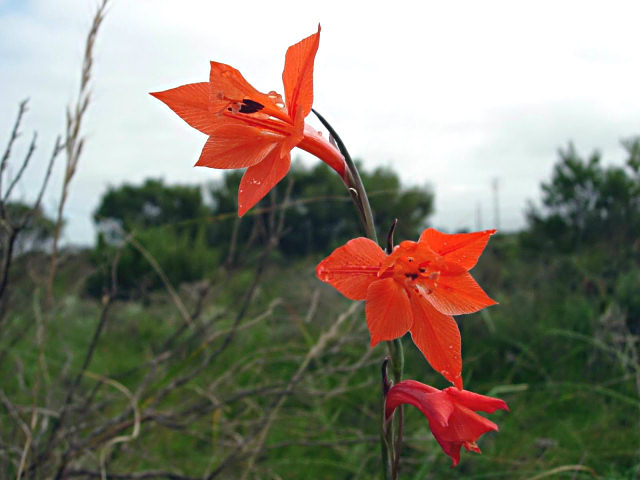
Gladiolus saccatus (Klatt) Goldblatt & M.P.de Vos, formerly known as Anomalesia saccata or Antholyza saccata, extends from the western Cape of South Africa into Namibia. It is found in both summer and winter rainfall areas. It has bright red flowers and is pollinated by birds. This one was growing alongside the road in Namaqualand. Height range: 25-80 cm. Photo #1 taken August 2001 by Mary Sue Ittner. The second photo was taken by Rod Saunders.
Gladiolus salmoneus Baker see Gladiolus oppositiflorus
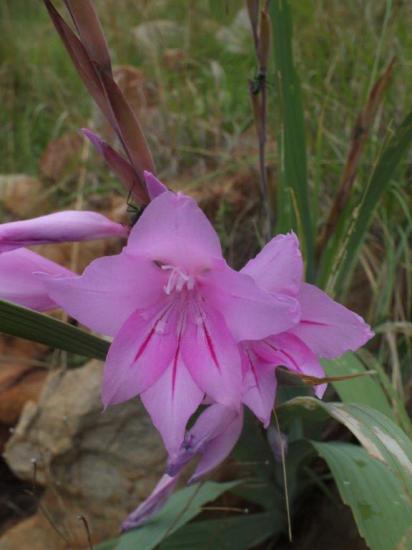
Gladiolus salteri G.J.Lewis is a winter-grower found in a small area in Namaqualand where it grows in coarse, gritty decomposed granite, or in red, wind-blown sand, usually on the edges or in the middle of drainage lines. It has thin pink unequal tepals, with red and cream chevrons on the lower ones, and is believed to be pollinated by long-tongued bees. Height: 10-20 cm. Photos from iNaturalist were taken by Nick Helme in Namaqualand August 2024 and shared under a CC BY-SA license.


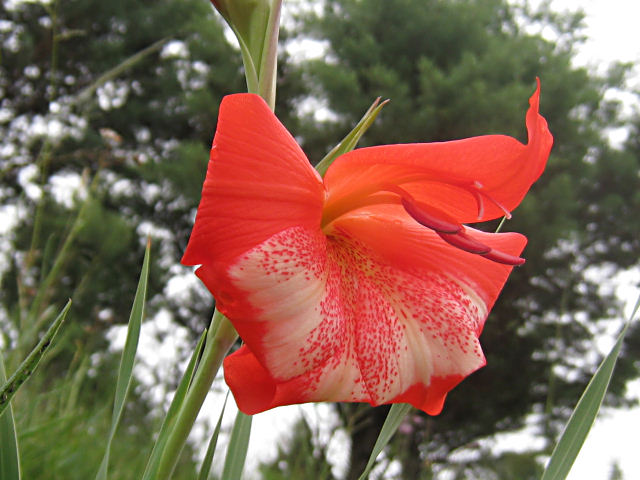
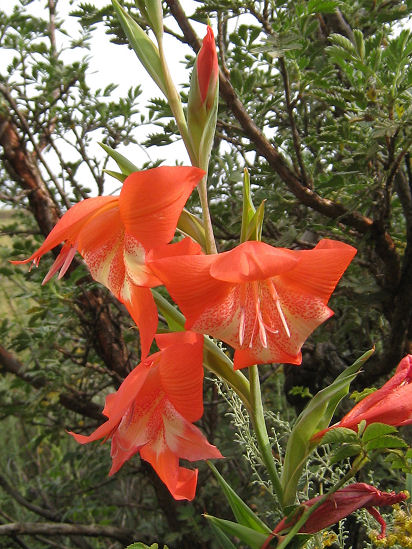
Gladiolus saundersii Hook.f. is native to the southern and central Drakensberg and grows in summer on rocky outcrops, scree slopes and other exposed habitats in dry spots that are seasonally wet. It has bright red flowers that face sideways or are drooping. The lower three tepals are speckled in the lower half with red on a white field. Height: 40-60 cm. This species is pollinated by butterflies. It is a winter-dormant species and its habitat is very cold in winter with frequent snow. It was named after Katherine Saunders who was a botanical artist in Natal in the 1800s. Photos 1-3 taken in the Eastern Cape February 2008 and photo 4 taken at Naude's Nek January 2010 by Cameron McMaster.

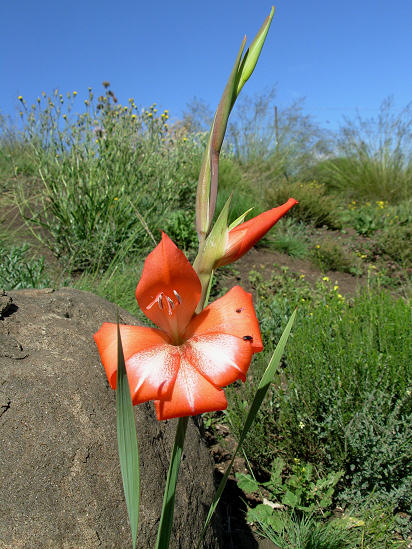
Gladiolus saxatilis Goldblatt & J.C.Manning, syn. Gladiolus lithicola Goldblatt & J.C.Manning, is a narrow endemic of the summer rainfall region where it occurs between Mariepskop and Graskop along the lower Drakensberg escarpment of Mpumalanga growing in shady places on sandstone rocks and cliffs of black reef quartzite. Growing from 45 to 80 cm high, it has six to ten fan like relatively broad (18 to 35 mm) soft textured leaves reaching to the base and middle of the spike and a slightly inclined spike of 9 to 16 relatively large pale pink to mauve unscented flowers. The lower tepals have weakly defined pale mauve, linear diamond shaped median nectar guides and the perianth tube is narrowly and obliquely funnel shaped. The floral bracts are purplish when young, becoming dry and rust-colored after flowering which occurs mid March to late April, possibly into May. Photos from Rachel Saunders.
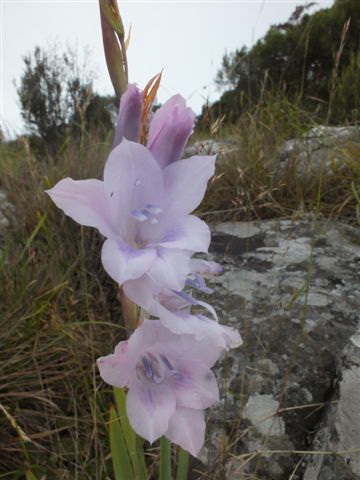
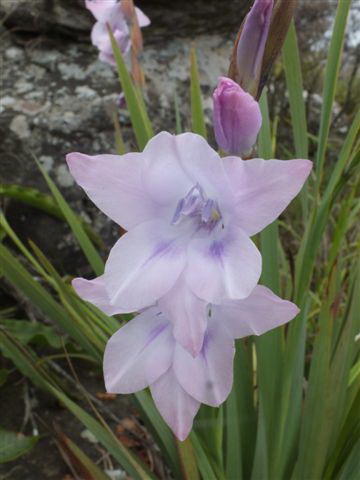
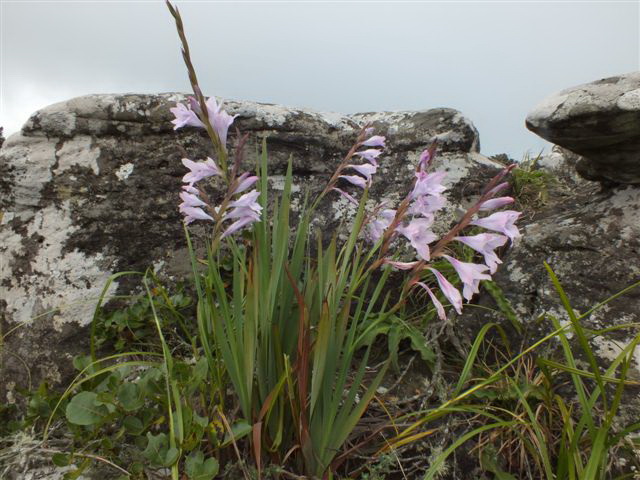
Gladiolus scabridus Goldblatt & J.C.Manning is restricted to the mountains of northern KwaZulu-Natal and southern Swaziland where it grows at elevations of 1000 to 2000 m in well-drained, rocky habitats. Flowering from December to late January at lower elevations into February at cooler, wetter sites, it has an erect spike of 10 to 16 flowers. The unscented long tubed flowers are bright pink with a narrow white longitudinal zone in the lower two thirds and a narrow reddish streak in the midline. Plant height: up to 100 cm. Photo taken by Rachel Saunders in KwaZulu-Natal January 2015.
Gladiolus scullyi Baker is found on silty clay and granite slopes in the northern winter rainfall areas (Namaqualand and western Karoo). It is very similar to Gladiolus venustus but is less colorful with dull yellow to light brown flowers with darker yellow on the lower tepals and darker brown to purplish highlights. The dorsal tepal is also more horizontal, inclined over the stamens and the upper two lateral tepals curve outward in an arc. It is fragrant and windowed in profile. Height range: 15-40 cm. Photos 1-2 taken by Bob Rutemoeller September 2006 near Nieuwoudtville (photos 1-2). Photos 3-5 taken by Cameron McMaster in various locations near Nieuwoudtville September 2011.
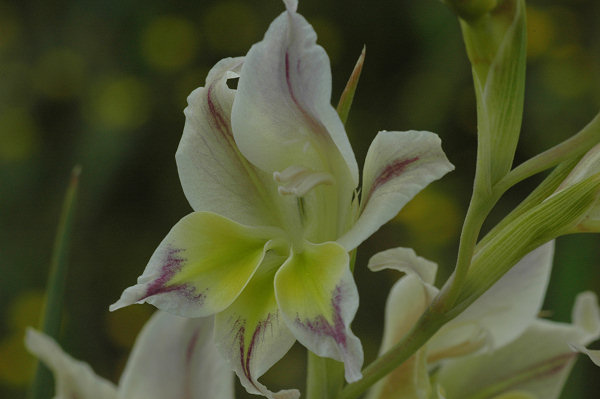
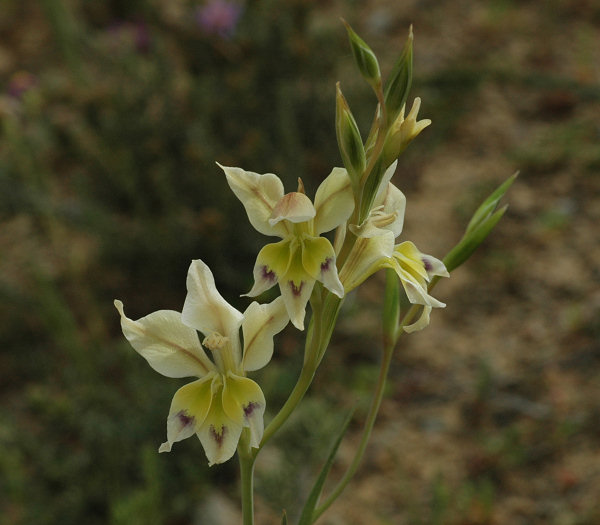
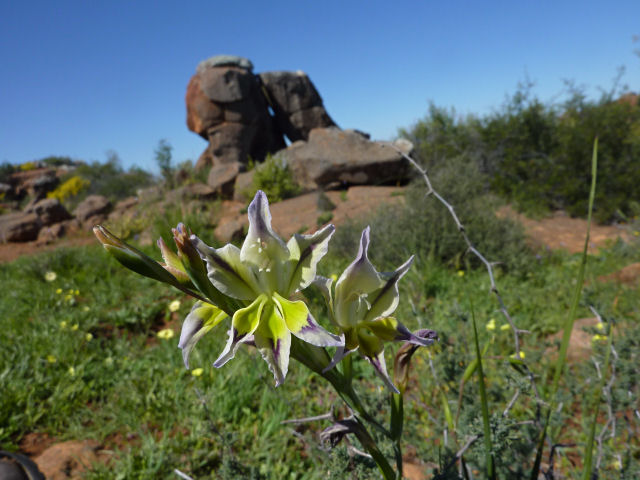
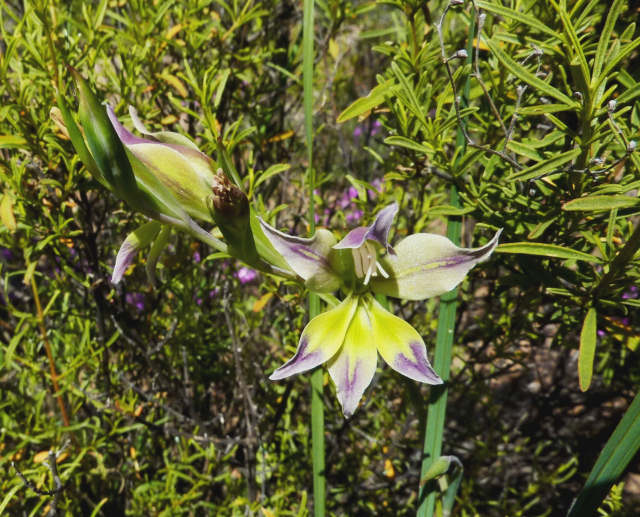
Photos 1-2 taken by Bob Rutemoeller September 2006 in Namaqualand. Photos 3-4 were taken by Cameron McMaster September 2011 near Carolusberg in Namaqualand. The last two photos were taken taken by Bob Werra.
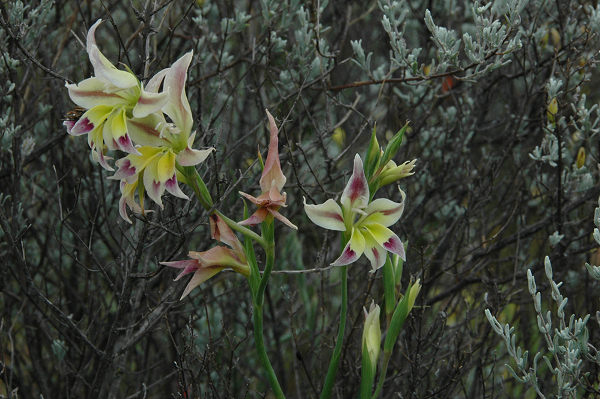
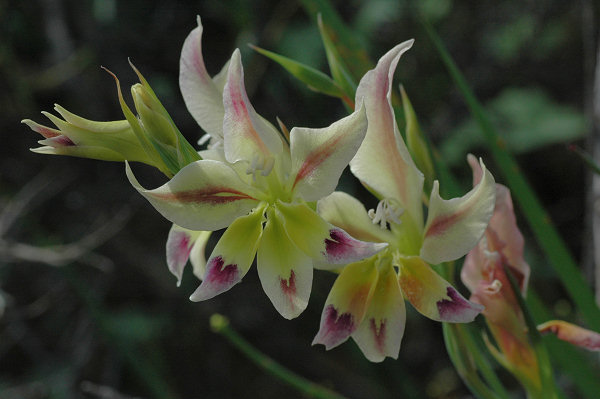
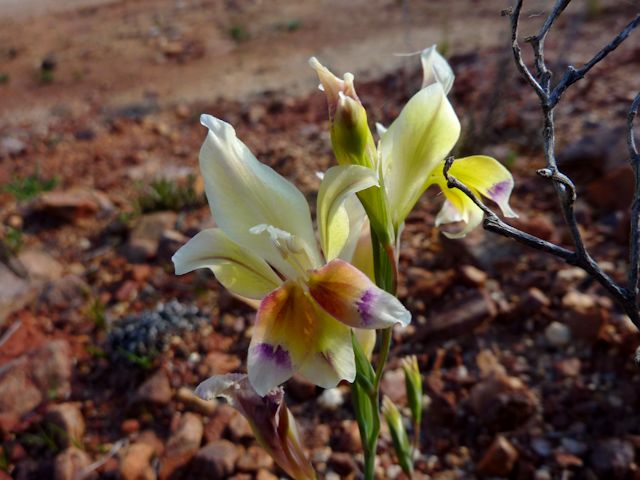
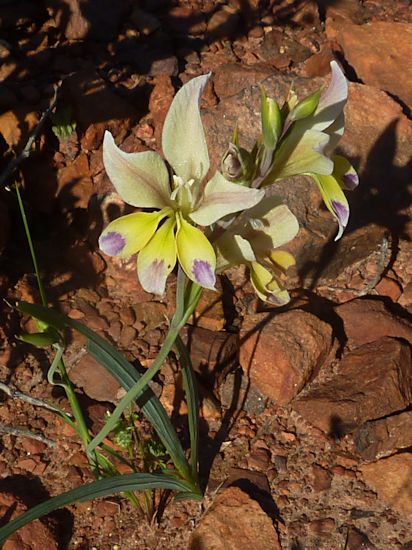

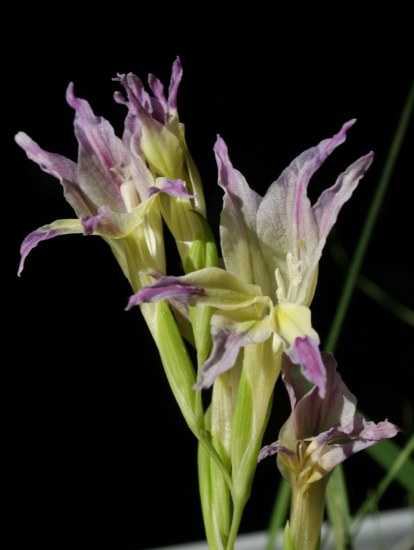
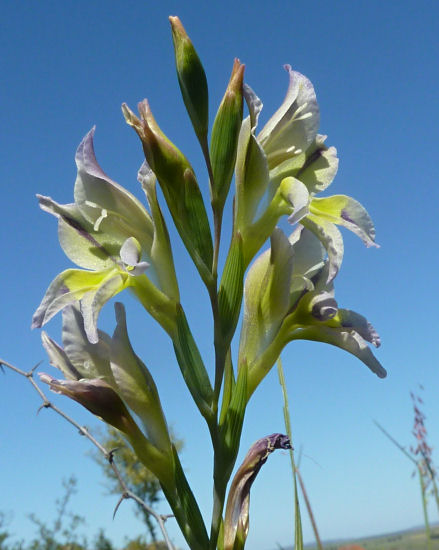
Gladiolus sekukuniensis P.J.D.Winter is known from two sites in Sekukuniland, west of the Transvaal Drakensberg where it is found on alkaline soils in open woodland and flowers from March to April. It grows from .6 to 1 m and has linear leaves with a thickened and raised midrib and a spike of 8 to 17 flowers. Flowers are white or cream to pale salmon pink with a narrow, dark red, longitudinal median streak on each tepal except for the dorsal where the streak is sometimes incomplete or lacking. The lower tepals sometimes have a yellow streak in the center. Flowers are distinctively windowed (in profile there is gaping between the dorsal and upper lateral tepals) with the tepals unequal and narrowed below into claws with twisted and undulate tail-like tips. Photos by Rachel Saunders.
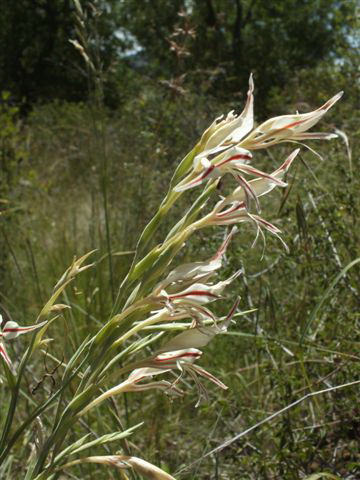
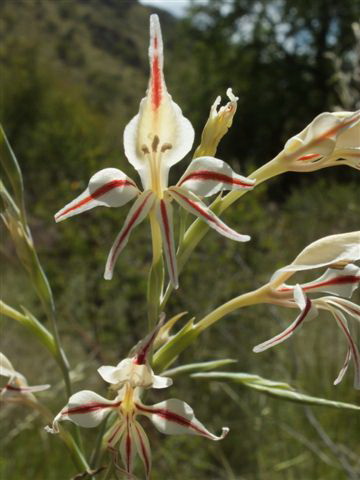
Gladiolus sericeovillosus (Hook) is a medium sized summer flowering Gladiolus related to Gladiolus oppositiflorus with pale cream spotted flowers on a distichous spike from Transvaal grasslands. It comes in two subspecies. Photo from Rod Saunders.

G. sericeovillosus subsp. calvatus (Baker) Goldblatt is characterized by leaves which exceed the flower spike. This species may be found in trade as Gladiolus elliotii, likely because it was described by Lewis under this name, while the accepted Gladiolus elliotii (Baker) is a different species. Pictures by Martin Bohnet show a plant with exactly this misnamed history. He grows it in a container in southern Germany, even though some sources attest it hardiness to USDA Zone 7. The yellow throat markings are optional according to some descriptions.
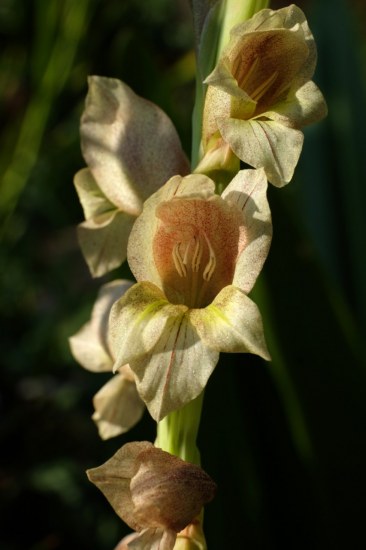
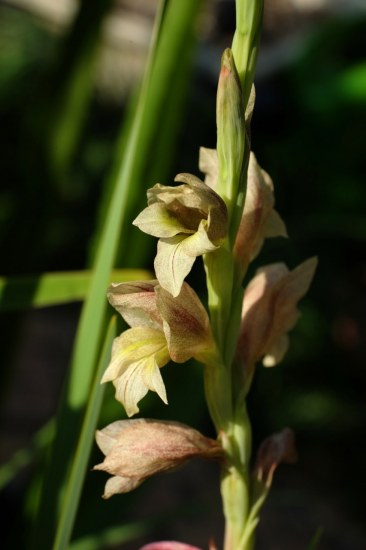
G. sericeovillosus subsp. sericeovillosus has shorter leaves and fine hair on the bracts and stem. In some specimen, the spots on the flowers may be missing.
Gladiolus serpenticola Goldblatt & J.C.Manning is endemic to the Barberton District of Mpumalanga, South Africa where it grows in serpentine soils. It is tall (75-150 cm) with small pale pink flowers with pale mauve markings on the lower lateral tepals. Photos by Rod Saunders and Terry Frewin.
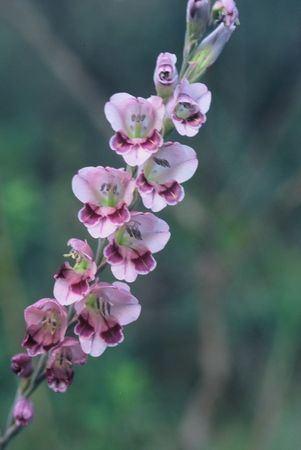
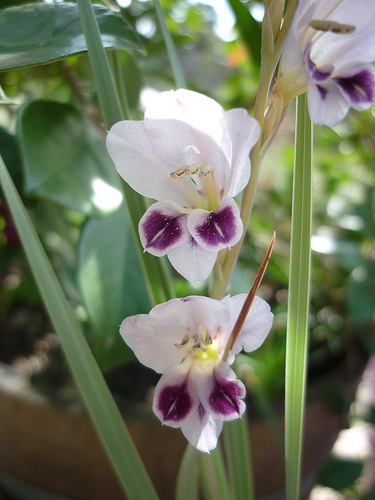
Gladiolus speciosus Thunb. is found in deep sandy soils in the Northwest and Southwest Cape. It is similar to Gladiolus alatus with 2 to 8 flowers in a spike, orange marked yellow to greenish and hooded over the stamens. One of the distinguishing characteristics is that it is colored yellow on the reverse. Height range: 12-20 cm. The first four photos taken in the western Cape near Darling September 2006 by Bob Rutemoeller and Mary Sue Ittner. The last photo was taken by Andrew Harvie near Bokbaai in the Western Cape.
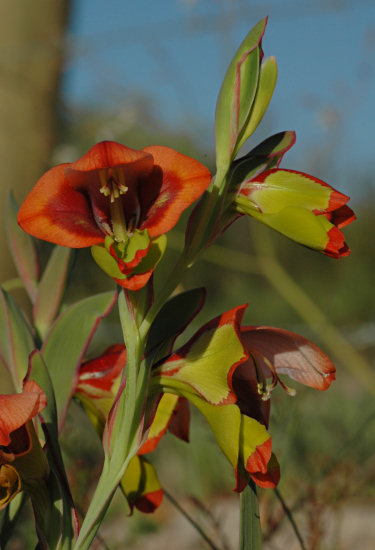
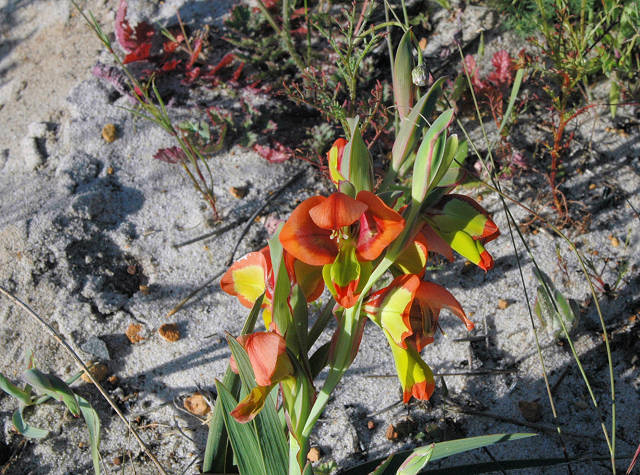
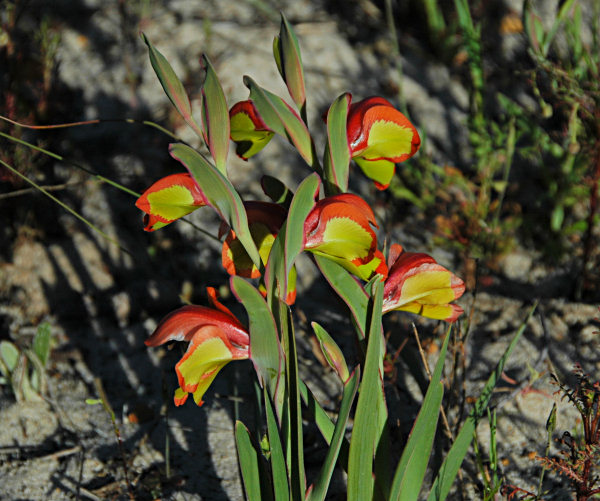
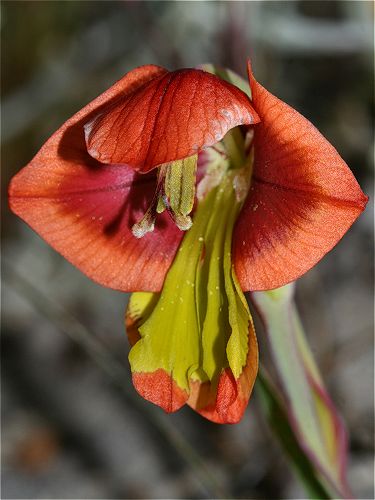
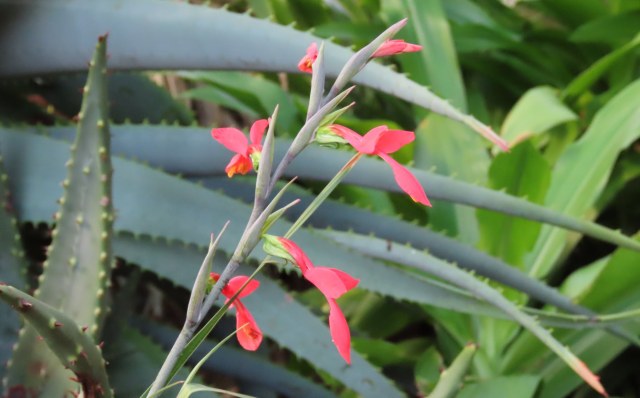
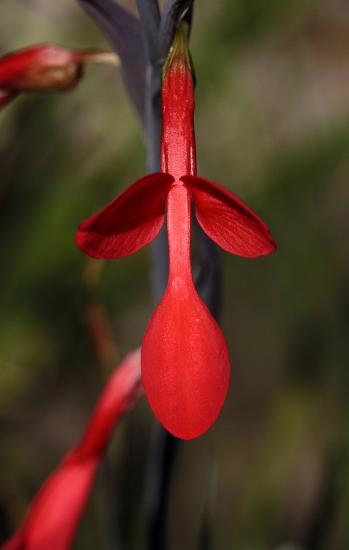
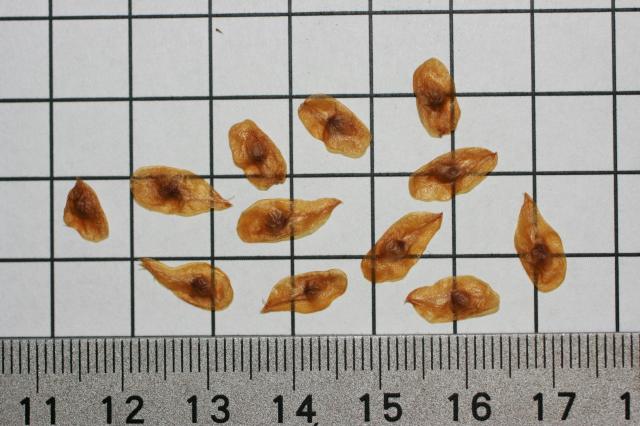
Gladiolus splendens (Sweet) Herb., formerly known as Anomalesia splendens (Sweet) N.E.Br., is found in rocky clay, mostly near streams in the Roggeveld and the Calvinia district. The bright red flowers are formed in a strongly inclined spike. Height: 50-110 cm. Photos 1 and 2 were taken by Mary Sue Ittner near Middelpos September 2006; photo 3 was taken by Bob Rutemoeller in a garden in Calvinia. Photo 4 was taken by Alan Horstmann. Photo 5 was taken by Uluwehi Knecht. Photo 6 by Nhu Nguyen shows the seeds on a 1 cm square grid.
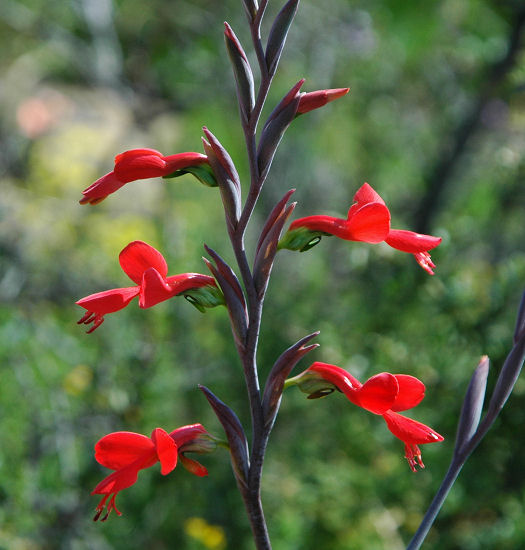
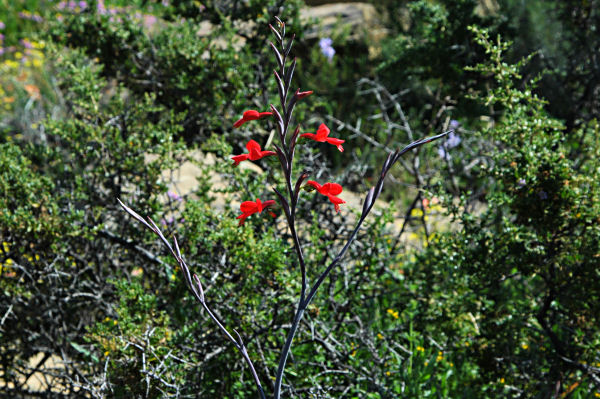
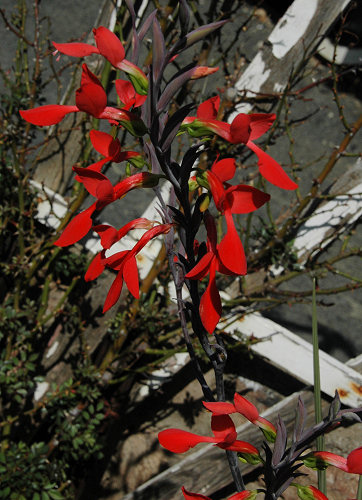
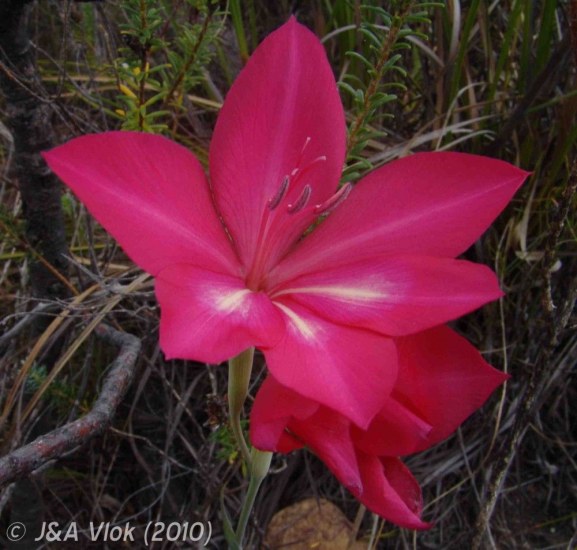
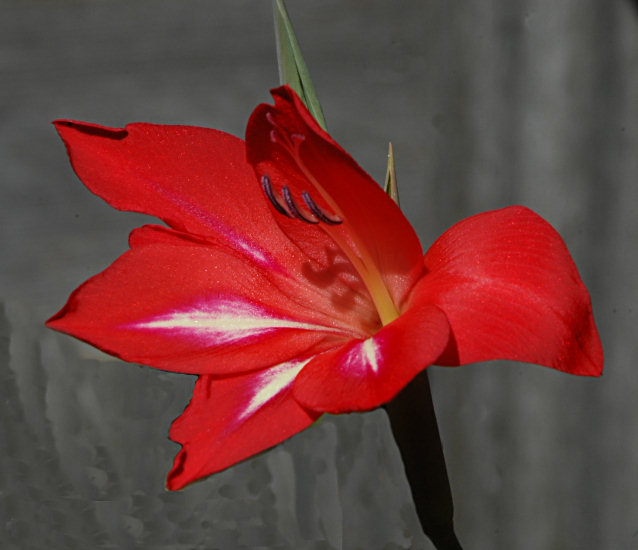
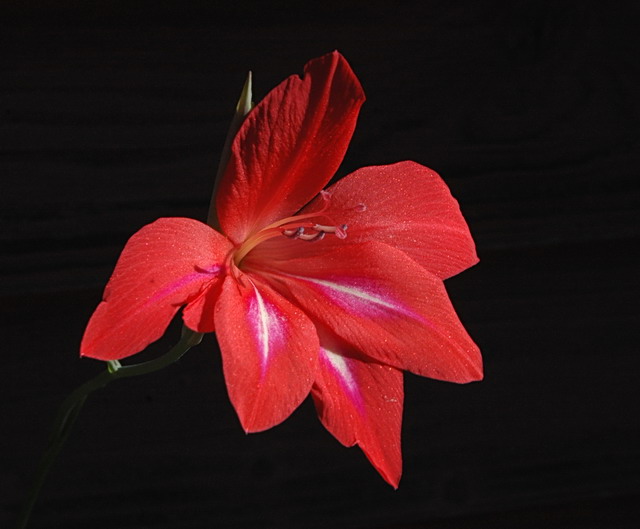
Gladiolus stefaniae Oberm. grows in the mountains of the southern Cape on rocky slopes in gullies that are wet. It grows up to 60 cm. This species flowers at the end of the dry hot summer after the weather has become cooler and it has started to rain. The flowering stem is produced before the leaf. The large flowers are red with a median white streak in the lower two-thirds of the lower three tepals and are pollinated by the mountain pride butterfly. The first photo from the book Plants of the Klein Karoo courtesy of Jan and Anne Lise Schutte-Vlok. The last two photos by Mary Sue Ittner are close-ups of the first flower (of two) blooming September-October 2008 in Northern California. It has continued to flower, but not increase. It usally flowers in California before our rainy season has started.
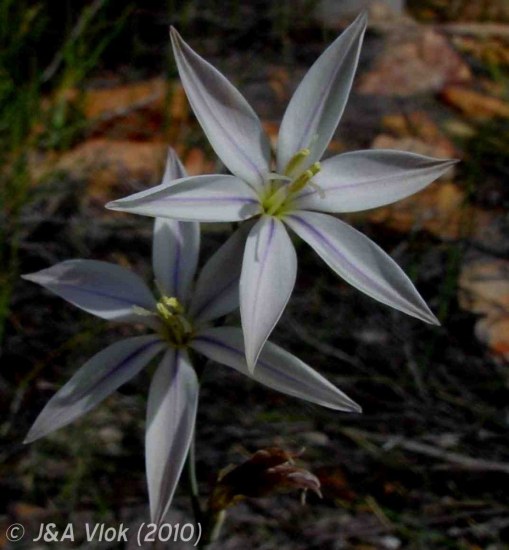
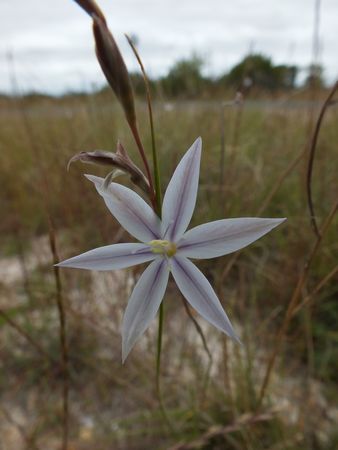
Gladiolus stellatus G.J. Lewis is found on clay lower slopes in renosterveld in the coastal mountains of the Southern Cape (Swellendam to Port Elizabeth). It grows from 30 to 60 cm and has linear and whip-like leaves with a prominent midrib and small white to lilac star-like fragrant flowers. It flowers in spring (September to November). The first photo from the book Plants of the Klein Karoo courtesy of Jan and Anne Lise Schutte-Vlok. The second photo from Rod Saunders.
Gladiolus stokoei G.J.Lewis is found on marshy sandstone slopes from 500 to 1000 m in the Riviersonderend Mountains (Southwest Cape.) Flowering March to April, it grows from 30 to 45 cm with the scarlet tulip shaped flowers (in a one to three flowered spike) appearing before the solitary linear leaf. Photos taken March 2016 by Rachel Saunders.
Gladiolus subcaeruleus G.J.Lewis grows on sandy loam and clay slopes in renosterveld in the southwestern Cape and flowers in the fall. It is described as having pale blue to mauve flowers with yellow transverse to spear shaped markings outlined in purple on the lower tepals. The dorsal tepal is hooded over the stamens. Height range: 15-30 cm. Photos taken by Cameron McMaster in the Overberg, Bot River and Napier show variations.

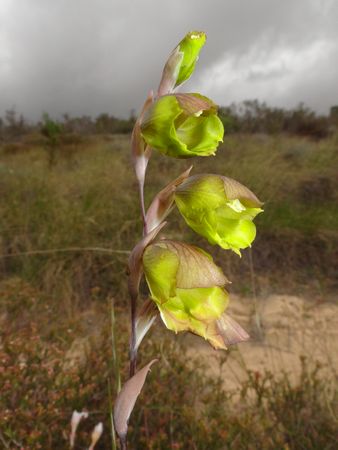
Gladiolus sufflavus (G.J.Lewis) Goldblatt & J.C.Manning is found on marshy sandstone soils in the Bokkeveld Mountains. Growing from 45 to 70 cm high, it has linear to terete leaves, cross-shaped in section, hairy stems, and pale yellow to greenish bell-shaped scented flowers with dark markings on lower tepals. It flowers August to September. Photo from Rachel Saunders.
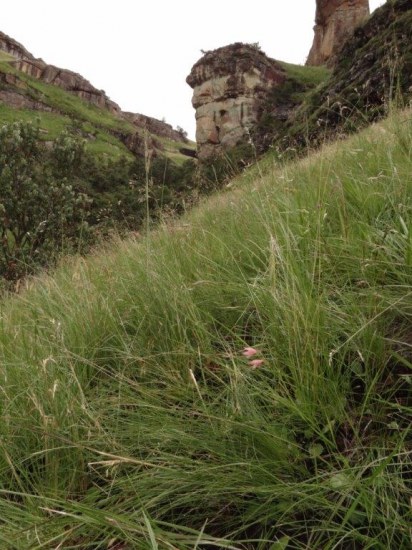
Gladiolus symonsii F.Bolus is a montane species growing at 1900 to 3200 m on grassy slopes and cliffs in the Drakensberg range of KwaZulu-Natal and eastern Lesotho. Plants are 25-45 cm high and flower in early to midsummer, December and January. Flowers are bright pink to pale rose, whitish in the throat and relatively small with a short tube. Stems are unbranched and the spikes bear only two to four flowers. There are three leaves with the lowermost longest, sheathing the lower third of the stem. This species has rarely been collected and three plants were discovered by the photographers Rod Saunders and Rachel Saunders in an area that had burned on a dark day with a storm coming making it difficult to get good photographs.


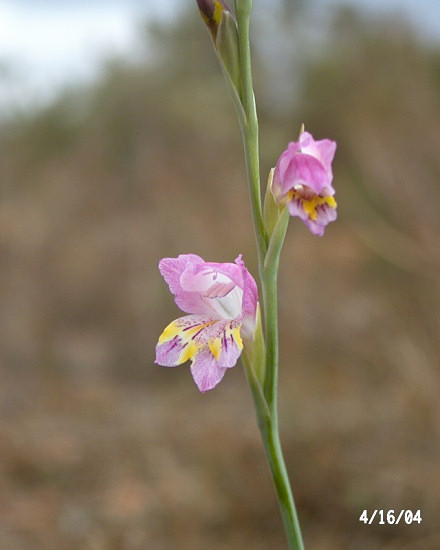
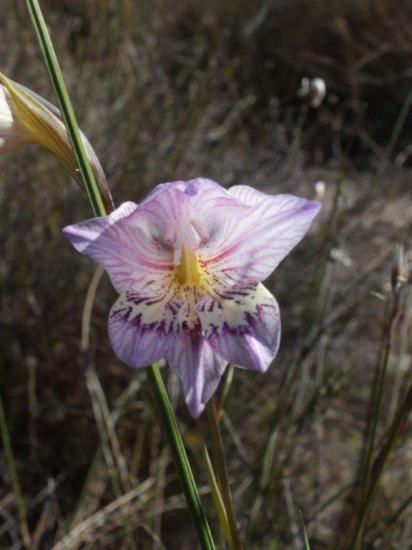
Gladiolus taubertianus Schltr. is restricted to the eastern Cederberg and the northern edge of the Cold Bokkeveld in the winter rainfall zone of the Western Cape where plants grow in coarse, stony, sandstone derived ground in well drained sites in dry mountain fynbos. Flowers are pale mauve to slate blue and lightly streaked with purple and lightly sweetly scented. The lower tepals have transverse yellow markings edged with dark purple. Flowering time is August to September. Height: 18-25 cm. The first photo from Rachel Saunders taken in the Cederberg August 2012 and the second taken in the Northern Cape September 2015.

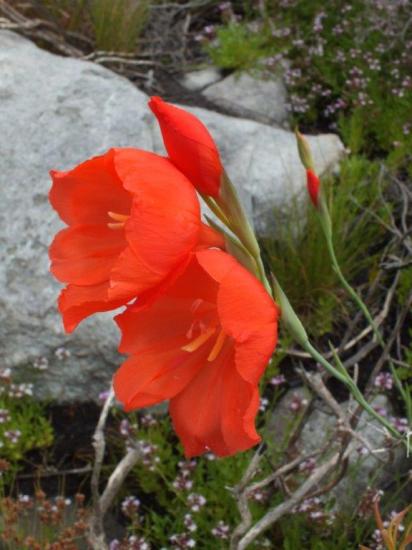
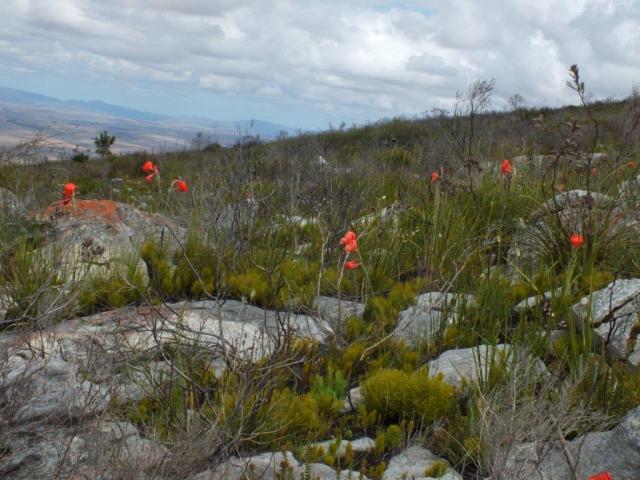
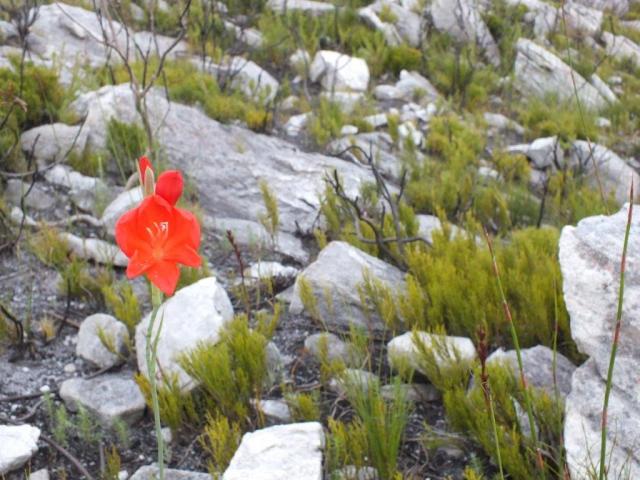
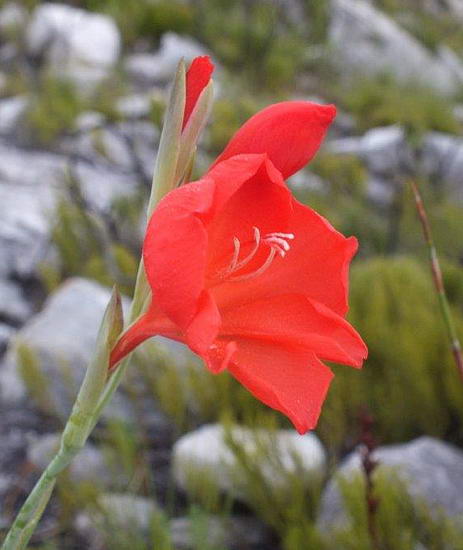
Gladiolus teretifolius Goldblatt & M.P.de Vos (syn. Homoglossum muirii) is a rare plant found in the southern Cape growing in heavy soils in renosterveld. It has scarlet flowers and blooms fall to winter. Height range: 40-70 cm. Photos taken by Cameron McMaster in the Overberg, Bredasdorp and Agulhas.

Gladiolus trichonemifolius Ker Gawl. is found on wet sandy flats in the winter rainfall areas. Height range: 10-25 cm. It flowers in late winter to early spring and is cream to yellow with brown lines on the lower tepals and a darker yellow center.
Photos below show the typical form. The first photo by Alan Horstmann, the second by Mary Sue Ittner, and the last two by Michael Mace.
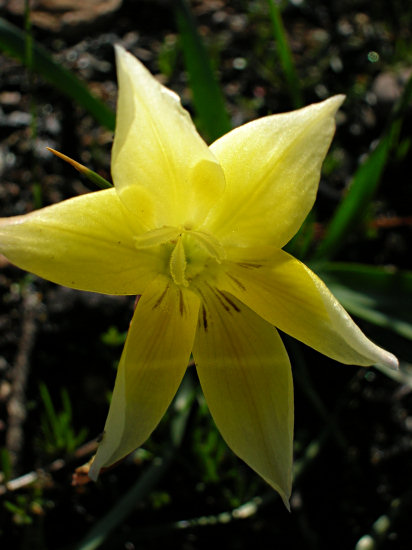
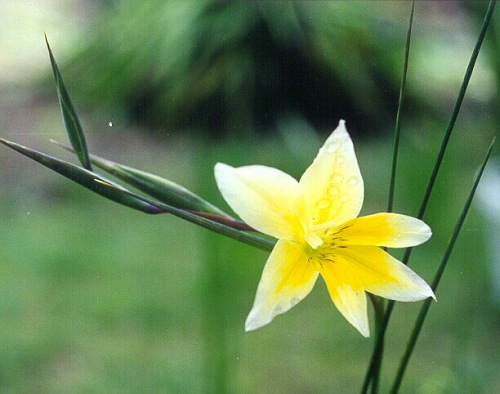
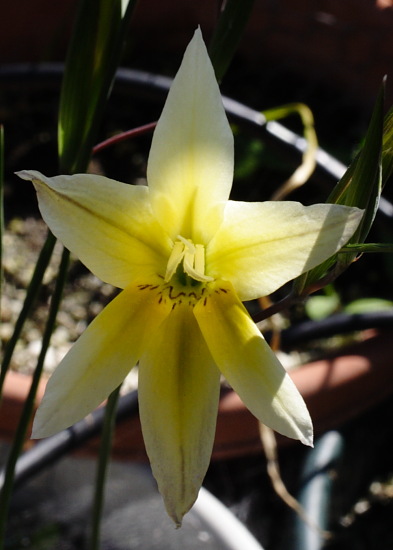
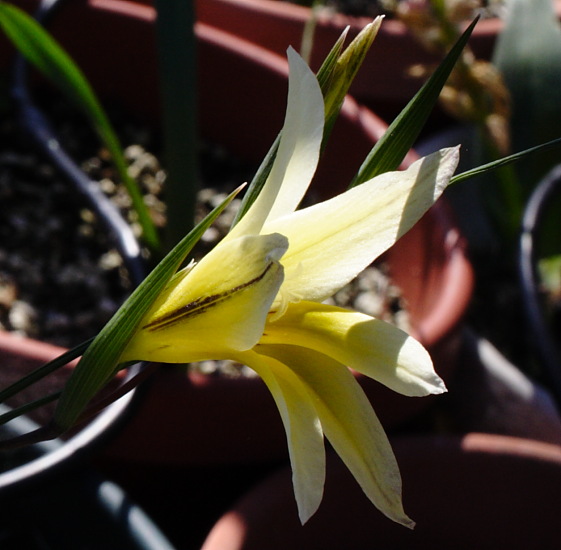
This species now includes a form formerly known as Gladiolus citrinus Klatt, which has a cupped perianth and a dark purple blotch in the center. It's very different from the typical form. The first three photos from Rod Saunders and Bob Rutemoeller show the former Gladiolus citrinus.

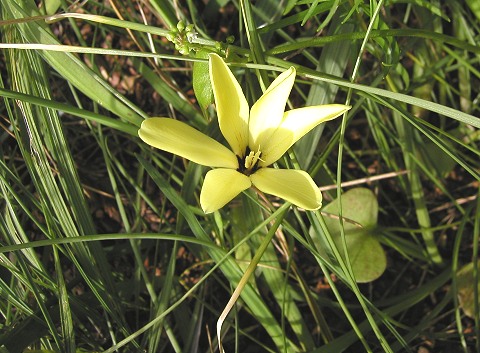
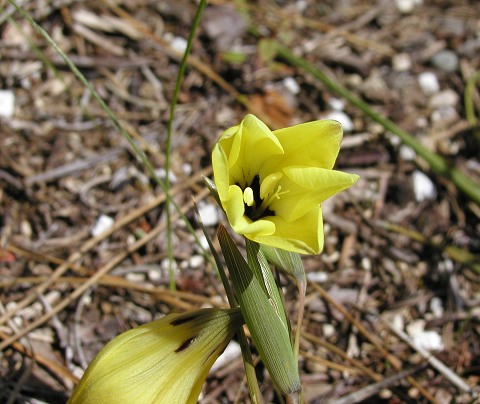
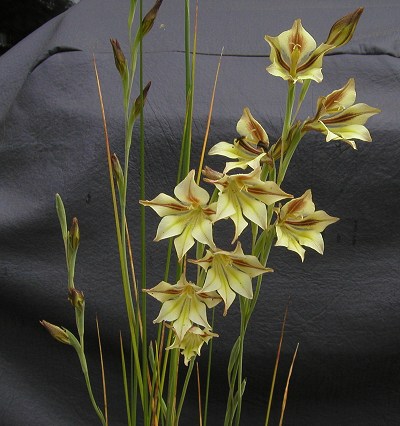
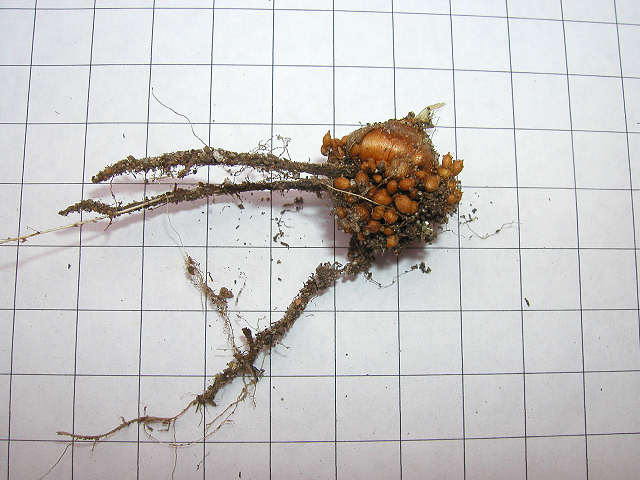
Gladiolus tristis L. is one of the more widespread species in the winter rainfall regions. It is often found in dense colonies on damp flats, but can be found near sea level to high elevations. It is nicknamed the marsh Afrikaner and can be found in marshy areas, but also on banks above streams, in poorly drained seeps or on cool south-facing slopes. The time of bloom varies by populations. It produces a lot of little cormlets around the base of the corm and can spread to other pots if soil is reused. This species also spreads by seed, and has been known to naturalize in habitats it likes such as gardens and botanical gardens. It's not a thug, but be aware of what you're doing if you put it in the ground in a mediterranean climate. Plants grow to about 2 feet (~0.7m) tall with slender, spiraling leaves about the diameter of a chopstick. It is easily grown in a well-drained mix, full sun, and summer dry dormancy. Give it a dilute or slow release fertilizer high in phosphorous when in active growth.
Photos 1-2 were taken by Sheila Burrow, 3 by Doug Westfall, 4-5 by Alan Horstmann and 6 by Kathleen Sayce.
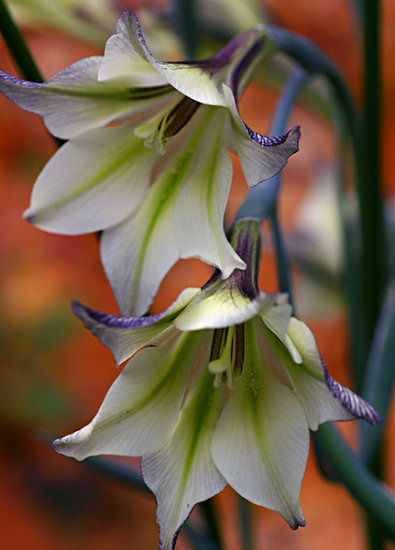
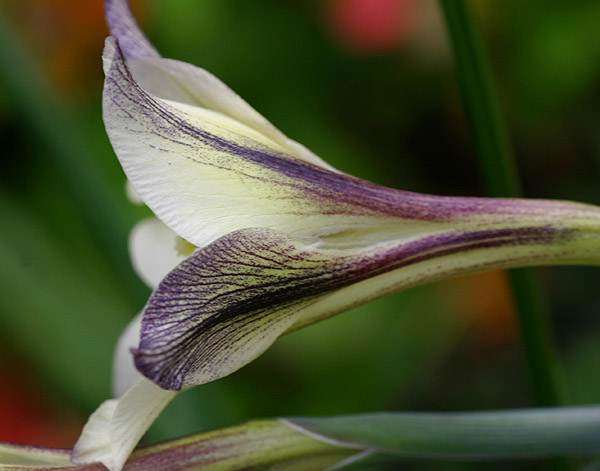
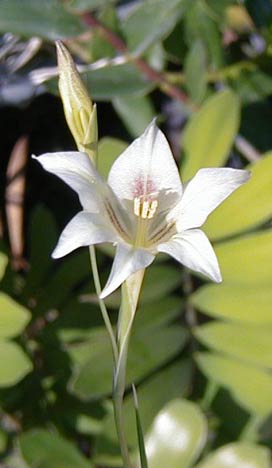
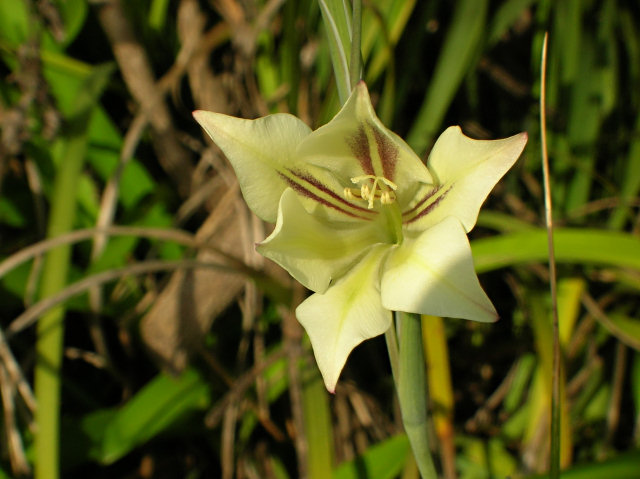
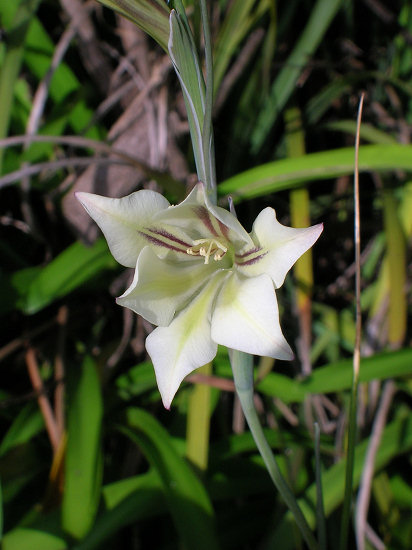
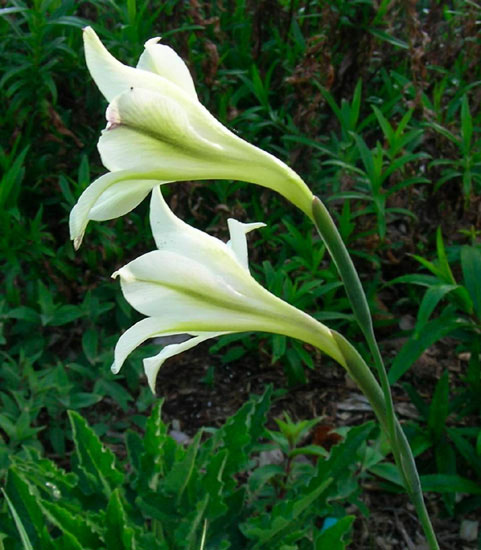
I grow two forms. One is light yellow and blooms March to April. It is only slightly fragrant at night. It is the first one pictured below. In the second photo there is a spider on the flowers, catching what seems to be a fly pollinator. The second form pictured below in photos 3-4 is a late blooming form, once known as Gladiolus tristis var. aestivalis, but not recognized as a variety by Goldblatt and Manning. These plants were grown from IBSA seed collected near Paarl where they grow in wet boggy areas that are shady. This form is very fragrant at dusk/night when the flowers are open wider as well. The last photo shows one corm on a 1 cm grid with all the cormlets showing how many new plants are possible from one corm. Photos by Mary Sue Ittner .
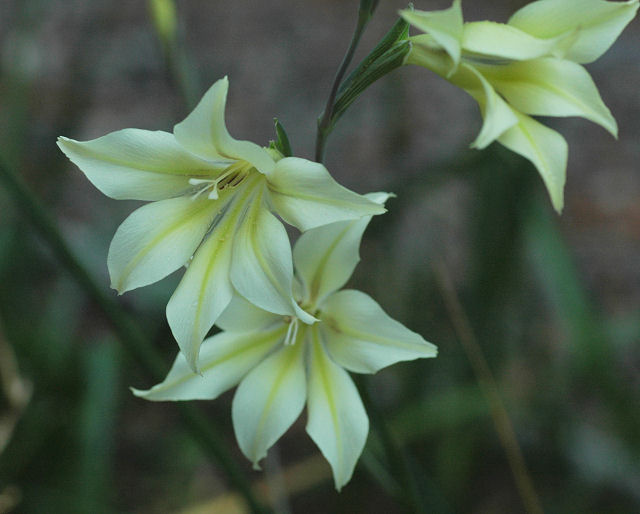

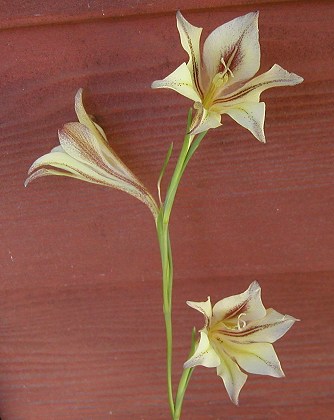
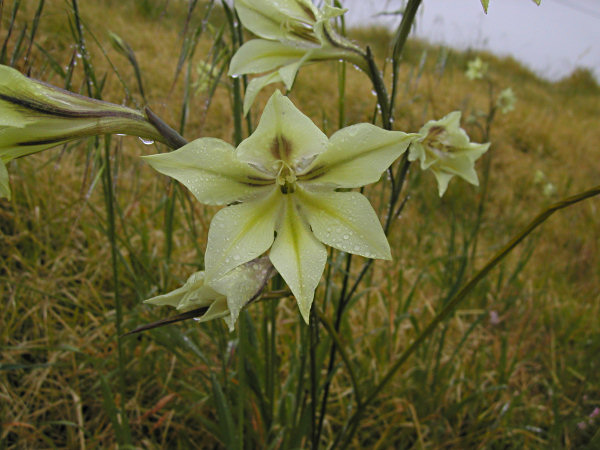
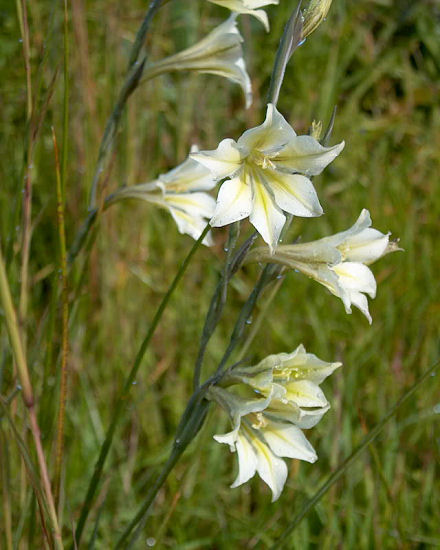
Habitat shots taken by Bob Rutemoeller September 2003 at Drayton and Cameron McMaster at Bredasdorp.
Gladiolus index - Southern African gladiolus A-B - Southern African gladiolus Ca - Southern African gladiolus Ce-E - Southern African gladiolus F-H - Southern African gladiolus I-Me - Southern African gladiolus Mi-Pa - Southern African gladiolus Pe-R - Southern African gladiolus U-Z - Gladiolus Hybrids - Miscellaneous gladiolus